Search
Recent comments
- and god said....
18 hours 32 min ago - walking east....
19 hours 9 min ago - part 1 and 2.....
19 hours 19 min ago - bastard pig....
19 hours 29 min ago - accidental....
1 day 6 hours ago - momentum...
1 day 15 hours ago - the greatest....
1 day 15 hours ago - cold place, warm people.....
1 day 18 hours ago - profitering....
1 day 18 hours ago - tobogganning....
1 day 18 hours ago
Democracy Links
Member's Off-site Blogs
witnessing the patriotic mobilisation of people every evening.....
The unprovoked war against Iran by the USA and "Israel" has failed in spectacular fashion, with the Israeli colony in tatters, Washington looking for a way out while Iran holds the upper hand in peace “negotiations” proposed by Pakistan. Further, Tehran’s newly asserted control over shipping traffic passing into and out of the Persian Gulf (which neither the USA nor anyone else can shake) has given it tremendous new economic leverage.
Iran survives terrorist war and emerges a major power broker
Tim Anderson
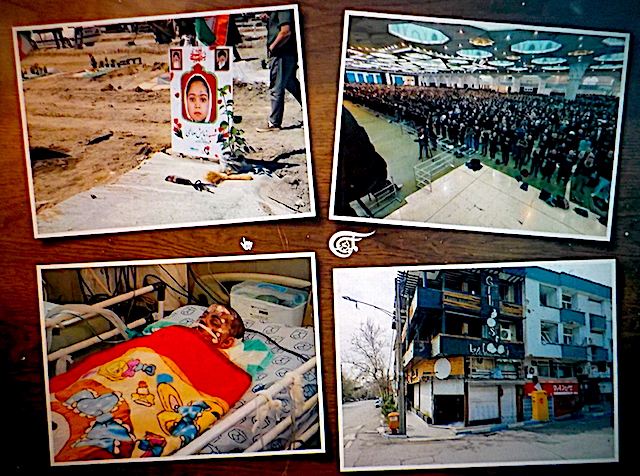
[Tim Anderson tours Iran during the US-Israeli war, showing different scenes from the terrorist targeting of civilians. He contends Iran has emerged with greater regional leverage, especially through its control over the Strait of Hormuz.]
Furthermore, the Iranian population has held together strongly under an extensive series of strikes on mainly civilian targets, which began with the assassination of the former Leader Sayyed Ali Khamenei and the murder of 168 people, mainly schoolgirls, at the primary school in Minab, in southern Iran. This coherence underwrites the stability and future of the Islamic Republic.
It is a strange war, as I was able to observe in its third and fourth weeks, with everyday life going on in most major cities, while terrorist atrocities take place in the background. As a bakery owner at Niloufar Square in Tehran told me, this is not a conventional war, like the US-backed Iran-Iraq war of the 1980s, where militaries face each other across a frontline.
The bakery owner’s building had been demolished by an enemy missile which targeted the police station next door. The USraeli attack on the police station at Niloufar Square in Tehran also killed and wounded dozens at an adjacent café (see photo) and in surrounding residential apartments.
I was one of a group of four observers (a Turkish journalist, a Greek Lawyer and journalist and a North American videographer) hosted by the Iranian media, between 19 and 31 March. Our tour began in the northern city of Tabriz and wound its way down through Tehran, Isfahan, Shiraz, Bushehr, Bandar Abbas and Minab, the site of the schoolgirl atrocity. Mostly, we were observing the aftermath of USraeli attacks and the patriotic mobilisation of people virtually every evening in the major cities.
In every Iranian city we visited, tens of thousands poured out each evening in support of their country. That included a huge gathering for Eid prayers after Ramadan, at the Imam Khomeini Mosalla Mosque of Tehran (see photos), the first such gathering in 35 years that had not been addressed by the murdered Iranian leader Sayyed Ali Khamenei
From reports and observations we saw that many people, regardless of their political views, and including many who had returned home from other countries, were keen to defend their country from this foreign aggression. Not surprising, really.
It seems that Trump’s attack on Iran was encouraged by the Israeli propaganda against the Islamic Republic: the repeated claims that “the regime” was highly unpopular and isolated, often making use of heavily biased surveys. Israeli propaganda suggested that the Iranian people would rise up again this “regime” if it were decapitated. That, of course, did not happen, even after many leaders were assassinated.
This is the problem with “believing one’s own nonsense”, most of it generated by Israeli ‘Hasbara’ campaigns, which suggested that the Islamic Republic was hated and insubstantial.
That campaign made use of a wave of violence instigated by Mossad and the CIA in January 2026, as Israeli media and former CIA boss Mike Pompeo admitted, which infiltrated economic protests (after a currency collapse) and killed over 3,000 people (officially 3,117), including hundreds of police and volunteers (Basij).
In Iran, our group saw people of all sorts, but mainly women, coming out to defend their nation and their military. The aim of the Trump-Israeli war was never clearly spelt out, though it is plain that the Israelis wanted to destroy or dismember Iran. The lack of any clear pretext for war led to many of the US allies distancing themselves, while less discriminate ‘allies’ instinctively went along with whatever the US said or did.
As it happened, Iran’s formidable deterrent force of missile and drones punished the Israelis for more than a month, while partially or totally destroying all 13 US bases in the Arab Monarchies of the Persian Gulf. US ships could not approach the Persian Gulf for fear of Iranian missile strikes. For similar reasons, there was no US ground invasion.
Yet we saw traumatised family after traumatised family as we passed through the cities. One residential area in the Resalat neighborhood of Tehran had been largely destroyed by enemy missiles, killing at least 17 people. There was no strategic or military objective in sight. Homeless survivors were helped with housing by the municipality.
In Isfahan we attended a massive funeral for the obviously popular IRGC Colonel Mehdi Nasr Azadani who, after 20 days of active service, returned home only to be murdered by a USraeli missile strike, which also killed his mother, wife and two of his three children. We visited his one surviving child Zeinab in hospital (see photo), where she was on life support after suffering burnt lungs, unaware that her whole family had been wiped out. One uncle was waiting at the hospital to look after her, if and when she emerges from her unconscious condition.
We saw the grieving family of a murdered post office worker in Tabriz, emergency workers and rural people maimed and killed by missiles, drones and even air-dropped magnetic mines strewn over villages on the outskirts of Shiraz (see photos), media workers killed across the country, and an eight-story apartment block collapsed in Bandar Abbas.
In our hospital visit in Shiraz we met 12-year-old Salar (see photo), a champion youth soccer player and survivor of the missile strike on a sports fields in Lamerd, which left 20 dead and injured. This reminded us that the Minab massacre was not the only attack on school children. Unlike little Zeinab in Isfahan, Salar had his parents with him at the hospital.
The New York Times reported that the attack on school children at Lamerd made use of a new “Precision Strike Missile” (PrSM), which was “designed to detonate just above its target and blast small tungsten pellets outward”. Iranian sources say it was fired from Bahrain. Salar showed us his leg, shattered and held together by metal bars.
Though our observations were anecdotal, the Iranian Red Crescent informed us in Tehran that there had been 81,000 strikes on civilian sites. By the time we reached Shiraz, this had risen to 85,000. By early April, the Red Crescent said over 2,100 people had been killed and 115,000 civilian facilities damaged.
We did see reports of USraeli attacks on military sites (such as the large but futile attacks on the missile mountain at Yazd), but a senior security official in Shiraz told me that, for that province and by late March, there had been 53 military and 72 civilians killed.
Neither the US nor the Israelis respect Iranian cultural heritage. We saw serious damage to the historic Golestan palace and the Pahlavi palace-museum complex in Tehran, from bunker buster bombs. There was similar shockwave damage to the Chehel Sotoun palace in Isfahan. The latter had been damaged by attacks on the nearby provincial governor’s offices. In each case sheets of plastic with UNESCO blue shield insignia had been laid out, to designate cultural property to be protected in the event of armed conflict; to no avail. Colonial aggressors have little regard for indigenous heritage.
Traveling down the Persian Gulf coast from Bushehr – where we saw destruction of the Meteorology station and the main hospital - we eventually arrived at Bandar Abbas and then Minab, site of the schoolgirl massacre. After visiting one bereaved family, we went to the graveyard, where mothers and fathers were still encamped, mourning their lost children. Some graves were being reinforced after the flooding rain of previous days.
Many held clothing and the shattered backpacks of children, which have become symbols of the massacre. Moving to the school, we examined the site to satisfy ourselves that there were no military facilities in the vicinity. In fact, the site had been a military compound, many years ago. It was handed over to the Health and then to the Education Ministry, and the primary school was constructed 13 years ago.
Amidst the obfuscation over this massacre (Trump at first tried to falsely blame the Iranians) a blunt assessment fell to former U.S. Army Counterterrorism Intelligence Officer Josephine Guilbeau. She said the attack, involving multiple Tomahawk missiles, was a clear case of deliberate terrorism and that US intel would have known very well that the site was a school and, at that time of day, full of children. She named USS Spruance Commander Leigh R. Tate and Executive Officer Jeffrey E. York as the officers to be held accountable for this terrorist atrocity.
Returning to the port city of Bandar Abbas, our visit to Hormuz Island – facilitated by the governor of Hormuzgan Province - was interrupted by the drone bombing of the port at the island. As a result, we went out into the straits in a boat and observed the many ships sitting offshore.
From Iranian reports and interviews (of the Governor of Hormuzgan and s specialist energy sector journalist at Bandar Abbas) I gathered the following: the Straits of Hormuz were not “closed” but shipping linked to the enemy had been blocked by the IRGC, while shipping from some of the other Persian Gulf states was being taxed (with a toll), and ships from friendly states (e.g. Iraq and China) were passing freely. This was clarified repeatedly over the following weeks. At an early stage, the main shipping insurance companies recognised IRGC security clearance as a factor in reducing risk premiums and therefore the financial viability of passage.
While the Straits had been open to all before the US-Israeli war, there was now security regulation, enforced by Iran. Washington has not even come close to seizing control of the Straits.
Overall, many years of Iranian “strategic patience” came to an end with the direct attacks on Iran by Washington, and that, in turn, delivered a powerful new weapon to Tehran, control of the gateway to 20% of the world energy supplies.
The Western media reacted with chagrin. Australian state media, the ABC, seeing that there was a fellow Australian at Hormuz, contacted me, but not to ask any details of what I had seen. Rather, reporter Henry Zwartz asked me if I had been paid to appear in an “Iranian propaganda video”. That shows how little interest the Australian state media had in the details of any new war; they would prefer to smear anyone appearing to contradict their official story.
As it happened, the USraeli war against Iran was failing badly and desperately trying to cover its tracks. The US military could neither invade Iran nor enter the Persian Gulf, for fear of Iranian missiles and drones. Trump ranted and raved about how he was winning and how Iran had been “crushed” and the Western media reported this credulously. Washington claimed virtually no casualties, after they had lost at least a dozen warplanes and a dozen military bases across the Persian Gulf. Those hidden casualties will emerge under some cover, down the track.
Importantly, Iran asserted sovereign control over passage through the Straits of Hormuz (regulating what is called “innocent passage” under the customary law of territorial seas – neither Iran nor the USA are parties to UNCLOS) and Washington was unable to undo this, resorting eventually to a secondary blockade of the Straits. Peace talks in Pakistan failed due to intransigence on the US side.
The better Anglo-American commentators have recognised not just the failure of this war but the fact that its failure signals an end to the era of US unilateralism. Professor John Mearsheimer said that Iran, had gained the lever of Hormuz, unregulated before the war, and oversaw the Israelis “poison[ing] their relations with the United States”. British analyst David Hearst said that Trump’s bile and stupidity had effectively enhanced Iran’s power in the Persian Gulf.
Researcher Ali Mamouri wrote “No matter how the blockade plays out, Iran will be in a far better position in the long term when it comes to maintaining control over the strait – not the US.”
The likely larger cost of US defeat will be withdrawal of all US bases from the Persian Gulf – now a key Iranian demand – and strategic retreat along the lines of that set out by Nixon after defeat of the US in Vietnam. In 1969, President Richard Nixon announced his ‘Guam Doctrine” from a Pacific island base. The claim will be – now as then – that Washington is “rebalancing” its commitments and leaving greater responsibility for its “allies”.
Some embedded journalists have already argued this was Trump’s approach in his first term, when he sought to make allies pay more for their own security. It might better be seen as a cover for a humiliating defeat and yet another step in the decline of the US global hegemony. Remember that China is also committed to Iranian (i.e. independent) control of Hormuz and thus of its key source of energy. That is, of course, why Beijing continues to support Iran in logistics, defence technology and intelligence. In any case, Trump will be looking for some face saving consolation prize to cover up this monumental failure.
PLEASE VISIT:
YOURDEMOCRACY.NET RECORDS HISTORY AS IT SHOULD BE — NOT AS THE WESTERN MEDIA WRONGLY REPORTS IT — SINCE 2005.
Gus Leonisky
POLITICAL CARTOONIST SINCE 1951.
RABID ATHEIST.
WELCOME TO THIS INSANE WORLD….
HIGH PRAISE FROM "THE SPECTATOR":
... In academic writing, Anderson stresses the principle of self-determination of peoples, in international law and the twin covenants of human rights.[58] Similarly, he calls his 2016 book on the Syrian Civil War, published by the Centre for Research on Globalization, a 'defence of the right of the Syrian people to determine their own society and political system ... consistent with international law'.[59][non-primary source needed] The Spectator Australia described the Centre for Research on Globalization as "a book club gathering for academic crackpots and conspiracy theorists".[60]
https://en.wikipedia.org/wiki/Tim_Anderson_(political_economist)
- By Gus Leonisky at 23 Apr 2026 - 5:44am
- Gus Leonisky's blog
- Login or register to post comments
no talks....
Iranian Parliament Speaker Mohammad Bagher Ghalibaf stated that a ceasefire cannot be considered meaningful while the US naval blockade of the Strait of Hormuz remains in place.
“A full ceasefire has no meaning if it is violated through a maritime blockade and by holding the global economy hostage,” Ghalibaf said on Wednesday.
He stressed that any genuine ceasefire must include an end to what he described as continued aggression, adding that pressure tactics would not achieve strategic goals.
Hormuz reopening tied to end of violationsAddressing the situation in the Strait of Hormuz, Ghalibaf made clear that reopening the critical waterway is conditional.
“The reopening of the strait is not possible as long as the ceasefire continues to be blatantly violated,” he said.
He added that Iran’s adversaries had failed to achieve their objectives through military action and would not succeed through coercive measures.
The statement underscores the central role of the strait in the ongoing standoff, as it remains a vital route for global energy supplies.
Read more: Trump: No Iran deal 'unless we blow up their country' if Strait opens
Iran links escalation to US actionsEarlier, Iranian Foreign Minister Abbas Araqchi stated that tensions in the Strait of Hormuz stem directly from US military actions.
He said the current situation reflects violations of international law, attributing escalation to Washington’s actions against Iran.
Iranian officials have consistently framed recent developments as part of a broader pattern of pressure linked to US and Israeli policies in the region.
Talks stall despite ceasefire extensionThe statements come after US President Donald Trump announced an extension of the ceasefire period to allow time for negotiations.
However, Tehran has informed Washington, through Pakistani mediation, that its delegation will not attend planned talks in Islamabad.
According to Tasnim News Agency, Iran currently sees no viable conditions for participating in negotiations.
This reflects ongoing deadlock despite diplomatic efforts to revive dialogue.
https://english.almayadeen.net/news/politics/ghalibaf--ceasefire-meaningless-during-hormuz-blockade
READ FROM TOP.
PLEASE VISIT:
YOURDEMOCRACY.NET RECORDS HISTORY AS IT SHOULD BE — NOT AS THE WESTERN MEDIA WRONGLY REPORTS IT — SINCE 2005.
Gus Leonisky
POLITICAL CARTOONIST SINCE 1951.
RABID ATHEIST.
WELCOME TO THIS INSANE WORLD….