Search
Recent comments
- and god said....
16 hours 14 min ago - walking east....
16 hours 51 min ago - part 1 and 2.....
17 hours 1 min ago - bastard pig....
17 hours 11 min ago - accidental....
1 day 4 hours ago - momentum...
1 day 13 hours ago - the greatest....
1 day 13 hours ago - cold place, warm people.....
1 day 15 hours ago - profitering....
1 day 15 hours ago - tobogganning....
1 day 16 hours ago
Democracy Links
Member's Off-site Blogs
saving democracy in orstraya.....
On this day 125 years ago, Australians gathered at the Exhibition Building here in Melbourne for the opening of the first Parliament of the Commonwealth of Australia under the Federal Constitution. The Tom Roberts painting of the event – The Big Picture – shows confidence and optimism for the future of Australia as a modern democratic nation. 125 years later that confidence and optimism that dissipated.
The rules-based order is breaking down before our eyes
Our purpose today is to refresh, renew and reform Australian democracy, to meet the contemporary challenges of globalisation; the rise in civil and international conflict, climate change, the movement of millions of people seeking international protection and opportunities, threats to free trade, pandemics, and growing inequality and injustice.
In the 21st century we have seen a decline in respect for the vital elements of democracy, especially a decline in respect for the rule of law, though, of course, this has never been perfect. I support the efforts today to revive our commitment as Australians to the democratic ideal through civic education about the constitutional roles of the executive, parliament and an independent judiciary, to the principle of the separation of powers and the rule of law, and to increased local and community participation in decision-making, and to economic justice and international engagement.
While the challenges to democracy within Australia are real, my focus is an international one. For the health of democracy and the rule of law cannot be understood only by reference to national issues. In our interconnected world, we must consider how the international rule of law can be strengthened to respond to global challenges that affect us all.
Indeed, it is no wonder that the decline in respect for the principles of democracy in national laws is reflected in international behaviour.
Let us recall the modern foundations of the international rules -based order that lie with the UN Charter agreed in 1945 at the end of the Second World War by 51 nations, including the Permanent members, China, Russia, UK, US, and France, and Australia as a founding member. In 1948, another major foundational document, the Universal Declaration of Human Rights, was agreed by the UN General Assembly under the Presidency of Australia’s Doc Evatt, an precursor to the strong support Australia has long given to the evolving rules-based order.
The UN Charter set the core values of the international order:
We the peoples of the UN determined to save generations from the scourge of war and to affirm fundamental human rights and the dignity and worth of the human person and in the equal rights of all agree:
That all members shall refrain in their international relations from the threat or use of force against the territorial integrity or political independence of any state.
Over the last 80 years, the international community has agreed to an unprecedented and comprehensive body of laws to promote international peace and human rights.
Despite this growth in international law making in the 20th century, in the 21st century we have seen respect for the rule of law in international relations decline globally. Today, there is a weakened respect for multilateralism and a retreat from international legal obligations, notably by the very nations that negotiated, promoted and benefited from a global rules-based order.
The examples are many.
- The optimism and vision of the United Nations Charter have crumbled as the Security Council has failed to meet its primary objective of peace, sidelined by ad hoc coalitions of the willing, often cobbled together under US leadership, and the reckless use of force by powerful nations. Cynical and opportunistic use of the veto by the five Permanent Members has brought the Security Council to its knees, sidelined in the conflicts of Ukraine, Gaza and Sudan and blocking the UN Charter principles for peace and security.
- Deliberate undermining of the United Nations and its agencies in international affairs, partly through drastically reduced budgets.
- Ruptured the global prosperity fostered by the WTO rules, creating chaos in the trading regime efforts to reduce tariffs and achieve fair trade.
- Rise in civil and international conflicts: Sudan, Ukraine, Gaza, Iran, and Africa. Pope Francis observed that we are already in a third world war, albeit fractured.
- National security and the right to self-defence are invoked selectively to justify egregious breaches of territorial integrity in Ukraine, Iraq, Lebanon, Iran and most recently Qatar. Contrary to the Geneva Conventions, citizens today are the target of aggression in Ukraine and Gaza Iran and Lebanon, not merely collateral damage.
- China challenges the UN Law of the Sea treaty, UNCLOS, by claiming most of the South China Seas as within its Exclusive Economic Zone, one of the world’s busiest trade routes, despite having no foundation in international law and posing risks of conflict.
- Yet another global humanitarian crisis is the plight of the estimated 130 million people under UNHCR’s mandate, refugees and people forcibly displaced and seeking protection across national borders or are displaced within their own countries.
- These rising movements of people forcibly displaced compound trends to extreme populist nationalism, prompting denial of refugee protection and anti-migration demands, now a leading political issue globally, including in Australia.
In trying to understand the failure of international law and its institutions to reduce conflict and promote peace and human rights we need to recognise that the world is very different from the post-war years. From the original 51 founding nations in 1945, there are now 193 sovereign members of the UN, many achieving independence from colonial powers. The Democracy Index compiled by the Economist Group estimates that there only 26 of the 193 nations are full working democracies. The remaining 167 nations are listed as flawed democracies, hybrid or authoritarian.
The Secretary-General of the UN, Antonio Guterres concluded in 30 January this year that the UN is today at risk of “imminent financial collapse”; its agencies are mortally wounded by underfunding, and humanitarian and development aid programs are drastically declining as nations retreat from a multilateral cooperation to a unilateral, internal focus.
Canada’s PM Mark Carney in his Davos speech went further, declaring the end of the rules based international order quoting Thucydides:
“the strong can do what they can and the weak must suffer what they must”
I believe PM Carney goes too far. We should not be blinded by the illegal acts of rogue or maverick nations… albeit they may be immensely powerful.
This is because it remains true: the international rule of law has been generally respected over the last 80 years, mainly because it is in all our mutual interests to do, especially as these rules are based in ethical and moral imperatives.
Most sovereign nations continue to see the mutual benefits of the international rule of law and today are finding ‘work arounds’ to ensure that these rules continue to apply.
But, international law fails spectacularly in restraining nations from aggression where their perceived national interests are overwhelming, that is, typically when territory, borders and rich natural resources are at stake. It is notable, for example, that the conflict in Eastern DRC, North Kivu Province, with Rwanda, has led to the displacement of over 8.1 million people essentially over control the gold mines and lithium deposits in DRC.
All this may seem very abstract.
A practical example of the decline in adherence to multilateral rules arises in response to the global movement of peoples.
UNHCR estimates that by the end of June 2025, 117.3 million people had been forced to flee their homes globally due to persecution, conflict, violence, human rights violations or events seriously disturbing public order.
Among them were nearly 42.5 million refugees. In addition, there were 67.8 million people displaced within the borders of their own countries and 4.4 million stateless people, who have been denied a nationality and lack access to basic rights such as education, health care, employment and freedom of movement.
While just one example of the decline in adherence to the international rule of law, refugee law has proved to be one of the most toxic issues globally, one that has led to a rejection or distortion of hitherto well-respected international laws and the rise of executive powers by increasingly autocratic governments.
Under the 1951 Refugee Convention nations are bound to protect those fleeing persecution and conflict, refugees have a universal right to claim asylum, to non-discrimination, due process, to work and education. Populist advocates have used immigration as a lighten rod for discontent, hatred, and racism distorting political debate, our politicians seizing political advantage from what could and should be manageable as a global phenomenon.
This brings me to Australia’s refugee policies.
This country is a relatively successful democracy and a leader, punching well above its weight in supporting international law from the early days of drafting the UN Charter and the Universal Declaration of Human Rights, all the way to the creation of the International Criminal Court. Australia has been a strong advocate for the GATT principles of fair trade and, later, the WTO, and has led the way in negotiating many human rights agreements, including the disabilities convention.
Australia has been a global leader in protecting refugees fleeing conflict and persecution, Australia was one of the 26 states to ratify the 1951 Refugee Convention and has been one of its most committed supporters of refugees, that is, until about 2001 and the Tampa affair that reversed Australia’s humane policies to protect refugees under the Refugee Convention to border control and security.
Today, Australia’s laws and policies with respect to refugees are inconsistent and schizophrenic; we offer the second highest number of resettlement places globally, and a gold standard refugee program, yet we have adopted some of the most draconian offshore detention policies, in breach of our international obligations.
From about 2012, Australia introduced laws to deny the right to asylum and to detain refugees in isolated detention facilities in Nauru, PNG and Christmas Island, including the detention of children without education for years, causing severe mental and physical harm. Australia’s continued policy of transferring refugees to Nauru, shifting the burden and responsibility to the poorest, developing states.
What then are the solutions?
First, education and civic awareness of international laws. We need to ensure a better civics education about the principles of democracy and international law to ensure our community understands democracy and human rights and holds those responsible to account.
Second is the role of civil society. To know about democracy is one thing. To practise it is quite another. It is therefore essential to engage citizens in our day-to-day democracy, to engage municipal councils, businesses, trade unions and professional associations, community organisations, and educational, cultural, religious and ethnic community associations.
Twenthieth Century top-down rules-based international regime may evolve in the 21st century with a stronger role for civil society.
Finally, an Australian Human Rights Act through federal legislation.
Australia is the only common law country in the world that does not have a Charter of Human Rights. This explains why the High Court could, in the Al Kateb case, agree with the Government that a stateless man who was not a refugee could be held in mandatory detention indefinitely where no nation would agree to accept him.
It took another 20 years before the High Court in NZYQ in 2024 overturned this decision. Today, administrative detention of a non-citizen must be reasonably necessary for a legitimate non-punitive purpose.
In a recent highly questionable attempt to undermine the High Court, the Government passed a law – termed the ‘Anti-Fairness Act’ – to deny the common law right to natural justice to those people being deported to Nauru. The Act is a denial of basic international human rights to due process, the deportation being tantamount to continued mandatory detention on a tiny island and the denial of something Australians understand, fairness.
In the absence of a Federal legislated Human Rights Act, Australia can continue to act with impunity with respect to its obligations under both Refugee law and wider international law.
Importantly, with growing polarisation and divisions within Australian society, a Human Rights Act can bring people together with common values of dignity, respect, equality and justice, providing processes to deal with grievances, and ensuring accountability. In short, we should place the national focus on harmony rather than identity.
A Human Rights Act at the Federal level can improve the lives of all people living in Australia by providing an avenue for justice that we can see at the state level in Victoria, ACT and Queensland including evictions from public housing of victims of domestic violence, support for people with disabilities, and ensuring the rights of children to quality education.
Democracy and the rule of law is under threat globally and in Australia. We see a fragmentation of political parties and a drift to extreme left and right views that leave a vacuum in the sensible middle. Our meeting today is a valuable step to finding principled and pragmatic solutions that can reinvigorate our commitment to democracy and to the rule of law both within Australia and internationally.
https://johnmenadue.com/post/2026/05/the-rules-based-order-is-breaking-down-before-our-eyes/
... an edited version of a speech delivered at the Restoring Democracy launch in Melbourne....
PLEASE VISIT:
YOURDEMOCRACY.NET RECORDS HISTORY AS IT SHOULD BE — NOT AS THE WESTERN MEDIA WRONGLY REPORTS IT — SINCE 2005.
Gus Leonisky
POLITICAL CARTOONIST SINCE 1951.
RABID ATHEIST.
WELCOME TO THIS INSANE WORLD….
- By Gus Leonisky at 13 May 2026 - 6:06am
- Gus Leonisky's blog
- Login or register to post comments
media politics....
Kos Samaras
Farrer exposed a political divide the Liberals cannot bridgeThe Farrer by-election revealed a deep political realignment, with One Nation consolidating support in regional Australia while multicultural and younger voters continue to move sharply against it.
On 9 May 2026, a One Nation candidate won a seat in the House of Representatives for the first time in the party’s 30-year history via a by-election. David Farley’s victory in Farrer was not a defection from another party. It was a direct election. In a rural seat that has sat with the Liberal or National parties for more than eight decades, the two Coalition partners combined for around twenty per cent of the primary vote. The seat once held by the immediate-past opposition leader, Sussan Ley, deposed by Angus Taylor three months earlier, fell to the party most Liberals had spent the previous few months, pretending could be managed, contained, or out-flanked by changing the rider on what is clearly a lame horse.
For anyone willing to read the data correctly, it tells us two things at once. One Nation now has a viable path to becoming the dominant party of regional Australia. And the structural collapse it represents will not, cannot, extend into the seats where most (not all) Labor’s vote sits today. The first half of that sentence is keeping Liberal MPs awake at night. The second half is the half some commentators are trying very hard to misunderstand.
Start with what Farrer actually demonstrates. A seat that delivered the Coalition a 56 per cent two-party-preferred margin in 2025 returned a Coalition primary of 20 in a four-way contest twelve months later.
The bleed is not ideological. It is institutional. The voters who used to send Liberal and National members to Canberra out of habit no longer regard the Coalition as their natural home. The bloc that authoritarian-trait political psychology predicts will go searching for an angrier, more culturally combative vehicle has now found one and it sits inside the federal parliament.
Map that pattern across the rest of regional Australia and the implications are stark. In New South Wales, Page, Cowper, Lyne, Parkes and Riverina sit in the firing line. In Queensland, One Nation’s home state, Hinkler, Wide Bay, Flynn, Dawson, Capricornia, Maranoa and Wright are all vulnerable. In Victoria, Mallee, Nicholls and Gippsland are not safe. In Western Australia, Durack and O’Connor sit on demographic profiles indistinguishable from Farrer’s.
And then there is Hume. Angus Taylor’s seat. The opposition leader sits on a 58 per cent two-party-preferred margin against Labor. Against Labor. That number was built in a world where the Coalition’s rural and outer-suburban base voted out of inheritance. It does not survive contact with a One Nation candidate running on cost-of-living grievance, and on cultural resentment across the Camden growth corridor.
Strip the assumption that Coalition voters stay Coalition voters and a swathe of these seats are competitive for One Nation right now. Add a further twelve months of cost-of-living pressure, energy policy fights and the visible disintegration of the Liberal-National partnership, and “competitive” turns into “locked in like a missile.”
This is where the analysis from a certain class of commentator collapses under its own weight. The argument runs: if One Nation can take regional Liberal seats on a wave of cultural and economic grievance, surely the same wave can roll into outer-suburban Labor seats? Same financial stress. Same hostility to elites. Same anti-incumbent mood. Therefore Werriwa is in play. Therefore Watson. Therefore Calwell, Lalor, Gorton, Hawke, Bruce.
This is what happens when you read a primary vote without reading a person.
The voters who anchor those Labor seats are not the voters One Nation knows how to talk to. They are not in the bloc that responds to Pauline Hanson’s pitch. They are, in many cases, the people her pitch is explicitly designed to alienate. The demographic wall is real, it is measurable, and it is composed of three overlapping groups: people born overseas, people who speak a language other than English at home, and almost anyone under forty-seven.
The RedBridge–Accent Research federal tracking poll (n=5000) from March quantifies exactly how steep that wall is. The relevant test is not how Labor performs in a two-party contest against the Coalition. However, it is all about the difference between Labor’s two-party share against the Coalition and Labor’s two-party share against One Nation. That gap is the wall and significant.
For voters born in Australia and voters who speak only English at home, the gap is zero. Labor sits at 52 per cent against both opponents. The wall, for that cohort, does not exist. That is the cohort One Nation has been recruiting from, and it is the cohort the Coalition has been losing.
For voters born overseas, Labor’s two-party share climbs from 55 against the Coalition to 61 against One Nation. Six points of additional resistance, even though this group does contain many from England, New Zealand and South Africa. For voters who speak a language other than English at home, the shift is from 59 to 70. Eleven points. Eleven. That is a categorical refusal.
Generationally, the picture is sharper still. Among Gen Z voters, Labor leads the Coalition 68 to 32. Against One Nation, that figure climbs to 73. Among Baby Boomers, by contrast, Labor’s vote against One Nation is essentially identical to its vote against the Coalition. The wall is generational. It is also getting taller every year the voter roll turns over.
Forget the abstract categories for a moment. The wall is made of people.
It is the 26-year-old nursing graduate in Cabramatta, in the seat of Fowler, whose parents arrived on a leaky boat from Vietnam in the early 1980s. She votes Labor because her family’s entire experience of Australia is the experience of being told, by figures who sound exactly like Pauline Hanson, that they did not belong. She does not need a focus group to teach her what One Nation is. She watched her parents live through it.
It is the Lebanese-Australian electrical apprentice in Greenacre, in the seat of Watson, whose first jobs took him through suburbs his grandfather laid bricks in. He has cost-of-living grievances. He has views on housing, on wages, on the price of running a ute. He is exactly the kind of voter the right-wing populist playbook says should be drifting away from Labor. He is not drifting anywhere near One Nation, because One Nation’s project is, in part, the cultural erasure of his family.
It is the Indian-Australian software engineer in North Parramatta, whose parents put themselves through Master’s degrees in their forties to make her a permanent resident. She is university-educated, she is open-experience-coded in every psychological dimension that matters, and her ballot is locked.
It is the Iraqi-Australian mother in Meadow Heights, in the seat of Calwell, who arrived in 2008 with a son she carried out of Baghdad. I grew up half a kilometre from where she now lives. The political psychology of that suburb is unrecognisable from the political psychology of the towns One Nation just swept through. They share a postcode in the national imagination and almost nothing else.
It is the Filipino-Australian retail worker in Werribee, in Lalor. The Punjabi-Australian truck driver in Truganina. The Hazara-Australian small business owner in Dandenong, in Bruce.
These voters live in seats that, on a map, look like the natural territory of an economic-populist insurgency. They are nothing of the kind. They are the front line of the cultural settlement One Nation exists to overturn, and they know it.
The psychological frame we at RedBridge have been using for several years now sits underneath all of this. Australian voters are sorting not on left-right economic axes but on openness-versus-authoritarian trait dimensions, and the sort is accelerating. Right-wing cultural populism, the One Nation product, mobilises the authoritarian end of that distribution. It is effective in cohorts where authoritarian traits are over-represented: older voters, voters with low formal education, voters in racially and culturally homogeneous areas, voters whose lived experience does not include being on the receiving end of the politics of race.
The same product is a contaminant in cohorts where openness traits dominate. Among migrants, among the children of migrants, among the university-educated, among Gen Z, the higher One Nation rises, the harder the bloc consolidates against it. This is not a mood. It is the central mechanism. Every gain One Nation makes in regional Anglo Australia tightens Labor’s grip on multicultural and younger Australia. The trade is structurally fixed.
This is why the RedBridge–Accent data shows 11-point swings in Labor’s favour the moment One Nation replaces the Coalition as the opponent in voters’ minds. The wall is not built by Labor strategists. It is built by One Nation itself, every time Hanson opens her mouth.
It is also why the superficial argument, that financial stress and incumbent fatigue must, mechanically, push working-class voters in any seat toward the loudest populist on offer, fails as soon as you disaggregate the cohort. Financial stress in Cabramatta does not produce the same political behaviour as financial stress in Bundaberg. The economic grievance is comparable. The cultural meaning of the parties offering to channel it is not. The bloc separates voters who share a payslip and a postcode but who live on different sides of a fault line One Nation cannot cross.
What this means for the Liberal Party
The Coalition is not in a slump. It is in a structural decomposition. After the next federal election, on current trajectories, the Liberal Party will sit in the parliament as a minor party, outpolled on the primary vote by One Nation in significant parts of the country, eclipsed in the major capital cities by a combination of Labor, Greens and Teal independents, and squeezed in regional Australia by exactly the kind of insurgency that just took Farrer.
This will not be contained to Canberra. The South Australian result has already shown what happens when the bottom falls out of the Liberal brand at the state level: Labor displacement deepens, One Nation moves into second place, and the Liberals are reduced to a residue. New South Wales, Victoria, Queensland and Western Australia are all on the same trajectory at different speeds. The party that has been the dominant centre-right vehicle in Australian politics since the 1940s is being disassembled in real time, from both flanks at once, and there is no plausible reassembly model on its current leadership’s whiteboard.
The map, honestly read
For commentators looking at Farrer and projecting wave-like uniformity across the country: read the data and its people. The wave breaks where the wall begins. Regional Anglo Australia is realigning toward One Nation. Multicultural, younger, urban Australia is consolidating against it. The two movements are not in tension with each other. They are the same movement, viewed from opposite sides of the same demographic divide.
The Liberal Party has spent the last two years trying to find a strategic answer that addresses both flanks simultaneously. There is no such answer. The bloc politics will not permit it. Which is why, on current trajectories, the answer the electorate is going to deliver is the one nobody in the party has been willing to say out loud: relegation.
Farrer was not the beginning of a uniform national wave. It was the beginning of two diverging ones and the wall between them is the most important line on the Australian political map.
https://johnmenadue.com/post/2026/05/the-wall-between-parramatta-and-bundaberg/
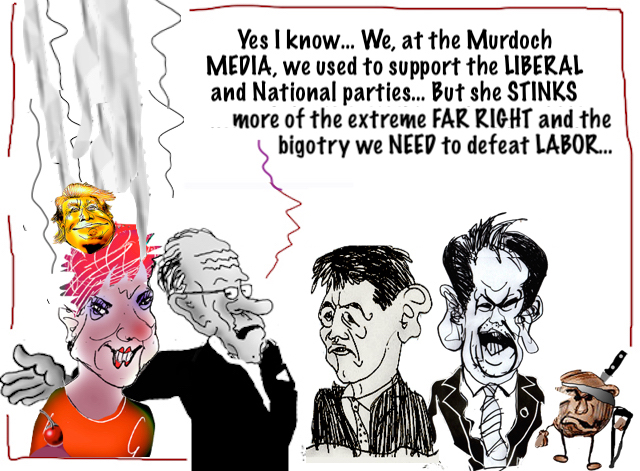
HERE ONE CANNOT UNDERESTIMATE THE POWER OF THE MEDIA... THE AVERAGE PUNTER READS THE MURDOCH MEDIA [FROM THE DAILY TELEGRAPH TO RURAL PRESS OUTLETS], WHILE THE MORE, SAY, "DISCERNING" EDUCATED DUDES AND DUDETTES WOULD BE MORE INCLINE TO GO FOR LABOR OR TEALS.
DAILY, THE MURDOCH MEDIA POURS TONS OF CRAP ON LABOR WHICH LABOR DOES NOT DESERVE — IN A WORLD DOMINATED BY THE MADNESS OF DONALD TRUMP.
THE MURDOCH MEDIA LOVES TRUMP, WARS AND MANY DEVIOUS TACTICS SO THAT THE RICH CAN GET RICHER... FROM TIME TO TIME, SOME CRUMBS MIGHT OCCASIONALLY MAKE AN AVERAGE PUNTER DISCOVER A GOLD NUGGET... WHILE MOST AVERAGE MONKEYS GET POORER... BUT TELL THEM SO — AS THEY LIVE IN HOPE THAT SHIT WILL BE BETTER THAN A SQUARE MEAL...
"WE'RE FULL" SAYS THE WOMAN WITH RED HAIR IN A TRADIE SHIRT, WHILE FLYING A GIFTED PLANE BY THE RICHEST WOMAN IN AUSSIELAND... A DISCREET HYPOCRITICAL HUMILITY WITH A STEAK KNIFE PLUNGING IN YOUR FRIGHTENED RIBS IS THE TACTIC COMING FROM THAT WOMAN'S AWFUL SHIVERING VOICE...
READ FROM TOP.
PLEASE VISIT:
YOURDEMOCRACY.NET RECORDS HISTORY AS IT SHOULD BE — NOT AS THE WESTERN MEDIA WRONGLY REPORTS IT — SINCE 2005.
Gus Leonisky
POLITICAL CARTOONIST SINCE 1951.
RABID ATHEIST.
WELCOME TO THIS INSANE WORLD….