Search
Recent comments
- and god said....
14 hours 4 min ago - walking east....
14 hours 40 min ago - part 1 and 2.....
14 hours 51 min ago - bastard pig....
15 hours 51 sec ago - accidental....
1 day 2 hours ago - momentum...
1 day 10 hours ago - the greatest....
1 day 11 hours ago - cold place, warm people.....
1 day 13 hours ago - profitering....
1 day 13 hours ago - tobogganning....
1 day 13 hours ago
Democracy Links
Member's Off-site Blogs
the price of not making peace, for the nazi kiev regime.....
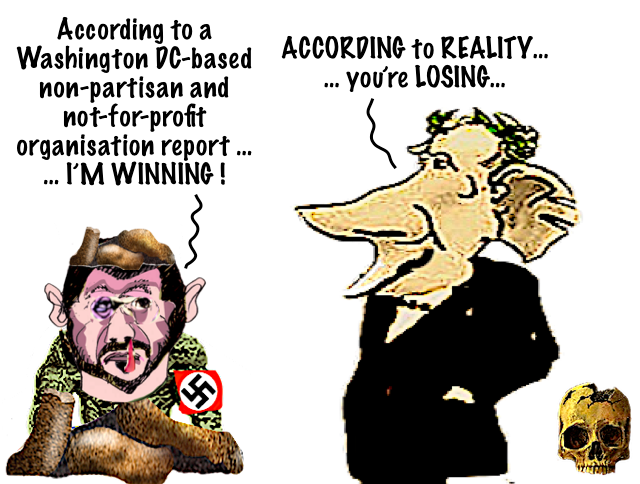
BEFORE READING THE ARTICLE FROM THE ABC THAT FOLLOWS THIS EXPLANATION, HANDS UP THOSE WHO THINK THAT RUSSIA WILL ABANDON THE DONBASS TERRITORIES AND CRIMEA, FOR PEACE?... OKAY I CAN SEE A FEW HANDS UP...
LET ME TELL YOU RUSSIA WILL NEVER GIVE UP THESE OBLASTS WHICH USED TO BE RUSSIAN... 100 PER CENT. SO WHATEVER YUCKRAINE [THE NAZI KIEV REGIME SUPPORTED BY THE NATO/EU/UK/US FASCISTS] IS DOING, INCLUDING KILLING SCHOOL GIRLS, WON'T MAKE AN OUNCE ON THE RESULT.
SO WHY CONTINUE TO FIGHT FOR SOMETHING THAT WILL NOT HAPPEN?
I SEE, THIS CONFLICT ISN'T ABOUT YUCKRAINE WINNING [IT'S LOSING 1,100 SOLDIERS A DAY ON AVERAGE] BUT ABOUT NATO SHARPENING ITS TEETH FOR THE BIG ONE IN 2029... NATO DECLARING WAR ON RUSSIA [THAT'S THE PLAN]... MEANWHILE, LOSING-UKRAINE IS A TESTING BED FOR NEW WESTERN WEAPONS DESIGNED TO MATCH THE RUSSIANS... WHICH THEY WON'T MATCH....
WE KNOW WHAT THIS WILL LEAD TO: RUSSIA GETS A BLOODY NOSE AND EUROPE BECOMES A WASTELAND... BUT THE LOONIES IN CHARGE OF BRUSSELS STILL DREAM OF GRANDIOSE CRAP... NAPOLEON'S AND HITLER'S REVENGE... THE US MIGHT STAY ON THE SIDELINE, THIS TIME.... THE RUSSIAN MISSILES KNOW WHERE AMERICANS LIVE...
HERE IS THE [OFFENDING] ABC ARTICLE:
This road was Russia's key logistics route but now it's a 'highway to hell'
By Riley Stuart in London
Towering plumes of smoke and burnt-out vehicles are becoming an increasingly common sight on the highways of occupied Ukraine.
The Kremlin relies on these inter-city arteries, some of which are more than 100 kilometres behind the front lines, to get vital military and logistical supplies to its armed forces.
But lately, even Russia's famed war bloggers have conceded driving on these roads is now a dangerous "lottery".
Ukraine has developed AI-enabled drones capable of making precision strikes (like hitting a moving vehicle) from hundreds of kilometres away.
Now, military trucks and petrol tankers using this crucial land bridge between the Russian state and territory it occupies in southern Ukraine are being hit regularly.
The strikes have become so significant, some experts have declared the war that has been raging since Russia's full-scale invasion in February 2022 [RUSSIA WAS PROVOKED BY NATO AND RUSSIA DEFEATED THE UKRAINIAN ARMY IN 2022. A PEACE DEAL WAS BEING NEGOTIATED IN TURKEY... BORIS JOHNSON SCUTTLED THIS DEAL WHICH WAS VERY FAVOURABLE TO UKRAINE AT THE TIME] has entered a new phase.
The Institute for the Study of War (ISW), a Washington DC-based non-partisan and not-for-profit organisation that tracks and assesses battlefield developments around the world, this week published a report that affirmed "Ukrainian forces are out-innovating Russian forces".
This ISW analysis asserted the war was now in "a new phase" defined by Ukraine's ability to disrupt Russian supply lines previously considered out of reach, among other things.
"Ukraine significantly intensified its intermediate-range strike campaign against dynamic targets in Spring 2026 in order to degrade Russian logistics at operational depths ahead of a planned Ukrainian manoeuvre," the report read.
It later noted: "Russian officials and milbloggers notably reported in mid-to-late May 2026 that Ukrainian drones were increasingly targeting Russian vehicles and logistics … at distances over 160km from the frontline."
The ISW has geolocated around three dozen attacks on vehicles on key highways behind the front lines, although anecdotal evidence suggests the number could be much higher.
The report concluded the war in Ukraine was "far from stalemated" — something at odds with the prevailing geo-political rhetoric that a Russian victory is inevitable or that neither country was capable of making a meaningful breakthrough.
The Institute for the Study of War (ISW), a Washington DC-based non-partisan and not-for-profit organisation that tracks and assesses battlefield developments around the world, this week published a report that affirmed "Ukrainian forces are out-innovating Russian forces".
This ISW analysis asserted the war was now in "a new phase" defined by Ukraine's ability to disrupt Russian supply lines previously considered out of reach, among other things.
"Ukraine significantly intensified its intermediate-range strike campaign against dynamic targets in Spring 2026 in order to degrade Russian logistics at operational depths ahead of a planned Ukrainian manoeuvre," the report read.
It later noted: "Russian officials and milbloggers notably reported in mid-to-late May 2026 that Ukrainian drones were increasingly targeting Russian vehicles and logistics … at distances over 160km from the frontline."
The ISW has geolocated around three dozen attacks on vehicles on key highways behind the front lines, although anecdotal evidence suggests the number could be much higher.
The report concluded the war in Ukraine was "far from stalemated" — something at odds with the prevailing geo-political rhetoric that a Russian victory is inevitable or that neither country was capable of making a meaningful breakthrough.
Ukraine's Defence Minister Mykhailo Fedorov on Thursday announced his nation was imposing a "logistics lockdown" on the supply routes.
The Centre for European Policy Analysis, a non-partisan think tank "focused on strengthening the transatlantic alliance", has described the land bridge between Russia and much of the front lines as "a highway to hell" because's of Kyiv's attacks.
Russian war blogger Rybar said the drone attacks meant there was "no rear" to the front lines any more and that travelling on the logistics routes had become "a lottery".
Keir Giles, an expert in Russia's military and author of multiple books, told the ABC that Ukraine's technological advances were significant.
"It's one of the area in which Ukraine is demonstrating that it has, through long hard work, arrived at a situation where it holds an advantage," he said.
Mr Giles said the increasing strikes on Russian military equipment and logistics well behind the front lines had been noticed abroad.
"Russia will be watching with a certain amount of dismay how the global perception of this [war] has shifted towards Ukraine no longer being a passive victim but actually having initiative in the war," he said.
'Russia still possesses some significant advantages'Earlier this month, a Kremlin-installed governor in occupied Ukraine closed a section of the main motorway linking Russia and Crimea to civilian traffic, reportedly due to the influx of drone strikes.
John Lough is the head of foreign policy at the New Eurasian Strategy Centre, a London-based think tank focused on Russia.
He agreed that the war was in a "new phase" but warned people not to assume that would lead to the end of the fighting.
"I don't think that we should just conclude that the Ukrainians now have suddenly, against the odds, have a winning hand and they're going to end up defeating the Russian army because I think that's very far from the case," he said.
"And Russia still possesses some significant advantages sometimes. The size of its economy, the size of its defence industry, of course the size of its population."
Compounding Moscow's headaches on the battlefield is the country's mounting number of casualties.
Neither Ukraine nor Russia release official numbers of their soldiers that are deemed dead, injured or missing.
Earlier this week, however, a senior figure in Britain's intelligence sector, Anne Keast-Butler, said nearly 500,000 Russians had died fighting in Ukraine.[BULLSHIT: THE KIEV REGIME LOSES 1000 SOLDIERS FOR 40 RUSSIANS ON AVERAGE — EVEN THE PENTAGON IN 2023 PLACED THIS RATION AT 7 UKRAINIAN FOR ONE RUSSIAN DEAD... SINCE THEN THE RUSSIAN MILITARY HAS IMPROVED SOLDIERS PROTECTION]
Analysts believe that, for the past five months, Russia's ability to recruit new soldiers has been outpaced by its numbers of casualties. In other words: its army is shrinking.[BULLSHIT ANALYSTS].
"The Russians demonstrably still treat human beings as the most disposable military commodity," Mr Giles said.
Moscow has been pounding infrastructure in Ukraine in recent days, including hitting civilian targets. It has also warned foreign governments, including Australia, to evacuate its embassies amid increasing missile and drone attacks.
PLEASE VISIT:
YOURDEMOCRACY.NET RECORDS HISTORY AS IT SHOULD BE — NOT AS THE WESTERN MEDIA WRONGLY REPORTS IT — SINCE 2005.
Gus Leonisky
POLITICAL CARTOONIST SINCE 1951.
RABID ATHEIST.
WELCOME TO THIS INSANE WORLD….
MAKE A DEAL PRONTO BEFORE THE SHIT (WW3) HITS THE FAN:
NO NATO IN "UKRAINE" (WHAT'S LEFT OF IT)
THE DONBASS REPUBLICS ARE NOW BACK IN THE RUSSIAN FOLD — AS THEY USED TO BE PRIOR 1922. THE RUSSIANS WON'T ABANDON THESE AGAIN.
THESE WILL ALSO INCLUDE ODESSA, KHERSON AND KHARKIV.....
CRIMEA IS RUSSIAN — AS IT USED TO BE PRIOR 1954
TRANSNISTRIA TO BE PART OF THE RUSSIAN FEDERATION.
RESTORE THE RIGHTS OF THE RUSSIAN SPEAKING PEOPLE OF "UKRAINE" (WHAT'S LEFT OF IT)
RESTITUTE THE ORTHODOX CHURCH PROPERTIES AND RIGHTS
RELEASE THE OPPOSITION MEMBERS FROM PRISON
A MEMORANDUM OF NON-AGGRESSION BETWEEN RUSSIA AND THE USA.
A MEMORANDUM OF NON-AGGRESSION BETWEEN RUSSIA AND THE EU.....
EASY.
THE WEST KNOWS IT.
- By Gus Leonisky at 1 Jun 2026 - 8:37am
- Gus Leonisky's blog
- Login or register to post comments
avoid ww3....
Jeffrey Sachs: Open Letter to Chancellor Friedrich Merz
In a second open letter in Berliner Zeitung, the author tells the German chancellor that diplomacy with Russia is urgent to avoid a wider war in Europe.
By Jeffrey D. Sachs
Berliner Zeitung
May 26, 2026
Chancellor Merz,
When I wrote an open letter to you a half year ago, I urged Germany to pursue diplomacy with Russia rather than the normalization of war. Six months later, the situation in Europe is dramatically worse. Europe and Russia are slipping into open war. And in that drift, Chancellor, your responsibility is singular. No European leader — not in Paris, not in Warsaw, not in Rome — holds the position that Germany holds, or has the power that you personally hold, to interrupt this catastrophe. Will you try for peace?
You yourself, with Prime Minister Meloni and President Macron, called in January 2026 for Europe to restart relations with Russia and described Russia as “a European country.” Yet you did not pursue diplomacy. With the future of Europe at stake, this is an extraordinary abdication of leadership. Have you, in your months as Chancellor, attempted one substantive dialogue with President Putin? Has your foreign minister attempted one substantive dialogue with Foreign Minister Lavrov? Real conversations, the kind that ended the Cold War. The answer, as far as the public record reveals, is no. Not once. And not for want of recognizing the urgency.
The past days have brought a dangerous acceleration that should focus every European mind. Both capitals are now under sustained attack: Ukrainian long-range drones have struck deep into Moscow, including civilian sites; Russian missile and drone strikes against Kyiv have greatly intensified. Ukrainian drones have crossed into the airspace of the Baltic states, raising the immediate prospect of an incident that could pull Europe directly into the war. A horrific Ukrainian strike on a boys’ school in Lugansk has further eroded what little remains of restraint. And on May 25, Foreign Minister Sergey Lavrov, acting on instructions from President Putin, formally notified the United States Secretary of State that the Russian Armed Forces are now launching „systematic and sustained strikes“ on facilities and decision-making centers in Kyiv, and the Russian Foreign Ministry has advised that the United States and other countries „ensure the evacuation of their diplomatic personnel and other citizens from the capital of Ukraine.“ That message is the prologue to a major escalation. Diplomacy is more urgent than ever.
The way to defend Ukraine is not continued slaughter, but peace on terms that are agreeable to all parties. Instead, we face escalation, with more deaths, more destruction, and the real prospect of a war that expands beyond Ukraine. By calling for ever more weapons, ever greater war-fighting capacity, and ever louder demonstrations of „resolve,“ and by signaling that Germany is preparing for war rather than working to end it, you have allowed Berlin to become an accelerant rather than a brake to a European-wide war.
Germany’s Responsibility: Six Particulars
Germany bears profound responsibility for the situation it now confronts. Before German policy can be reset toward peace, Germany’s record must be confronted honestly. I set out below six serious failures of German foreign policy vis-à-vis Russia since German reunification in 1990.
First — the 2+4 Treaty and NATO’s eastward expansion. On 12 September 1990, in Moscow, Germany signed the Treaty on the Final Settlement with Respect to Germany — the „2+4 Treaty“ — that completed German reunification. That treaty was secured because Mikhail Gorbachev was given solemn assurances, by Hans-Dietrich Genscher, by Helmut Kohl, by James Baker, and by other Western leaders, that NATO would not move eastward. The declassified record — including the now-public memoranda assembled by the National Security Archive of George Washington University — is unambiguous: those assurances were given and were clearly meant at the time to apply beyond the territory of the former GDR to Eastern Europe. These assurances were reaffirmed through 1990 and 1991.
The 2+4 Treaty restricts the placement of NATO troops in the former GDR, and recalls the principles of the Helsinki Final Act, which emphasizes that no nation’s security should come at the expense of another’s. Does any serious person believe that the Soviet Union cared about Western troops on the territory of the former GDR but was indifferent to NATO armies in Warsaw, Vilnius, or Kyiv? Of course not.
The matter of NATO enlargement was discussed in detail and explicit assurances of non-enlargement to the East were given by Germany to the Soviet leaders — and then were broken. Germany was the principal beneficiary of those assurances, which were the quid pro quo for Germany’s reunification. Yet as early as 1993, German leaders began to promote the violation of those assurances.
Second — Chancellor Merkel’s own testimony. In her memoirs, Angela Merkel writes with striking candor that she understood at the time of the 2008 Bucharest Summit that inviting Ukraine and Georgia into NATO would be tantamount to a declaration of war on Russia. She knew Russia’s red line. And yet she gave in to American pressure, accepting the compromise communiqué that Ukraine and Georgia „will become“ NATO members. That single sentence set in motion the catastrophes of 2014 and 2022. Merkel’s later candor is a gift to her successors: she has told you, plainly and in her own words, what was understood at the time. Germany should not now pretend otherwise.
Third — the betrayal of the February 21, 2014 agreement. On 21 February 2014, in Kyiv, Germany’s then–Foreign Minister Frank-Walter Steinmeier, together with his Polish and French counterparts, brokered an agreement between President Yanukovych and the opposition. The agreement provided for a return to the 2004 constitution, the formation of a national-unity government, and early presidential elections. President Putin was consulted; the agreement was confirmed. It was a serious diplomatic achievement under conditions of intense violence. Yet within twenty-four hours Yanukovych was forcibly overthrown by a violent coup. Germany did not insist on the agreement it had just guaranteed. Instead, following the U.S. lead, Germany backed the new government, as if there had been no agreement in place. That decision persuaded Moscow that Western signatures could not be trusted.
Fourth — Minsk II. In February 2015, Chancellor Merkel personally negotiated Minsk II in the Normandy Format and pledged Germany’s political backing through the Declaration of Support adopted in Minsk on 12 February 2015. For seven years, the key political provision — autonomy for the Donbas regions within a sovereign Ukraine — was never implemented by Kyiv. Germany did not press Kyiv to implement the autonomy provision it had championed — and Merkel later acknowledged that the agreement had been used as a holding action to allow Ukraine to rearm. President Hollande said the same. The guarantee, in other words, was not a guarantee at all. It was a stratagem — once again at Washington’s behest. Once again, the message to Moscow was that Western signatures cannot be trusted.
Fifth — Nord Stream. On 7 February 2022, in the East Room of the White House, President Biden announced — with then-Chancellor Olaf Scholz standing beside him — that „if Russia invades… then there will be no longer a Nord Stream 2. We will bring an end to it.“ Asked how, he replied, „I promise you, we will be able to do that.“ The pipelines were destroyed seven months later in an act of sabotage in the Baltic Sea. The available evidence — investigative reporting in the United States and Germany, the trail followed by the German federal prosecutor, and the public statements of former officials — points overwhelmingly to a joint Ukrainian-American operation. The German government has long known this. And yet Germany has permitted the public blame to fall on Russia, against the direct evidence, while an act of industrial sabotage against the German economy has gone unprosecuted and unanswered.
Sixth — the April 2022 Istanbul agreement that was within reach. Just weeks after Russia’s invasion in February 2022, Russian and Ukrainian negotiators converged in Istanbul on the terms of a peace agreement: Ukrainian neutrality outside NATO, multilateral security guarantees, agreed troop limits, and the political resolution of the Donbas and Crimea questions over time. The agreement was within days of signature. Former Israeli Prime Minister Naftali Bennett, one of the mediators, has confirmed publicly that the deal was close and that the West — the United States and the United Kingdom in particular — moved to block it. Prime Minister Boris Johnson’s mission to Kyiv in April 2022 to instruct Ukraine not to sign is a matter of public record. Hundreds of thousands of Ukrainian and Russian lives, and the wider European order, have paid the price for that US–UK intervention. Germany has not raised its voice on this — even though Germany, more than any other European state has borne the economic consequences.
The Second Catastrophe: Germany’s Economic Self-Destruction
Your first concern must be peace. Yesterday’s message from Moscow tells us how late the hour is. But there is a second catastrophe unfolding alongside the first: the willful destruction of the German economy, with Berlin as both author and victim.
Germany’s industrial economy was built on trade with Russia. The destruction of Nord Stream and the subsequent severance of Germany’s trade relations with Russia have left Germany buying natural gas from the United States at prices several times higher than the Russian pipeline gas it replaced. This is industrial suicide. Germany’s chemical sector, its steel sector, its glass industry, its energy-intensive manufacturers — the very foundations of the Mittelstand — are losing international competitiveness day by day. Skilled jobs are draining out of the German economy. And the German taxpayer and the German consumer are making a transfer of national wealth from Germany to American gas producers at a scale unprecedented in postwar Europe.
On top of this, the German government is now pledging an enormous defence build-up — hundreds of billions of euros over the coming decade — to arm for a war that diplomacy can easily prevent. This is a profound misallocation of national resources. The fundamental challenge facing Germany in this decade is competitiveness in the digital age. Every euro spent on tanks, missiles, and artillery shells is a euro not spent on Germany’s AI capacity, its chip-design and chip-fabrication capability, its energy infrastructure, and the high-speed digital networks that Germany needs to remain a top global economy.
The hard reality, Mr. Chancellor, is that there is no security to be bought with these arms that diplomacy cannot buy at a tiny fraction of the cost, and there is no prosperity to be had without the digital and energy investments that this arms buildup will crowd out.
My Appeal
Chancellor Merz, more than any other European leader, the question of whether Europe descends into general war, or returns to negotiation, and to economic sanity, rests with you. The hour is very late. Yesterday’s formal message from Moscow to Washington says so explicitly. Please open a dialogue with President Putin. Please send your foreign minister to Moscow or invite Russia’s Foreign Minister to Berlin. Please reopen the OSCE channels that Germany has allowed to atrophy. Please tell Kyiv to cease its strikes on civilian targets.
Most importantly, please tell the German public the truth: that a negotiated peace based on Ukrainian neutrality is the realistic path out of catastrophe, and that restoring a normal economic relationship with Russia is the realistic path out of Germany’s industrial decline.
The terms of an acceptable agreement that Germany could propose are clear. The fighting would stop on an armistice line. All sides would renounce any future resort to violence on the question of borders. Ukraine would restore its neutrality, and NATO would permanently renounce further eastward enlargement.
Europe and Russia would restore economic relations and would stop the warmongering. The OSCE would once again become the central forum for European security, with the fundamental precept that European security is indivisible, not based on military blocs dividing Europe. Alongside this peace, Germany would redirect its national resources toward the digital, AI, semiconductor, and energy investments that Germany’s economic future demands.
History will record what you do in the weeks ahead, and what you fail to do. So will the German public. So will the peoples of Russia, Ukraine, and Europe generally. It’s time for diplomacy, Mr. Chancellor. The choice is yours to make.
Respectfully,
Jeffrey D. Sachs
University Professor of Columbia University
Jeffrey D. Sachs is a University Professor and Director of the Center for Sustainable Development at Columbia University, where he directed The Earth Institute from 2002 until 2016. He is also President of the U.N. Sustainable Development Solutions Network and a commissioner of the U.N. Broadband Commission for Development. He has been advisor to three United Nations secretaries-general, and currently serves as an SDG Advocate under Secretary-General Antonio Guterres. Sachs is the author, most recently, of A New Foreign Policy: Beyond American Exceptionalism (2020). Other books include: Building the New American Economy: Smart, Fair, and Sustainable (2017) and The Age of Sustainable Development (2015) with Ban Ki-moon.
https://consortiumnews.com/2026/05/28/jeffrey-sachs-open-letter-to-chancellor-friedrich-merz/
READ FROM TOP.
PLEASE VISIT:
YOURDEMOCRACY.NET RECORDS HISTORY AS IT SHOULD BE — NOT AS THE WESTERN MEDIA WRONGLY REPORTS IT — SINCE 2005.
Gus Leonisky
POLITICAL CARTOONIST SINCE 1951.
RABID ATHEIST.
WELCOME TO THIS INSANE WORLD….
another....
ANOTHER RUSSIA-BASHING ARTICLE FOLLOWS THIS INTRODUCTION. THE ABC LIKES TO PUBLISH SHIT ON THIS SUBJECT, [I HAVE NO IDEA WHY, PROBABLY BECAUSE THE INFO COMES FROM LONDON, NOT KNOWING IT IS MOSTLY MI6 FABRICATIONS] USUALLY WITH NO PROOFS, NOR ANY UNDERSTANDING OF WHAT HAS BEEN, IS AND WILL BE HAPPENING. SO BEWARE, THE ABC INFORMATION IS COMPLETELY FABRICATED TO SUIT A NARRATIVE... BY THE END OF IT, WE REDRESS THIS CRAP WITH SOME REALITY CHECK....
==========================
Lessons have looked a little different at some universities and technical colleges around Russia this year.
The Kremlin, struggling to recruit the soldiers required to cover massive casualties in Ukraine, is now tapping educational institutions for their supply of young men.
Quotas have reportedly been introduced in some institutions, and secret recordings of academic staff and military officials trying to enlist students have gone viral online.
In one recording taped earlier this year, the director of a transport college in Siberia branded a cohort of 18-year-olds "cowards" for not signing up.
She railed: "What are you afraid of? Who made you this scared? Who's gonna protect us?"
"I'm telling you, go [to the army] right now, and then you'll get your diploma. Now go sign a contract."
Experts have told the ABC this "extraordinary" recruitment strategy is a sign of how desperate Russian President Vladimir Putin has become to sustain the war, amid financial pressures facing his government and a resurgent Ukrainian military, which has been retaking territory on the battlefield.
While neither Ukraine nor Russia releases official numbers of soldiers killed and injured, many analysts believe Moscow's army has been shrinking for the past five months.
The country's prisons have already been raided, and the government is trying to avoid initiating another deeply unpopular forced mobilisation.
According to reports, the Kremlin has set a quota for 2 per cent of male students to be recruited to the military and it is offering to wipe tuition fees and expunge poor grades for some of those who sign up.
The independent Russian news outlet, Groza, has reported there are more than 250 universities and technical colleges taking part in the recruitment drive.
The strategy first emerged in December. What some people believe started as academic officials encouraging young men to serve their country, has quickly become coercion.
Denis* attends a university in Moscow and is among those who have been offered a contract after failing a subject last semester. He told the ABC that in previous years, retaking an exam was a straightforward proposition. Not anymore.
"The university said if you agree to fight then you will not be expelled, you can come back to study and the academic debts will be cleared too," he said.
"It's quite difficult to retake any subjects now. It's as if they [the university] just don't allow it on purpose.
"They offered us the option to join the military with some conditions that were just unrealistic."
Denis, 19, managed to exploit a loophole in the system, in which he could avoid signing up by taking a gap year. It required the help of a family friend.
"We found a way, but I know people who went to the military," he said.
"The way I managed to solve my situation was not strictly legal. I was very lucky.
"Before I realised we had connections, I was expecting to have to go to the army."
Some of Russia's top institutions are involved in the recruitment drive, including Moscow's Higher School of Economics, which held a "drone festival" in February, and the Plekhanov Russian University of Economics, which has devoted its website to encouraging students to sign up.
'Boys are being sent to kill. It's a disgrace'Analysts believe Russia is now sustaining about 35,000 casualties a month. Even before this, Moscow's losses were so severe, the war was described as Mr Putin's "meat grinder".
Ukraine has had a mobilisation in force for men aged 25-60 — with some exceptions — since Russia's full-scale invasion began, alongside a voluntary recruitment and incentive-driven programs.
Russia's previous partial mobilisation in 2022 was fateful. While 300,000 men were drafted into the army, it is estimated hundreds of thousands also fled the country.
Keir Giles, an expert in Russia's military and the author of multiple books, said the Kremlin was treating another round of forced recruitment as a last resort.
"I think if it were politically viable, Putin would have done it by now," Mr Giles said.
"The fact that this is still being avoided, even when the Russian armed forces have gone through minor manpower crises in the course of this conflict, indicates what a hard decision it is to make."
Denis's aunt, Maria*, was distraught about the prospect of her nephew, who she raised as a child, being sent to war, and she said some universities were trying to fail students.
"It's happening in basically every university," she told the ABC. "We have found out that the uni is paid money for each person who is recruited to the military."
Universities have been accused of hiking the cost of tuition and reducing state-funded places in favour of giving veterans and widows priority.
"I'm shocked by it all. So many boys are being sent to kill. It's a disgrace," Maria said.
It's reactions like this that have analysts warning this recruitment drive could backfire on the Kremlin and spark rare shows of public dissent among Russians.
The country's economy is being strangled by Western sanctions and Ukraine's increasing ability to hit critical infrastructure with long-range drones.
For many Russians, life has become much more difficult, and expensive, than it was before the full-scale invasion.
Natia Seskuria is a senior research fellow in Russian and Eurasian security at the Royal United Services Institute, a London-based independent defence think tank.
She described Moscow's campaign to enlist students as "aggressive".
"Looking at some of the websites of major Russian universities, we see that there is quite a lot of campaigns online in terms of sourcing and influencing the students' decision to join this war effort," she said.
"This is quite extraordinary. We haven't seen this previously when Russia fought its wars."
Soldiers have been filmed giving speeches to students inside Russian universities and technical colleges in recent months, spruiking the benefits of joining what is officially referred to as the "special military operation" in Ukraine.
Students have reported receiving assurances they will serve in units far from the front lines, and that they will be freed after a year, but not everyone is convinced.
"These contracts cannot be trusted. It really depends on what sort of battlefield necessities Russia will have," Ms Seskuria said.
"There have been a lot of cases where people suddenly ended up on the front lines without having much training, just to sustain the war."
Under Russian law, military contracts currently bind people to indefinite service or at least until the Ukraine war ends, whenever that might be.
*Not their real name
GUSNOTE: NOT A REAL STORY. IT IS A BULLSHIT STORY WRAPPED IN TOILET PAPER....
THE KILL-RATE A PRESENT ON THE BATTLEFIELD IS 100 UKRAINIAN FOR FOUR RUSSIANS. THE RUSSIAN MILITARY OPERATION IS NOT A FULL-SCALE INVASION: KIEV IS STILL STANDING BECAUSE IT IS PROTECTED BY VLADIMIR PUTIN, NOT BY PATRIOT MISSILES. THE [RUSSIAN POPULATED] DONBASS IS THE GOAL PLUS A BUFFER ZONE. THE UKRAINIAN MILITARY IS RETREATING. THE RUSSIANS ARE ADVANCING.
ANY NEW RUSSIAN RECRUIT HAS TO BE VOLUNTEER AND THE TRAINING IS SIX MONTHS. RUSSIA HAS OVER A MILLION TROOPS IN RESERVE. THERE IS NOTHING WRONG IF RUSSIAN UNIVERSITIES WISH TO PROMOTE ENLISTMENT ON A VOLUNTEER BASIS.
IN UKRAINE, THE "VOLUNTEERS" ARE HIGHJACKED FROM THE STREET AND SENT TO THE FRONT WITHOUT MUCH TRAINING [24 HOURS]. ZELENSKY IS BEGGING EUROPEAN COUNTRIES TO SEND BACK YOUNG UKRAINIANS WHO HAVE SOUGHT REFUGE TO ESCAPE THE MILITARY, KNOWING FULLY WELL THEY WOULD BE KILLED OR MAIMED ON WEEK ONE AT THE FRONT...
A VIDEO: BORZZIKMAN IS ON AVERAGE 99.99 PER CENT ACCURATE....
SHOCKING PayBack: Russia confirmed the evacuation of dozens of bodies of NATO servicemen from KYIV
READ FROM TOP.
PLEASE VISIT:
YOURDEMOCRACY.NET RECORDS HISTORY AS IT SHOULD BE — NOT AS THE WESTERN MEDIA WRONGLY REPORTS IT — SINCE 2005.
Gus Leonisky
POLITICAL CARTOONIST SINCE 1951.
RABID ATHEIST.
WELCOME TO THIS INSANE WORLD….
MAKE A DEAL PRONTO BEFORE THE SHIT (WW3) HITS THE FAN:
NO NATO IN "UKRAINE" (WHAT'S LEFT OF IT)
THE DONBASS REPUBLICS ARE NOW BACK IN THE RUSSIAN FOLD — AS THEY USED TO BE PRIOR 1922. THE RUSSIANS WON'T ABANDON THESE AGAIN.
THESE WILL ALSO INCLUDE ODESSA, KHERSON AND KHARKIV.....
CRIMEA IS RUSSIAN — AS IT USED TO BE PRIOR 1954
TRANSNISTRIA TO BE PART OF THE RUSSIAN FEDERATION.
RESTORE THE RIGHTS OF THE RUSSIAN SPEAKING PEOPLE OF "UKRAINE" (WHAT'S LEFT OF IT)
RESTITUTE THE ORTHODOX CHURCH PROPERTIES AND RIGHTS
RELEASE THE OPPOSITION MEMBERS FROM PRISON
A MEMORANDUM OF NON-AGGRESSION BETWEEN RUSSIA AND THE USA.
A MEMORANDUM OF NON-AGGRESSION BETWEEN RUSSIA AND THE EU.....
EASY.
THE WEST KNOWS IT.