Search
Recent comments
- ben vs bret.....
8 hours 26 min ago - quincy.....
8 hours 53 min ago - royal cesspool....
12 hours 34 min ago - iran/iraq war.....
13 hours 57 min ago - call for probe....
14 hours 3 min ago - tipping points....
14 hours 26 min ago - concentration....
14 hours 50 min ago - warming....
18 hours 34 min ago - human rights....
21 hours 25 min ago - kiev's nazis....
1 day 9 hours ago
Democracy Links
Member's Off-site Blogs
the pentagon: the true would-be ruler of the world....
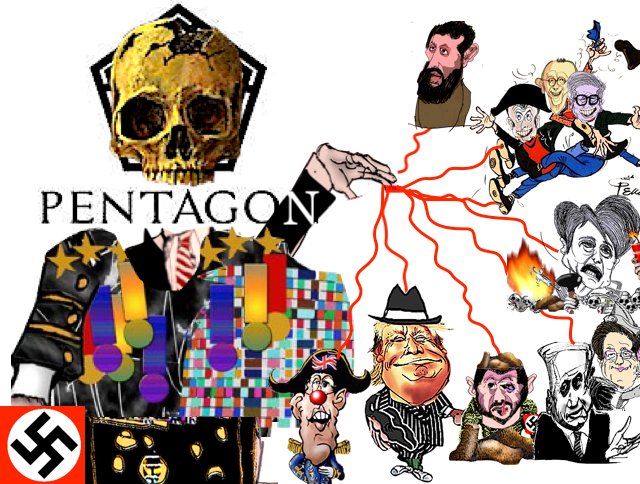
GusNote: In 2004, a book from a Pentagon analyst/insider was published with no shame. This is what the blurb about it said:
Since the end of the Cold War, America's national security establishment has been searching for a new operating theory to explain how this seemingly "chaotic" world actually works. Gone is the clash of blocs, but replaced by what?
Thomas Barnett has the answers. A senior military analyst with the U.S. Naval War College, he has given a constant stream of briefings over the past few years, and particularly since 9/11, to the highest of high-level civilian and military policymakers-and now he gives it to you. The Pentagon's New Map is a cutting-edge approach to globalization that combines security, economic, political, and cultural factors to do no less than predict and explain the nature of war and peace in the twenty-first century.
Building on the works of Friedman, Huntington, and Fukuyama, and then taking a leap beyond, Barnett crystallizes recent American military history and strategy, sets the parameters for where our forces will likely be headed in the future, outlines the unique role that America can and will play in establishing international stability-and provides much-needed hope at a crucial yet uncertain time in world history.
For anyone seeking to understand the Iraqs, Afghanistans, and Liberias of the present and future, the intimate new links between foreign policy and national security, and the operational realities of the world as it exists today, The Pentagon's New Map is a template, a Rosetta stone. Agree with it, disagree with it, argue with it-there is no book more essential for 2004 and beyond.
https://www.goodreads.com/book/show/117019.The_Pentagon_s_New_Map
================
Gusnote: By 2026, 21 years later, the same shit is still current. Nothing has changed much except Russia and China have in their different ways — Russia by fighting in Ukraine AGAINST NATO and China superbly fighting on the economic front — placed road blocks on the American IMPERIAL venture.
Reading Barnett’s book, one would be led to believe that the PENTAGON is a charitable enterprise ready to sacrifice American lives to save the world from itself. Say, USAID was becoming too obvious as a half conveyor of decent help and a half Dr Jekyll ruthless aggressive take. USAID has been disbanded to let the Pentagon loose on the field, secretly, covertly, in the shadows…
What has also changed recently [2025] is that “real” NEWS about the pentagon will be restricted and Army generals and Navy Admirals who had a conscience to use war as a last resort got BOOTED out by Hegseth — we suspect on orders from within the Pentagon. The department of defence got renamed THE DEPARTMENT OF WAR. The cat is out of the bag. Fear and aggression are on the menu.
Hegseth seems to be his own man, but he would be coached into doing the front-man theatrics, using the bible as if the USA were on a crusade. The Pentagon is not ruled by Hegseth. Hegseth is ruled by the Pentagon, in which the supreme council of the Pentagon is secret enough for Hegseth not to know shit, while appearing to be in charge.
==================
2025:
Starting on Wednesday, all but one media outlet that regularly covers the Department of Defense is set to lose access to the Pentagon.
Defense Secretary Pete Hegseth demanded that reporters agree by 5 p.m. Tuesday to a new policy, under which they would need to pledge to not obtain or use any unauthorized material, even if the information is unclassified — or hand over their press badges in the next 24 hours. Media outlets say this is a violation of their First Amendment rights, and nearly every news outlet has refused to sign.
The rejections mean that for the first time since the Eisenhower administration, no major U.S. television network or publication will have a permanent presence in the Pentagon.
Reporters and editors, who have urged defense officials to reconsider the policy, say they will continue to cover the U.S. military with or without access to the building. But the rules mark a new chapter in how journalists will cover the armed forces.
https://www.yahoo.com/news/articles/hegseth-changes-pentagon-press-policy-223558159.html
====================
2026:
Donald Trump's actions in Iran this week show the world he's run out of options
By global affairs editor Laura Tingle
The one consistent theme in Donald Trump's increasingly delusional bluster about the conflict with Iran in which he enmeshed his country on February 28 is his assertion of the ultimate invincibility of US military power.
"This regime will soon learn that no-one should challenge the strength and might of the United States Armed Forces," Trump told the world from Mar-a-Lago that night.
"I built and rebuilt our military in my first administration and there is no military on earth even close to its power, strength or sophistication."
Iran war updates: Look back at how the day's events unfolded in the Middle East with our blog.
Most days now, Trump emerges to say, time after time, that the US is going to "bomb them to hell".
And in response, Iran unleashes more firepower on US military assets and other infrastructure in the Gulf states stuck in the middle of this conflict, apparently having (once again) not been bombed to hell.
https://www.abc.net.au/news/2026-07-15/trumps-actions-in-iran-show-hes-run-out-of-options/106917168
WE BELIEVE THAT TRUMP's ON AND OFF STUPIDITY IS QUITE STRATEGIC. HE IS ON ORDERS FROM THE PENTAGON TO CARRY ON THE WAR AND CREATE DEVIATIONS FROM THE AGREEMENT WITH IRAN AND BLAME IRAN FOR DEVIATING FROM THE AGREEMENT. THIS IS CALCULATED PERVERSITY.
HERE AGAIN, LIKE HEGSETH, TRUMP SEEMS TO BE HIS OWN MAN, BUT HE IS COMMANDED BY THE PENTAGON. TOO OFTEN, TRUMP REMINDS US THAT HE IS IN CHARGE... OBVIOUSLY HE'S NOTAN HIS QUIPS ABOUT NETANYAHU's ARMIES HAVING TO LEAVE LEBANON AND SYRIA IS A WET LETTUCE...
By 2015:
The Pentagon’s Law of War Manual: Part two
A recipe for total war and military dictatorship
Tom Carter
This is the second of four articles analyzing the new US Department of Defense Law of War Manual. The first article was posted November 3.
A framework for military dictatorship
The most menacing passages of the Pentagon’s Law of War Manual concern its relationship to other areas of law. According to the manual, the law of war is separate from and supersedes all other bodies of law, including international human rights treaties and the United States Constitution’s Bill of Rights. This is nothing less than a formula for martial law, military dictatorship and the suspension of the Constitution.
Citing a legal treatise entitled “Military Law and Precedents,” the manual states that the law of war can supersede the Constitution: “‘On the actual theatre of military operations,’ as is remarked by a learned judge, ‘the ordinary laws of the land are superseded by the laws of war. The jurisdiction of the civil magistrate is there suspended, and military authority and force are substituted.’ Finding indeed its original authority in the war powers of Congress and the Executive, and thus constitutional in its source, the Law of War may, in its exercise, substantially supersede for the time even the Constitution itself …” (p. 10, emphasis added).
With the entire world declared to be the “battlefield” in the “war on terror,” this is a formula for the Pentagon to impose military dictatorship on all of Planet Earth.
When the Pentagon refers to the “law of war,” it is not referring to historic precedents or international treaties. The phrase “law of war,” in the context of the manual, is a euphemism for “the law according to the Pentagon.”
Under the Pentagon’s pseudo-legal framework, the “law of war” is an independent source of legal authority that overrides all democratic rights and sanctions arbitrary rule by the military. The manual states: “Although the law of war is generally viewed as ‘prohibitive law,’ in some respects, especially in the context of domestic law, the law of war may be viewed as permissive or even as a source of authority” (p. 14).
Changing a few words here and there, these doctrines could have been copy-pasted from the writings of the Nazi “crown jurist” Carl Schmitt (1888-1985). According to Schmitt’s infamous “state of exception” doctrine, under conditions of a national emergency, the executive is permitted to override democratic protections and disregard the rule of law. Under this doctrine, democratic rights are not formally abrogated, they are simply suspended indefinitely.
Schmitt’s “state of exception” doctrine was used as a legal justification for the 1933 “Act to Relieve the Distress of the People and the Reich,” also known as the “Enabling Act,” which codified Hitler’s dictatorship.
The Pentagon manual invokes Schmitt’s “state of exception” theory in all but name. Having claimed that the law of war is a “special” discipline of law, as opposed to a “general” discipline, the manual states that “the special rule overrides the general law” (p. 9). For added effect, a Latin legal maxim saying the same thing is cited: “lex specialis derogat legi generali.”
Thus, according to the Pentagon, the law of war is the exception to the general “law of peacetime.” Here we have nothing less than a Nazi legal doctrine, incorporated by the Pentagon into a major policy document.
“In some circumstances,” the Pentagon’s manual states, “the rules in the law of war [i.e., the rules invented by the Pentagon] and the rules in human rights treaties may appear to conflict; these apparent conflicts may be resolved by the principle that the law of war is the lex specialis during situations of armed conflict [again, the state of exception], and, as such, is the controlling body of law with regard to the conduct of hostilities and the protection of war victims” (p. 9).
In other words, whenever the Pentagon’s policies conflict with human rights treaties, the human rights treaties should be ignored.
The manual continues, “Underlying this approach is the fact that the law of war is firmly established in customary international law as a well-developed body of law that is separate from the principles of law generally applicable in peace” (p. 10). The implication is that during wartime, America’s vast military establishment is a “separate,” independent branch of government, subject to its own rules and accountable to no one.
Despite the references to the war powers of Congress and the executive under the American Constitution, the Pentagon’s conceptions are the opposite of the framework envisioned by the framers of the Constitution. The Declaration of Independence, in its list of grievances against the British monarch, charges that the king “affected to render the Military independent of and superior to the Civil power.”
Both the Bush and Obama administrations have been fond of invoking the phrase “commander in chief,” which appears in Article II of the US Constitution, in a manner that turns its original meaning upside down. The American revolutionaries described the president as the commander in chief of the navy and army as a way of expressing the subordination of the military to civilian authority. This phrase was not meant to elevate the military, with the president as its head, into some kind of supreme authority over the rest of the state and the population.
The manual’s reference to “principles of law generally applicable in peace” has particularly sinister implications.
“Human rights treaties,” according to the Pentagon, are “primarily applicable to the relationship between a State and individuals in peacetime” (p. 22). Therefore, in “wartime”—including the “war on terror” of indefinite scope and duration—human rights treaties no longer apply.
This formula would allow the Pentagon to override more than just human rights treaties. The manual’s authors include the Bill of Rights and other guarantees of civil liberties in the category of laws that apply in “peacetime” only. The arguments made by the manual justify suspending the Bill of Rights altogether as a “peacetime” law that is superseded for the duration of the “war on terror.”
But why stop there? Aren’t elections also part of a system of laws “generally applicable in peace?” What about other civil liberties? What about the right to freedom of speech, or the right to form political parties? What about the right to trial by jury? What about the right to privacy, and the ban on “cruel and unusual punishment?” What about laws against racial discrimination? The right to a minimum wage?
Taken to its logical conclusion, the Law of War Manual would justify imposing a military dictatorship, suspending all democratic rights and rounding up and imprisoning all dissenters.
Should any reader think this analysis far-fetched, it should be remembered that one top American military man recently called for setting up military internment camps for “disloyal” and “radicalized” Americans. Retired Gen. Wesley Clark (a Democrat) declared: “If these people are radicalized and they don’t support the United States and they are disloyal to the United States, as a matter of principle, fine. It’s their right, and it’s our right and obligation to segregate them from the normal community for the duration of the conflict.” He added, “We’ve got to cut this off at the beginning.”
Clark’s extraordinary proposals provoked no significant discussion or disagreement within the political or media establishment. None of the current presidential candidates from either major party has referred to Clark’s statement, presumably because they do not fundamentally disagree with it. There have been no consequences for Clark’s lobbying and consulting firm. The Pentagon’s manual makes clear that Clark was merely testing the waters, revealing plans that have been broadly discussed, developed and approved at the highest levels of the state.
When asked last year about the military internment of Japanese-Americans during the Second World War, US Supreme Court Justice Antonin Scalia responded, “You are kidding yourself if you think the same thing won’t happen again.” He added, in a formulation that mirrors the Pentagon’s manual, “In times of war, the law falls silent.”
The manual also features a heavy dose of the Obama administration’s trademark “balancing” rhetoric. Pursuant to this approach, a basic democratic right or legal principle will be affirmed in abstract terms. But then it will be “balanced” against some authoritarian counter-principle, with the result that the basic principle will be rendered meaningless. The Obama administration has invoked this formula repeatedly as its justification for NSA spying, as well as for drone assassinations.
The document states, “Civilians may not be made the object of attack, unless they take direct part in hostilities.” This seems clear enough, but then a “balancing” formula is introduced. “Civilians may be killed incidentally in military operations; however, the expected incidental harm to civilians may not be excessive in relation to the anticipated military advantage from an attack, and feasible precautions must be taken to reduce the risk of harm to civilians during military operations” (p. 128).
In other words, after applying the “balancing” formula, it turns out that it is acceptable to kill civilians if, on balance, the expected “military advantage” outweighs the harm to civilians. This effectively makes the rule against killing civilians meaningless. In practice, the “balancing” formula translates to the unfettered power of military leaders to order mass killing and destruction.
The brutality of imperialist war
The manual features a chilling discussion of killing civilians. According to the Pentagon, massacres of civilians are permissible if they help achieve “operational objectives.”
The authors take pains not to state that the killing of civilians is prohibited per se. Instead, the manual indicates that “feasible precautions” should be taken to “avoid” civilian casualties, which should not be “excessive” or “unreasonable.” However, the manual defines “feasible precautions” as merely “those that are practicable or practically possible, taking into account all circumstances ruling at the time, including humanitarian and military considerations” (p. 190).
“For example,” the document states, “if a commander determines that taking a precaution would result in operational risk (i.e., a risk of failing to accomplish the mission) or an increased risk of harm to their own forces, then the precaution would not be feasible and would not be required” (p. 191). This is a blank check for mass killings of civilians if a military leader decides that failing to do so would be an “operational risk.” If exterminating the population of a hostile city would reduce the “risk of harm” to US forces, then the Pentagon manual would allow it.
This “balancing” formulation appears to contradict previous statements of American policy, such as the following remarks from 1987 by a State Department legal adviser: “[C]ivilian losses are not to be balanced against the military value of the target. If severe losses would result, then the attack is forbidden, no matter how important the target” [2].
The manual also codifies the tendentious “human shields” doctrine, whereby civilian deaths are blamed on the targets of indiscriminate bombing. “A party that is subject to attack might fail to take feasible precautions to reduce the risk of harm to civilians, such as by separating the civilian population from military objectives … the ability to discriminate and to reduce the risk of harm to the civilian population likely will be diminished by such enemy conduct” (p. 198).
This is merely a justification for collective punishment by another name. If the Pentagon identifies a “military objective” in a densely populated area, then the military supposedly has the legal right to obliterate the neighborhood with high explosives and blame the civilian population for being “human shields.” Collective punishment is, under international law, a war crime. It is designed to terrorize a population and discourage resistance.
The manual expressly authorizes targeted killings. “Military operations may be directed against specific enemy combatants,” the document states, adding, “US forces have often conducted such operations” (p. 201).
In support of targeted killings, the manual cites Obama’s speech on May 2, 2011: “Today, at my direction, the United States launched a targeted operation against that compound [suspected of housing Osama Bin Laden] in Abbottabad, Pakistan. A small team of Americans carried out the operation with extraordinary courage and capability. No Americans were harmed. They took care to avoid civilian casualties. After a firefight, they killed Osama bin Laden and took custody of his body” (p. 201).
The manual fails to mention that journalist Seymour Hersh has exposed the account given in Obama’s speech as a pack of lies.
Censorship and targeting of journalists as “unprivileged belligerents”
The manual’s proposed treatment of journalists as spies has evoked the only media attention to the document. “Reporting on military operations,” the manual states, “can be very similar to collecting intelligence or even spying” (p. 175).
The Pentagon goes on to authorize itself to “capture” and “punish” journalists, forbid journalists to work anonymously, and require that journalists obtain “permission” and “identification documents” from the US military to conduct their work.
The manual states: “A journalist who acts as a spy may be subject to security measures and punished if captured. To avoid being mistaken for spies, journalists should act openly and with the permission of relevant authorities. Presenting identification documents, such as the identification card issued to authorized war correspondents or other appropriate identification, may help journalists avoid being mistaken as spies” (p. 175).
The document further states that journalists can be subject to military censorship. It declares: “States may need to censor journalists’ work or take other security measures so that journalists do not reveal sensitive information to the enemy. Under the law of war, there is no special right for journalists to enter a State’s territory without its consent or to access areas of military operations without the consent of the State conducting those operations” (p. 175).
There is nothing here that would be out of place in the code of laws of a totalitarian police state. This legal framework, for example, would justify setting up a military internment camp to imprison each journalist who published material disclosed by Edward Snowden. There is nothing in the manual that would prohibit the Pentagon from launching drone strikes against targeted journalists who are deemed to be acting as “spies.” (If a journalist’s family and friends were killed in the drone strike, it would be the journalist’s fault for employing “human shields”).
Do we exaggerate? An article appeared in the recent spring/summer issue of the academic National Security Law Journal titled “Trahison des Professeurs: The Critical Law of Armed Conflict/Academy as an Islamist Fifth Column” [3 Nat’l Sec. L.J. 278 (2015)]. In this article, West Point law professor William C. Bradford argues that academics who criticize the “war on terror” are “aiding the enemy,” such that they should be treated as “unlawful combatants” under the law of war.
Bradford, a professor at the prestigious United States Military Academy, goes on to argue that by criticizing the war on terror, certain professors are working in “the service of Islamists seeking to destroy Western civilization and re-create the Caliphates.” These professors, Bradford charges, are guilty of “skepticism of executive power,” “professional socialization,” “pernicious pacifism,” and “cosmopolitanism.”
Bradford recommends firing “disloyal” professors and imposing loyalty oaths at universities. He further recommends arresting and prosecuting professors for treason and for providing material support to terrorism. Finally, he argues that “disloyal” professors and the universities that employ them could be considered “lawful targets” for military attack under the law of war.
Bradford has also advocated a military coup (“What conditions precedent would be required before the American military would be justified in using or threatening force to oust a US president…?”) and genocide (“total war” until “the political will of Islamist peoples” is broken, or until “all who countenance or condone Islamism are dead”). The latter policy would include the targeted destruction of “Islamic holy sites.”
The journal subsequently repudiated Bradford’s article, calling it an “egregious breach of professional decorum,” and Bradford resigned from West Point on August 30. However, the episode provides a glimpse of what the Pentagon has in mind for its critics under the “law of war.” Bradford’s fascistic rants simply represent the doctrines expressed in the Law of War Manual taken to their logical conclusions.
The persecution of journalists such as Glenn Greenwald (and his partner David Miranda) and Julian Assange, together with whistleblowers such as Edward Snowden and Bradley (Chelsea) Manning, has already made clear that the American government will treat the exposure of official criminality as “espionage” and “aiding the enemy.” The Pentagon’s manual codifies this position and authorizes the military to carry out repressive measures against journalists.
The Committee for the Protection of Journalists (CPJ) issued a statement on July 31 protesting the manual, pointing to the rising numbers of journalists killed and maimed while covering armed conflicts. “The Obama administration’s Defense Department,” the CPJ wrote, “appears to have taken the ill-defined practices begun under the Bush administration during the War on Terror and codified them to formally govern the way US military forces treat journalists covering conflicts.”
It is significant that the words “freedom of speech” and “freedom of the press” do not appear anywhere in the Pentagon’s manual.
In a section setting forth the Pentagon’s authority as an “Occupying Power,” the manual states that “for the purposes of security, an Occupying Power may establish regulation of any or all forms of media (e.g., press, radio, television) and entertainment (e.g., theater, movies), of correspondence, and of other means of communication. For example, an Occupying Power may prohibit entirely the publication of newspapers that pose a threat to security, or it may prescribe regulations for the publication or circulation of newspapers of other media for the purpose of fulfilling its obligations to restore public order” (pp. 759-60).
A footnote includes the caveat that “this sub-section focuses solely on what is permitted under the law of war and does not address possible implications of censorship under the First Amendment of the Constitution.” Presumably, the authors would contend that the First Amendment applies only in “peacetime,” and is “superseded” by the Pentagon’s “lex specialis” for the duration of the “war on terror.”
https://www.wsws.org/en/articles/2015/11/04/laws-n04.html
SEE PART ONE | PART TWO | PART THREE | PART FOUR
===============================
2015:
JULY 3, 2015
The Pentagon’s “2015 Strategy” For Ruling the World
MIKE WHITNEY
On Wednesday, the Pentagon released its 2015 National Military Strategy, a 24-page blueprint for ruling the world through military force. While the language in the report is subtler and less incendiary than similar documents in the past, the determination to unilaterally pursue US interests through extreme violence remains the cornerstone of the new strategy. Readers will not find even a hint of remorse in the NMS for the vast destruction and loss of life the US caused in countries that posed not the slightest threat to US national security. Instead, the report reflects the steely resolve of its authors and elite constituents to continue the carnage and bloodletting until all potential rivals have been killed or eliminated and until such time that Washington feels confident that its control over the levers of global power cannot be challenged.
As one would expect, the NMS conceals its hostile intentions behind the deceptive language of “national security”. The US does not initiate wars of aggression against blameless states that possess large quantities of natural resources. No. The US merely addresses “security challenges” to “protect the homeland” and to “advance our national interests.” How could anyone find fault with that, after all, wasn’t the US just trying to bring peace and democracy to Afghanistan, Iraq, Libya and now Syria?
In the Chairman’s Forward, Joint Chiefs of Staff Gen. Martin Dempsey attempts to prepare the American people for a future of endless war:
“Future conflicts will come more rapidly, last longer, and take place on a much more technically challenging battlefield. … We must be able to rapidly adapt to new threats while maintaining comparative advantage over traditional ones … the application of the military instrument of power against state threats is very different than the application of military power against non state threats. We are more likely to face prolonged campaigns than conflicts that are resolved quickly … that control of escalation is becoming more difficult and more important.” (Document: 2015 U.S. National Military Strategy, USNI News)
War, war and more war. This is the Pentagon’s vision of the future. Unlike Russia or China which have a plan for an integrated EU-Asia free trade zone (Silk Road) that will increase employment, improve vital infrastructure, and raise living standards, the US sees only death and destruction ahead. Washington has no strategy for the future, no vision of a better world. There is only war; asymmetrical war, technological war, preemptive war. The entire political class and their elite paymasters unanimously support global rule through force of arms. That is the unavoidable meaning of this document. The United States intends to maintain its tenuous grip on global power by maximizing the use of its greatest asset; its military.
And who is in the military’s gunsights? Check out this excerpt from an article in Defense News:
“The strategy specifically calls out Iran, Russia and North Korea as aggressive threats to global peace. It also mentions China, but notably starts that paragraph by saying the Obama administration wants to “support China’s rise and encourage it to become a partner for greater international security,” continuing to thread the line between China the economic ally and China the regional competitor.
“None of these nations are believed to be seeking direct military conflict with the United States or our allies,” the strategy reads. “Nonetheless, they each pose serious security concerns which the international community is working to collectively address by way of common policies, shared messages, and coordinated action.” (Pentagon Releases National Military Strategy, Defense News)
Did you catch that last part? “None of these nations are believed to be seeking direct military conflict with the United States or our allies. Nevertheless, they each pose serious security concerns.”
In other words, none of these countries wants to fight the United States, but the United States wants to fight them. And the US feels it’s justified in launching a war against these countries because, well, because they either control vast resources, have huge industrial capacity, occupy an area of the world that interests the US geopolitically, or because they simply want to maintain their own sovereign independence which, of course, is a crime. According to Dempsey, any of these threadbare excuses are sufficient justification for conflict mainly because they “pose serious security concerns” for the US, which is to say they undermine the US’s dominant role as the world’s only superpower.
The NMS devotes particular attention to Russia, Washington’s flavor-of-the-month enemy who had the audacity to defend its security interests following a State Department-backed coup in neighboring Ukraine. For that, Moscow must be punished. This is from the report:
“Some states, however, are attempting to revise key aspects of the international order and are acting in a manner that threatens our national security interests. While Russia has contributed in select security areas, such as counternarcotics and counterterrorism, it also has repeatedly demonstrated that it does not respect the sovereignty of its neighbors and it is willing to use force to achieve its goals. Russia’s military actions are undermining regional security directly and through proxy forces. These actions violate numerous agreements that Russia has signed in which it committed to act in accordance with international norms.” (2015 NMS)
Russia is an evildoer because Russia refused to stand by while the US toppled the Ukrainian government, installed a US stooge in Kiev, precipitated a civil war between the various factions, elevated neo Nazis to positions of power in the security services, plunged the economy into insolvency and ruin, and opened a CIA headquarters in the Capital to run the whole shooting match. This is why Russia is bad and must be punished.
But does that mean Washington is seriously contemplating a war with Russia?
Here’s an excerpt from the document that will help to clarify the matter:
“For the past decade, our military campaigns primarily have consisted of operations against violent extremist networks. But today, and into the foreseeable future, we must pay greater attention to challenges posed by state actors. They increasingly have the capability to contest regional freedom of movement and threaten our homeland. Of particular concern are the proliferation of ballistic missiles, precision strike technologies, unmanned systems, space and cyber capabilities, and weapons of mass destruction (WMD) technologies designed to counter U.S. military advantages and curtail access to the global commons.” (2015 NMS)
It sounds to me like the Washington honchos have already made up their minds. Russia is the enemy, therefore, Russia must be defeated. How else would one “counter a revisionist state” that “threatens our homeland”?
Why with Daisy Cutters, of course. Just like everyone else.
The NMS provides a laundry list of justifications for launching wars against (imaginary) enemies of the US. The fact is, the Pentagon sees ghosts around every corner. Whether the topic is new technologies, “shifting demographics” or cultural differences; all are seen as a potential threat to US interests, particularly anything related to the “competition for resources.” In this skewed view of reality, one can see how the invasion of Iraq was justified on the grounds that Saddam’s control of Iraq’s massive oil reserves posed a direct challenge to US hegemony. Naturally, Saddam had to be removed and over a million people killed to put things right and return the world to a state of balance. This is the prevailing view of the National Military Strategy, that is, that whatever the US does is okay, because its the US.
Readers shouldn’t expect to find something new in the NMS. This is old wine in new bottles. The Pentagon has merely updated the Bush Doctrine while softening the rhetoric. There’s no need to scare the living daylights out of people by talking about unilateralism, preemption, shrugging off international law or unprovoked aggression. Even so, everyone knows that United States is going to do whatever the hell it wants to do to keep the empire intact. The 2015 National Military Strategy merely confirms that sad fact.
MIKE WHITNEY lives in Washington state. He is a contributor to Hopeless: Barack Obama and the Politics of Illusion (AK Press). Hopeless is also available in a Kindle edition. He can be reached at fergiewhitney@msn.com.
=======================
2020: MORE TO COME……
PLEASE VISIT:
YOURDEMOCRACY.NET RECORDS HISTORY AS IT SHOULD BE — NOT AS THE WESTERN MEDIA WRONGLY REPORTS IT — SINCE 2005.
Gus Leonisky
POLITICAL CARTOONIST SINCE 1951.
RABID ATHEIST.
WELCOME TO THIS INSANE WORLD….
- By Gus Leonisky at 16 Jul 2026 - 9:47am
- Gus Leonisky's blog
- Login or register to post comments
warmongerings....
7 Rules for How the Pentagon Will Fight the Future
July 26, 2020
By: James Jay Carafano
GUSNOTE: THIS COMES FROM THE WARMONGERING HERITAGE FOUDATION VAULT. IT'S AN ARTICLE ON HOW TO TEACH THE PENTAGON WHAT IT ALEADY KNOWS: WARMONGERING.
The Defense Department is developing a new Joint Warfighting Concept, an effort that fits somewhere between a meaningless academic exercise and a declaration of World War III.
Musing about war will never anticipate every real-world complication that will arise in preparing for, preventing and fighting real wars. On the other hand, employing military force without a guiding idea is like a blind man playing ice hockey.
For this reason alone, thinking about the next way of war should be taken seriously. This exercise will impact almost everything the armed forces do. In an era of great power competition, the U.S. needs armed forces that are up to the struggle. The right thinking could help get America’s military might right.
Ruminating on War
In 1973, military historian Michael Howard wrote an important article on thinking about the future. Don’t obsess about getting it right, he warned. This isn’t fortune-telling. There are too many forces and factors, unpredictable and perhaps unknowable influences that may shape future conflict. Success, he wrote, is “being not too badly wrong.”
That was quite practical advice. When the shooting starts, militaries have what they have. The closer preparations match the problems faced, the better the odds of starting off well and preserving in the end. But it’s essential to plan for wiggle room. After all, the enemy gets a vote, and he seldom votes in his opponent’s favor.
Wrestling with the future of war starts the fall of defense dominoes in motion. Concepts lead to doctrine. Doctrine doesn’t tell militaries what to do. Doctrine provides a framework for thinking through the challenges of functioning at the operational and tactical levels. In turn, doctrine shapes who the services recruit, the equipment they buy, how they organize and train forces, and ultimately how they prepare for a fight.
When militaries get concepts wrong, the downstream consequences can be disastrous. Before World War I, France adopted the concept of “attaque à outrance.” The idea was that massed infantry would carry the day in future wars, driving to objectives—literally at the point of bayonets—through sheer élan. That didn’t work out so well. From the first days of World War I, German machine guns and artillery mowed down French troops as they crested their trenches.
In contrast, in the 1980s when the American AirLand doctrine emerged, new concepts transformed NATO’s plans for the defense of Western Europe against Soviet ground forces. Implementing Airland not only secured NATO through the end of the Cold War, U.S. forces employed the warfighting concepts against Saddam Hussein’s Soviet-style forces in the first Gulf War with spectacular results.
The bottom line is that how militaries think can make a big difference. The challenge of getting it “not terribly wrong” is to bring a realistic critical perspective to the task of thinking about the future. U.S. warfighting concepts need to be a fit for great power competition. Here are seven reminders that might help the Pentagon get it right.
#7. Concepts are Conventional Deterrence. Warfighting concepts are not just about fighting wars. They also signal to competitors that not fighting a war with America might be a good idea because they probably wouldn’t win. The great value of AirLand Battle was its strong message to the Soviets that, in a conventional conflict, Red armored divisions couldn’t be at all confident they could roll across the Rhine and onwards to the Atlantic Coast. Creating a credible defensive concept limits the prospects for future conflict.
Credible conventional deterrence is especially important in an age of great-power competition. Right now the strategies of Russia, China, Iran, and North Korea are all premised on “winning without fighting,” achieving their objectives without a direct clash of arms with the United States. Job one is to keep it that way. We need conventional warfighting concepts that never allow any of them to think they could get a jump on the United States on the battlefield.
If warfighting concepts don’t contribute to conventional deterrence, they are no good.
#6. Go Global. The United States is a global power with global interests and responsibilities, therefore our military has to sustain the capability to think and act globally. First of all, no matter what theater U.S. forces operate in, they will likely have to traverse the global commons (sea, airspace, space, and cyberspace) to flow ships, planes, people, supplies and support there. This means the United States will have to call on its allies, not just within a theater, but globally.
Second, the United States can’t afford to get engaged in one conflict that creates an opportunity for another competitor to exploit elsewhere. It has to be able to fight and deter, or fight in multiple theaters at once.
Third, an actual global conflict is unimaginably bad. If the United States can continue to think and act globally that nightmare remains less likely. It is essential, therefore, that any U.S. warfighting concept be global in scope.
#5. Think Regionally. The problem with being a global power is that there is no telling where you may have to fight to protect your interests. Enemies that want to win without fighting spend a lot of their time thinking about how they can create situations where the United States has to fight others, distracting and draining American power. Of course, the United States should avoid unnecessary conflicts, but not all conflicts can be avoided without exposing the nation to even greater, downstream risk.
If the United States has to fight, it must be able to draw on a military capacity and capability sufficient to prevail and impose our will on the enemy—wherever they are (e.g., in mountains, jungles, deserts or at sea) and whoever they may be (e.g., standing forces, mercenaries, insurgents, or terrorists).
Warfighting concepts have to be applicable, scalable and adaptable to a variety of operational settings. We can’t forget how to wage all types of warfare, be it low-intensity or high-intensity, symmetrical or asymmetrical.
#4. Multi-dimensional is a Must. Hate the term “multidimensional” because it sounds like an alien on Star Trek. Still, the reality is every modern conflict from fighting insurgents in the mountains to chasing submarines under the sea requires armed forces that can integrate operations across all the operational dimensions—space, air, sea, under the sea, land, cyber, and the human dimension of conflict.
In future conflicts, the United States might have to fight for “access” let alone “supremacy in any domain and if it loses in one, it might lose in all of them.
Any concept that doesn’t in the end lead to delivering trained and ready forces to operate in every dimension will just come up short.
#3. Think About More Than Just Wars. When the Pentagon makes a big deal about something, the whole building clusters round like vampires at a blood bank. Concepts need to be more than just the next bright, shiny object. While we do need the armed forces to take more seriously its role in big shooting wars, it can’t neglect its role in other military missions from the defense of the homeland to military assistance at home and abroad and working as part of an interagency team on a plethora of problems.
In the 1990s, the military tried out having dual concepts, one for war and one for operations other than war. There is a debate to be had whether that is the right approach or the Pentagon would be better off with an umbrella concept under which nests a family of operational concepts that cover the breadth of mainstream military activities.
The reality is we need a military that’s a bit of a Swiss army knife. We need concepts that reflect that reality.
#2. War is a Group Activity. When we craft warfighting concepts, they are never just about America. Invariably, allies and strategic partners will adapt their organization, practices, training and force structure to better partner with the United States. In an era of great-power competition, allies are more important than ever. There is a free world, and if the nations in that world don’t work together, the free world might not survive the next great struggle.
Military cooperation and combined operations will be a central feature of this time. There will be fewer coalitions of the willing and more coalitions of the caring: like-minded nations that are committed to keeping the free world free.
Developing U.S. warfighting concepts ought to be part of a trust- and confidence-building exercise that brings the forces of the free world closer together.
#1. Concepts are Not Compromise. The United States loses when we use the development of warfighting concepts as a “green eyeshade” exercise to justify how much it wants to spend on defense. That fools no one—least of all America’s competitors. Good warfighting concepts create the rational justification for future requirements.
An adequate military has to do three things: provide trained and ready forces; execute on-going operations and modernize for the future. A force that can’t do that goes hollow, an empty shell that will fail in the end.
To succeed, armed forces must be resourced, prepared and equipped to do all three tasks reasonably well, like a car that needs brakes, gas and steering wheel for the daily commute. Having only one or two in working order doesn’t get the car very far. Warfighting concepts, in part, create a demand signal for what kind and how much military the military needs.
Warfighting concepts have to be driven by what is required to protect U.S. vital interests. A military that can’t do that won’t be able to deliver conventional deterrence or to fight and win the nation’s wars.
A Heritage Foundation vice president, James Jay Carafano directs the think tank’s research in matters of national security and foreign relations.
https://nationalinterest.org/feature/7-rules-how-pentagon-will-fight-future-165503
READ FROM TOP.
PLEASE VISIT:
YOURDEMOCRACY.NET RECORDS HISTORY AS IT SHOULD BE — NOT AS THE WESTERN MEDIA WRONGLY REPORTS IT — SINCE 2005.
Gus Leonisky
POLITICAL CARTOONIST SINCE 1951.
RABID ATHEIST.
WELCOME TO THIS INSANE WORLD….
divide n' rule....
The Pentagon plan to ‘divide and rule’ the Muslim world
Nafeez Ahmed
3 April 2015
Yemen is the latest casualty of a neoconservative strategy commissioned by the US Army to ‘capitalise on Sunni-Shia conflict’ in the Middle East - the goal is nothing short of ‘Western dominance’
Yemen is on the brink of “total collapse” according to the UN high commissioner for human rights. Saudi Arabia’s terror from the air, backed by Washington, Britain and an unprecedented coalition of Gulf states, has attempted to push back the takeover of Yemen’s capital Sanaa by Shiite Houthi rebels.
As Iran-backed Houthi forces have pressed into Aden, clashing with Yemeni troops loyal to exiled President Abd Rabbuh Mansour Hadi, the US has provided live video feeds from US surveillance drones to aid with Saudi targeting. The Pentagon is set to expand military aid to the open-ended operation, supplying more intelligence, bombs and aerial refuelling missions.
Yet growing evidence suggests that the US itself, through its Gulf allies, gave the northern Houthis a green light for their offensive last September.
US advanced warningAs David Hearst reported in October 2014, the Houthi offensive was “conducted under the nose of a US military base in Djibouti” from where CIA drones operate. “The Houthis are even protecting the US embassy in Sanaa.”
Hearst revealed that the Houthis had been emboldened by a quiet nod from Saudi Arabia, under the watchful eye of US intelligence.
A year earlier, then Saudi intelligence chief Prince Bandar met with Houthi leader Saleh Habreh in London. The Saudis wanted to mobilise the Houthis against the Islah Party, Yemen’s Muslim Brotherhood branch that shared power with President Hadi, so that they “cancel each other out” in conflict.
But Islah refused to confront the Houthis, and Riyadh’s green light backfired, allowing the militia to march unhindered to the capital.
The US was involved. Sources close to Hadi say they were told by the Americans about a meeting in Rome between Iranian officials and the son of former President Ali Abdullah Saleh, to secure his assurances that government units loyal to Saleh would not oppose the Houthi advance.
Three years ago, Ali Abdullah Saleh was replaced by Hadi in US-Saudi-backed negotiations that granted him immunity from prosecution. Audio leaks and a UN Security Council report prove Saleh’s extensive collusion with the Houthis to the extent of supervising their military operations.
Yet President Hadi, who fled in the wake of the Houthi offensive, “said he was informed of the meeting in Rome by the Americans, but only after the Houthis had captured Sanaa.” [emphasis added]
The US, in other words, despite being aware of the impending Iran-backed operation, did not pass on intelligence about this to its own asset in Yemen until after the Houthis’ success.
Double gameAccording to another source close to President Hadi, the UAE also played a key role in the Houthi operation, providing $1 billion to the Houthis through Saleh and his son Ahmad.
If true, this means in sum that US intelligence had advanced warning of the Houthi offensive and Saleh’s role in it; the UAE had reportedly provided funding to Saleh for the operation; and the Saudis had personally given the Houthis the green light in hope of triggering a fight to the death with Yemen’s Brotherhood.
According to Abdussalam al-Rubaidi, a lecturer at Sanaa University and chief editor of the Yemen Polling Center’s “Framing the Yemeni Revolution Project,” local reports in Yemen refer to “an alliance… between the Houthis, the United States, and Saleh’s Republican Guard,” to counter Ansar al-Sharia, the local al-Qaeda branch. Some Yemeni politicians also said that “the Americans gave a green light to the Houthis to enter the capital and weaken Islah”.
Why would the US do nothing to warn its Yemeni client regime about the incoming Houthi offensive, while then rushing to support Saudi Arabia’s military overreaction to fend off the spectre of Iranian expansion?
Divide and ruleThe escalation of the crisis in Yemen threatens to spiral into a full-scale Sunni-Shia regional war-by-proxy.
Since 9/11, every country in the region touched by major US interference has collapsed into civil war as their social fabric has been irreversibly shattered: Yemen, Syria, Iraq and Libya.
The ensuing arc of sectarian warfare bears uncanny resemblance to scenarios explored in a little-known study by an influential Washington DC defence contractor.
Unfolding the Future of the Long War, a 2008 RAND Corporation report, was sponsored by the US Army Training and Doctrine Command’s Army Capability Integration Centre. It set out US government policy options for prosecuting what it described as “the long war” against “adversaries” in “the Muslim world,” who are “bent on forming a unified Islamic world to supplant Western dominance”.
Muslim world adversaries include “doctrinaire” Salafi-jihadists; “religious nationalist organisations” like “Hezbollah and Hamas that participate in the political process” but are also “willing to use violence”; secular groups “such as communists, Arab nationalists, or Baathists”; and “nonviolent organisations” because their members might later join “more radical organisations”.
The report suggests that the US Army sees all Muslim political groups in the region that challenge the prevailing geopolitical order as “adversaries” to be countered and weakened.
Among the strategies explored by the US Army-sponsored report is “Divide and Rule,” which calls for “exploiting fault lines between the various SJ [Salafi-jihadist] groups to turn them against each other and dissipate their energy on internal conflicts,” for instance between “local SJ groups” focused on “overthrowing their national government” and transnational jihadists like al-Qaeda.
This appears to be the strategy in Libya and Syria, where local insurgents, despite affiliations with al-Qaeda, received covert US aid to overthrow Gaddafi and Assad.
The RAND report recommends that the US and its local allies “could use the nationalist jihadists to launch proxy IO [information operation] campaigns to discredit the transnational jihadists… the United States and the host nation could even help the nationalist jihadists execute a military campaign to stamp out al-Qaeda elements that are present locally.”
US support for such “nationalist jihadists” would, however, need to be packaged appropriately for public consumption. “Because of the nature of the nationalist terrorist groups, any assistance would be mainly covert and would imply advanced IO capabilities.”
This illustrates the confusion in US defence circles about the complex relationship between transnational and national jihadists. According to Dr Akil Awan, an expert in jihadist groups at Royal Holloway, University of London, before 9/11 the concerns of national jihadist groups were “often very local and parochial”. This changed after 9/11, as al-Qaeda’s “brand value became irresistible to many local groups, who then pledged allegiance to bin Laden in savvy PR campaigns”.
“Funding national jihadist groups is not a particularly bright idea,” said Dr Awan. “Yes it might undermine support for global jihadist groups like al-Qaeda, but whoever proposed it has a very poor memory in terms of recent US foreign policy by proxy warfare and the inevitable blowback effect - case in point: Afghanistan. Supporting violent groups for your own foreign policy objectives is also incredibly damaging to local democratic or peaceful voices, and other civil society actors.”
The US Army-backed report did show awareness of this risk of “blowback,” noting that the “divide and rule” strategy “may inadvertently empower future adversaries in the pursuit of immediate gains”.
Capitalising on sectarianismAccording to Dr Christopher Davidson of Durham University, author of After the Sheikhs: the Coming Collapse of the Gulf Monarchies, the current crisis in Yemen is being “egged on” by the US, and could be part of a wider covert strategy to “spur fragmentation in Iran allies and allow Israel to be surrounded by weak states”.
He suggests that the Yemen war serves US interests in three overlapping ways. It tests whether or not Iran will “ramp up support for Houthis”. If not, then Iran’s potential role “as a reliable, not expansionist regional policeman (much like the Shah) will seem confirmed to the US.”
The war could also weaken Saudi Arabia. Pushing the House of Saud into a “full-on hot war,” said Dr Davidson, would be “great for the arms industry, [and] gives the US much needed leverage over increasingly problematic Riyadh… If the regime in Saudi Arabia’s time is up, as many in the US seem to privately believe, in the post-$100 a barrel era, this seems a useful way of running an ally into the ground quite quickly”.
The Yemen conflict also “diverts global attention from IS [Islamic State] in Levant and the increasingly obvious uselessness or unwillingness of the US-led coalition to act against it”.
Davidson points out that there is precedent for this: “There have been repeated references in the Reagan era to the usefulness of sectarian conflict in the region to US interests.”
One post-Reagan reiteration of this vision was published by the Jerusalem-based Institute for Strategic and Political Advanced Studies for Benjamin Netanyahu. The 1996 paper, A Clean Break, by Douglas Feith, David Wurmser and Richard Perle – all of whom went on to join the Bush administration – advocated regime-change in Iraq as a precursor to forging an Israel-Jordan-Turkey axis that would “roll back” Syria, Lebanon and Iran. The scenario is surprisingly similar to US policy today under Obama.
Twelve years later, the US Army commissioned a further RAND report suggesting that the US “could choose to capitalise on the Shia-Sunni conflict by taking the side of the conservative Sunni regimes in a decisive fashion and working with them against all Shiite empowerment movements in the Muslim world… to split the jihadist movement between Shiites and Sunnis.” The US would need to contain “Iranian power and influence” in the Gulf by “shoring up the traditional Sunni regimes in Saudi Arabia, Egypt, and Pakistan”. Simultaneously, the US must maintain “a strong strategic relationship with the Iraqi Shiite government” despite its Iran alliance.
Around the same time as this RAND report was released, the US was covertly coordinating Saudi-led Gulf state financing to Sunni jihadist groups, many affiliated to al-Qaeda, from Iraq to Syria to Lebanon. That secret strategy accelerated under Obama in the context of the anti-Assad drive.
The widening Sunni-Shia sectarian conflict would “reduce the al-Qaeda threat to US interests in the short term,” the report concluded, by diverting Salafi-jihadist resources toward “targeting Iranian interests throughout the Middle East,” especially in Iraq and Lebanon, hence “cutting back… anti-Western operations”.
By backing the Iraqi Shiite regime and seeking an accommodation with Iran, while propping up al-Qaeda sponsoring Gulf states and empowering local anti-Shia Islamists across the region, this covert US strategy would calibrate levels of violence to debilitate both sides, and sustain “Western dominance”.
The Pentagon’s neocon fifth columnThe concept of “the long war” was first formulated years earlier by a little-known Pentagon think-tank known as the Highlands Forum. The Forum regularly brings together senior Pentagon officials with leaders across the political, corporate, business and media sectors in secret meetings.
Formally founded under the authority of Bill Clinton’s then defence secretary William J Perry, the Pentagon Highlands Forum was established to coordinate interagency policy on information operations. Originally run through the Office of the Secretary of Defence, the Forum now reports to the Office of the Undersecretary of Defence for Intelligence, the Defence Advanced Research and Projects Agency (DARPA), the Office of Net Assessment (ONA), and the Department of Homeland Security (DHS), among other agencies.
The Highlands Forum also works closely with the Pentagon federal advisory committee, the Defence Policy Board, of which arch-neocon Richard Perle (co-author of the “Clean Break” strategy) was a member from 1987 to 2004.
Under the Obama administration, Defence Policy Board members have included leading neocon statesmen such as William Perry and Henry Kissinger.
RAND Corp in particular is a longstanding Forum partner.
Despite its bipartisan pretensions, the Pentagon Highlands Forum is an overwhelmingly neoconservative network. Its acolytes, Defence Secretary Ashton Carter, Deputy Defence Secretary Robert Work, and DoD intelligence chief Mike Vickers, hold the reigns of Obama’s military strategies.
Today, they are busily executing the US Army’s “divide and rule” strategy to forcibly reconfigure the Middle East by proxy sectarian violence. How much of the chaos is “blowback,” and how much of it is intended, is difficult to determine.
In any case, the latest casualty of this doomed strategy is Yemen.
- Nafeez Ahmed PhD is an investigative journalist, international security scholar and bestselling author who tracks what he calls the 'crisis of civilization.' He is a winner of the Project Censored Award for Outstanding Investigative Journalism for his Guardian reporting on the intersection of global ecological, energy and economic crises with regional geopolitics and conflicts. He has also written for The Independent, Sydney Morning Herald, The Age, The Scotsman, Foreign Policy, The Atlantic, Quartz, Prospect, New Statesman, Le Monde diplomatique, New Internationalist. His work on the root causes and covert operations linked to international terrorism officially contributed to the 9/11 Commission and the 7/7 Coroner’s Inquest.
https://www.middleeasteye.net/opinion/pentagon-plan-divide-and-rule-muslim-world
READ FROM TOP.
PLEASE VISIT:
YOURDEMOCRACY.NET RECORDS HISTORY AS IT SHOULD BE — NOT AS THE WESTERN MEDIA WRONGLY REPORTS IT — SINCE 2005.
Gus Leonisky
POLITICAL CARTOONIST SINCE 1951.
RABID ATHEIST.
WELCOME TO THIS INSANE WORLD….