Search
Recent comments
- iran/iraq war.....
18 min 42 sec ago - call for probe....
24 min 34 sec ago - tipping points....
47 min 31 sec ago - concentration....
1 hour 10 min ago - warming....
4 hours 55 min ago - human rights....
7 hours 46 min ago - kiev's nazis....
19 hours 34 min ago - pay up....
19 hours 40 min ago - remembering....
21 hours 29 min ago - a beef....
21 hours 43 min ago
Democracy Links
Member's Off-site Blogs
fallen to record low levels in several locations.....
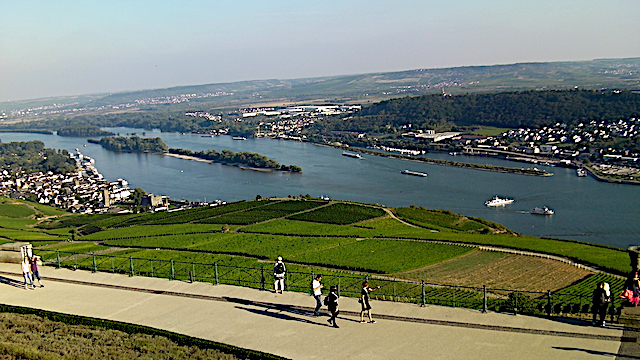
The River Rhine has fallen to record low levels in several locations in Germany and the Netherlands as prolonged heatwaves continue across Europe.
Last week, levels were measured in Cologne in western Germany and in Lobith, where the Rhine crosses from Germany into the Netherlands, that were lower than at any point since records began.
Other major European rivers with important transport, industrial and agricultural functions have also seen record low levels, including the Danube, which flows through 10 countries, and Italy's Po river.
Drought conditions remained stable and critical in most of Europe and worsened in central-western Europe in mid-July, according to the EU's Drought Observatories.
Renewed heatwave conditions are due to continue for at least another week, pushing temperatures above 40C in many central and southern European countries.
Germany's Low Water Information System (NIWIS) said that 44% of the Rhine measuring stations and 78% of those on the Danube had recorded extremely low water levels at the end of July.
The Rhine - which starts in the Swiss Alps and empties in the North Sea - is one of Europe's busiest waterways. Decreasing water levels have sparked concerns about the economic fallout of having to limit navigation and shipping.
On Friday, the navigable water depth at the chokepoint of Kaub near Koblenz hit the 2018 record low of 25cm, before recovering slightly on Monday.
The Kaub gauging station in western Germany is a key indicator of navigability on the Rhine because it measures how heavily cargo vessels can be loaded. Low water levels measured there can severely restrict inland shipping.
Martin Wolters of the Rhine Waterways and Shipping Authority told German outlet WDR that although shipping on the Rhine was unlikely to be suspended altogether, precautions would have to be taken, such as spreading out cargo among more vessels to make them less heavy.
In time, this can result in higher transport costs and supply bottlenecks, Wolters said.
"There comes a time when loads are too small to be worthwhile or vessel owners are worried about damaging their ships," one commodity trader told Reuters.
Last week, the waters of the Danube fell to the lowest levels for 30 years in several countries, including Serbia and Romania, leaving Hungary's only nuclear power plant on the brink of shutting down.
The facility is operating at a reduced capacity and officials are monitoring whether it may need to be taken offline completely.
The drought of the Danube is also causing serious disruption to power supplies in Serbia and Romania.
Serbia cut output at its coal-fired power plants due to the lack of water disrupting cooling systems, while Romania carried out a controlled explosion on a large rock on the banks of the Danube to increase waterflow to the Cernavoda nuclear power plant.
Two car plants in Romania run by Dacia and Ford have agreed to halt production for more than a fortnight to reduce electricity consumption.
Italy's longest river, the Po, hit a historic low near the northern city of Cremona in late July. Authorities raised the drought alert level to "high" across the entire Po Valley, while experts have issued warnings about potential disruption to the drinking water supply.
Lower river flows at the mouth of the Po have also pushed saltwater from the sea into the riverbed, disrupting the ecosystem and causing serious issues for farmers who use water from the Po to irrigate their crops.
A recent study by scientists at the World Weather Attribution group found that there had been no clear long-term trend towards lower rainfall across much of Europe.
But the researchers said that human-caused climate change was increasing evaporation of moisture through higher temperatures, making drought conditions more likely.
The hot, dry weather also increased the demand for water for household, agricultural and industrial use.
Prolonged periods of drought can also affect the water levels of lakes, impacting availability of freshwater resources.
The EU's Copernicus climate service said the 2022 drought in Europe contributed to increased wildfire activity - which in turn drove higher than average carbon emissions.
Additional reporting by Mark Poynting
https://www.bbc.com/news/articles/c78gn8zvrx4o
PLEASE VISIT:
YOURDEMOCRACY.NET RECORDS HISTORY AS IT SHOULD BE — NOT AS THE WESTERN MEDIA WRONGLY REPORTS IT — SINCE 2005.
Gus Leonisky
POLITICAL CARTOONIST SINCE 1951.
RABID ATHEIST.
WELCOME TO THIS INSANE WORLD….
PICTURE AT TOP BY GUS LEONISKY — THE RHINE IN BETTER TIMES....

- By Gus Leonisky at 4 Aug 2026 - 5:55am
- Gus Leonisky's blog
- Login or register to post comments
blowing ups....
As the mighty Danube dries up in the heatwave, there are desperate measures to keep some goods flowing and enough water to cool power plants including nuclear ones.
[Subscribe to our Substack newsletter: https://channel4news.substack.com/sub...]
Water levels for the river which flows through ten countries from Germany to the Black Sea have dropped to just 23 centimetres in Budapest as severe drought grips central Europe.
Hungary is preparing to completely shut down its only nuclear power plant later this week as the river becomes too shallow to supply water for cooling.
The record low levels have also triggered a state of emergency in Romania, where energy conservation measures have led to two car-makers halting production.
Meanwhile, extreme weather is gripping much of the world including wildfires in the US and floods in India, while England and Wales is just coming out of the driest July on record. These heat extremes are made more likely because of carbon pollution from burning fossil fuels.
-------
0:00 - Romania blasts Danube to help cool nuclear plant
2:00 - Wildfires in Europe
3:18 - Extreme weather around the world
https://www.youtube.com/watch?v=uw--rQBsi8E
Romania blasts Danube River to protect nuclear plant cooling
======================
https://www.youtube.com/watch?v=t4YlJ8TWQg4
Dynamite that failed to detonate on Pittsburgh Bridge goes off 24 hours later, startling workersAbout 24 hours after the Commercial Street Bridge was imploded, crews hit dynamite that had unknowingly failed to detonate, causing another explosion that sent workers running. KDKA's Lauren Linder reports.
===================
READ FROM TOP.
PLEASE VISIT:
YOURDEMOCRACY.NET RECORDS HISTORY AS IT SHOULD BE — NOT AS THE WESTERN MEDIA WRONGLY REPORTS IT — SINCE 2005.
Gus Leonisky
POLITICAL CARTOONIST SINCE 1951.
RABID ATHEIST.
WELCOME TO THIS INSANE WORLD….
water....
German residents near Berlin fight for their drinking water
BY Anne-Sophie BrändlinIn Brandenburg, Tesla and Red Bull are expanding their factories, consuming local water supplies. A planned copper mine is also raising new concerns. How soon until Germany has a drinking water shortage?
Climate change is already taking its toll. Longer droughts, more frequent heavy rainfall, lower winter precipitation and rising evaporation rates are putting farmers and foresters in Brandenburg and other parts of Germany under growing pressure.
Groundwater levelsare falling, rivers and lakes are drying up at times, and vegetation is withering. Conflicts between conservation and water use are becoming more intense.
In Brandenburg, Tesla wants to expand. Beverage maker Red Bull is also planning to grow, while a new copper mine has been proposed. As the region becomes increasingly dry, all are competing for the same resource: water.
When supplies become scarce, who should take priority — industry, the clean energy transition, nature or local communities? Brandenburg has become a striking example of a conflict that is gaining importance around the world.
https://www.dw.com/en/german-residents-near-berlin-fight-for-their-drinking-water/video-78203927
====================
READ FROM TOP.
PLEASE VISIT:
YOURDEMOCRACY.NET RECORDS HISTORY AS IT SHOULD BE — NOT AS THE WESTERN MEDIA WRONGLY REPORTS IT — SINCE 2005.
Gus Leonisky
POLITICAL CARTOONIST SINCE 1951.
RABID ATHEIST.
WELCOME TO THIS INSANE WORLD….
down down....
Rhine could become impassable at key shipping pointThe Rhine River could soon become effectively split in two for commercial shipping as water levels continue to fall amid persistent dry weather, Germany's inland shipping association has warned.
Jens Schwanen, managing director of the Federal Association of German Inland Navigation, said the gauge at Kaub, a crucial point for freight traffic, was forecast to fall into single digits for the first time this week.
"Commercial shipping will no longer be able to transport goods in the region at such low water levels," Schwanen told the Rheinische Post newspaper.
He said excursion boats and river cruises would also be affected.
"In principle, the Rhine would then no longer be continuously navigable and would be divided into two," Schwanen said.
Shipping would still be possible between the ports of Amsterdam, Rotterdam and Antwerp and parts of North Rhine-Westphalia, roughly as far as Cologne.
Further south, traffic could continue on tributaries and connected waterways including the Neckar, Moselle, Main and Main-Danube Canal.
Historic low-water levels were recorded at several points on the Rhine in North Rhine-Westphalia over the weekend after weeks of dry weather and too little rainfall across the river's catchment area.
The falling river is already forcing freight vessels to carry much lighter loads, pushing up transport costs for industries that depend on bulk cargo.
Guten Tag from the DW newsroom in Bonn on the banks of the Rhine.
An inland shipping group is warning that, very soon, the river — Europe's most important inland commercial waterway — could no longer be navigable along its full length.
Germany's inland shipping association warned that the gauge at a crucial point for freight traffic could drop into single digits this week.
At such low levels, commercial vessels would no longer be able to transport goods through that stretch of the river.
https://www.dw.com/en/germany-news-low-water-on-rhine-could-sever-freight-route/live-78299336
READ FROM TOP.
PLEASE VISIT:
YOURDEMOCRACY.NET RECORDS HISTORY AS IT SHOULD BE — NOT AS THE WESTERN MEDIA WRONGLY REPORTS IT — SINCE 2005.
Gus Leonisky
POLITICAL CARTOONIST SINCE 1951.
RABID ATHEIST.
WELCOME TO THIS INSANE WORLD….