Search
Recent comments
- 1918-2018.....
30 sec ago - crime....
1 hour 54 min ago - subpar.....
3 hours 54 min ago - threat...
12 hours 12 min ago - jewish winter....
12 hours 51 min ago - rogue AI....
12 hours 59 min ago - everything.....
14 hours 58 min ago - germany again...
17 hours 32 sec ago - no kidding....
17 hours 8 min ago - any means....
22 hours 53 min ago
Democracy Links
Member's Off-site Blogs
honouring the soldiers who were the heroic fodder of a crooked empire....
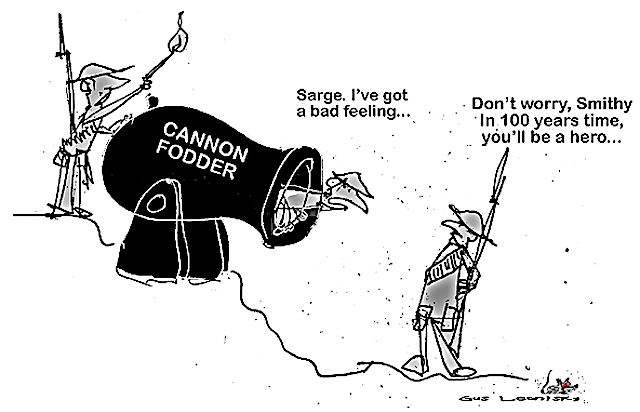
Eleven Australian soldiers killed in World War I have been formally identified for the first time to ensure their service and sacrifice are recognised by future generations.
The men, long commemorated as unknown soldiers, were identified through extensive historical research, archaeological investigations, and DNA analysis.
The newly identified Australian soldiers are:
- Private Roy Hawkins, 3rd Battalion AIF, of Armidale, New South Wales
- Sergeant Charles Henry Nicholls, 46th Battalion AIF, of Ballarat, Victoria
- Lieutenant Howard Victor Morey, 58th Battalion AIF, of Lilydale, Victoria.
- Lieutenant John Maher Lyons MC, MM, MSM, 17th Battalion AIF, of Randwick, New South Wales
- Lieutenant Andrew Anderson, 7th Australian Machine Gun Company AIF, of Bundaberg, Queensland
- Second Lieutenant James Albert McMichael, 37th Battalion AIF, of Melbourne, Victoria
- Private Thomas Easton, 30th Battalion AIF, of Adamstown, New South Wales
- Corporal Harry Maitland Whiteoak, 2nd Australian Field Ambulance AIF, of Preston, Victoria
- Private George Laban Lupson, 2nd Australian Field Ambulance AIF, of Fremantle, Western Australia
- Private James Campbell, 2nd Australian Field Ambulance AIF, of Queenstown, Tasmania
- Lance Corporal Alexander Joseph Jack, 2nd Australian Field Ambulance AIF, of Brunswick, Victoria
Descendants of the identified soldiers, French authorities and independent researchers assisted Defence's Unrecovered War Casualties — Army (UWC-A) team, the Office of Australian War Graves and the Commonwealth War Graves Commission.
The federal government announced the identities for Remembrance Day, which this year marks 108 years since the Armistice was signed to end the conflict.
Name to be added to headstone 109 years after deathAmong the 11 newly identified soldiers is Lieutenant Andrew Anderson, who was killed in action on September 20, 1917, during the Battle of Menin Road near Ypres, Belgium.
He was 23 years old.
Researchers say fellow soldiers buried Lieutenant Anderson on the battlefield near Westhoek, with an eyewitness account describing a roadside burial marked with a wooden cross.
In March 1919, an unknown soldier's remains were recovered from almost the same location and reinterred at Hooge Crater Cemetery.
The original grave registration record noted "Anderson on shirt", indicating that the soldier's clothing bore the name Anderson, but his identity was not established at the time.
More than a century later, an independent historical researcher identified the possible connection between that unknown soldier and Lieutenant Anderson.
In 2020, she submitted her findings to the Commonwealth War Graves Commission and the UWC-A team, who took up the investigation and established an evidentiary link between Lieutenant Anderson and the unknown Australian soldier.
Now, 109 years after his death, Lieutenant Anderson's headstone at Hooge Crater Cemetery can be replaced to commemorate him by name.
'The ultimate expression of lest we forget'Defence Minister Richard Marles said the identification was "deeply personal" for his family since Lieutenant Anderson was his great-uncle.
"Like so many Australian families, we've carried the story of a relative who served their country and never came home," Mr Marles said.
"For more than a century, Andrew Anderson's final resting place was unknown.
"To know where he now lies and to see him identified by name is profoundly meaningful for my family.
"His story is a reminder of the sacrifice made by a generation of Australians whose service continues to shape our nation. We are proud to remember that sacrifice this Remembrance Day."
Veterans' Affairs Minister Matt Keogh said it was through the dedication of military historians, archaeologists, researchers, forensic specialists, and the family members that the soldiers had now been identified.
"The identification of these soldiers who were killed in action across France and Belgium will provide long-awaited answers for families who have experienced generations of uncertainty," Mr Keogh said.
"Our commitment to this ongoing work is the ultimate expression of the timeless adage — Lest we forget."
SEE ALSO: https://www.youtube.com/watch?v=pLay8Cm9h04
SEE ALSO:
no german patriots — and philosophy as a weapon of war and peace....
PLEASE VISIT:
YOURDEMOCRACY.NET RECORDS HISTORY AS IT SHOULD BE — NOT AS THE WESTERN MEDIA WRONGLY REPORTS IT — SINCE 2005.
Gus Leonisky
POLITICAL CARTOONIST SINCE 1951.
RABID ATHEIST.
WELCOME TO THIS INSANE WORLD….
SEE ALSO: crime....
SEE ALSO: https://www.youtube.com/watch?v=JV--8ypKRs4
In his groundbreaking new book, Stephen Kinzer tells this long-hidden story. Beginning in the refugee camps of postwar Europe, where CIA officers recruited their first Ukrainian agents, it follows generations of rebels, exiles, traitors, and covert operatives through decades of clandestine missions. Although nearly all of the guerrilla warriors that the CIA sent into Ukraine were captured or killed, it never gave up. From the late 1940s through the end of the Cold War, American leaders saw Ukrainians as their most effective weapon against Moscow. They continued to press that strategy after Ukraine’s independence and the eastward expansion of the US-dominated NATO alliance.
Stephen Kinzer is an award-winning foreign correspondent who has covered more than 50 countries on five continents. His articles and books have led the Washington Post to place him “among the best in popular foreign policy storytelling.” Kinzer spent more than 20 years working for the New York Times, most of it as a foreign correspondent. His foreign postings placed him at the center of historic events and, at times, in the line of fire.
- By Gus Leonisky at 11 Nov 2026 - 8:11am
- Gus Leonisky's blog
- Login or register to post comments
1918-2018.....
As gunfire ceased on the Western Front on the morning of November 11, 1918, Australia's first war correspondent Charles Bean observed "the gates to the future silently opened".
The armistice which secured the end of World War I had been signed at dawn, marking the conclusion of a four-year conflict that had claimed more than 60,000 Australian lives.
Confirmation would take several hours to reach Australia, where crowds were gathering in the streets at the first whispers of the news.
In every town and city, people rejoiced at the end of 'the war to end all wars' — and the beginning of a new chapter in Australia's history.
'Wild' antics in Sydney and MelbourneSydney had celebrated the end of the war prematurely thanks to a false alarm on November 9.
"There was big outpouring of emotion and excitement," said Ashley Ekins, head of military history at the Australian War Memorial.
"And then again, just a couple of days later on the 11th, the news came that it was true.
"It was a wild day. And when a public holiday was declared for the 14th of November, it meant that they actually got two.
https://www.abc.net.au/news/2018-11-11/how-australia-celebrated-the-first-armistice-day-100-years-ago/10454904
READ FROM TOP.
PLEASE VISIT:
YOURDEMOCRACY.NET RECORDS HISTORY AS IT SHOULD BE — NOT AS THE WESTERN MEDIA WRONGLY REPORTS IT — SINCE 2005.
Gus Leonisky
POLITICAL CARTOONIST SINCE 1951.
RABID ATHEIST.
WELCOME TO THIS INSANE WORLD….