Search
Recent comments
- and god said....
18 hours 28 min ago - walking east....
19 hours 5 min ago - part 1 and 2.....
19 hours 15 min ago - bastard pig....
19 hours 25 min ago - accidental....
1 day 6 hours ago - momentum...
1 day 15 hours ago - the greatest....
1 day 15 hours ago - cold place, warm people.....
1 day 18 hours ago - profitering....
1 day 18 hours ago - tobogganning....
1 day 18 hours ago
Democracy Links
Member's Off-site Blogs
for whom the gold tolls....
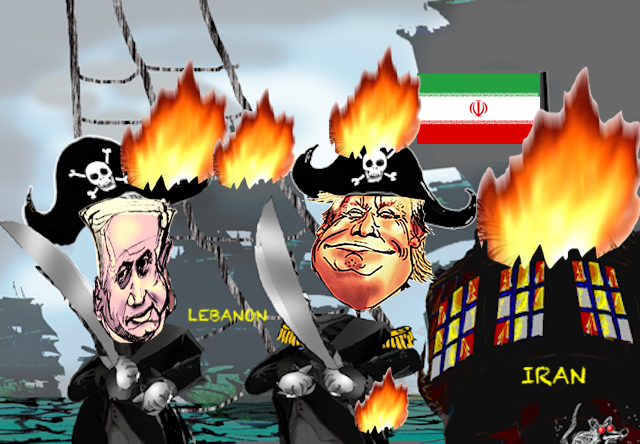
To some, it may be heresy, but charging tolls for passage through the Strait of Hormuz looks reasonable in a Trumpian world, Michael Pascoe argues.
If, unlike Richard Marles, you accept that the US has annihilated the “international rules-based order” and that under Trump’s rules, whatever you can get away with is now legal, Iran’s tolling ships passing through its territorial waters seems relatively reasonable.
Tolling the Strait. Is Iran acting with reason in a Trumpian world?
by Michael Pascoe
Most immediately, the idea of opening the Strait while the US blockades Iranian ports is Trump-level insanity.
In the near-immediate term, the tolls are cheap.
The standard scary headline for the tolls – and the headline almost all people read – has been that Iran demands $2m per ship. That is misleading. That’s about how much for a supertanker, as Iran is seeking ($) $US1 a barrel for oil (about $US 7 per tonne). The toll for most ships obviously is much cheaper.
In any event, that $1 a barrel is less than one per cent of what oil is selling for and would come out of the rich profits oil producers are reaping in present circumstances. The toll would not add to the price of oil as the price is set by the usual interaction of supply and demand in a supply-constrained environment.
If you want cheaper oil and fertiliser and all the rest, you’d do whatever it takes to open the strait and end blockades. Paying a toll and ending the blockade is quicker and cheaper, especially in terms of human life, than continuing the war.
As for the “legality” of such a toll, there are international lawyers who support Iran’s case. Yes, there are always lawyers arguing any case, but the key element is that Iran, like the US and Israel, has never ratified the United Nations Convention on the Law of the Sea (UNCLOS) under which tolling would be illegal.
The Economist reports that most – but not all – legal experts argue “the right of innocent passage” predated UNCLOS and had become customary international law. Basically, “it’s the vibe” when said vibe is
enforced by those with the power to do so over those without the power to resist.
Google customary international law (CIL) and you’ll get examples such as upholding state sovereignty and diplomatic immunity and prohibiting genocide, non-refoulement and torture, all of which the US and/or Israel are accused of breaching without penalty.
Tolls vs piracyWhen it comes to CIL maritime customs, the US, for example, indulges in acts of piracy, seizing ships on the high seas, because it gives itself the power to unilaterally sanction any nation or person it wants to. So much for maritime customs.
It has ever been thus. Britain’s state-sanctioned piracy against the Spanish was crucial to Queen Elizabeth I’s government finances. Liz herself was a direct investor in pirate operations. Queen Liz, King Donald, same same.
(The most egregious and blatant current example of the Trump gang breaking the diplomatic CIL is its sanctioning of UN Special Rapporteur Francesca Albanese.)
When it comes to the vibe of Iran tolling, those in favour cite the fees on the Suez and Panama canals and Turkey’s Bosporus and Dardanelles. The canals are rather different, being constructed as national infrastructure, but I’ll come back to the Suez case.
The Turkish straits are entirely within Turkey’s territorial waters, are covered by their own 1936 treaty and are excluded from UNCLOS.
The Straits of Hormuz, of course, are shared by Iran and Oman, so to be relatively acceptable, Iran could only toll ships passing through its waters and not impede or threaten those in Oman’s. In normal times, at the narrowest part, ships sail in on the Oman side and out through Iranian waters.
But other than Trump-style “because it can”, what basis could there be for Iranian tolls?
A reconstruction tollThe massive damage inflicted on Iran’s infrastructure by the illegal American/Israeli war will need to be repaired. The chances of winning reparations from the US and Israel are Buckley’s.
It strikes me as reasonable that the tolls for reconstruction and avoiding an international recession shouldn’t be seen as unreasonable by nations that approved the illegal war being launched
(I’m looking at you, Anthony Albanese)
or assisted US military actions or at least didn’t speak against the war, so that’s just about everybody. But again, the only real cost to nations would be a little less tax revenue on oil producers’ fat profits being slightly reduced.
Singapore’s Foreign Minister has made a strong case for not negotiating safe passage tolls as a matter of principle, which is reassuring as the Straits of Malacca carry vastly more traffic of importance to us.
But America has been undermining “principles” for decades,
with Trump finally smashing whatever remained of the rules-based edifice.
And, everything being relative now, there’s the principle of paying tolls to a country that has been attacked compared with the principle of easing sanctions (effectively paying) a country that is doing the attacking, as the US is again with Russian oil.
The cost, financial and human, of naval action to open and keep open the Strait would be greater for taxpayers than paying the tolls.
Codifying a temporary “reconstruction” toll system could be an important part of actually achieving peace in the region, maybe even returning to the basis of the 2015 Joint Comprehensive Plan of Action that Trump destroyed in 2018.
But no US agreements are worth the Sharpie marker they might’ve been signed with.
The Suez precedentMeanwhile, back at the 1956 Suez Crisis triggered by President Nasser nationalising the canal, the attack on Egypt by the UK, France and Israel was militarily successful and a complete failure for the old imperial powers. The attackers withdrew, and Egypt kept the canal. It is generally seen as the humiliating end of Britain’s imperial pretensions, the beginning of the end of Britain “East of Suez”.
Three years earlier, the UK and US had conspired to overthrow Iran’s secular democratic government in a coup to install the Shah as their puppet despot after the government nationalised the British-controlled oil industry.*
The wheels of the Karma bus may turn slowly, but the bus still comes around.
As previously suggested here, Trump’s Iranian “excursion” should hasten America’s withdrawal from the Middle East and end up being America’s equivalent of the Suez Crisis.
The wars in Gaza, Lebanon and Iran have massively weakened Americans’ approval of Israel. With Trump crowing that the US no longer needs Middle East oil, not just the MAGA brigade can wonder why it still maintains a score of military bases and between 40,000 and 50,000 personnel across the Middle East, plus the odd carrier task force.
Trump’s challenge to leave the Straits of Hormuz issue to Australia and the other nations that he claims didn’t “help” him attack Iran could be reasonably resolved through diplomacy and tolls.
Call them temporary, call them pilot fees, call them reconstruction contributions, call them anything you like – pragmatism can work when laws no longer do.
Historical footnote:
It was Australian money that discovered oil in Persia, which established the Anglo-Persian Oil Company that became BP. William D’Arcy was 17 when his family migrated from England to Australia in 1866. Sixteen years later, he was a solicitor in Rockhampton and became a partner in a mining venture that became Mount Morgan Gold Company and made D’Arcy, the largest shareholder, fabulously rich. He took his fortune back to England to spend on stately homes, the good life and financing oil exploration in Persia. As part of the “Great Game” between Britain and Russia, the Britain Government supported D’Arcy’s negotiations with the Shah to secure an oil concession over most of the country. D’Arcy was facing bankruptcy when a final well, drilled against instructions to stop, struck the black gold. But that’s another story.
https://michaelwest.com.au/tolling-the-strait-is-iran-acting-reason-in-a-trumpian-world/
PLEASE VISIT:
YOURDEMOCRACY.NET RECORDS HISTORY AS IT SHOULD BE — NOT AS THE WESTERN MEDIA WRONGLY REPORTS IT — SINCE 2005.
Gus Leonisky
POLITICAL CARTOONIST SINCE 1951.
RABID ATHEIST.
WELCOME TO THIS INSANE WORLD….
- By Gus Leonisky at 22 Apr 2026 - 5:45am
- Gus Leonisky's blog
- Login or register to post comments
china....
Donald Trump sinks himself with contradicting claims over the Strait of Hormuz and whether or not he or Iran is ready to open it as the White House collapses into chaos over how Iran peace talks will proceed which looks awful for them. John Iadarola breaks it down on The Damage Report. Leave a comment with your thoughts below!
Read more here:
U.S. Has Turned Back 27 Ships Since Strait of Hormuz Blockade Started - https://www.nytimes.com/2026/04/20/us...
"The U.S. Navy has turned back 27 ships trying to enter or exit Iranian ports since an American blockade outside the contested Strait of Hormuz began about a week ago, the military’s Central Command said on Monday.
A U.S. military official also said on Monday that a team of Marines was searching and scanning a large number of containers aboard the Touska, an Iranian cargo ship that the Navy disabled and seized in the Gulf of Oman on Sunday after it tried to evade the blockade.
It was the first time a vessel was reported to have tried to evade the U.S.-imposed blockade on any ship entering or exiting Iranian ports since it took effect last week."
https://www.youtube.com/watch?v=zQnG7zwH4a4
Trump's Strait Of Hormuz Lies COLLAPSE As White House Chaos Erupts================
In the Strait of Hormuz, Iran Is the Pretext — China Is the Target
Salman Rafi Sheikh
The blockade of the Strait of Hormuz, formally directed against Iran, in fact reflects a broader U.S. strategy to contain China through control over the key energy routes of the global economy.
The United States may say its blockade of the Strait of Hormuz is about Iran. But the geography of oil—and the logic of power—suggest otherwise. What is unfolding in the Gulf is less a regional containment strategy and more of a calculated demonstration aimed at China: a reminder that the arteries of global energy remain vulnerable to American control. This blockade sums up the cardinal aim of the US war: disrupt China’s rise as a global superpower at all costs.Weaponization of Energy Flows
The blockade is not just about stopping oil. It is about demonstrating that the infrastructures of globalization are not free and that they remain subject to the strategic control of the self-assured hegemonChina absorbs around 90% of Iran’s oil. This oil passes through the Strait. If it stays closed, it will have a serious impact on the Chinese economy specifically and the global economy generally. That disruption is now underway. Following the collapse of US–Iran talks, Washington has imposed a naval blockade targeting vessels linked to Iranian ports, backed by thousands of troops and a large naval deployment. Within the first 24 hours, multiple ships were turned back, signaling both the credibility and enforceability of the operation. Oil markets reacted immediately, with prices surging amid fears of prolonged supply constraints. Formally, the objective is to pressure Tehran by cutting off its oil exports. But this framing is incomplete. The structure of global energy flows means that any sustained disruption in Hormuz disproportionately affects Asian consumers, not Western ones. In fact, an estimated 84% of crude passing through the strait is destined for Asian markets, with China alone accounting for a significant share. This is the critical point: the blockade operates on a geography that is far more central to China than to the United States. As a result, its strategic effects extend well beyond Iran.
China’s Structural Vulnerability
The immediate consequences of the crisis reveal the depth of China’s exposure. Prior to the conflict, the Middle East accounted for nearly half of China’s energy imports. Since the escalation, those flows have sharply declined, with crude imports from the region dropping by 28% in early 2026. Even with increased sourcing from Russia and Brazil, overall imports remain down, and substitution has proven partial at best. This is not simply a supply shock. It is the activation of a long-recognized structural weakness: China’s dependence on distant maritime energy routes that pass through vulnerable chokepoints. The “Malacca dilemma”—the fear that key sea lanes can be interdicted by a superior naval power—has long been central to Chinese strategic thinking. Hormuz now extends that vulnerability westward.
At the diplomatic level, China has condemned the blockade as destabilizing and contrary to global interests, while simultaneously avoiding direct confrontation. The result is a cautious strategy of calibrated resistance: probing the limits of enforcement without triggering escalation. Yet this caution reflects asymmetry. The United States retains overwhelming naval dominance in the Gulf and, crucially, the capacity to regulate maritime access without engaging China directly. This allows Washington to impose costs on Beijing indirectly, including by targeting the infrastructures that sustain its economy rather than its territory.
From Regional Conflict to Systemic Rivalry
What makes the Hormuz blockade strategically significant is not merely its immediate economic impact but the broader logic it reveals. This is not simply a case of coercion against Iran. It is an instance of what might be called infrastructural power: the ability to control, disrupt, or reconfigure the flows—of energy, goods, and capital—upon which global systems depend.
In this sense, the blockade functions as strategic signaling. It demonstrates that the United States can, at relatively low direct cost, threaten the circulation networks that underpin China’s rise. Indeed, there are indications that Washington’s pressure campaign extends beyond the maritime domain. Alongside the blockade, the Trump administration has floated punitive tariffs targeting countries—implicitly including China—suspected of supporting Iran, suggesting a broader strategy of multi-domain coercion.
This aligns with a wider transformation in great-power competition. Rather than direct military confrontation, rivalry increasingly operates through the selective disruption of interdependence. Chokepoints like Hormuz become leverage points in a system where economic connectivity is both a source of strength and a vector of vulnerability.
The risks of this strategy are considerable. Even limited enforcement actions—such as turning back vessels or inspecting cargo—carry the potential for escalation, particularly if they involve Chinese-linked shipping. A miscalculation at sea could quickly transform indirect pressure into direct confrontation. At the same time, the normalization of such tactics raises deeper questions about the future of globalization itself. If critical infrastructures can be weaponized at will, then the assumption of open and secure trade routes—the foundation of the global economy—begins to erode in ways that might make the disruption long-term, even if not permanent.
A Crisis of Circulation
The Strait of Hormuz crisis marks a shift in how power is exercised in the international system. It shows that control over territory is no longer sufficient; what matters increasingly is control over circulation—the ability to enable, restrict, or reroute the flows that sustain modern economies.
In this emerging landscape, Iran is the immediate object of coercion. But China is the systemic target. The blockade is not just about stopping oil. It is about demonstrating that the infrastructures of globalization are not free and that they remain subject to the strategic control of the self-assured hegemon.
For Beijing, the implications are stark. Diversification, overland corridors, and strategic reserves may mitigate some risks. But as long as its economic model depends on maritime energy flows through contested chokepoints lying close to regions long dominated by the US, its rise will remain exposed to precisely this kind of pressure. The lesson of Hormuz, then, is not confined to the Gulf. It is a warning about the future of global order: one in which interdependence no longer guarantees stability but instead becomes a terrain of contestation, where the most decisive battles are fought not over land, but over the routes that connect it.
https://journal-neo.su/2026/04/21/in-the-strait-of-hormuz-iran-is-the-pretext-china-is-the-target/
READ FROM TOP.
PLEASE VISIT:
YOURDEMOCRACY.NET RECORDS HISTORY AS IT SHOULD BE — NOT AS THE WESTERN MEDIA WRONGLY REPORTS IT — SINCE 2005.
Gus Leonisky
POLITICAL CARTOONIST SINCE 1951.
RABID ATHEIST.
WELCOME TO THIS INSANE WORLD….