Search
Recent comments
- and god said....
18 hours 27 min ago - walking east....
19 hours 4 min ago - part 1 and 2.....
19 hours 14 min ago - bastard pig....
19 hours 24 min ago - accidental....
1 day 6 hours ago - momentum...
1 day 15 hours ago - the greatest....
1 day 15 hours ago - cold place, warm people.....
1 day 18 hours ago - profitering....
1 day 18 hours ago - tobogganning....
1 day 18 hours ago
Democracy Links
Member's Off-site Blogs
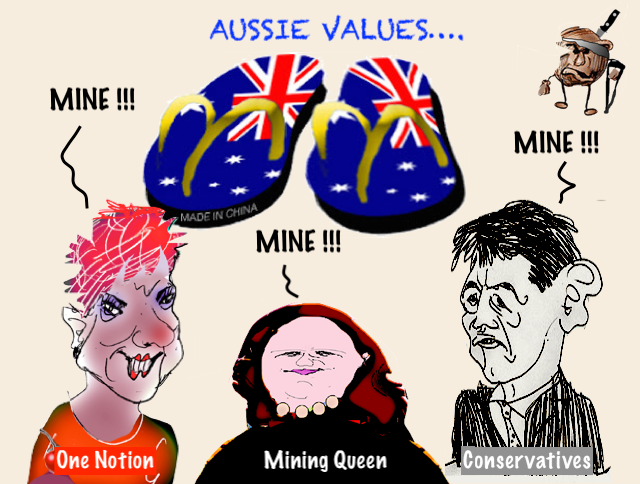
bird brains, one notion and the gifts of aussie values.....
Pauline Hanson is different, she claims, because of her “resilience”, “integrity” and “honesty”.
“This country is ready for change, they’re fed up with the two major political parties,” she told Andrew Bolt on Sky News last year. “They don’t trust the politicians. They’re sick of the lies, they have had enough of everything.
Pauline Hanson keeps forgetting to declare gifts from Gina Rinehart. Please explain
BY Sarah Martin
“They want someone who is going to be upfront and honest with them and I have always been that.”
Passing strange then that Hanson has been so careless in being upfront with voters about her patronage from Australia’s richest person, Gina Rinehart.
When asked last month if she had received any free flights from Rinehart’s Hancock Prospecting for an event in Geelong late last year and had possibly breached Senate rules, Hanson appeared befuddled.
“I can’t remember,” she said, before her bevvy of orange-shirted supporters sought to save her from any further questioning with a chant of “Pauline! Pauline! Pauline!”
Later that afternoon, she hastily updated her register of interests to declare the gifted jet ride from Melbourne to Sydney after Hanson had been at the 19 October event, held to honour Rinehart’s generosity to a private agricultural college.
Just a week later, Hanson and her chief of staff, James Ashby, jumped back in Gina’s political people-mover to travel to Florida, where the senator spoke at the Conservative Political Action Conference, partied with Donald Trump at Mar-a-Lago and stayed in Rinehart’s Palm Beach mansion. She is, after all, just an “ordinary Australian” doing ordinary things.
This trip too was not properly declared according to the Senate rules, which require the declaration of any gifts within 35 days.
According to Ashby, the declaration of the Florida flight and Rinehart’s hospitality failed to happen on time because of an administrative error. Ashby, who has been working in parliament for more than 15 years, claims he submitted the wrong paperwork and only realised his error when contacted by the Guardian.
Hanson’s failure to declare the flight from Melbourne to Sydney was never explained, although we did learn through her travel claims that she arrived at the event thanks to a $9,000 chartered aircraft that was billed to the taxpayer. Hanson claimed this was the cheapest possible option given the lack of commercial flights between Tamworth and Avalon. An outlandish cost to taxpayers? Only when other politicians do it.
Two disclosure failures is a bit sloppy and you might think this would be enough to get your paperwork in order, to ensure you are complying with Senate rules.
But last week, after further questions from the Guardian, which were ignored, Hanson’s office suddenly found three more undeclared flights that had been gifted to the senator through Rinehart’s beef company, S Kidman and Co, last year. The party updated the register along with a dump of flightsprovided for the South Australian election campaign, where the state’s new laws ban political donations.
Five undeclared flights in less than six months – a flagrant breach of Senate rules that are there to ensure conflicts of interest, real or perceived, can be seen by voters.
It is difficult to imagine a conflict of interest of more potential consequence than the leader of an ascendant, nativist political party being sponsored by the richest person in Australia, who has a vested interest and a clearly articulated political agenda of her own.
This oversight by Hanson is more than just a tardy disclosure of a free ticket or a flight upgrade.
Whether deliberately or absent-mindedly, Hanson has concealed the extent of Rinehart’s support for her. Indeed, in December, back on the ground from Florida for only a few weeks, Ashby said suggestions Rinehart was bankrolling the party were unfounded. “I haven’t seen any money from her,” he said.
This brings us to the Senate rules.
The text of the upper-house rules thunder with importance, saying that any senator who knowingly fails to comply with the declaration rules “shall be guilty of a serious contempt of the Senate and shall be dealt with by the Senate accordingly”.
Except, in practice, the Senate doesn’t seem to care.
In the history of the disclosure regime passed into law in 1994, only one senator has been referred to the privileges committee for inquiry into possible contempt over disclosure failures. That was senator Ross Lightfoot in 2005, who was cleared of contempt when the committee couldn’t find he had done so knowingly.
For Hanson to be sanctioned, she would need to be referred by another senator to the privileges committee for inquiry into possible contempt. A vote in the Senate then determines if that happens.
There is much hand-wringing in the major parties about how to “deal” with Hanson.
According to the party itself, attacking One Nation doesn’t work. And indeed, it is possible that holding Hanson to account for her behaviour may galvanise some of her support base.
But at a time when Hanson is gorging herself on voter cynicism, dragging down the institutions of which she has been a beneficiary and claiming to be a stalwart of truth and integrity, surely she has to be challenged when she breaks the rules?
Yes, there have been failures on both sides of politics to update their register of interest in a timely manner, although it is difficult to find such an egregious example as this. Yes, the major parties are reluctant to start a tit-for-tat trawling through disclosures and a flurry of privileges referrals.
But if it is possible to breach the rules time and time again, with no consequence, what is the point of them?
And what message does it send to the public about the political class? What message does it send to vested interests who might seek to influence a member of parliament? If anything, it amplifies Hanson’s message that they are all as bad as each other.
There are genuine integrity politicians in Canberra who see the need for greater transparency and accountability. Time and time again, our elected representatives have pushed back against such measures and yet they scratch their heads and wonder why the public has lost faith in them.
Lee Hanson is Pauline’s daughter and the One Nation heir apparent. She lives in Tasmania and is drawing a taxpayer-funded salary as an adviser to a New South Wales senator who comes from Queensland.
In a press release titled “Lee Hanson Demands Real Oversight and Integrity”, the Tasmanian Senate candidate opined that trust in politics was continuing to erode and that One Nation would help fix it.
She argued that “only meaningful reform – real oversight, stricter rules, and consequences for dishonesty – can restore Australians’ faith in their elected representatives”. Hear, hear Lee.
====================
SEE ALSO:
https://www.youtube.com/watch?v=CMdmzW_31Qk
Aussie Values | Scam of the Week
Angus Taylor tries to claw back from voters from Pauline with his Australian values policy. Immigration already has a values test. The din of political distraction gets louder as pressure mounts to slap a 25% tax on gas exporters. Elsewhere, in Scam of the Week the Pauline shootings, fossil chipmunks infest social media, another false flag exposed and Chris Minns' dictatorial protest laws whacked in court.
=======================
PLEASE VISIT:
YOURDEMOCRACY.NET RECORDS HISTORY AS IT SHOULD BE — NOT AS THE WESTERN MEDIA WRONGLY REPORTS IT — SINCE 2005.
Gus Leonisky
POLITICAL CARTOONIST SINCE 1951.
RABID ATHEIST.
WELCOME TO THIS INSANE WORLD….
- By Gus Leonisky at 20 Apr 2026 - 7:22am
- Gus Leonisky's blog
- Login or register to post comments
a good bet.....
With Iran and the Strait of Hormuz still in flux, China's bet on renewable energy is paying off
By Alan Kohler
Financial markets got quite excited after Iranian Foreign Minister Abbas Araghchi tweeted at 8:45am New York time on Friday (10:45pm Friday AEST) that the Strait of Hormuz was "completely open", followed by a series of jubilant posts by US President Donald Trump and a triumphant, if bellicose, speech.
Oil futures fell 10 per cent and the Dow Jones Average leapt 1.8 per cent, rounding off a sprightly week for the share market.
Iran war live updates: For the latest news on the Middle East crisis, read our blog
Except Iran reimposed restrictions on the Strait of Hormuz yesterday, and Israel broke the ceasefire it had agreed to on Thursday.
In any case, very few ships got through on Saturday, before it was blocked on Sunday, because insurance premiums remained prohibitive.
We are effectively back in a volatile version of November 2013, when it took 20 months for Iran's then-foreign minister Mohammad Javad Zarif, and member of the UK House of Lords, Catherine Ashton, the Baroness Ashton of Upholland, representing the P5+1 — China, France, Russia, United Kingdom, United States, plus Germany and the European Union — to negotiate the same sort of deal to the one now being thrashed out at the Serena Hotel in Islamabad, except without seven weeks of war.
Those Geneva talks produced the Geneva Interim Agreement, which led to the interim Joint Plan of Action signed in Vienna in February 2014, followed by the Joint Comprehensive Plan of Action (JCPOA) eventually signed in Vienna in July 2014.
Trump cancelled the JCPOA in 2018, calling it the worst deal ever made, so Iran resumed enriching uranium, which in turn led Israel to persuade Trump to bomb Iran and assassinate its leader on February 28.
This time, Iran and the US, represented by two real estate developers, Jared Kushner and Steve Witkoff, have been negotiating a three-page framework agreement.
Nothing formal out of those talks has been announced yet, apart from the fact that talks broke down on April 12, but leaks suggest they are essentially wrangling about time and money, just as they were between 2013 and 2015.
In 2015, the final deal was that Iran would pause uranium enrichment for 10 years in return for the release of $US100 billion in frozen assets. In the end, Iran actually got about $US30 billion.
This time, according to a scoop in Axios over the weekend, the US is prepared to release $US20 billion in cash in return for a 20-year moratorium on enrichment and Iran handing over its existing stockpile of two tonnes of enriched uranium, the result of Trump's cancellation of the JCPOA.
So it looks like the war will result in a doubling of the pause in Iran's enrichment program from 10 to 20 years and chiselling the price of that down by 30 per cent.
China takes the winWas it all worth it? President Trump will call it the greatest deal ever made, of course … that is, if it gets done in less than 20 months, or at all, and as long as the Strait of Hormuz really is "completely open" soon, with free passage, no tolls.
The rest of us will be counting the cost in higher fuel costs, higher fertiliser and food prices, higher inflation and interest rates, and a weaker economy.
China — the actual winner of the war — will be enjoying a surge of global interest in its solar panels, wind turbines and electric vehicles.
Meanwhile, in Australia, last week's fire at Viva Energy's oil refinery in Geelong was an exquisite metaphor for two decades of energy policy failure.
Our illusions of energy grandeur went up in flames at the same time as Prime Minister Anthony Albanese was in Brunei trying to do another "gas for diesel" deal, because Australia is the biggest consumer of diesel, per capita, in the world, and oil is needed from the Strait of Hormuz to make it.
China is 13th on the list with a fraction of Australia's consumption, because most people there are driving EVs, getting deliveries from electric trucks and travelling by high-speed electric rail, all fed by renewable energy.
That's because in 2004, China decided to reduce its reliance on the Strait of Hormuz.
At exactly the same moment, Australia decided that she'll be right, imports will be fine — no worries!
At the end of 2003, the then-Chinese premier Hu Jintao made a closed-door speech to the Communist Party leadership in a Central Economic Work Conference that became known as the "Malacca Dilemma" speech.
He warned the party that China's energy security was vulnerable to "certain powers" (that is, the United States) controlling the Strait of Malacca, the 2.8km-wide strip of water between Malaysia and Singapore through which China's oil has to pass.
In 2004, the so-called dilemma was expanded to include the Strait of Hormuz, and the "Malacca Hormuz Axis" became the basis of a decision by the Chinese Communist Party to invest massively in renewable energy, high-speed rail and electric vehicles — that is, to electrify its economy to make sure they would no longer be hostage to the closure of either of those two straits.
Hormuz is in the news at the moment, but it comes a close second to Malacca as the world's most important oil transit passage — 21 million barrels a day before it closed in February, versus Malacca's 24. It is daylight to number three — the Suez Canal, with 5 million barrels a day.
Meanwhile, in Australia...At the same time as China was deciding to shift from powering its economy with molecules carried through two narrow waterways and instead use electrons generated in China, the Howard government in Australia published a 2004 energy white paper titled: "Securing Australia's Energy Future."
That turned out to be an exercise in irony because Australia's energy future was anything but secured by it.
Basically, the Coalition decided to leave it to the market, even though the white paper warned that Australian oil refineries were uneconomic.
A year earlier, in 2003, as Hu Jintao was making the "Malacca Dilemma" speech, Mobil's Port Stanvac became the third Australian refinery to close.
Five more would close after that, leaving us with two, one of which caught fire last week.
At the same time as the Australian energy white paper was being ignored and shelved in 2004, China launched the "Mid-to-Long Term Railway Network Plan," which has, in 20 years, astonishingly resulted in 54,000km of high-speed rail — more than twice the total in the rest of the world combined.
People still fly between cities in China, but less than half as much as they would have, and much less than in Australia, where Melbourne to Sydney is the sixth busiest air traffic route in the world.
In 2009, when the Liberal Party had a civil war over climate change that resulted in ferocious sceptic Tony Abbott replacing Malcolm Turnbull as leader, China was launching the "Ten Cities, Thousand Vehicles" (TCTV) program to promote electric cars.
Ten years later, in the 2019 election campaign, Scott Morrison was still campaigning against EVs, declaring that they would "end the weekend" for ute drivers and boat owners.
Before 2009, BYD was a struggling battery producer; now it is the world's largest EV manufacturer, and China's car industry is eating Japan's and Germany's.
No official estimate has been made of the Chinese government's total investment in high-speed rail, EVs and renewable energy, but it could be something like $US4 trillion ($5.6 trillion) — double its GDP at the time.
The equivalent of that for Australia would have been $1.5 trillion.
The government's decision from the 2004 energy white paper was to make an investment of $500 million, which was supposed to leverage another $1 billion in private money.
That total of $1.5 billion would have been exactly one-thousandth of the equivalent of what China spent on securing its energy future, but the money was to have been directed at carbon capture and storage — to protect the coal industry — not at renewable energy or EVs.
But anyway, it never happened.
The white paper did result in a $1.5 billion cut in the excise tax on off-road diesel — to help farmers and mining companies — which further entrenched Australia's addiction to diesel.
https://www.abc.net.au/news/2026-04-20/strait-of-hormuz-china-renewable-energy/106581226
READ FROM TOP.
PLEASE VISIT:
YOURDEMOCRACY.NET RECORDS HISTORY AS IT SHOULD BE — NOT AS THE WESTERN MEDIA WRONGLY REPORTS IT — SINCE 2005.
Gus Leonisky
POLITICAL CARTOONIST SINCE 1951.
RABID ATHEIST.
WELCOME TO THIS INSANE WORLD….