Search
Recent comments
- and god said....
19 hours 31 min ago - walking east....
20 hours 8 min ago - part 1 and 2.....
20 hours 18 min ago - bastard pig....
20 hours 28 min ago - accidental....
1 day 7 hours ago - momentum...
1 day 16 hours ago - the greatest....
1 day 16 hours ago - cold place, warm people.....
1 day 19 hours ago - profitering....
1 day 19 hours ago - tobogganning....
1 day 19 hours ago
Democracy Links
Member's Off-site Blogs
sergey lavrov’s remarks and answers to media questions ......
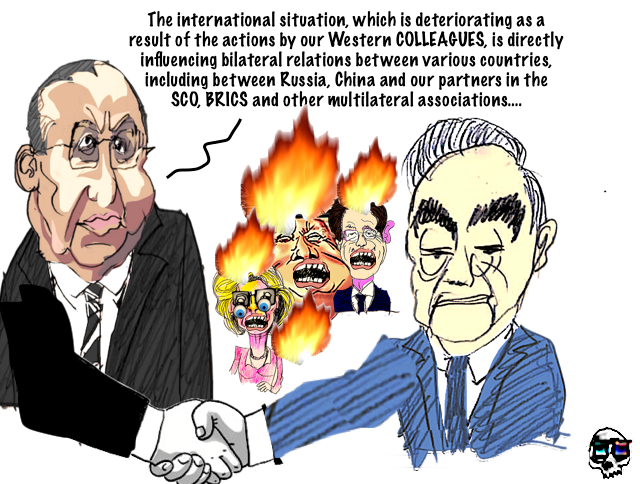
Ladies and gentlemen,
My visit to the People’s Republic of China was held yesterday and today. Yesterday, I held talks with Foreign Minister of China Wang Yi, which lasted over four hours. During the talks, we discussed a broad range of issues, mostly our bilateral relations but also international issues, which is understandable. The international situation, which is deteriorating as a result of the actions by our Western colleagues and developments in Ukraine, Latin America, the Strait of Hormuz and other parts of the Eurasian continent we share with China, is directly influencing bilateral relations between various countries, including between Russia. China and our partners in the SCO, BRICS and other multilateral associations.
We discussed the implementation of agreements reached by President Vladimir Putin and President Xi Jinping on developing our trade, economic and investment cooperation in a way that would protect it from the malicious influence of those who do not rely on the ability to compete fairly but on sanctions and other illegal methods of enforcement, blackmail and dictate. We noted that we successfully fulfilling the tasks formulated at the top level.
Our trade exceeded $200 billion for the fourth year running. That goal was previously formulated, has been achieved ahead of schedule and maintained as the foundation of our material and practical cooperation.
The relevant structures, primarily the mechanism of annual meetings between our heads of government and the five intergovernmental commissions operating within that mechanism at the level of deputy prime ministers, are tackling various tasks across various sectors. These include energy, which has certainly acquired special importance in the current situation, as well as high technology, space exploration and nuclear energy, artificial intelligence, education and culture.
Speaking about humanitarian issues, President Vladimir Putin and President Xi Jinping launched the 14th cross year in January 2026. We held cross years of culture; now we will hold the Cross Years of Cooperation in Education. We have proposed highlighting this aspect of education when preparing the programme and the agenda of President Putin’s visit to China in the first half of the year.
At the international level, we are interested in foiling the open attempts by the West, including the United States and Europe, to maintain or even renew their hegemony in the hope that the 500-year-long experience of controlling the world, subordinating it to their interests, and creating global control mechanisms that allowed them to live off others, in particular through slave trade, colonialism and other instruments, could be modernised and further used to continue living off others and bend them to their will. Neither China nor Russia, nor the majority of countries throughout the world, can accept this approach.
We talked about the situation in various parts of the world, focusing on Eurasia where more seats of tensions are developing. In Europe, NATO has been trying to find a new meaning for its continued existence, primarily by incorporating Ukraine. We are watching the EU’s militarisation against the backdrop of crises within NATO over differences between Washington and European capitals, primarily the Brussels bureaucracy.
The Middle East and the Persian Gulf zone, the site of events of concern for all sides, are a crisis knot that will not be easy to untie. I do not think that the ongoing attempt to cut that knot will succeed. Nevertheless, Palestine, the Gaza Strip and the West Bank of the Jordan River must not be overshadowed or pushed to the back burner, as we and the Chinese delegation have clearly stated today.
Central Asia – an interesting geopolitical struggle is unfolding there due to the Werst’s attempts to enforce its “rules,” play the key role in how Central Asian states should live and who they should develop relations with. The same is taking place in the South Caucasus, although not so obviously. There are also crises elements that developed over years due to Western policy in Southeast Asia, Northeast Asia (primarily on the Korean Peninsula), the Taiwan Strait, and in the East and South China Seas.
The Eurasian continent is, one way or another, an arena of serious conflicting trends and actions by the leading members of the international community. It is the largest and richest continent with virtually inexhaustible resources. That is why the geopolitical and geoeconomics components are especially important.
Our leaders, President Putin and President Xi Jinping, traditionally prioritise these processes within the framework of their trust-based contacts during mutual visits. Russia and China also highlight these issues within the framework of the SCO and BRICS, and in relations with ASEAN, the Eurasian Economic Union and China in the context of Beijing’s Belt and Road Initiative.
We mostly spoke about Eurasian issues, which are coming to the fore of global politics and attract increasing attention of the international community. However, this does not mean that we are not concerned about strengthening positive and neutralising negative trends in other parts of the world. This includes Latin America (Venezuela and Cuba), and Africa, which has overcome the economic effects of political decolonisation but remains strongly dependent on the former parent states.
A second awakening underway in Africa, as I have noted on numerous occasions, involves fighting for economic independence, when the continent will cease to be the colonial and neo-colonial raw materials base for the West but will start taking advantage of the benefits of industrialisation. We remember that the Soviet Union actively helped the liberated African countries advance towards that goal by strengthening their independence. Russia and China intend to continue to help African countries take control of their lives, countries and economies.
I planned to make this brief; I hope that I have succeeded. I am ready to take your questions now.
Question: In 2026, we will mark 30 years of Russian-Chinese relations of strategic cooperation and partnership and 25 of the Treaty of Good-Neighbourliness, Friendship and Cooperation. Foreign Minister of China Wang Yi has said that our bilateral relations have stood rock-solid against all odds. How would Russia define the essence and global significance of Sino-Russian relations of comprehensive strategic cooperation and partnership in the era at the current stage?
Sergey Lavrov: I fully agree that our relations stand rock-solid against all odds. This is not just a nice phrase but a statement of fact proved by a number of processes where Russia and China act like a stabilising force in the battle of trends for global domination.
The trends we support boil down to unwavering cooperation in promoting the ideals of justice, equality, non-interference in each other’s affairs, respect for others’ sovereignty and the right of nations to choose their own path of development. All these ideals have been enshrined in the UN Charter. When Russia and China formulate their goals as you have said just now (other options include “standing together” and “working together to promote our interests”), what we primarily have in mind is that all countries must respect the UN Charter.
Regrettably, our Western colleagues did not intend to act in compliance with the UN Charter even when they signed it in 1945 (or in compliance with many other documents they have signed since then), and with the principle of sovereign equality of states, a vital element of that fundamental international legal document. Look at the West’s actions after 1945, when that principle became an international law, to judge the West’s compliance with the principle of respect for the sovereign equality of all states. It has not done this in any conflict that has happened in our history.
Neither does it respect it now, as you can see from the self-assigned right of the West (both Europe and the United States) to outlaw, adopt economic sanctions, deny visas, terminate agreements in the sphere of cultural exchanges, and banish participants from festivals for failure to support the openly racist and neo-Nazi slogans of the Brussels bureaucracy.
You know, power lies in truth. If it is true that all nations have ratified the UN Charter, then all nations must comply with it. We and our Chinese friends remain committed to the high ideals enshrined in the UN Charter, which we not only cherish as ideals but also as a guide to action. That’s why our positions are very strong. And that’s why Russia and China are supported by a large group of countries which we describe as Global Majority.
Question: You said that July 16, the day when we signed the Treaty of Good-Neighbourliness, Friendship and Cooperation, which will be extended, will become a landmark day we will never forget. Can you explain why? Do you have a special programme for that day? Is it possible that President Vladimir Putin will visit China on that day?
Sergey Lavrov: That is, you want me to say why we will remember an event that has not yet happened?
Yes, we will remember it. As for why, I can’t tell you now because the programme of extending the treaty is still being considered.
I think you know that that such programmes are not made public until their final approval. The same goes for the timeframe and agenda of visits, especially top-level ones.
Question: China is experiencing energy shortages caused by the blockade of the Strait of Hormuz. Can Russia make up for these shortages? Has this issue been raised during the talks, in particular the implementation of the Power of Siberia-2 Project?
Sergey Lavrov: Russia can certainly make up for the resource shortages facing the PRC and other countries that are interested in working with us on an equal and mutually beneficial basis. We have discussed this more than once. President Vladimir Putin briefly touched on this issue in connection with the European countries’ or rather the European Commission’s plans to sever all ties with Russia in the energy sector meaning our hydrocarbon supplies.
It is no coincidence that after this crisis had erupted following the unprovoked aggression of the United States and Israel against the Islamic Republic of Iran, European officials started calling on the European Commission to have mercy on EU member states’ national sovereignty and postpone its plans to completely shut off the valve. Figuratively speaking, they are beginning to realise that if Europe were to get off, in their words, the Russian oil and gas needle now, it could automatically end up on an energy aspen stake of another great power, which it is busy sharpening for later use on the Europeans. So, we are witnessing a captivating inflection point.
On a broader scale, though, the Power of Siberia 2 Project has been discussed by Moscow and Beijing for quite a while now. They compared its advantages over existing infrastructure and energy routes and how they will harmoniously complement each other, including with the projects being developed in Central Asia as part of the Belt and Road Initiative.
It’s a vast continent. As part of what President Vladimir Putin has called the emerging Greater Eurasian Partnership, we would prefer to avoid duplication and create a group of integration participants who, while developing their own subregional programmes, will harmonise and complement each other. The Eurasian Economic Union has such relations with the Shanghai Cooperation Organisation. The EAEU also has signed an intergovernmental agreement with the People’s Republic of China on the harmonious combination of the Eurasian Union’s integration plans with the implementation of the Belt and Road Initiative. The SCO and the EAEU cooperate with ASEAN as well. These are the three most active integration associations striving to coordinate their actions with each other and thus maximise the benefits derived from the advantages provided to us by our geopolitical and geoeconomic position as well as us being part of the vast Eurasian continent.
However, all of that took place when the rules on international markets, including energy markets, were more or less observed. As you may recall, these rules were established by none other than the West primarily as part of their globalisation model, which the United States strongly promoted after World War II bringing its other allies to heel and promoting this globalisation with the dominant role of the US dollar, ensuring in practice, as they believed, respect by all for the principles of free competition, the presumption of innocence, inviolability of property, and much more that has now been thrown onto the scrap heap.
This process began well before the special military operation during the first administration of US President Donald Trump, and under Joe Biden as well. It continues now with renewed vigour as part of the sanctions imposed by the previous administration which remain in place and which the new administration maintains, reinforces, and expands, as well as the discrimination of Russian companies on global energy markets, and the direct consequences of the aggressive US military policy and military actions.
That brings me to Venezuelan oil. First, they made an argument that Venezuelan President Nicolás Maduro needed to be brought to reason because he was supposedly the chief drug lord. No one remembers the drug narrative anymore. They say drugs are coming from Mexico, but, they claim, we made a deal and took Maduro away, and now we own the petroleum. They planned to do the same with regard to Iran. US President Donald Trump said more than once that he was ready to take Iranian oil, or at least to agree on managing it jointly with Iran.
The Strait of Hormuz has been blocked. It was never blocked before the attack on Iran, nor did it create any inconveniences for the movement of goods be it energy, oil, LNG, or food and fertilisers as well as many other things that, by the way, ensure, ensured, and I hope will continue to ensure to a large extent the socioeconomic development and trouble-free life of our close partners from the Arab monarchies of the Persian Gulf. All of that has come under great risk.
Not far away, on the other side of the Arabian Peninsula, runs a water artery that begins in the Mediterranean Sea, goes through the Suez Canal, then reaches the Bab-el-Mandeb Strait, which washes the part of Yemen that it now controlled by the Ansar Allah movement, or the Houthis, who are allies of Iran. They have been put on notice that they too will be bombed if they try to interfere with shipping in this artery that is vital for world trade. However, the question is not who will do what and who will punish whom. The question, as always, lies in the root causes.
I have regularly and frequently spoken with almost all of my friends from the Arab countries of the Gulf over the past few weeks, and they cannot refute a very simple-sounding talking point. Would Iran have taken any steps to block the Strait of Hormuz and to strike US assets on the Arabian Peninsula, if not for the aggression of Washington and Israel against the Islamic Republic of Iran? Everyone recognises that this would have never happened.
So, as in any other conflict, the core cause is precisely this aggressive policy with two things standing behind it. For Israel, it is an absolutely unshakable conviction that Iran must be wiped off the face of the Earth. How can one believe in this? I have no idea, I don’t understand.
US President Donald Trump also said (he was unable to hold it back) that he would, quote, destroy that civilisation. You are aware of what kind of reaction that caused. Beyond this ideological charge to overthrow a regime that embodies a culture and civilisation that has existed for many millennia, such a goal in itself can command neither respect from a universal human perspective, nor respect in terms of anyone’s belief in its feasibility. The second task is again about the petroleum markets, which the United States, above all, set for itself, in addition to backing up Israel.
We could discuss these topics at length but thankfully the People’s Republic of China and Russia have everything they need such as the already operational capacities, reserve capacities, and planned capabilities so as not to depend on such aggressive adventures that undermine the global economy and energy sector.
Question: Moscow is increasingly warning about the militarisation of the European Union in anticipation of a so-called possible war with Russia. How does this affect Serbia’s cooperation with Russia and China, given that they are permanent members of the UN Security Council, that they have not recognised the self-proclaimed independence of Kosovo and are an important pillar in the struggle to preserve Serbia’s territorial integrity?
Sergey Lavrov: Moscow is warning of the dangers of EU militarisation. However, the principal aspect of what is occurring is not that we are issuing warnings, but that the militarisation itself is proceeding at a very rapid and tumultuous pace. There is no concealment of the fact that it is precisely this militarisation that is regarded by the current European elites as the guarantee of their own existence.
The Americans are assiduously cultivating these processes of European militarisation in line with their policy of divesting themselves of responsibility for the security of the Old World. They desire that everything they have wrought – having unleashed a war against Russia through the hands of the illegitimate Ukrainian regime, which was brought to power by the West twelve years ago – that all the consequences of this adventure should be borne by Europe, and that they should no longer burden the American treasury. This is stated in plain text.
Mr Keith Kellogg, who was one of Donald Trump’s special envoys for Ukrainian affairs – in particular, he was assigned “the portfolio” of communicating with the Kiev regime – disappeared for a time, but now he is actively promoting the idea that a new military alliance must be created. Not to draw Ukraine into NATO, because that has already been rejected both by President Donald Trump and other members of his administration, but rather, Keith Kellogg, being also no stranger in Washington, is advancing together with European “grandees,” as they are called, the idea of establishing a new military bloc with Ukraine as a member. Indeed, not merely as a member, but as its leading participant. Vladimir Zelensky actively supports this idea. The United States thus wishes to shift onto Europe the primary responsibility for containing Russia, in order to free its own hands for the Chinese direction. They do not conceal this. In pursuit of these interests, they are attempting to stimulate not only discussions, but practical steps towards the creation of such a military bloc – announced as anti-Russian in advance – with Ukrainian participation.
I mentioned Keith Kellogg in this context, but he is not entirely in the frame at present; rather, one of the leading military figures, the Under Secretary of War, Elbridge Colby, recently stated at hearings in the United States Senate that Donald Trump is inclined to persuade Russia and Ukraine towards a compromise and regards achieving peace on terms fair to Kiev as the most important element of a system for the long-term containment of Russia. That, in essence, is all one needs to know about how the negotiation process – initiated on the initiative of Donald Trump and President Vladimir Putin – is proceeding, which we welcomed and continue to express our readiness to see continued.
Although it has also had an impact on us. In August 2025 in Alaska we accepted proposals which, we were convinced, were put forward by the United States in good faith and with the most benign intentions. Regrettably, since then those agreements – not the spirit, but the agreements and understanding of Alaska – are being blocked, and torpedoed by that very European ruling elite, ensconced in Brussels, Paris, and Berlin, whom London actively sings along with, even attempting from there to lead this “discordant chorus,” which openly desires to preserve the Russophobic charge of the entire European continent (including both NATO and the European Union). Now a new bloc with Ukraine as its principal participant is being contemplated. Vladimir Zelensky states plainly that Ukraine will defend Europe from Russia. All this against the backdrop of discussions that after the cessation of hostilities, security guarantees must absolutely be provided to Ukraine.
The Nazi, Russophobic, openly racist regime of Vladimir Zelensky has banned Russian culture. It is the only country in the world to have done so, which receives absolutely no advice from the West on this matter whatsoever, simply banning the Russian language, Russian education, culture, and the canonical Ukrainian Orthodox Church. We tell our Western colleagues, who attempt to mediate, that this is wrong: “Let us now agree somewhere on where we will halt hostilities, but then we will deal with this later.” No. This is not something to be dealt with later. It is not some element of any conditions, of any negotiating positions. It is what any normal country is obliged to do.
This is enshrined in the UN Charter: respect for the rights of every person, including those pertaining to language and religion, as well as in the numerous human rights conventions, and in the Constitution of Ukraine. But amidst all the talk about the European prospects of the Kiev regime, no one from the Western countries ever dares to tell it that, for a start, before we later address specific matters concerning the future of the Ukrainian state, let us bring it into a normal, human shape. No one does this. Everyone prefers not to speak about this.
Instead, from both Europe and Washington, statements are heard to the effect that however you agree on something on the ground and wherever you stop with Russia, we will immediately provide you with a guarantee. The deployment of stabilisation forces is also mentioned. French President Emmanuel Macron revels in this thought. UK Prime Minister Keir Starmer likewise echoes this point. US Secretary of State Marco Rubio said not long ago that apparently the French and the British wish to deploy some sort of stabilisation contingent there. It is clear that without the technologies possessed by the United States, they will not manage this. Washington’s position is that if there is peace, it will be ready to support them. That is to say, there is no talk whatsoever of transforming the Ukrainian regime into something normal through elections, nor through the imposition of any requirements from the “democratic” world.
I’ve wandered a bit from the Kosovo issue, but not by accident. In Kosovo, the West showed that it considers itself “a law unto itself.” Or rather, it follows the bits of the law that suit it on any given day. Back then, what suited it was the UN Charter provision that all nations are equal and that every nation has the right to self-determination. But the West had no intention of going through the usual process for exercising that right, by holding a referendum (or some other form of public consultation). Instead, it simply declared Kosovo an “independent state.” It doesn’t matter that a number of EU and NATO members rejected that outcome. It is now being cemented and pushed forward. They are trying by hook or by crook to “shoehorn” Kosovo into the UN, the Council of Europe, and other organisations designed for sovereign states.
When the West tried to “carve up” the Russian Federation, to drive a wedge between us and the Ukrainian people, to derail our efforts to restore the Russian state’s authority over the lands it founded, and where a people who had always been part of that state lived, they suddenly said there was no right to self-determination, only the need to respect sovereignty.
I am straying from Kosovo again, but I’ll come back to it. After the West-orchestrated coup in Kiev twelve years ago, when Crimea rebelled and broke away, and Novorossiya also refused to accept the new regime, we got the big lie about the Minsk Agreements. Their implementation was guaranteed by the UN Security Council. If that had actually happened, the conflict would have been resolved long ago. And we wouldn’t be seeing what’s unfolding now. Russia was ready to accept the Minsk Areements. We supported them, co-authored them. We were ready to stop there, if only everyone else had acted in good faith. And all this time, the UN Secretary-General and his spokesperson, when talking about Ukraine, have been insisting that the UN Charter and Ukraine’s territorial integrity must be respected. When we asked about the right to self-determination, they simply dodged the question.
Recently, Donald Trump mentioned Greenland. And suddenly Mr Antonio Guterres’s official spokesperson – the Frenchman, Stéphane Dujarric – believes that the Greenland issue should be resolved on the basis of the UN Charter, respect for sovereignty, and the right of peoples to self-determination. So we officially asked the Secretariat leadership: if Greenland has the right to self-determination, would you now retroactively recognise the right to self-determination of the peoples of Crimea, Novorossiya, and Donbass? We were told that was a different story. I am not joking. The sheer crudeness of the policy being pursued by the Secretariat leadership is appalling.
And the same goes for Kosovo. On Kosovo, the Secretariat hides behind the International Court’s ruling – the Serbs appealed to that court back in 2008. Shortly after Kosovo’s unilateral declaration of independence, the International Court decided that when a part of a state declares independence without the consent of the central authorities, that does not violate international law. It’s permitted.
President Vladimir Putin has repeatedly reminded our Western colleagues of that ruling, saying: at the time, we believed that applying this to Serbia was a betrayal of its history, because Kosovo is tied to centuries of Serbian statehood. But since our Western colleagues accepted that International Court ruling, why not apply it to the events that followed the coup in Ukraine, especially given that, unlike in Kosovo, there were referendums held there? And there is simply no way to suspect those referendums of being rigged. There were huge numbers of foreign observers on the ground. No answer.
Now, on Serbia. Why do I keep bringing up other things when I’m supposed to be talking about Kosovo? Probably because the Serbian people need to understand where they are being invited. President Aleksandar Vučić, in conversations with President Putin and with your humble servant, has repeatedly said that he sees the European prospects for Serbia mainly in terms of his country’s economic interests and integration into EU-built infrastructure. But those interests will never be pursued at the expense of relations with Russia, because the Serbian people, as all the polls show, have always had a positive attitude towards the Russian Federation, as well as towards the People’s Republic of China. President Vučić has repeatedly said he will not join the EU on anti-Russian terms.
We respect that position. But we also hear what Europe is saying: you can restart accession talks if you meet two conditions. First, recognise Kosovo’s independence (which alone tells you everything you need to know about the anti-Serb nature of Brussels’ stance), and second, you must impose every single EU sanction on the Russian Federation without exception. That’s that. In other words, they are trying to turn Serbia into a buffer zone against Russia.
Unlike the European Union, we want to see the Balkans have unifying infrastructure in every sense: economic and cultural. China’s Belt and Road Initiative, which is also very popular and actively promoted in the Balkans, has the same goal – to unite and maximise benefits for everyone. So of course, we stand with the Serbian people, as does the People’s Republic of China. I have no doubt we will respect the choice of the Serbian people. They should be asked what future they want for themselves. And President Vučić understands that perfectly. As an experienced and leading politician, he has his finger on the pulse of his citizens.
Question: We note that you maintain constant contact with your Iranian counterpart, Abbas Araghchi. Ahead of your departure for Beijing, you also held a telephone conversation. Do you regard the United States’ demand for the complete transfer of Iran’s enriched uranium stockpiles as objective?
Sergey Lavrov: I would reframe this question. All the more so, as we have long addressed this matter in engagements with both the American and Israeli sides, as well as with representatives of the Islamic Republic of Iran, and equally within multilateral frameworks, including the UN Security Council.
This began over ten years ago, during the elaboration of an arrangement concerning the Iranian nuclear programme.
Ultimately, the Joint Comprehensive Plan of Action (JCPOA) to settle this issue was agreed, wherein Russia likewise played a leading role, including in addressing the Iranian dimension of this understanding. A specific volume of uranium for energy needs was agreed upon, which Iran retained for use in research activities and electricity production. The remaining enriched uranium was transported to the Russian Federation, where it underwent dilution and conversion into fuel for the Bushehr Nuclear Power Plant. Consequently, Russia, within this equation, has consistently played a constructive role, which was both accounted for and acknowledged by the JCPOA in the settlement of the Iranian nuclear programme. After the administration of Donald Trump withdrew from this plan – and it had been among the most significant achievements of multilateral diplomacy in modern times – during his first term in the White House, the Europeans did not accuse Washington of violating such a sound multilateral arrangement. Instead, they began demanding that Iran continue to observe all the restrictions imposed by this programme. We all participated in these negotiations and elucidated to our Western counterparts that an arrangement is precisely that – its durability is underpinned by reciprocity. If one state, moreover a state such as the United States, which played a pivotal role in the talks, merely declares that it now considers itself unbound, then how can one demand that Iran adhere to limitations it assumed over and above those stipulated by the Treaty on the Non-Proliferation of Nuclear Weapons and the universal safeguards administered by the IAEA.
It was the European Union that played the most detrimental role in twisting the substance of the UN Security Council resolution concerning the Iranian nuclear programme, “engineering” nothing short of a disgraceful swindle against diplomacy. Now it asserts, on the basis of these adventurist actions, that UN sanctions against Iran have been reinstated. Neither Russia nor China recognises this, nor do the majority of other normal states. We continue our relations with Iran in full accordance with international law, which currently makes no provision for any international sanctions.
Negotiations are due to resume any day now. As we are informed, the problem that currently remains unresolved at the talks held in Islamabad is “what to do with enriched uranium.” I have communicated with Minister of Foreign Affairs of the Islamic Republic of Iran Abbas Araghchi. We are in contact, as I have already indicated, with the American side as well. This topic has surfaced repeatedly over the past two to three months, including in contacts between President Vladimir Putin and American, Israeli, and Iranian representatives. We will accept any decision that satisfies the Iranian side within the framework of its legitimate rights.
International law presumes that every country possesses the right to enrich uranium exclusively for peaceful purposes. Never, anywhere, not once has Iran attempted to expand these peaceful purposes into any ambiguous interpretations or thereby sought to employ its technologies for military ends. There exists no evidence whatsoever.
In Iran, as you know, before the brutal killing of Supreme Leader Ayatollah Ali Khamenei at the onset of the aggression, there existed his fatwa categorically prohibiting the production of nuclear weapons. The IAEA has never – despite Iran being the most inspected country under the Agency’s purview – recorded any suspicions that enriched uranium could have been diverted towards military objectives.
The right to enrich uranium for peaceful purposes is an inalienable right of the Islamic Republic of Iran. However, the Islamic Republic itself disposes of this right in the course of negotiations – whether it takes a pause or insists on preserving this right – any approach grounded in this principle of the universality of the right to enrichment will be accepted by the Russian side.
I very much hope that those who directly participate in the negotiations – the American side in this instance – will be realists and take into account the interests of the entire region, and will not persist with the unprovoked aggression from which, first and foremost and most of all, let us call things by their proper names, the allies of the United States suffer – I refer to the Arab monarchies of the Persian Gulf countries, our good friends. We are not indifferent to how such adventures impinge upon their economy, well-being, prosperity, and population.
Question: Peter Magyar who won the elections in Hungary said that he would not call Moscow, but that he would take a phone call from Russia, if any. In this context, what does Moscow think about prospects for establishing relations with the new authorities in Budapest, especially in the light of the fact that Brussels is already demanding that Peter Magyar start quickly revising Viktor Orban’s foreign policy?
Sergey Lavrov: We are polite people, and when someone, including President of France Emmanuel Macron, says that he will soon call President of Russia Vladimir Putin, we see this as his intention. When he does not call, we see this as an indication of the fact that his mood has changed.
If Peter Magyar, the leader of the party that has won the elections in Hungary, now says that he will not call President of Russia Vladimir Putin, then we see this as his personal right to be the master of his own wishes. I do not want to comment on anything here.
We never shy away from dialogue. President of Russia Vladimir Putin has repeatedly noted this and proved this by specific deeds. Of course, we would like people conducting dialogue with us to really represent national interests of their countries and peoples. Consequently, this would facilitate substantive dialogue.
Question: You’ve confirmed Russia’s readiness to help with the Iranian settlement. Does that mean Moscow is prepared to take on the role of formal guarantor of any future agreements, like the Normandy format, or is this more of an advisory role? Could Russia initiate an emergency inspection to confirm that Iran has no nuclear weapons, or offer other security guarantees?
Sergey Lavrov: Historically speaking, across modern history, Russia has always been part of the process that ultimately led to the agreement on safeguards for resolving Iran’s nuclear programme. To that end, we have the Joint Comprehensive Plan of Action, which was agreed by the five permanent members of the UN Security Council plus Iran and Germany, and endorsed by a Security Council resolution. That comprehensive plan and the resolution backing it contain everything needed to address any concerns that Iran might one day start producing nuclear weapons. They contain everything needed for reliable verification that Iran’s peaceful nuclear programme is not being diverted into a military one. The United States destroyed that programme. That’s what Israel always wanted. It happened in 2019. It’s a sad fact of modern world history.
Now the only hope is to rebuild something similar from the ruins left by that major multilateral diplomatic agreement. Russia, just as it was when that programme was agreed back in 2015, is ready to play its part in resolving the enriched uranium issue. That could take various forms, including converting highly enriched uranium into fuel-grade uranium and transferring a certain amount to Russia for storage. Anything acceptable to Iran, as long as it doesn’t violate Iran’s inalienable right (like any other state’s) to enrich uranium for peaceful purposes.
Negotiations are currently underway in Islamabad. The first round has taken place. The parties have commented on it in different ways, but they haven’t walked away from the idea of continuing. We’ll see. That should become clearer in the coming days. At the same time, there’s a group of countries that want to organise external diplomatic support for settlement efforts: Pakistan, Türkiye, Egypt, and Saudi Arabia. They have already met in that format.
We are in touch with all of those states and their representatives who are working on resolving issues around shipping in the Strait of Hormuz and, more broadly, the Iranian problem. We discussed this with our Chinese friends today. We are willing to help these efforts if our help – and China’s – is needed.
In that context, let me remind you that many years ago, our country proposed developing a Security Concept for the Persian Gulf. That would have brought together the six Arab monarchies of the GCC, the Islamic Republic of Iran, and their immediate neighbours – Iraq and Jordan. At the time, we envisaged the five permanent members of the UN Security Council forming an “external perimeter”, supporting negotiations that, following the principles of those “good old days” of the pan-European process, would focus on developing security guarantees, confidence-building measures, and transparency around military exercises. That initiative never got off the ground, even though several meetings of political scientists from all the countries I mentioned found it quite promising.
But there were also those who were dead set against any steps towards normalisation between the Arabs and Iran, in particular in the Gulf region. Later, before these military actions began, before the hostilities were unleashed, before the aggression of June 2025, and two or three years before that, we tried to revive interest in this idea.
Our Chinese colleagues put forward a similar initiative. They have done a great deal to kick-start a practical process of reconciliation and normalisation between the Arabs and Iran. In particular, the PRC leadership quietly facilitated agreements between Saudi Arabia and the Islamic Republic of Iran to normalise relations and exchange embassies. That, too, wasn’t to everyone’s taste.
You can see what’s happening now. Beyond the stated existential desire to wipe out Persian civilisation, to take control of or get hold of the oil, there is a hidden desire to prevent rapprochement and normalisation between the Arabs and Iran. That’s also achieved by stoking the intra-Islamic tribal tensions between Sunnis and Shiites.
We, like China, are trying to push in the opposite direction. Yesterday, Chinese Foreign Minister Wang Yi and I discussed how we can help facilitate normalisation at this stage. I won’t go into details, but we sense growing interest in achieving that kind of normalisation. We’ll see how things go – but the position of the GCC itself will be crucial.
The Islamic Republic of Iran has stated publicly that it is ready for this kind of interaction between the littoral states, so that both the Gulf and the straits become zones of peace, cooperation, and mutual benefit.
Question: On Monday, US President Donald Trump said that the United States might “stop by” Cuba after it was through with Iran. As you see it, what is the likelihood of the US putting into practice its threat in relation of Cuba? What are the likely implications of this step for Cuba and the situation in the world? Has Cuba applied to Russia for mediation in talks with the United States?
Sergey Lavrov: I will not engage in guesswork as to what consequences this step is likely to entail. We have heard a lot of statements from Washington. Far from all of these later materialised into practical actions.
We have repeatedly reiterated our firm support for sovereignty and independence of our Cuban friends. Statements by Cuban leaders, including President Miguel Diaz-Canel, confirm their resolve to uphold freedom to the end by all expedients at their disposal. We, like the People’s Republic of China, are rendering Cuba political (at the UN and other forums), economic and humanitarian support.
We have sent the first tanker with 100,000 tonnes of oil for Cuba. This is certain to last them for a couple of months. I have no doubt that we will continue to give them assistance of this kind and that the People’s Republic of China will also go on participating in this effort.
I hope that the United States will not relapse into the era of direct colonial wars and suppression of free nations. It is not Cuba that has renounced a dialogue with Washington for decades. The United States did whatever it could to isolate the Cuban state, although the Europeans maintained and continue to maintain diplomatic relations with Cuba for a long time. In the meantime, Washington was attempting to engineer a regime change by “stifling” the Cuban economy. Regrettably, this policy continues to this day.
I would advise the United States to start a dialogue with a government whenever it dislikes one. Throughout history, not a single country, including Venezuela, ever refused to dialogue with the US. But the United States used to make a deal and later would renege on its promises. Agreements were signed with Cuba during the Obama administration. Havana accepted them. They were mutually respectful and mutually beneficial. They say that politeness and good manners can achieve much more than the opposite traits of human nature.
Question: With the blockade of the Strait of Hormuz announced by President Trump effectively in place, another key strait - the Bab el-Mandeb Strait, which is also used to ship energy - may be shut down as well. Does Moscow think that, in the absence of a peaceful settlement and due to mounting economic pressure, the Gulf countries might join the conflict? In your assessment, how high is the probability of the conflict widening, and what are Moscow and Beijing doing to prevent this scenario from playing out?
Sergey Lavrov: I have touched on this topic several times in my previous remarks.
They want to drag the Gulf countries into the war. To reiterate, those who started this strongly want to prevent the normalisation of relations between the Arabs and Iran, and to advance the two-war concept. According to them, the fact that the Islamic Republic of Iran was attacked by the United States and Israel doesn’t mean much when it comes to Iran’s right to respond. Why? Because, they claim, Iran begins its response on the territory of the Arab countries of the Persian Gulf. The Arabs did not attack and stated from the very beginning that they would not provide airspace or allow the use of US bases on their territory to attack Iran. That much is true.
We strongly supported this approach in our contacts with the Arab nations, including at the top level. President Vladimir Putin spoke with the President of the UAE and other leaders. We pointed out that we not only deeply respect this position but also stand in solidarity with them that they should not be affected by that war.
Let’s be frank about it. I have conversations with all my counterparts. It was impossible not to understand that US military assets on the territory of Iran’s Arab neighbours would become legitimate targets that Iran would attack in response to the aggression against itself. Everyone was clear about that. The Arabs have tried, primarily with the help of the Americans, to push a resolution at the UN Security Council that would simply condemn Iran for an unprovoked attack on its neighbours and for blocking the Strait of Hormuz, without saying a single word about what happened before that. In conjunction with the People’s Republic of China, we made an honest effort to explain that this resolution does not reflect the objective process, but was once again used to promote cancel culture.
The West is fond of cancelling the historical period which inconvenienced it when it tried to justify its actions in a particular crisis. This is how it began the modern history of the Ukraine crisis as well. We were accused of annexing Crimea. We say that the people of Crimea refused to recognise the coup d’état. They say the coup was one way democracy works, while Russia allegedly up and annexed Crimea. The same thing happens whenever the West finds earlier developments or root causes inconvenient; it goes ahead and cancels them, end of story.
This resolution, which the People’s Republic of China and Russia did not support and prevented from being adopted, had the root cause blotted out from it as well. Future generations would have been left with a record that Iran supposedly attacked its neighbours for no particular reason.
History has proven that this resolution would have changed nothing, because just a few hours after that UN Security Council meeting, it was announced that peace talks would take place in Islamabad. Had this resolution been adopted, Iran, which was unjustly condemned in it, would have been antagonised, and the talks might not have taken place. We would all have understood the reason behind Iran’s position. Or, if those talks had not taken place and the war had continued, those who attacked Iran could have said that the UN Security Council approves their actions and that they were acting in accordance with it. Neither we, nor our Chinese colleagues, nor the Arab countries themselves need any part of that. No one needs to see the UN Security Council steamrolled that way as it undermines the authority of the UN and its Security Council.
We insist on these talks continuing and on an agreement on returning to freedom of navigation in the Strait of Hormuz be reached. This would remove the risks of a recurrence of this situation in the Bab el-Mandeb Strait. The leaders of Ansar Allah, the Houthis, have already made clear that if this aggression were to continue, they would be forced to resort to such measures.
There is no need to provoke the developments which cripple most of the global economy. Throughout the entire existence of the Islamic Republic of Iran, the Strait of Hormuz has never been mentioned among the problems concerning freedom of navigation and maritime trade. Never. The problems arose only following the February 28 attack, which took place in the midst of negotiations.
Russia and China are strongly in favour of seeing these talks continue so that the parties pursue realistic and fair goals, fully taking into account the legitimate rights of every country in accordance with international law. We and China stand ready to support various formats for external facilitation of these negotiations. We discussed this matter in detail yesterday as well.
Question: Russian-Chinese ties are growing stronger, but what about relations between Moscow and Washington? Have we overcome the freezing point? For example, the talks on Ukraine have been put on ice. Is there hope for their resumption?
Sergey Lavrov: Our relations are not frozen. They were put on ice under President Biden, whose administration fully terminated all contacts. A summit meeting was held in Geneva in June 2021. It looked to me like a candid and serious conversation between two experienced politicians, but the United States soon started knocking together an anti-Russia coalition of Western countries and states that depend on the West and Washington, making waves and alleging that we plan to take over Ukraine. You remember these narratives.
We responded on President Putin’s instructions with the idea of signing Russia-US and Russia-NATO treaties on security guarantees, which would formalise the agreements reached several decades ago, namely, that NATO will not expand into the post-Soviet space. The proposal was rejected categorically and arrogantly.
As part of that process, I met with US Secretary of State Antony Blinken in Geneva in January 2022. He said it was out of the question, speaking with a sense of superiority that was characteristic of the “talking heads” of the Biden administration.
That’s when things happened. Their categorical refusal to guarantee NATO’s non-proliferation and Ukraine’s non-admission to the bloc has created a situation when our relations were shut down. It was not our fault. Even when we started the special military operation, we remained open for contact, ready to answer questions and explain our actions. But they blocked all communication channels. When President Trump was elected, he said that it was wrong, that he did not start that war, that he inherited it, that he wanted to stop it and to launch dialogue with President Putin.
A dialogue was launched very soon. They spoke on the phone. In February 2025, Secretary of State Marco Rubio and then National Security Adviser Michael Waltz held a meeting with me and Presidential Aide Yury Ushakov in Riyadh. It was a candid conversation when we said that ideology should be put aside, and that we should be guided by national interests, which Russia, the United States and all other countries certainly have.
After that, there were other phone calls between President Putin and President Trump, and finally, the meeting in Alaska. Before it, Special Envoy Steve Witkoff visited Moscow several times to put forth their ideas. The Americans put these ideas on paper and presented to us in Alaska. All the participants made their comments, including President Putin and me.
To cut a long story short, we accepted the proposal made to us in Alaska and remain committed to these arrangements, as President Putin has pointed out on multiple occasions. We are not to blame that the European “pack” hastened to convince the US administration to reject and withdraw its own proposal.
I have told you before what they are saying now. Their main idea is to end the war at the current contact line. At the same time, Zelensky says that they will never recognise these regions as Russian territories. No referendum, the Crimea and Donbass are Ukraine, and they will only designate them as “temporarily occupied territories.” This is not what was proposed in Anchorage, where the United States proposed the idea of the de jure recognition of realities on the ground.
They also say that if the conflict is frozen, Zelensky will tell the people that Ukraine has not surrendered, the West will continue to guarantee the security of the current Kiev regime without changing it and its Nazi essence, and that it won’t do anything to stop its flagrant violations of human rights, the rights of ethnic, language and religious minorities, and the glorification of Nazism. They have it enshrined in law and actively applied.
As for the “freezing point,” our relations with the United States have not reached that stage. We engage regularly at various levels. We remain open to contacts: some initiated proactively, others at the request of the American side. Not all of these interactions are publicised, as very often practical results depend on the “regime of silence.” I have said this on numerous occasions and I want to highlight this again: we harbour no illusions about the objectives pursued by the United States, even when it claims to be guided by national interests, in contrast to the previous administration of Joe Biden.
These interests are clearly outlined in doctrinal documents such as the national security and energy strategies, which explicitly set the goal of achieving dominance in global energy markets. This objective is being actively pursued, including in relation to Venezuelan oil. Now, they are also trying to use some kind of “scheming” around Iranian oil, aiming to profit from it one way or another.
Look at the recent decisions by the Donald Trump administration. Not only have sanctions introduced under Joe Biden been extended (all sanctions Joe Biden introduced against Russia have been extended), but additional measures have targeted Lukoil and Rosneft, effectively pushing them out of most international projects and limiting their operations largely to the domestic market.
We assess the situation soberly. Should the Ukrainian crisis be resolved with full consideration of Russia’s legitimate interests, we would be interested in restoring investment cooperation with the countries willing to engage on an equal and mutually beneficial basis.
We sense that there are companies in the United States interested in such cooperation, and that the administration shares this interest. We will see what promising mutually beneficial projects remain by the time the US says ‘Thank God, we have settled the Ukraine issue, so let’s get down to business now.’ So far, only the theoretical dimension has been discussed. First, the Ukrainian crisis must be resolved, then there will be business. However, the scope of these projects may shrink by the time the US decides to start business talks.
I would like to conclude with the fact that the global developments once again reaffirm that the upcoming anniversary of our relations with China will be dedicated to more than just festivities, though they are important, too. It is also essential to reinforce public understanding in both Russia and China of the deep bilateral ties, strategic partnership, and readiness to act together in the current international environment.
Naturally, these anniversary engagements will largely focus on identifying shared interests and developing concrete approaches to advancing them amid profound global changes. As attempts by Western countries to preserve their dominance continue, the international system is shifting from globalisation toward fragmentation.
The fragmentation can be seen as a form of emancipation from global economic and financial mechanisms historically shaped and controlled by the West. Major reforms are imminent. The role of such organisations as BRICS, the SCO, and the G20 in shaping new global governance mechanisms will, of course, only increase.
In this context, the global governance initiative proposed by Beijing in August 2025 appears particularly timely. The formation of structures to address such issues is now being actively considered.
Today, when receiving our delegation, President of China Xi Jinping emphasised the initiative’s importance for consolidating the global majority around efforts to ensure stability and order in international relations, grounded in the principles of the United Nations Charter – which was highlighted once again. This opens up huge opportunities for further cooperation with our Chinese friends.
https://mid.ru/en/press_service/minister_speeches/2094750/?
PLEASE VISIT:
YOURDEMOCRACY.NET RECORDS HISTORY AS IT SHOULD BE — NOT AS THE WESTERN MEDIA WRONGLY REPORTS IT — SINCE 2005.
Gus Leonisky
POLITICAL CARTOONIST SINCE 1951.
RABID ATHEIST.
WELCOME TO THIS INSANE WORLD….
- By Gus Leonisky at 18 Apr 2026 - 5:07pm
- Gus Leonisky's blog
- Login or register to post comments
caveats.....
https://www.youtube.com/watch?v=FNiwsPqshs0
1 MIN AGO: Iran Just OPENED the Strait of Hormuz — But There's a Trap Nobody Sees Coming!Iran just announced that the Strait of Hormuz is “open” — and global markets exploded.
Oil dropped. Stocks surged. Investors celebrated.
But buried inside the statement from Abbas Araghchi is a critical detail that changes everything:
“on the coordinated route.”
In this video, we break down what that actually means:
Why the Strait isn’t truly open
How the “coordinated route” gives Iran full control
Why the Islamic Revolutionary Guard Corps still controls ship movement
And why global oil supply may NOT normalize anytime soon
Because this isn’t the end of the crisis.
It’s a temporary illusion of stability — with all the real risks still in place.
READ FROM TOP.
PLEASE VISIT:
YOURDEMOCRACY.NET RECORDS HISTORY AS IT SHOULD BE — NOT AS THE WESTERN MEDIA WRONGLY REPORTS IT — SINCE 2005.
Gus Leonisky
POLITICAL CARTOONIST SINCE 1951.
RABID ATHEIST.
WELCOME TO THIS INSANE WORLD….