Search
Recent comments
- and god said....
19 hours 32 min ago - walking east....
20 hours 9 min ago - part 1 and 2.....
20 hours 19 min ago - bastard pig....
20 hours 29 min ago - accidental....
1 day 7 hours ago - momentum...
1 day 16 hours ago - the greatest....
1 day 16 hours ago - cold place, warm people.....
1 day 19 hours ago - profitering....
1 day 19 hours ago - tobogganning....
1 day 19 hours ago
Democracy Links
Member's Off-site Blogs
failure to achieve the war’s objectives would annoy the NYT.....
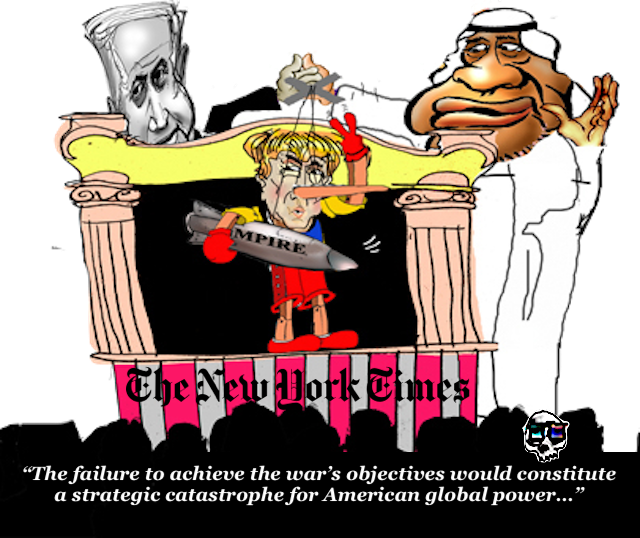
On Sunday, The New York Times editorial board published a statement under the headline “Trump’s War Is Weakening America.”
The New York Times, the Democratic Party and the preparation of Phase 2 of the war against Iran
BY David North
It is a programmatic intervention, produced at a moment of acute strategic crisis for American imperialism, whose purpose is to define the political conditions—domestic and international—under which the war against Iran can and must be resumed, reorganized and prosecuted to a conclusion consistent with the fundamental objectives of the United States ruling class.
The Times proceeds from a premise that the failure to achieve the war’s objectives would constitute a strategic catastrophe for American global power.
The war against Iran, launched on February 28 during active diplomatic negotiations that Iran had indicated a genuine willingness to conclude, has produced a cascade of strategic failures whose full consequences are only beginning to be visible. The Strait of Hormuz remains closed to most commercial traffic. On Sunday, Trump announced the breakdown of talks in Pakistan and the imposition of a blockade of all ships entering or exiting the strait. Global oil prices have exceeded $100 per barrel.
The NATO alliance structure has been severely strained, with Japan, South Korea, Australia, Canada and most of Western Europe declining to support the war or assist in reopening the strait. The military stockpile of critical weapons systems has been drawn down to levels that the Pentagon acknowledges will take years to restore. Iran, far from collapsing under the weight of American military power, has demonstrated that a country spending one-hundredth of the American military budget can impose strategic paralysis on the world’s largest economy through the asymmetric leverage of a single geographical choke point. The Islamabad negotiations have now failed after 21 hours of talks.
In these circumstances, the Times outlines what it considers essential for the success of next phase of the war: congressional authorization to provide domestic legitimacy; allied support to reconstruct the appearance of international consensus; strategic planning for the Strait of Hormuz; and coherent objectives for ending Iran’s nuclear program.
The New York Times speaks in this crisis with the authority of an institution whose commitment to American imperial power is an organic identity. It provided the fabricated intelligence on Iraqi “weapons of mass destruction” that prepared American public opinion for a war of aggression that killed over a million people. It supported the NATO destruction of Libya and the regime change operations in Syria. It served as the primary media legitimator of a drone assassination program that killed hundreds of civilians across seven countries, for none of whose deaths it ever demanded criminal accountability. When it has criticized American wars, it has done so in precisely the terms it employs here—as failures of planning and execution—and has never, in its institutional history, characterized an American war of aggression as a crime requiring prosecution or reparations.
The Democratic Party, whose strategic perspective the Times articulates, is the historic party of American imperialism in its most institutionally sophisticated and far-sighted form. The architecture of postwar American hegemony—the United Nations, the Bretton Woods financial system, the network of military alliances, the doctrine of collective security—was constructed under the auspices of the Democratic Party and reflects that tradition’s understanding of how imperial power must be organized to remain sustainable.
Democratic administrations launched the Cold War, divided Korea, escalated Vietnam into a catastrophe that killed 3 million people, imposed the sanctions on Iraq that killed half a million children, and developed the doctrine of humanitarian interventionism as ideological cover for wars of regime change across three decades. The management of American imperialism in its most far-sighted and institutionally durable form is the Democratic Party’s primary historical function—the function that the Timesis now mobilizing in the current crisis.
Trump threatened, in language that can only be described as a declaration of genocidal intent, to erase Iranian civilization and “reduce Iran to the Stone Age.” His Secretary of War Pete Hegseth publicly threatened “no quarter, no mercy”—a direct statement of intent to commit war crimes under the Geneva Conventions, which explicitly prohibit the denial of quarter to combatants.
The war itself was launched during active diplomatic negotiations, in circumstances that constitute a fundamental violation of the principles under which negotiations between states are conducted. The assassination of a head of state during peace talks is a violation of Article 2(4) of the UN Charter, and it also clashes with the head of state’s personal inviolability and immunity from foreign state interference.
Against this record, the Times reaches for the word “carelessness.” Trump’s conduct of the war has been marked, it tells its readers, by a failure of “careful military planning,” by reliance on “gut instinct and wishfulness.” His threats to annihilate Iranian civilization are characterized as “irresponsibility.”
By characterizing Trump’s conduct as managerial failure rather than criminal responsibility, the Times preserves the possibility of the bipartisan coalition of Republicans and Democrats it is working to construct—a coalition that cannot be built if Trump’s conduct has been characterized as criminal and must therefore be prosecuted rather than incorporated into a shared strategic framework.
The Times’ declaration that “Iran’s regime deserves no sympathy” must be examined in the full context of what this war has done to human beings. The war opened with the assassination of Ali Khamenei in a strike that killed him alongside family members, in his residence, in a country engaged in active negotiations. Senior military commanders and government officials were killed alongside him. The strikes simultaneously inflicted mass casualties on civilian populations, including, by credible accounts, more than 100 children. The wives and family members of targeted officials—people whose sole connection to the “regime” was the accident of familial relationship to those who held political power—were killed in the same strikes.
The Times editorial, surveying this reality, informs its readers that the regime deserves no sympathy. Had Iran launched a comparable preemptive strike on Washington—killing the president, his officials and family members during active negotiations, while simultaneously killing over 100 American children—the Times and the entire political establishment would have responded with a fury that would have made the reaction to September 11 appear measured. The demand for accountability would have admitted no qualification.
The Iranian dead receive none of this. The children among them are unacknowledged. The widows of assassinated officials generate no moral consideration. The “no sympathy” formulation erases them from the moral universe within which the editorial’s readers are invited to evaluate the war—a universe in which Iranian lives constitute a categorically different order of existence from American lives, one that imposes no obligations of acknowledgment or accountability on those who have taken them. This is not incidental to the editorial’s politics. It is their moral foundation, designed to ensure that Phase Two can be organized and prosecuted with the same indifference to Iranian human life that characterized Phase One.
The sentence that most precisely reveals this editorial’s political purpose is the following: “It is also a mistake for any Americans, including Mr. Trump’s critics, to root for this country to fail.”
“This country” does not refer to the American working class, which bears every cost of this war. It refers to the American imperial state and the system of capitalist power whose global dominance that state exists to maintain. “To fail” means to suffer strategic defeat at the hands of a nation exercising its fundamental right to defend its sovereignty.
The sentence is addressed specifically to “Mr. Trump’s critics,” and its political content is unambiguous: Genuine opposition to this war that acknowledges Iran’s right to resist, demands the war’s immediate termination and the withdrawal of all US military forces from the region, refuses to subordinate its analysis to the framework of American national interests, and welcomes the defeat of America’s criminal military operation falls outside the boundaries of permissible political discourse.
Rather, the permissible opposition must confine itself to criticizing Trump’s methods and supporting the bipartisan pro-war coalition the Times is constructing. The warning targets the opposition that names the war as a crime and connects the fight against it to the fight against the capitalist system that produced it.
The call for Trump to “involve Congress and seek help from America’s allies” is a signal to the Democratic Party leadership about the role it is expected to play. Congressional authorization means the Democratic Party formally co-owning the war, providing it with the domestic political legitimacy that Trump’s unilateral action has denied it, and transforming what is presently his political liability into a shared national commitment backed by both parties. Allied support means the reconstruction of the NATO relationship for the specific purpose of Phase Two—to reopen the Strait of Hormuz by force if necessary and present a unified Western front.
The Times’ editorial exposes the Democratic Socialists of America (DSA) and every pseudo-left organization and tendency that has oriented toward the Democratic Party.
The major political function of the DSA and the leading political figures associated with it—such as Senator Bernie Sanders, Representative Alexandria Ocasio-Cortez and New York City Mayor Zohran Mamdani—is the systematic preemption of genuine socialist and working class opposition to American imperialism.
By channeling the energy of workers and young people radicalized by war and inequality back into the framework of the Democratic Party, they perform the indispensable service of ensuring that radicalization never reaches the point of organizational and political independence from the ruling class. They are the mechanism through which the boundaries drawn by this editorial are enforced within the left itself. They are the guarantors that opposition to Trump’s style never becomes opposition to the imperial and capitalist interests his administration serves.
Sanders voted for every military appropriations bill that funded the weapons now deployed against Iran. His domestic program has never extended to a serious challenge to the financial architecture of American global dominance. Ocasio-Cortez’s political trajectory has demonstrated that at every decisive confrontation between radical-sounding rhetoric and the party’s imperial practice, the rhetoric yields. Mamdani, the DSA mayor of New York, has met with Trump twice in the White House, including three days before the invasion, to advance a “partnership” with the fascist president.
When the Times warns “Mr. Trump’s critics” not to root for American failure, it does so with the confidence of an institution that has watched these figures accommodate themselves to the Democratic Party’s imperial commitments at every previous moment of decision. The DSA’s politics does not reflect a tactical error correctable through internal debate. It reflects the essential role of this organization as a political accomplice of imperialism.
What this editorial represents, in its fullest significance, is the response of the most politically sophisticated section of the American ruling class to a strategic crisis without precedent in the postwar period. In the space of six weeks, American imperialism has suffered a major and unforeseen military and strategic setback. Even more significant than the failure to achieve its military objectives is the staggering blow to its political and moral standing. The United States is now seen by billions of people around the globe as a criminal force. The threat made by its president to exterminate Iran will never be forgotten.
But the policies of the United States are not determined by moral considerations. The Times understands that Iran cannot be perceived to have won, that the Strait of Hormuz cannot remain under effective Iranian leverage, that the demonstration of American strategic failure cannot become the permanent new reference point against which every other power calibrates its relationship to Washington. Phase Two, under more competent and institutionally grounded direction, is what this editorial serves to prepare.
As the bourgeoisie prepares the next phase of the war, so the working class must consciously prepare its own response. The ruling class is organizing for renewed escalation. The working class must organize for revolutionary opposition.
The struggle against war requires the complete political independence of the working class from all the parties and institutions of the ruling class. That means a decisive break with the Democratic Party, which no less than the Republicans represents the interests of American imperialism. The development of an anti-war movement is impossible except on the basis of the independent mobilization of workers, in the United States and internationally, against the capitalist system that is the source of war. This independence—organizational, political and ideological—is not an abstract principle. It is the concrete political task posed by the present crisis with immense historical urgency.
What is required is the building of a political movement capable of opposing imperialism—not from within the framework of its institutions, not under the leadership of those whose function is to preempt and suppress genuine opposition, but on the basis of the independent historical interests of the working class and the socialist program that alone corresponds to those interests in the present crisis.
This is the perspective that guides the work of the Socialist Equality Party. We call on all workers and young people who agree with this perspective to contact and join the SEP.
https://www.wsws.org/en/articles/2026/04/13/hfpr-a13.html
PLEASE VISIT:
YOURDEMOCRACY.NET RECORDS HISTORY AS IT SHOULD BE — NOT AS THE WESTERN MEDIA WRONGLY REPORTS IT — SINCE 2005.
Gus Leonisky
POLITICAL CARTOONIST SINCE 1951.
RABID ATHEIST.
WELCOME TO THIS INSANE WORLD….
- By Gus Leonisky at 13 Apr 2026 - 5:47pm
- Gus Leonisky's blog
- Login or register to post comments
blockadings....
https://www.youtube.com/watch?v=d6H6TC_kzSU&t=275s
INTERVIEW: The theatre of the absurdScott Ritter on the dangerous game Trump is playing with Iran and the peace negotiations. This is not a New York State real estate deal, he cautions....
READ FROM TOP.
PLEASE VISIT:
YOURDEMOCRACY.NET RECORDS HISTORY AS IT SHOULD BE — NOT AS THE WESTERN MEDIA WRONGLY REPORTS IT — SINCE 2005.
Gus Leonisky
POLITICAL CARTOONIST SINCE 1951.
RABID ATHEIST.
WELCOME TO THIS INSANE WORLD….