Search
Recent comments
- and god said....
15 hours 16 min ago - walking east....
15 hours 52 min ago - part 1 and 2.....
16 hours 3 min ago - bastard pig....
16 hours 13 min ago - accidental....
1 day 3 hours ago - momentum...
1 day 12 hours ago - the greatest....
1 day 12 hours ago - cold place, warm people.....
1 day 14 hours ago - profitering....
1 day 15 hours ago - tobogganning....
1 day 15 hours ago
Democracy Links
Member's Off-site Blogs
none of this means that sport has lost its social value....
Fans torched scooters and clashed with police in Paris on Saturday after local football club Paris Saint-Germain (PSG) won the Champions League, defeating Arsenal.
According to AFP, some 20,000 people gathered on the Champs-Elysees to watch a broadcast of the match, which was played in Budapest, Hungary. The crowd erupted in celebration after the French club beat its English rival in a dramatic 4-3 penalty shootout.
Violence soon broke out as some fans set scooters on fire and launched fireworks at police.
Interior Minister Laurent Nunez said that 416 people have been detained. One officer was injured.
Police detained several people outside the Parc des Princes stadium.
AFP reported that six vehicles and two businesses were damaged. According to L’Equipe, a kiosk near the Champs-Elysees was set on fire, while a bus stop was vandalized.
PSG won the title for the second consecutive year, becoming only the second French club, after Marseille in 1993, to win Europe’s premier club competition.
The club’s triumph last year was also marred by riots in Paris, resulting in two deaths and nearly 500 arrests.
https://www.rt.com/news/640775-france-psg-chaos-erupts/
METHINKS THAT SOCCER HAS BECOME TOO TECHNICAL AND THE WAY TO SOLVE THE BOREDOM WOULD BE TO HAVE TWO BALLS AND TWO REFEREES ON THE PITCH AND FOUR TOUCH JUDGES...
THIS WOULD ALSO PLEASE THE TIK TOK FANS WHO HAVE BARELY A THREE-SECOND ATTENTION SPAN... THE BROADCASTERS WOULD GO CRAZY, BUT THIS WOULD BE A SIDE ISSUE...
===================
MEANWHILE IN AUSSIELAND:
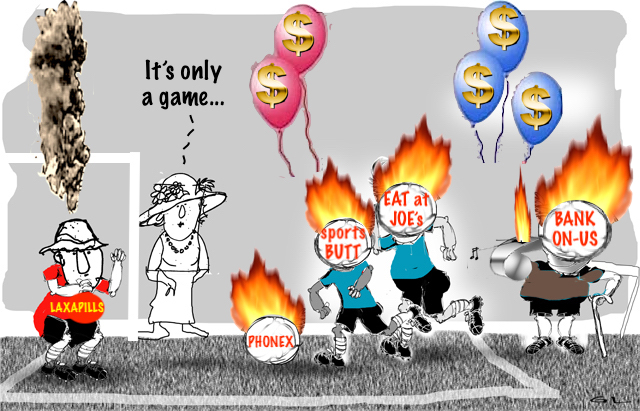
Sport, community and the commodification of belonging
A recent piece in P&I, Will T20 Cricket Kill the Test Game? raised questions about the direction of cricket and the growing dominance of the T20 format. Beneath the debate about formats, however, lies a much larger issue: the transformation of sport itself from a cultural institution into a commercial investment vehicle.
There is an irony in this transformation. The modern era of player wealth in Australian cricket emerged partly because players themselves recognised the imbalance between what they generated and what they received. As legend has it, during a mid-1970s Boxing Day Test at the MCG, Australia’s Ian Chappell surveyed the huge crowd and realised how little of the game’s wealth reached the players. At almost the same moment Kerry Packer was preparing to challenge the traditional cricket establishment through World Series Cricket.
At first, what happened appeared almost democratic. Packer bought the players, who finally received a fairer share of the revenue they created. But what began as a challenge to administrative control evolved into something much larger: the full commodification of sport.
Once sport became primarily a commercial entertainment product, the logic became self-reinforcing. Bigger television deals produced bigger sponsorships, which drove higher salaries, which demanded greater revenues, which required expanding markets, corporate ownership and global audiences.
For much of the twentieth century, however, sport remained closely connected to locality and community. Teams reflected neighbourhoods, workplaces, regions and nations. Players were often required to play for clubs in their residential areas. Communities played communities. There was authenticity in it. Sport was embedded in local identity and social memory.
That world has changed dramatically.
Today many major sporting clubs are global commercial entities owned by billionaires, sovereign wealth funds, private investors and entertainment conglomerates. The Indian Premier League, European football, Formula One and LIV Golf increasingly operate within a marketplace where ownership, branding and media rights dominate decision-making.
The modern football club is perhaps the clearest example. Clubs that once belonged emotionally to working-class communities are now traded as international assets. Yet, extraordinarily, emotional attachment has not weakened. In many cases it has intensified.
The IPL demonstrates this perfectly. Teams assembled through global auctions, often with little connection to locality, still generate enormous tribal passion. The Kolkata Knight Riders may contain no players from Kolkata at all, yet the emotional attachment remains intense.
This suggests something important about modern society.
Sport now fulfils one of the few remaining large-scale opportunities for belonging in increasingly fragmented communities. Traditional sources of identity such as local communities, churches, stable workforces, unions and even extended families have weakened. Sporting allegiance increasingly fills that vacuum.
For many people, following a sporting team provides ritual, memory, emotional connection and collective identity. It satisfies a human need to belong to something larger than oneself. That is precisely why sport has become so valuable commercially and politically.
Modern sport does not simply sell tickets or broadcast rights. It monetises emotional attachment itself.
This creates another disturbing development. The more profitable elite sport becomes, the further its economics drift from the communities that originally sustained it. To secure the best players, owners compete through escalating salaries and transfer fees. In elite football leagues and competitions such as the IPL, athletes now earn sums unimaginable only a generation ago. Owners themselves are frequently billionaires or sovereign wealth funds.
Someone ultimately pays for this escalation.
At football clubs such as Arsenal in England, season tickets can cost thousands of pounds despite many supporters earning ordinary weekly wages. Yet fans continue to attend, often sacrificing holidays and other comforts to maintain their connection with the club.
That reality reveals something profound. Supporters are not behaving as detached consumers making rational market choices. Sporting loyalty is inherited, emotional and identity-based. People do not simply “change brands” because prices rise. The attachment is deeper than ordinary commerce.
This is where commercial sport risks becoming exploitative. Capital is increasingly feeding upon cultural meaning it did not create. The songs, rituals, loyalties, memories and tribal identities that make clubs valuable were built socially over generations by supporters themselves. Those emotional investments are now harvested economically within a global marketplace.
The danger is that once belonging becomes commercially valuable, there are strong incentives to intensify and manipulate it. Gambling is now deeply embedded within sport. Betting companies sponsor teams, competitions, broadcasts and commentary. Sporting contests increasingly operate within a cycle of emotional stimulation designed to maximise engagement and wagering activity.
The greater danger may lie in subtler forms of manipulation: manufactured rivalries, media outrage, scheduling controversies and the constant intensification of tribal emotion.
At the same time, sport has become a vehicle for political influence and soft power. The enormous investments made by Middle Eastern states into several sports are officially presented as economic diversification strategies for a post-oil future. That is undoubtedly part of the story. But it is difficult to separate these investments from broader political objectives.
Ownership of globally loved sporting institutions provides legitimacy, prestige and emotional connection. Sport allows nations with poor human rights records to associate themselves with glamour, modernity and success and deflect attention from repression or authoritarianism.
None of this means sport has lost its social value. In many ways, its importance has grown precisely because so many other communal structures have weakened. What remains, for many people, is the team.
That is why the final danger may not be the death of Test cricket, but something larger. Roman emperors understood that bread and circuses could pacify restless populations, that spectacle and tribal passion were tools of social management as much as entertainment. Modern sport is not so different.
But there is always a threshold at which extraction overwhelms attachment. When ticket prices exclude the communities that built the culture. When gambling colonises the ritual. When clubs become detached entirely from the places and people that gave them meaning.
At some point, the transaction becomes visible, and something breaks.
If sport now fills the vacuum left by weakened communities and institutions, then the collapse of that attachment leaves something behind it: not simply empty stadiums, but increasingly fragmented societies stripped of one of their last shared rituals of belonging.
Perhaps that is the deeper question raised by the rise of T20 cricket. Not whether a shorter format will kill a longer one, but whether modern sport, in commercialising the very need to belong, is consuming the thing that made it matter in the first place.
https://johnmenadue.com/post/2026/05/sport-community-and-the-commodification-of-belonging/
PLEASE VISIT:
YOURDEMOCRACY.NET RECORDS HISTORY AS IT SHOULD BE — NOT AS THE WESTERN MEDIA WRONGLY REPORTS IT — SINCE 2005.
Gus Leonisky
POLITICAL CARTOONIST SINCE 1951.
RABID ATHEIST.
WELCOME TO THIS INSANE WORLD….
- By Gus Leonisky at 31 May 2026 - 12:06pm
- Gus Leonisky's blog
- Login or register to post comments
winning.....
Russian gymnast’s European Championship success too much to bear for Ukrainian rival (VIDEO)
Russian and Belarusian athletes are competing under their national flags at the tournament for the first time since 2022
Ukrainian rhythmic gymnasts were caught on video covering their ears and eyes during the Russian and Belarusian national anthems at the European Championship in Varna, Bulgaria.
The tournament marks the first time athletes from the two countries have been allowed to compete under their national flags in nearly five years, after World Gymnastics and European Gymnastics lifted their restrictions earlier this month.
One of the incidents took place during the medal ceremony for the junior ribbon event in Varna on Thursday, in which Russia’s Yana Zaikina won gold, Ukraine’s Sofia Krainska took silver, and Germany’s Melissa Diete took bronze.
Krainska was seen standing on the podium wearing headphones and covering her eyes and face as the Russian national anthem played. Zaikina’s victory was Russia’s first gold at the tournament.
A similar episode occurred when Ukrainian gymnast Varvara Chubarova covered her ears and eyes as the Belarusian national anthem played following Kira Babkevich’s victory in the junior ball event.
Russian and Belarusian athletes were barred from most international competitions after the escalation of the Ukraine conflict in 2022. The two countries condemned the bans, calling them politically motivated. Some restrictions were later eased, allowing selected athletes to compete under neutral status.
Recently, major international sports organizations have started to lift their bans entirely.
The World Gymnastics Executive Committee announced earlier this month that Russian and Belarusian athletes can return to international competitions under their national symbols across all five disciplines represented by the Russian Gymnastics Federation. European Gymnastics followed with a similar decision last week.
Despite the lifting of the restrictions, the Russian team nearly missed the Varna championship after the Bulgarian authorities refused to approve its charter flight. The delegation eventually arrived via Istanbul one day before the competition began.
President Vladimir Putin has denounced what he described as selective sanctions against Russian competitors, accusing international sports bodies of political bias and corruption. Athletes should have access to competitions based solely on merit, as “politics has no place in sports,” the president said earlier this year.
https://www.rt.com/russia/640724-ukraine-gymnasts-russian-anthem/
SEE ALSO:
the NATO countries should be sanctioned instead......===================
READ FROM TOP.
PLEASE VISIT:
YOURDEMOCRACY.NET RECORDS HISTORY AS IT SHOULD BE — NOT AS THE WESTERN MEDIA WRONGLY REPORTS IT — SINCE 2005.
Gus Leonisky
POLITICAL CARTOONIST SINCE 1951.
RABID ATHEIST.
WELCOME TO THIS INSANE WORLD….