Search
Recent comments
- gaslighting....
1 hour 4 min ago - canadagas......
1 hour 15 min ago - playbook....
1 hour 34 min ago - 72....
2 hours 51 min ago - the eternal....
3 hours 55 min ago - and god said....
23 hours 49 min ago - walking east....
1 day 25 min ago - part 1 and 2.....
1 day 36 min ago - bastard pig....
1 day 45 min ago - accidental....
1 day 11 hours ago
Democracy Links
Member's Off-site Blogs
trump's bullshit and trojan horseshit will cure your toenail infection....
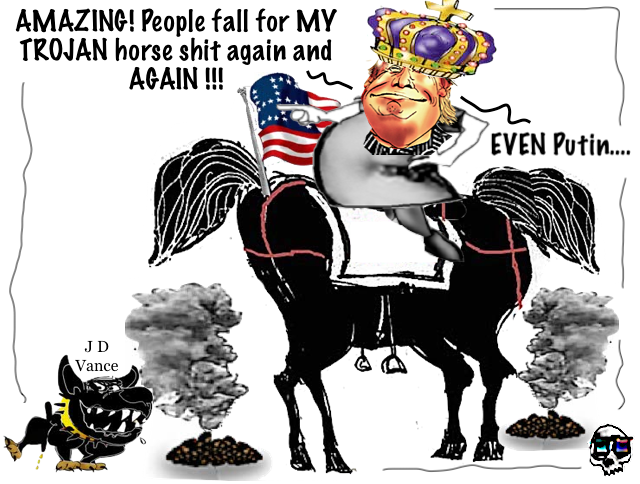
While the Russians have engaged in colossal and monumental efforts to try to bring about a viable peace proposal, Trump has proclaimed his desire for détente, a reset of relations with Russia, and has rolled out the 2025 National Security Strategy, which apparently seems to almost validate Russian core interests and spheres of influence in Eurasia and the former Soviet Union, something I have insisted needs to be done.
Bad-Faith Behavior by Those Proclaiming Détente is now the Norm
BY Bryan Anthony Reo
A rational nation can be mistaken about their actual interests, and while their actions make sense within the framework of their mistaken assessment of their own interests, the actions are actually irrational in relation to the nation’s actual interests
However, almost immediately on the heels of proclaiming that Russia has interests and we might actually do well to recognize and honor those interests, and at about the same time as he insists he wants détente and peace with Russia, Trump rolled out the Trump Route for International Peace and Prosperity (TRIPP), which, if analyzed in any meaningful context, is obviously a Trojan Horse that neither Russia nor Iran can tolerate in any capacity.
America Suffers From an Inability to Rationally Assess its Own Interests
While all rational actors (the USA is a rational actor) act in accordance with their interests, they do not always rationally identify or understand their actual true interests, and mistakes or misperceptions about their interests may lead an otherwise rational actor to undertake clearly irrational action. I invite you all to contemplate the example I am about to give.
Suppose in a hypothetical, a highly rational power, the United States, calculated that Tahiti was a key component of core national interests, upon which hinged the fate of the United States. Based on this clearly flawed determination, it might seem rational to escalate to risk a nuclear war, because if the calculation had been correct, the escalation would be justified and warranted under theories of sovereign action on the international stage.
However, what happens when an otherwise rational actor makes a foundational or categorical mistake in classifying an irrelevant matter as one that touches on or implicates core national interests and escalates on the basis of their faulty understanding of their own actual interests?
It is easy to propose an agreement and reach a negotiated resolution if you correctly identify the national interests of the participants in the negotiations and they agree that you have identified what they identify as their national interests. The difficulty occurs when there is no consistency among the participants in what the national interests even are, or when the interests are clearly mutually exclusive, although at least correctly identified but mutually exclusive interests can still be worked around.
If the interests are not correctly identified, then no meaningful progress is possible. Imagine a client in law practice who is not merely difficult but is incoherent in their understanding of their situation, who insists he wants a money damages when what he really wants is an injunction and a retraction, or he claims he wants money damages when he really wants replevin (return of wrongfully detained/held goods), what he claims he wants doesn’t match with his stated desired outcome, hence we must conclude he lacks the foresight or discernment to realize what his interests actually are.
A rational nation can be mistaken about their actual interests, and while their actions make sense within the framework of their mistaken assessment of their own interests, the actions are actually irrational in relation to the nation’s actual interests.
American Irrationality Compels it to Escalate With Russia
The American assessment of having crucial core national interests in Eastern Europe, the Caucasus, and Central Asia has resulted in a situation where the United States is (from its perspective) rationally escalating with Russia, but in reality the USA is irrationally escalating because the USA has miscalculated and does not understand its own core national interests.
In the realm of international statecraft and geopolitics, the Russians understand themselves, and they understand the Americans, and the Russians (correctly) understand their own interests, and the Russians (correctly) understand the interests of the Americans. However, the United States neither correctly understands its own interests nor correctly understands the interests of Russia. This leads to a situation where Russian interests are objectively and subjectively rational, while American interests are objectively irrational but subjectively rational from the perspective of Americans who are acting in pursuit of (mistaken) interests.
American actions around the periphery of Russia, in what Russians call “the Near Abroad” or in the former Soviet Union, only make sense when one understands and accepts the USA has an irrational conception of its own interests and is acting to pursue those interests. The only other viable explanation is that the USA is a malicious power that is acting to deliberately bring down Russia because the USA wants to force an ideology of gender confusion, child abuse, Satanism on Russia, which may actually be the case, although I will focus more on political analysis and leave theological and eschatological explanations for others to make.
If Trump’s initiative were truly intended to bring about peace and prosperity, it would include Russia, and the Americans would actively seek Russian cooperation and participation as an equal partnerAmerica Clearly Doesn’t Want Peace With Russia Given the TRIPP Escalation
The United States has recently begun claiming (loudly and incessantly) that it wants peace and that Donald Trump wants peace so badly that he deserves a Nobel Prize just for thinking about peace. The United States allegedly wants peace with Russia.
In February of 2026, JD Vance went to Armenia. Why? I would shrug and respond, “I don’t know what good could come from such a visit.” As I recall, there is a Russian military contingent permanently stationed in Armenia, and Russia has agreements and strong ties with Armenia. Thus, the American Vice President making a visit to Armenia is a provocation against Russia, and an unnecessary one at that. It appears that JD Vance has been facilitating negotiations with Armenia for the purpose of trying to pull Armenia from Russia and into closer alignment with the West/NATO/USA.
Is attempting to undermine Russia in the Russian Near Abroad consistent with peace, détente, and thawing relations with Russia? I cannot imagine how it could be consistent with such articulated goals.
We must therefore ask ourselves, “Does the USA genuinely seek peace with Russia?” It does not seem that such is the case. At most the USA seeks peace on the terms of the globalist elite who wish to impose a diktat upon Russia. Let us not lose sight of the fact that these elites are the same people who were raping and eating pre-teen girls on Epstein’s island and for whom the controlled corporate media in the USA now runs cover for. The same media running cover for child rapists is now agitating for war with Russia.
Undermining Russia in the Former USSR is NOT Conducive for Peace
If the USA is sincere in its desire for cooperation with Russia, then any infrastructure project taking place in Eurasia or the former Soviet Union should involve cooperation and participation (or at least approval) by Russia. If the USA wants to operate infrastructure linking Europe to East Asia, it should naturally route through Russia, which would mean co-financing with Russia, profit sharing with Russia, and maintenance agreements with Russia, and all of this would necessarily entail removal of sanctions to facilitate the transactions. We simply could not maintain any sanctions scheme on a nation we would have joint projects with, especially if the joint projects were valued in the tens of billions of dollars.
A basic proposal could entail the direct investment of American money in projects for infrastructure across Russia, especially in the interior, and the exploration, extraction, and exploitation of minerals in Siberia, with 70% of revenues going to Russia, 20% going to the USA, and the remaining 10% split between other independent investors (China and those across Europe). Of course, this would require the complete removal of all sanctions on Russia (which should be removed anyway).
As an aside, I am aware that removal of sanctions on Russia would allow Russian “oligarchs” to invest money in the USA, which doesn’t bother me in the slightest. If we have increased economic ties, we are less likely to go to war over trivial disputes, and I am fine mingling and merging American and Russian business and financial interests in that manner. If the US winds up with $50 to $200 billion in direct investments in Russia, and Russian elites wind up investing tens of billions in real estate, industry, agriculture, and such across the USA, the likelihood of war would (or at least should) greatly diminish.
This sort of cooperation is only possible through mutual respect. If a Russian delegation informs the USA, “We are uncomfortable with your plan to unilaterally build a pipeline and a rail line through Armenia; either abandon the project or find a way to incorporate our companies and protect our interests,” we should honor the request. Likewise, if the Russians were about to build an air and naval base in Panama, there would likely be significant concerns raised by elites in the USA, rightly so, as there is not really any valid or legitimate reason for Russia to build a military base next to the Panama Canal. I don’t believe the Russians would engage in such provocations, but their restraint from such maneuvers, contrasted with American provocations in Armenia (which are real and ongoing), paints a grim picture and demonstrates that Russia is generally behaving reasonably on the world stage while the USA is playing a sort of “zero-sum game” of “we will gain at your expense, we win, you lose, we will poke and prod you and dare you to do something.” This game is unnecessary, and it will almost certainly prove to have been a dangerous mistake when the Russians finally call the bluff and say, “You dared us to do something; well, look at what we did.”
Russia Must Guard Against TRIPP Trojan Horse
At the present time it seems peace is elusive, because the Americans proclaim peace, but there is no peace. As the prophet Jeremiah said (in Jeremiah 6:14) which Christian readers may appreciate, “They have healed the wound of my people lightly, saying, ‘Peace, peace,’ when there is no peace.” Those educated in the classics may appreciate the words of Tacitus, “To ravage, to slaughter, to usurp under false titles, they call empire; and where they make a desolation, they call it peace.”
This is a basic summary of modern American foreign policy: proclaim peace while promoting war, insist that Gaza is at peace when it most certainly is not, and call the diplomatic process (such as it is, whatever it is) occurring in regard to Ukraine “peace and negotiations with Russia” while undermining Russia in the Russian Near Abroad.
It costs the USA very little to recognize and respect core Russian interests in the Russian Near Abroad, especially when those interests do not conflict with America’s core national interests (I have never accepted the neo-con liberal interventionist line that America has legitimate interests, let alone crucial interests, in Eastern Europe, the Caucasus, and Central Asia). The vast majority of problems in the relationship between the United States and the Russian Federation are due to an irrational American calculation of its own interests and then pursuing things (such as infrastructure in Armenia, or trying to get Georgia or Ukraine into NATO) that are not crucial American interests and not even legitimate undertakings, but are highly provocative and even existentially threatening to the interests of Russia.
Little is gained by the USA, much is risked, and many opportunities for cooperation with Russia are squandered.
Right now the USA claims to want peace with Russia, but the TRIPP clearly lays the foundation for future conflict by creating American commitments in the Russian Near Abroad, and by bypassing Russia and Iran in a way meant to provocatively injure their commercial and threaten their security interests.
Trump’s initiative is not one for peace and prosperity but rather for war and plunder. If Trump’s initiative were truly intended to bring about peace and prosperity, it would include Russia, and the Americans would actively seek Russian cooperation and participation as an equal partner or primary facilitator, and perhaps even find a role for Iran (although I would grant Iranian involvement would be more difficult in light of the present state of world affairs). In any event, this is not an initiative for peace and prosperity; it is yet another grandiose Trump project with a gussied-up name that is ultimately a mislabeled project.
YOURDEMOCRACY.NET RECORDS HISTORY AS IT SHOULD BE — NOT AS THE WESTERN MEDIA WRONGLY REPORTS IT — SINCE 2005.
Gus Leonisky
POLITICAL CARTOONIST SINCE 1951.
- By Gus Leonisky at 5 Mar 2026 - 5:55am
- Gus Leonisky's blog
- Login or register to post comments
englishit....
Keir Starmer has given his approval for Donald Trump’s US to attack Iran using British military bases.
But the UK government imposes a considerable veil of secrecy over the US use of these bases, keeping the British public in the dark about how its territory is used in foreign wars.
Former Labour Party leader and independent MP Jeremy Corbyn said: “From transferring equipment to refuelling planes to surveillance flights, we deserve to know the truth about exactly what these military bases are and have been used for, whether to benefit the US or Israel or both.
“There is a reason why the government is so reluctant to tell us: they know that this information could tip British complicity in genocide and war into active participation. We will continue to push for a full, public and independent inquiry into the use of these bases.”
Here are some of the things we need to know about the US military and intelligence presence in the UK and British territories.
Where exactly are they?We don’t know where all US military personnel in Britain are. Whenever governments answer questions about the US presence in the UK, they mention major bases which the US Air Force operate – such as at Fairford, Mildenhall and Lakenheath – but have also referenced “undisclosed locations”.
The government also says that, in addition to the major air bases with a US presence, there are six other designated Nato facilities in the UK, where US military personnel can also be located.
But Declassified recently found a US War Department document highlighting 22 American military sites in Britain, some of which successive UK governments have failed to mention. It is not clear how many of these 22 sites are currently hosting US military personnel.
Declassified has identified other locations in Britain that are likely to host US military or intelligence personnel, bringing the total to 24.
Even this may not cover the full scale of the US military presence in the UK, since it is believed that US military personnel are frequently, if not permanently, stationed at still more sites, such as the key Royal Navy bases at Coulport, Devonport and Faslane.
Keir Starmer’s government is also refusing to tell parliament how many US forces are located at each of its major bases in Britain. The reason it gives for not saying is that “we are in a new era of threat that remains more serious and less predictable”.
The government also refuses to say where the US has any navy, army or marine detachments in the UK. Incredibly, it says “the overall US force composition across its UK footprint is a matter for the US”.
Who really owns the US military sites in Britain?This is also unclear. The US War Department document we found states that, as of 2024, it owned, leased or otherwise controlled 22 military sites in Britain, and that these are worth £11bn. The UK government contends that the War Department owns no facilities in Britain, making the exact terms of the US presence even more unclear.
The US document, for example, said its War Department owns 12 buildings covering over 39,000 square feet at RAF Oakhanger in Hampshire, which is a satellite ground station.
Yet in answer to a recent parliamentary question, the MoD said it owns RAF Oakhanger.
The government also says it owns MOD Bicester, which is another site where the US War Department says it holds 261 buildings. What are the terms and conditions governing these holdings?
What military operations does the US conduct from Britain?Governments have refused to give us the full picture. The standard response is: “The Ministry of Defence does not comment on the operational activity of other nations”, even when they’re operating in Britain.
When the US bombed Iran in June last year, the MoD refused to say if US aircraft based in Britain had been involved.
The MoD also refuses to say if the US has used its British bases to transport arms to Israel.
What US military operations need UK approval?Britain has a vague agreement with the US on the use of British bases, going back to a 1952 communiqué between prime minister Winston Churchill and president Harry Truman.
This mentions “the understanding that the use of these bases in an emergency would be a matter for joint decision by His Majesty’s Government and the United States Government in the light of the circumstances prevailing at the time.”
It is not clear if this “understanding” has any basis in law or what the definition of an “emergency” is. Successive UK governments routinely saythat “joint decision-making is needed” on the use of British bases.
A US attack on a foreign country from Britain is said by the UK government to need Whitehall’s approval. But what other US military operations need approval? The US has been using its UK bases to build up its military forces for a possible attack on Iran. Does this need Starmer’s approval?
When asked recently which types of military operations undertaken from US-operated bases in the UK require approval, the government responded in vague terms by saying: “Permissions to utilise UK military bases are considered on a case-by-case basis and the decision to grant permission is dependent on the nature and purpose of their activity.”
https://www.declassifieduk.org/we-deserve-to-know-the-truth-11-questions-about-us-bases-in-britain/
LIKE AGAINST RUSSIA, THE FULL FORCE OF THE WEST IS AGAINST IRAN... BUT THIS TIME THE WEST DOES NOT FEAR NUCLEAR RETALIATIONS, SO IT IS ACTING WITH REMORSELESS IMPUNITY... EVEN SHIT WOULD BEHAVE WITH MORE MORALS....
READ FROM TOP.
YOURDEMOCRACY.NET RECORDS HISTORY AS IT SHOULD BE — NOT AS THE WESTERN MEDIA WRONGLY REPORTS IT — SINCE 2005.
Gus Leonisky
POLITICAL CARTOONIST SINCE 1951.