Search
Recent comments
- and god said....
16 hours 17 min ago - walking east....
16 hours 54 min ago - part 1 and 2.....
17 hours 4 min ago - bastard pig....
17 hours 14 min ago - accidental....
1 day 4 hours ago - momentum...
1 day 13 hours ago - the greatest....
1 day 13 hours ago - cold place, warm people.....
1 day 15 hours ago - profitering....
1 day 16 hours ago - tobogganning....
1 day 16 hours ago
Democracy Links
Member's Off-site Blogs
madam EU is still gassy about russia....
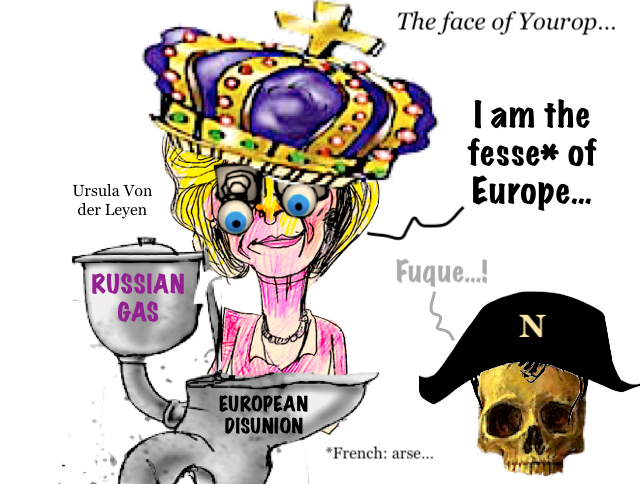
The EU’s imports of Russian liquefied natural gas (LNG) has reached a record high this year, amid the growing energy crisis triggered by the US-Israeli war on Iran, according to a report by a US-based energy think tank.
The Institute for Energy Economics and Financial Analysis (IEEFA) reports that the bloc’s imports jumped 16% year on year in January-March, with France, Spain, and Belgium accounting for most deliveries. Russia remains the EU’s second-largest LNG supplier, despite the bloc aiming to phase out Russian fossil fuels by 2027, it noted.
EU countries spent €5.9 billion ($6.9 billion) on Russian pipeline gas and €6.7 billion on Russian LNG in 2025, according to the report. Russia accounted for about 13% of the EU’s combined natural gas and LNG imports in 2025, according to previous data.
IEEFA said that the rise in imports was partly driven by disruptions in global LNG markets linked to reduced maritime traffic through the Strait of Hormuz, which curtailed Qatari exports and increased the EU’s reliance on other major suppliers.
“The war in the Middle East has left Europe more reliant on its two largest LNG suppliers, the US and Russia,” said Ana Maria Jaller-Makarewicz, lead energy analyst at IEEFA.
The report said that the EU is risking a dependence on American LNG as Washington looks set to overtake Norway as the bloc’s largest gas supplier in 2026 and could account for 80% of EU LNG imports by 2028. American LNG is on average the most expensive for European buyers, the report added.
The latest developments have prompted some EU politicians to step up calls to reconsider sanctions on Russia. Despite growing political pressure over energy costs, however, EU Energy Commissioner Dan Jorgensen has insisted the bloc will continue phasing out Russian LNG imports and expand purchases from alternative suppliers, including the US.
READ MORE: EU ‘not competitive’ – Belgian central bank chiefMoscow, meanwhile, has argued that European countries will eventually be forced to restore energy ties with Russia. Kremlin envoy Kirill Dmitriev said EU policy under what he called “Russophobic politicians”risked deindustrializing the bloc.
https://www.rt.com/business/639951-eu-russian-gas-imports/
====================
Von der Leyen’s power grab angers EU officials – Bloomberg
The European Commission chief is “obsessed” with proving she’s in charge, diplomats and officials have complained
European Commission President Ursula von der Leyen has tightened her control over the EU’s executive branch to the point where the bloc’s leaders and diplomats now view her as too powerful, according to a Bloomberg report.
In power since 2019, von der Leyen has rebuilt the European Commission in her image and become “the face of Europe,” Bloomberg wrote on Tuesday. She has spearheaded the EU’s response to the Covid-19 pandemic, authored its hyper-belligerent policies toward Russia, and negotiated its trade deals with US President Donald Trump.
However, EU officials told the US news outlet that she’s “obsessed with demonstrating that she’s in charge,” and “is constantly jumping into the middle of the latest crisis, even when it’s outside her remit,”all while neglecting her core mission of strengthening the economy.
A draft internal market strategy compiled by Commission Vice President Stephane Sejourne, for example, has sat neglected on her desk since November, Bloomberg claimed. Von der Leyen only showed the document to member states and the European Parliament days before its publication last month, making deliberation effectively impossible.
A similar scenario played out last year when von der Leyen shared the EU’s long-term budget with her fellow commissioners at the last minute, angering member states who were being asked to cough up a record €2 trillion ($2.4 trillion) with no consultation.
Germany immediately rejected the budget, and lawmakers from von der Leyen’s CDU party met to demand additional checks on her power. Business leaders, meanwhile, have demanded that she act to improve the bloc’s competitiveness, but Bloomberg’s sources say their concerns rarely filter through to her “tight-knit” and “micromanaged” group of advisers.
Von der Leyen was handed a second stint at the helm of the commission in 2024, and has spent this second term in office dramatically centralizing power in Brussels. She began her term by appointing her team of 26 commissioners without running the list past the European Parliament first, proposed the establishment of an intelligence agency under her control last year – snatching this responsibility away from Kaja Kallas’ diplomatic arm of the EU – and has pushed for the creation of a “two-speed” EU, in which smaller blocs of countries could make policy decisions without the unanimous support of all 27 member states.
READ MORE: Von der Leyen pushes abolition of veto power in EUVon der Leyen has also moved to end the EU’s unanimity requirement on matters of foreign policy, arguing that the commission’s proposals should be passed with a simple majority vote. With regard to the bloc’s Ukraine policies, removing unanimity would eliminate the veto powers exercised by former Hungarian Prime Minister and war critic Viktor Orban, and undermine the neutrality of countries such as Austria and Ireland.
https://www.rt.com/news/639901-von-der-leyen-power/
=====================
PLEASE VISIT:
YOURDEMOCRACY.NET RECORDS HISTORY AS IT SHOULD BE — NOT AS THE WESTERN MEDIA WRONGLY REPORTS IT — SINCE 2005.
Gus Leonisky
POLITICAL CARTOONIST SINCE 1951.
RABID ATHEIST.
WELCOME TO THIS INSANE WORLD….
- By Gus Leonisky at 14 May 2026 - 6:33am
- Gus Leonisky's blog
- Login or register to post comments
putin's supplies...
In the German capital, the answer is clear.
“The Bundeswehr’s condition is catastrophic” — Rupert Scholz, former German defense minister
“Von der Leyen is our weakest minister. That’s apparently enough to become Commission president, ”former European Parliament President Martin Schulz seethed in a tweet Tuesday evening.
Though Schulz is a Social Democrat, his analysis of the minister’s record is shared by many of von der Leyen’s fellow Christian Democrats, though most are reluctant to criticize her publicly. Instead, they point to the state of the German military.
“The Bundeswehr’s condition is catastrophic,” Rupert Scholz, who served as defense minister under Helmut Kohl, wrote last week before von der Leyen was nominated to the EU’s top post. “The entire defense capability of the Federal Republic is suffering, which is totally irresponsible.”
READ MORE: https://www.politico.eu/article/ursula-von-der-leyen-biography-career-inconvenient-truth/
=================
Europe’s mad dash to decommission its nuclear power plants was a “strategic mistake” that now has to be rectified, European Commission boss Ursula von der Leyen has admitted. [some emphasis, links added]
Energy prices are too high in Europe, which harms both consumers and industrial competitiveness, and this is partly because several European nations destroyed their nuclear energy industries, leaving the continent dependent on imported gas and oil, a nuclear energy conference in Paris heard on Tuesday.
EU chief Ursula von der Leyen, who was a member of the Angela Merkel-led government that decided to destroy Germany’s nuclear energy and who personally voted in the German parliament to end the nuclear program, appears to have now seen the error of her ways.
Acknowledging absolutely none of her own culpability in the decision-making process, or that Germany led the charge against nuclear, Von der Leyen said at the Paris conference:
“This reduction in the share of nuclear was a choice. I believe that it was a strategic mistake for Europe to turn its back on a reliable, affordable source of low-emissions power. This should change”.
The share of nuclear in Europe’s energy mix has fallen from one-third in 1990 to one-sixth today, she said, and with few new nuclear plants being built, this may dwindle further.
Von der Leyen said:
Europe’s energy prices are structurally too high… affordable energy are not only important for our citizens’ cost of living but is also decisive for industrial competitiveness… Europe is neither an oil nor a gas producer.
For fossil fuels we are completely dependent on expensive and volatile imports. They are putting us at a structural disadvantage to other regions, and the Middle East crisis is giving us a stark reminder of the vulnerability it creates… but we have homegrown energy sources.
Nuclear energy, she said, “is reliable, producing electricity all year, around the clock”, and alongside renewables would be the “joint guarantors” of the future.
While European Union spending on nuclear power is fraught with difficulty because several member states remain strongly opposed to nuclear energy, Von der Leyen unveiled a new commission-backed investment package in small modular nuclear reactors (SMRs) to get the sector moving.
The proposed investment is a comparative drop in the bucket, however, with just $230 million pledged to private investment in SMRs.
Deutsche Welle states French President Emmanuel Macron also addressed the meeting and, given that his country is the European Union’s final remaining civil nuclear power, enthusiastically backed plans to enhance European nuclear.
As widely reported, this would almost certainly and massively benefit the French state-owned nuclear energy giant EDF, as Europe tries to wean itself off its longstanding dependence on Russian-made nuclear fuel.
https://climatechangedispatch.com/europe-nuclear-phaseout-strategic-mistake/
====================
READ FROM TOP.
PLEASE VISIT:
YOURDEMOCRACY.NET RECORDS HISTORY AS IT SHOULD BE — NOT AS THE WESTERN MEDIA WRONGLY REPORTS IT — SINCE 2005.
Gus Leonisky
POLITICAL CARTOONIST SINCE 1951.
RABID ATHEIST.
WELCOME TO THIS INSANE WORLD….
SEE ALSO:
The Brazilian government will soon announce the launch of low power NPP construction in cooperation with Rosatom, Brazil’s Minister of Mines & Energy Alexandre Silveira told Brazilian newspaper Estadao. This will help to strengthen environmental protection in the Amazon region and phase out thermal power plants still running on fuel oil, he added. He said Russian President Vladimir Putin had instructed Rosatom to begin engaging with the Brazilian government shortly “so we can move toward the development of small nuclear reactors, which will be vital for our energy future”.
Silveira also welcomed collaboration with Russia on completing the unit 3 at the Angra NPP in Rio de Janeiro state. Rosatom is prepared to complete that project and take part in building additional NPPs across the country.
During the visit of Brazilian President Luiz Inacio Lula da Silva to Moscow for the 80th anniversary celebrations of the end of World War II, he held talks with President Vladimir Putin during which he emphasised that constructing small nuclear plants with Russia would enhance the country’s energy stability. He also called for expanding cooperation with Moscow in the surveying and extraction of critical minerals.
READ MORE: https://www.neimagazine.com/news/brazil-moves-forward-with-russian-backed-smrs/
SEE ALSO: https://www.neimagazine.com/news/brazil-plans-russian-floating-nuclear-plant/
поставка газа....
https://www.youtube.com/watch?v=HMedxMVXoxo
Russia’s First Icebreaking Tanker Begins Work in the Arctic
Discover how Russia built its first ice-class LNG tanker and braved the Arctic against all odds! From sanctions to engineering marvels, find out how this giant ship can fuel a whole city and who’s buying Russian gas now. Hit subscribe for more cool updates, and drop a comment telling us your favorite part of this epic journey!
READ FROM TOP.
PLEASE VISIT:
YOURDEMOCRACY.NET RECORDS HISTORY AS IT SHOULD BE — NOT AS THE WESTERN MEDIA WRONGLY REPORTS IT — SINCE 2005.
Gus Leonisky
POLITICAL CARTOONIST SINCE 1951.
RABID ATHEIST.
WELCOME TO THIS INSANE WORLD….
georgia....
I HAVEN'T BEEN ABLE TO CHECK THE VERACITY OF THIS AI GENERATED INFORMATION BUT IT NEEDS TO BE KNOWN:
Reports indicate a major disruption in a critical supply route linked to Russia, raising concerns about wider geopolitical and logistical consequences. In this analysis, Professor Seyed Mohammad Marandi breaks down why such moves happen, what strategic calculations may be involved, and how they could impact regional stability and global supply chains.
This video explores the broader context behind supply line security, sanctions pressure, and military logistics in today’s rapidly shifting geopolitical landscape.
https://www.youtube.com/watch?v=yjJlfqipDec
Russia Cuts Off Critical Supply Line Professor Marandi Reveals Why=====================
MEANWHILE, A REMINDER:
EU report states Georgia started 2008 war with Russia
Georgian attack unjustifiable under international law
Niall Green
When is military aggression not military aggression? For the powers that be in Washington and their media lackeys, the foreign policy interests of US imperialism dictate the answer. Hence, in the August 2008 war between US-ally Georgia and Russia, the former was portrayed as the helpless victim and the latter the aggressive bully.
Following 10 months of investigation ordered by the European Union (EU) into the war, a report has found “unequivocal” proof that Georgia was the aggressor.
The Independent International Fact-Finding Mission on the Conflict in Georgia issued a report September 30 that contains more than a thousand pages of evidence. The Council of the EU established the mission in order to verify conflicting claims of responsibility for the war. The inquiry was led by Swiss diplomat Heidi Tagliavini, who stated that “None of the explanations given by the Georgian authorities in order to provide some form of legal justification for the attack” are valid.
“In particular, there was no massive Russian military invasion under way, which had to be stopped by Georgian military forces,” Tagliavini added.
“The shelling of Tskhinvali [the capital of South Ossetia, the breakaway Georgian province in which Russian troops have been stationed since the early 1990s] by the Georgian armed forces during the night of 7 to 8 August 2008 marked the beginning of the large-scale armed conflict in Georgia,” the report states.
“There is the question of whether the force by Georgia during the night of 7/8 August was justifiable under international law. It was not…it is not possible to accept that the shelling of Tskhinvali with Grad multiple rocket launchers and heavy artillery would satisfy the requirements of having been necessary and proportionate,” the investigators found.
Scores of civilians were killed in the initial bombardment of Tskhinvali, and others were killed or injured following the invasion of the city by 1,500 Georgian troops. The BBC and Human Rights Watch found evidence of civilians being deliberately targeted by Georgian forces, including indiscriminate firing into basements being used as shelters. The EU report states that Georgian attacks on Russian peacekeepers in South Ossetia “in the initial phase of the conflict” were unjustified.
The findings directly refute claims made not only by the Georgia government of President Mikheil Saakashvili, but also by its backers in Washington and the US media.
Initially taken aback by the scale of Moscow’s response, Washington quickly acted to assert its interests in Georgia against those of Russia. Vice President Dick Cheney stated that “Russian aggression must not go unanswered,” adding that Russia’s military actions would have “serious consequences” for relations with the United States. Echoing this sentiment, then-presidential candidate Barack Obama denounced Russian “aggression” and solidarized himself with the position of the Bush administration in backing Georgia’s claims that it had only acted to defend itself.
True to form, the US media rapidly and assiduously adopted the official line. After initially expressing uncertainty as to who was responsible for the war, the media swung into full propaganda mode as soon as it became clear that the scale of Russia’s military response posed a threat to US strategic interests in a region vital to oil exports from the Caspian Sea.
To back these interests and send a message to Moscow that the US would not tolerate the toppling of its placeman in Tbilisi, Bush dispatched a US naval force off the Georgian Black Sea coast, close to the flagship of the Russian fleet.
On August 9, the Washington Post set the tone in an editorial entitled “Stopping Russia.” The paper’s editors lay blame for the conflict squarely on Russia’s pursuit of “hegemony in the Caucasus” before calling on the US and NATO to “impose a price on Russia.” The idea that Washington might also be in pursuit of hegemony in the region did not, of course, rate a mention.
Two days later in the same newspaper, neoconservative Robert Kagan wrote an opinion piece comparing Russia’s actions in Georgia with the Nazi invasion of Czechoslovakia in 1938. “[T]he details of who did what to precipitate Russia’s war against Georgia are not very important,” Kagan wrote.
Similar pieces appeared in the New York Times, the Los Angeles Times and the Wall Street Journal. The TV news channels joined the chorus, presenting a steady stream of footage of Georgian towns and villages allegedly destroyed by Russian forces, while blacking out any coverage of Georgian war crimes in South Ossetia.
Writing in the New York Times the following month, Roger Cohen called for a more aggressive defence of Georgia by NATO: “Blood has been shed, Georgia’s borders trampled, and its breakaway provinces of South Ossetia and Abkhazia recognized by Russia resurgent.… I’m appalled by what Russia has wrought in Georgia.”
As recently as July of this year, US Vice President Joe Biden, on an official visit to Tbilisi, stated that Russia “used a pretext to invade” Georgia in the hope of “wrecking its economy” and persuading its people that “democracy doesn’t work.”
The contents of the report will also embarrass the European powers. During the war, they fell in line behind the US in criticizing Russian “aggression,” with British foreign secretary David Miliband leading the pack with a denunciation of the “entirely unjustified” invasion by Russia. “You don’t need to be a student of the crushing of the Prague Spring in 1968 to find the sight of Russian tanks rolling into a neighbouring country chilling,” he wrote in Britain’s Times newspaper.
The exposure of this propaganda campaign by the EU investigation’s findings, which have been seized on by the Kremlin to justify its ongoing military presence in South Ossetia, will soon be swept under the carpet by a dutiful media eager to cover up its own role.
The response of the media to the report has been muted. The Washington Post had an article covering the EU mission’s findings on page 10, stating that an independent inquiry “has concluded that Georgia violated international law and triggered last year’s war.” Naturally, the paper expressed no contrition for the biased and hyperbolic articles and opinion pieces that it ran last year.
Roger Cohen’s article in the New York Times yesterday made no mention of the report and its detailed findings relating to a conflict that he had seemed so concerned about, while the newspaper ran a brief article that focused on the efforts of the Georgian government to dispute the EU investigation’s findings.
Shamelessly, the European powers and the Obama administration will seek to use the report to draw a line under the conflict and continue their limited rapprochement with Moscow as a means to secure Russian backing for more pressing concerns such as imposing sanctions on Iran and assisting the occupation of Afghanistan. It is for this reason that the Post, Times and other leading newspapers have given the report’s findings even the little coverage they have.
The Georgian government has claimed that the EU report justifies their claims that Russia was building up military forces in South Ossetia and overseeing attacks by allied militias on Georgian villages. However, the report states that while there is evidence of an increased presence of Russian military forces, and that Russia may have been turning a blind eye to Ossetian incursions into Georgia proper, this did not amount to a justification for Saakashvili’s launching of the war.
“There was no ongoing armed attack by Russia before the start of the Georgian operation. Georgian claims of a large-scale presence of Russian armed forces in South Ossetia prior to the Georgian offensive could not be substantiated…it could also not be verified that Russia was on the verge of such a major attack,” the investigation found.
The report states that Russia had a legal right to launch a counter-offensive against the Georgian attack. However, the massive Russian military response, including the invasion of the territory under Tbilisi’s control and the temporary occupation of some Georgian towns “went far beyond the reasonable limits of defence” and was “in violation of international law.”
In addition, the EU mission claimed that destruction in Georgia proper carried out by Russia forces “which came after the ceasefire agreement was not justifiable by any means.”
Since the end of the war, Russia has recognized the unilateral declarations of independence from Georgia of South Ossetia and the other pro-Russian breakaway province of Abkhazia. The report commented that the independence of these territories had no authority under international law and that Moscow should respect the sovereignty and territorial integrity of Georgia. It is worth noting that this same principle applies to the breakaway Serbian province of Kosovo, which the US and most of the EU countries have recognized against the protests of Belgrade.
The EU mission’s findings confirm an earlier report issued by the Organization for Security and Cooperation in Europe (OSCE), the international association whose monitors were in Georgia when the fighting broke out. Issued in late 2008, the OSCE report also flatly contradicted the Georgian and US accounts of the war.
The OSCE concluded that the conflict began in the early hours of August 8 when Georgian troops—trained and equipped by the US—shelled and fired rockets at Russian forces and civilian areas in Tskhinvali, “exposing civilians, Russian peacekeepers and unarmed monitors to harm.”
Rejecting Georgian claims that Russian troops had initiated the war by shelling Georgian villages, OSCE monitors stated that there was no evidence to back up Saakashvili’s main justifications for the assault.
Former British army officer Ryan Grist, who was the senior OSCE representative in Georgia when the war broke out, said, “It was clear to me that the [Georgian] attack was completely indiscriminate and disproportionate to any, if indeed there had been any, provocation.”
Far from the Saakashvili government responding to a large-scale Russian build-up in South Ossetia, it is much more likely that Tbilisi felt it could take control of the province precisely because of the weakness of the Russian military presence. Saakashvili doubtless felt he had the authority and the backing of the United States, which had sponsored his rise to power in the 2003 “Rose Revolution” and provided billions of dollars of aid and military support to the former Soviet republic.
Following the heavy Georgian bombardment of South Ossetia, Saakashvili evidently hoped a ground invasion of the territory would rapidly overrun remaining Russian and local forces, allowing the Georgian army to seize and seal off the Roki Tunnel, the main transport corridor through the mountains separating Russia and South Ossetia.
In the case of a weak Russian response—as was expected not only by Saakashvili but by the US, which was clearly surprised by the Kremlin’s massive military response—Georgia could have achieved the long-standing goal of establishing control over the secessionist province, which has not accepted Tbilisi’s authority since the end of the USSR.
While the regime of Saakashvili is clearly a dangerous and destabilizing force in an already unstable region, the principal aggressive power in the world today is US imperialism. Since the liquidation of the USSR by the Stalinist bureaucracy, Washington has sought to assert its power in the former Soviet region. Reflecting the relative economic decline of US capital vis-à-vis its major rivals, this task has been increasingly carried out utilizing its military superiority.
From the break-up of Yugoslavia and the US-led bombing of Serbia, to the expansion of NATO into the former USSR and Warsaw Pact countries, to the invasions of Afghanistan and Iraq, the US has set itself on a collision course with its rivals, especially with Russia. Washington’s backing of Saakashvili in August of last year was a continuation of this drive to dominate those regions most rich in oil and gas resources and energy transit routes.
While Obama is for now employing a policy aimed at “resetting” relations with Moscow from their nadir in the last days of the Bush administration, the US ruling class will not tolerate any attempts by Moscow to expand its power in the Caucasus region or elsewhere. Ultimately, the ambition of Washington is to roll back Moscow’s sphere of influence and establish the dominance of US-based capital. The war in Georgia, and the associated media campaign against Russia, provide a foretaste of even more direct conflicts to come.
The full text of the EU’s report can be found here: http://www.ceiig.ch/.
https://www.wsws.org/en/articles/2009/10/geor-o02.html
IN GEORGIA, THE WEST PUSHED GEORGIA TO FIGHT RUSSIA... HERE THE SAME SHIT APPLIES TO UKRAINE... RUSSIA WAS PROVOKED.... THE AIM OF THE "GAME" HAS ALWAYS BEEN TO DESTROY RUSSIA... FOR FRANCE SINCE NAPOLEON, FOR GERMANY SINCE 1945, FOR AMERICA SINCE 1917, FOR ENGLAND SINCE TIMES IMMEMORIAL...
GUSNOTE: ROBERT KAGAN IS A DEVIOUS IMPERIALIST FASCIST OPPORTUNIST...
===================
READ FROM TOP.
PLEASE VISIT:
YOURDEMOCRACY.NET RECORDS HISTORY AS IT SHOULD BE — NOT AS THE WESTERN MEDIA WRONGLY REPORTS IT — SINCE 2005.
Gus Leonisky
POLITICAL CARTOONIST SINCE 1951.
RABID ATHEIST.
WELCOME TO THIS INSANE WORLD….
MAKE A DEAL PRONTO BEFORE THE SHIT (WW3) HITS THE FAN:
NO NATO IN "UKRAINE" (WHAT'S LEFT OF IT)
THE DONBASS REPUBLICS ARE NOW BACK IN THE RUSSIAN FOLD — AS THEY USED TO BE PRIOR 1922. THE RUSSIANS WON'T ABANDON THESE AGAIN.
THESE WILL ALSO INCLUDE ODESSA, KHERSON AND KHARKIV.....
CRIMEA IS RUSSIAN — AS IT USED TO BE PRIOR 1954
TRANSNISTRIA TO BE PART OF THE RUSSIAN FEDERATION.
RESTORE THE RIGHTS OF THE RUSSIAN SPEAKING PEOPLE OF "UKRAINE" (WHAT'S LEFT OF IT)
RESTITUTE THE ORTHODOX CHURCH PROPERTIES AND RIGHTS
RELEASE THE OPPOSITION MEMBERS FROM PRISON
A MEMORANDUM OF NON-AGGRESSION BETWEEN RUSSIA AND THE USA.
A MEMORANDUM OF NON-AGGRESSION BETWEEN RUSSIA AND THE EU.....
EASY.
THE WEST KNOWS IT.