Search
Democracy Links
Member's Off-site Blogs
may your kingdom come on earth, as it is in hell.....
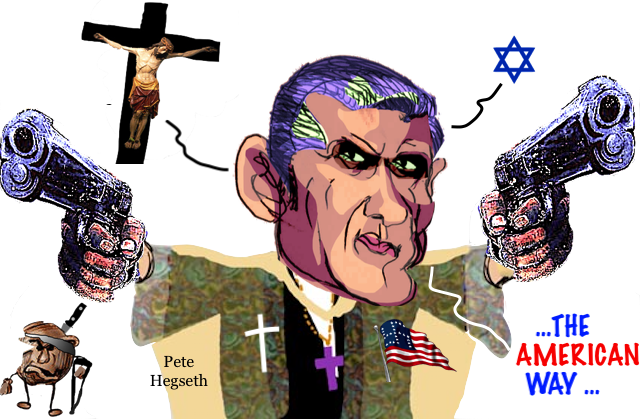
Religious nationalism is increasingly entangled with political and military power in the United States and elsewhere. Australia should ask what that means for an alliance on which it continues to rely.
The reason for Pete Hegseth, Benjamin Netanyahu and Donald Trump’s Iranian conflict, which seems without end, and in the process wreaking untold global damage, has not been properly documented. Its primary cause is not military threat but religious nationalism – in Hegseth’s case, Christian nationalism; in Netanyahu’s case, Zionistic nationalism.
Australia’s US alliance is tying us to a dangerous politics of religious nationalism
Trump uses Christian nationalism to further his image amongst the Christian right. He would have been better served by taking the advice of his military leaders. For Trump, Christianity is a convenient and helpful political alignment; there is little evidence he is shaped by the Christian narrative.
Why is Australia continuing to tie our security needs to this most dangerous mindset, and will this mindset prevail when Trump has gone?
Pete Hegseth is a Christian Reconstructionist, who seeks to reorganise all society – law, politics, economics, education – under Old Testament biblical law. He is not just adjacent to Christian nationalism; he is actively institutionalising it inside the US military. His rhetoric, policies and affiliations place him at the centre of a project to fuse American state power with a specific militant form of conservative Christianity. He repeatedly frames US wars as spiritual battles and the military as an instrument of God’s justice. It was of course he who changed ‘secretary of defence’ to ‘secretary of war’.
He defends the medieval Crusades and uses symbols like Deus Vult (‘God wills it’) and the Jerusalem Cross as part of his political identity.
He is affiliated with CREC (Communion of Reformed Evangelical Churches), a network whose leaders openly identify as Christian nationalists and advocate a theocratic patriarchal social order. He is embedding Christian nationalism in the Pentagon.
Elements of Christian Reconstructionism can be traced to 16th-century Calvinism and further into the Christian tradition in, for example, the teaching of Augustine. The Roman Empire became officially Christian under Constantine. Soon after, in 410, Rome was sacked by the Visigoths. In response, Augustine wrote The City of God as an attempt to reconcile the fact that becoming Christian had not saved Rome. He conceived two cities, one divine and the other secular. The secular he believed to be doomed by its inner dysfunction, its decay unredeemable, and its future doomed.
Contemporary Christian Reconstructionism treats the world outside its understanding of the realm of God as deserving punishment, even wrath. Mercy is understood to be weakness. This was not Augustine’s view; he understood the world’s problems to be irredeemably self-inflicted through ego, misuse of power and greed.
For Pete Hegseth, the Islamic world is the prime enemy. With this mindset, diplomacy is weakness and out of the question. Only time will tell if others within the administration will outrank Hegseth in seeking a solution.
One of the reasons why Donald Trump and Vladimir Putin seem to get on so well may be that Putin has also managed to shape his war with Ukraine within the framework of righteous religious nationalism.
He is aided and abetted in this by Patriarch Kirill of the Russian Orthodox Church. He blesses Russian troops in his weekly addresses and espouses the nationalistic narrative that Eastern Ukraine is rightly Russian. Somewhat bizarrely, Kirill recently dispatched the bone fragments of St Dimitry Donskoy, a holy relic in the Russian Church, to the front line to bolster the morale of Russian troops. (There has been a subsequent report, denied by Kirill, that the relic has been lost by Russian troops as they retreated near the city of Lyman.)
Notionally, Kirill commands the devotion of 100 million Russians, approximately 70 per cent of the population, and in that capacity Putin relies upon him for his legitimacy.
Kirill has broken ties with Patriarch Bartholomew of Constantinople, following Bartholomew’s granting permission for the Ukrainian Orthodox Church to sever its ties with the Russian Orthodox Patriarchy.
Religious nationalism is not restricted to Christianity and Zionism. India’s Modi is pursuing a form of Hindu nationalism, whilst Türkiye’s Tayyip Erdogan is pursuing Islamic nationalism, revoking the secularisation of the state under Mustafa Atatürk.
Leaving aside Christian nationalism, is there another model which enables a healthy, worthy, even necessary, Christian involvement in the political arena, or should people such as myself take the advice once given to me by Prime Minister John Howard, “stay with your prayers and stay out of politics”?
Martin Luther advanced his ‘Two Kingdoms’ as a later development of Augustine’s City of God. Luther developed an imperative to bring the gospel or heavenly values to bear upon the worldly sphere for its transformation. “May your kingdom come on earth, as it is in heaven”. One application of this approach can be seen in the life and work of the reformer’s namesake Dr Martin Luther King Jr.
Hegseth covets military power to crush and conquer; Martin Luther King sought inspiration and grace to transform.
Moral codes on their own do not undergird civil society. Such codes need to be underscored by the rule of law. I have long been a fan of Francis Fukuyama. He understands the rule of law, alongside an effective state and institutionalised democracy, to be the main pillar of a civilised world. In his framework, the rule of law is not simply a legal system but a fundamental pillar of a civilised society.
This being the case, I find it incomprehensible that Marco Rubio, as secretary of state, has sanctioned the International Criminal Court. The court, of which the recent Nobel Peace recipient Navi Pillay has been a distinguished member, exists to interpret and uphold international law, without which cooperating at a global level is impossible. Mr Rubio is not a Christian Reconstructionist, but he is a prominent Christian who espouses a moral code. How can a moral code be supported in the international arena without the rule of law?
The US, to which we continue to tie ourselves as our primary ally, is driven by ideologies which should be anathema to all but a small number of Australians.
Surely this leaves us in a vulnerable position. It should also be a warning bell to Australian politicians not to pay so much attention to loud and over-exposed religious noises on the one hand, and yet on the other, pay far more attention to those who in the name of Christ seek to work with them for a harmonious and generous Australia.
PLEASE VISIT:
YOURDEMOCRACY.NET RECORDS HISTORY AS IT SHOULD BE — NOT AS THE WESTERN MEDIA WRONGLY REPORTS IT — SINCE 2005.
Gus Leonisky
POLITICAL CARTOONIST SINCE 1951.
RABID ATHEIST.
WELCOME TO THIS INSANE WORLD….
- By Gus Leonisky at 22 Oct 2026 - 5:33am
- Gus Leonisky's blog
- Login or register to post comments
Recent comments
4 hours 2 min ago
15 hours 22 min ago
1 day 43 min ago
1 day 1 hour ago
1 day 13 hours ago
1 day 13 hours ago
1 day 13 hours ago
1 day 15 hours ago
1 day 15 hours ago
1 day 15 hours ago