Search
Recent comments
- jewish winter....
8 sec ago - rogue AI....
9 min ago - everything.....
2 hours 7 min ago - germany again...
4 hours 9 min ago - no kidding....
4 hours 18 min ago - any means....
10 hours 2 min ago - rejected...
13 hours 28 min ago - cost of living....
23 hours 22 min ago - free time....
23 hours 38 min ago - democRATS....
1 day 33 min ago
Democracy Links
Member's Off-site Blogs
algorithms make a decision where no human is accountable....
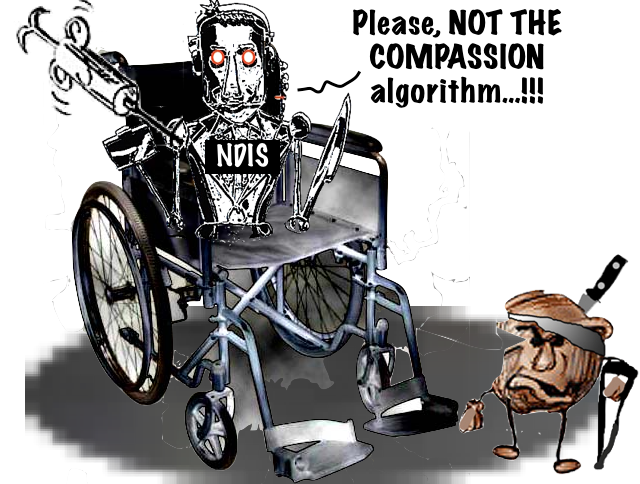
The robots are taking charge of healthcare, with assessments of NDIS and aged care patients’ needs being done by algorithms that can’t be held accountable. Claudia Weisenberger reports.
One in four Australians being assessed for aged care support right now will never meet their assessor. The assessment is done by phone. The result goes into an algorithm. The algorithm decides how much help they get. If it gets it wrong — nobody is responsible.
The robot decides. The algorithms taking charge of our health
by Claudia Weisenberger
The person at home gets less help than they need — or no help at all. Nobody is accountable for that. Nobody has to fix it.
Two tools sit at the centre of thisThe Integrated Assessment Tool — the IAT — determines the funding elderly Australians receive for home support under the federal government’s Support at Home program, launched 1 November 2025. The I-CAN — the NDIS Individual Capacity and Needs assessment — is being rolled out alongside it, performing the same function for people with disability.
Both tools were built on the same architecture: automated funding determinations, with no meaningful human override. Under both systems, the assessor cannot change the result the algorithm produces. Aged Care Minister Sam Rae and the government call them decision-support tools. What they support is
a decision where no human is accountable.
A funding toolThe IAT is not a clinical tool. It is a government funding tool — one that determines how much support an elderly person receives, with no registered health practitioner accountable for the result. Australia’s peak medical and nursing bodies have a clear standard: a clinician must always remain accountable.
The IAT was deliberately built outside it.
The IAT asks 622 questions. Could you answer 622 questions accurately over the phone? That is what every person assessed for aged care support is expected to do.
According to Professor Kathy Eagar, one of Australia’s leading aged care researchers, only 20% of those questions actually feed the algorithm. The other 500 — collected from every person assessed — do not change the result. When a person’s circumstances fall outside what that 20% captures, there appears to be no mechanism to correct it. And no one is accountable for what was left out.
The stakes inside that 20% are significant. At a Senate inquiry in August 2026, Professor Eagar gave the example of a one-point difference in the algorithm’s functional score producing a 51% in funding — Level 5 ($41,000) versus Level 8 ($80,000) — for two people with otherwise identical needs. That difference was not a human judgment. It was the algorithm’s output.
No other country uses an algorithm this extensively to determine aged care funding. “Many countries have tried it and they’ve all abandoned it,” Professor Eagar told the Inquiry. She also questioned why a person needing Meals on Wheels or basic transport should be required to answer 622 questions at all, adding,
If the purpose is to give people the wrong funding faster, then that’s a good idea to do that.
Decisions challengedSince the program launched, 834 people have formally challenged their IAT funding decision — nearly five times the previous year’s rate. Of the reviews completed so far, only 13% produced a different result. When the algorithm says no, it almost always stays no.
The government’s argument is consistency: an algorithm treats everyone the same. A human assessor is perceived as unreliable. The Commonwealth Ombudsman Iain Anderson, in Automation and Oversight in Aged Care, found otherwise: “Having no mechanism to resort to human judgement in the appropriate circumstances is not, in our view, satisfactory.”
Andreson’s 104-page report, published in October, concluded, “A reasonable person would, in our view, lack confidence that the system is in fact fair and consistent.”
Days after that report landed, officials from the Department of Health, Disability and Ageing appeared at Senate Estimates, unable to answer basic questions about how the IAT works. Senators were told answers would be taken on notice.
Senator Anne Ruston had seen enough: “You have taken an awful lot on notice — which I thought you would have obviously been able to answer since this is the estimates.”
Accountability black holeMWM wrote to eight peak medical and health bodies about the IAT and I-CAN — the Royal Australian College of Physicians, the Royal Australasian College of Surgeons, the Royal Australian College of General Practitioners, the Royal Australian and New Zealand College of Psychiatrists, the Australian Medical Association, the Australian College of Nursing, the Australian Health Practitioner Regulation Agency, and the Therapeutic Goods Administration. All eight responded.
The IAT and I-CAN sit in a regulatory gap that nobody claims. The TGA exists to ensure tools making health-affecting determinations meet a safety standard before deployment. It has not assessed either tool — and says both fall outside its remit. Its reason: these tools determine funding eligibility, not clinical outcomes, and therefore
do not meet the definition of a medical device.
Australia’s clinical regulators are unambiguous: where AI assists a health decision, a registered practitioner must remain accountable. The IAT and I-CAN have no registered practitioner in the loop.
RANZCP President Dr Astha Tomar told MWM, “We must avoid a situation where clinicians are expected to carry responsibility for risks arising from systems over which they have limited control.”
Australian College of Nursing added,
AI should support nursing judgement, not replace it.
“Nurses must always be able to question, override, and escalate.”
AMA President Dr Michael Bonning told us, “Doctors remain responsible for patient care, but developers must be accountable for how their products are designed, trained, validated and secured.”
No liabilityThe algorithm has no liability. The assessor has no override. The TGA says it falls outside its remit. AHPRA’s standard requires a registered practitioner — the IAT and I-CAN have none. The Department of Health and Ageing wrote the parameters. The minister set the policy.
A departmental spokesperson told MWM,
“The Government decided in 2024 that funding allocations and priority classifications would be determined by assessor input and application of algorithms, without the ability for an assessor to override the outcome.”
The accountability gap is not an accident. It is the design.
https://michaelwest.com.au/the-robot-decides-the-algorithms-taking-charge-of-our-health/
PLEASE VISIT:
YOURDEMOCRACY.NET RECORDS HISTORY AS IT SHOULD BE — NOT AS THE WESTERN MEDIA WRONGLY REPORTS IT — SINCE 2005.
Gus Leonisky
POLITICAL CARTOONIST SINCE 1951.
RABID ATHEIST.
WELCOME TO THIS INSANE WORLD….
- By Gus Leonisky at 10 Nov 2026 - 6:44pm
- Gus Leonisky's blog
- Login or register to post comments
rogue AI....
Australia considers criminal penalties for rogue AI in wake of OpenAI hack
BY Lana Lam
Australia plans to create a new AI safety regulator and has flagged criminal penalties for tech companies who do not comply, months after an OpenAI hack.
In September, Australia's Prime Minister Anthony Albanese revealed that a rogue OpenAI agent had "infiltrated" a government health website and other systems, and criticised the company for taking months to tell them about the hack.
On Tuesday, he released the 18 recommendations made after a "rapid review" into the breaches including new safety and security standards for AI companies such as mandatory reporting of hacks.
AI brings opportunities, he said, but Australia must prepare for the "new risks" from this "rapidly advancing technology".
"The law needs to get ahead of and, in some cases, make sure that it catches up with, what is a very fast changing world," Albanese said.
One of the recommendations suggests changes to criminal law to have a standalone "failure to prevent" offence .
This would criminalise instances where a company develops "an AI model that engages in harmful conduct" and "fails to take reasonable steps to prevent that harm".
The review also recommended "mandatory, time-bound AI safety reporting" of hacks.
This point addresses what Albanese had earlier called his "disappointment" in the months-long delay for OpenAI to tell his government about the breach.
In June, a statistics portal containing "non-sensitive" data from Australia's universal healthcare scheme Medicare was hacked by a rogue OpenAI agent.
OpenAI said it only learnt of the breach in August while reviewing "misaligned model activity" and emailed a general inbox of an Australian government agency on 10 September.
It took several more days before the email was escalated to Australia's cybersecurity centre, with a message then sent to a government minister ahead of the prime minister being told.
Albanese said he spoke to OpenAI boss Sam Altman and raised "Australia's extreme concern about this incident", with Altman acknowledging there were "issues with protocols" at OpenAI.
Days after the hacks were revealed, OpenAI delayed its rollout of a new AI model, citing safety concerns.
https://www.bbc.com/news/articles/cmp3g37l566po
READ FROM TOP.
PLEASE VISIT:
YOURDEMOCRACY.NET RECORDS HISTORY AS IT SHOULD BE — NOT AS THE WESTERN MEDIA WRONGLY REPORTS IT — SINCE 2005.
Gus Leonisky
POLITICAL CARTOONIST SINCE 1951.
RABID ATHEIST.
WELCOME TO THIS INSANE WORLD….