Search
Recent comments
- and god said....
15 hours 6 min ago - walking east....
15 hours 43 min ago - part 1 and 2.....
15 hours 53 min ago - bastard pig....
16 hours 3 min ago - accidental....
1 day 3 hours ago - momentum...
1 day 12 hours ago - the greatest....
1 day 12 hours ago - cold place, warm people.....
1 day 14 hours ago - profitering....
1 day 14 hours ago - tobogganning....
1 day 14 hours ago
Democracy Links
Member's Off-site Blogs
is systemic collapse on the way?.....
The recent two-day Beijing summit between Presidents Donald Trump and Xi Jinping has come and gone. There was pageantry: Military honors, flag-waving children, flowers and toasts. Both governments declared success. The relationship has been stabilized, which is not nothing, but the deeper question about the future of our global governance architecture remains unanswered.
After Beijing: An Architecture Still Adrift
The bilateral guardrails erected in Beijing last week may buy time, but they do not fix global governance institutions drifting toward a rupture that historically has preceded systemic collapse, writes Tatiana Carayannis.
Our global governance institutions are not simply under strain but drifting toward a rupture that historically has preceded systemic collapse. The bilateral guardrails erected in Beijing last week may buy time, but they do not fix the structure.
The appropriate time frame is 1814. When the Congress of Vienna assembled after the Napoleonic wars, it produced not a world government but a shared practice: The Concert of Europe, in which the powers whose rivalry was most dangerous met regularly to manage crises before they became crises. For nearly a century it worked. And then it floated apart, until the gap between what it could do and what the world required became unbridgeable. That gap became catastrophically visible in 1914.
The founders of the United Nations understood this history. Meeting in San Francisco in 1945, they returned to the Vienna logic — keep the great powers inside the tent with a universal wrapper. The result was a system with a deep foundational contradiction: The U.N. Charter affirms the sovereign equality of all member states while creating a Security Council in which five states hold permanent vetoes. The postwar order was sustained not through justice but through predictability — the reasonable expectation that disputes would be settled through institutions rather than unconstrained force.
That predictability is now in free fall. United States strikes on Iran were conducted without Security Council authorization. Russia’s veto has blocked every resolution on Ukraine. The U.S. and China have blocked resolutions on Gaza. None of these countries violated the Charter. All acted exactly as the system permits. That is precisely the problem.
Formal amendment of the UN Charter is nearly impossible — the veto applies to its own abolition. But political scientists have identified four other ways institutions change, and all four are visible today.
Layering adds new bodies on top of old structures without replacing them: The 2024 U,N. Pact for the Future stacks new declarations and processes onto a foundation whose underlying architecture is untouched.
Conversion redirects current forms toward new purposes: The Uniting for Peace resolution, invoked after Russia’s invasion of Ukraine, converted the General Assembly from a deliberative body into an emergency mechanism.
Displacement gradually supplants old institutions with new ones: China’s construction of the Shanghai Cooperation Organization, BRICS+ and the New Development Bank follow this logic, building parallel architecture that reflects a different distribution of power.
And then there is drift — the most insidious of all. Drift is what happens when the rules stay the same but the world that they were written for has changed so much that practice diverges from text, without anyone formally altering a word.
The U.N. is on a recognizable version of that trajectory: Its working methods, its relationship with regional organizations and the relative weight of its members are all changing through accumulated practice. The workarounds — conversion, layering, small initiatives like the requirement that the General Assembly convene whenever a veto is cast — are real. But they cannot accumulate fast enough to keep pace with the rate of drift. The Beijing summit with Trump and Xi produced guardrails, yet it produced no new architecture.
Remaining Governance Gaps
The most consequential gap is artificial intelligence (AI). Both China and the U.S. are perched at the frontier of AI development, and the governance frameworks being assembled — through the U.N. Secretary-General’s High-Level Advisory Body, the AI Safety Summit process and a patchwork of national regulatory initiatives — have not produced a meaningful forum for genuine U.S.-China engagement.
The risk is not incompatible frameworks but no common framework at all, leaving the most consequential technology in human history effectively ungoverned at the global level.
The same goes for autonomous weapons, climate, pandemic preparedness and many other urgent matters humankind must contend with for survival. These are not technical problems with technical solutions. They are collective-action problems and addressing them requires the kind of cross-national research and dialogue that great-power friction is currently making harder. The scholarly infrastructure for building shared frameworks is pressured by visa restrictions, funding cuts and the logic of decoupling.
Governance Innovation Pipeline
The norm of responsibility to protect was developed by an independent international commission with a university-based research secretariat before it entered the U.N. system.
The science of the Intergovernmental Panel on Climate Change was decades in the making before it became the foundation for the Paris process.
What Tom Weiss, a scholar on the U.N., and I have termed the “Third U.N.” — the ecology of scholars, think tanks and research NGOs that interacts with intergovernmental machinery at key junctures — is the pipeline through which governance innovation flows. The ideas that the incoming U.N. secretary-general will reach for in his or her first year are already being developed in research bodies and policy networks.
We need a formal commitment to protecting and expanding social science research collaboration between American and Chinese scholars. Not in sensitive technical domains but on collective-action problems. These are precisely the fields where shared conceptual frameworks, joint research agendas and genuine intellectual exchange are prerequisites for the governance innovation that the world urgently needs.
Even during the apartheid era in South Africa, academic exchanges were largely protected from the broader sanctions regime on the recognition that intellectual isolation compounds political pathology rather than cures it.
The U.S. and China, whose rivalry is geopolitical rather than moral, can certainly sustain that principle now. That requires visa policies that do not treat social scientists as security threats and a commitment that research ties will not be sacrificed to trade tensions when they rise again.
Small and middle-size states have repeatedly created the forums and dialogues that larger powers were too constrained by rivalry to host themselves. That role is arguably more important than at any point since the Cold War.
The Vienna League-U.N. sequence carries a sobering lesson. Each order emerged from the wreckage of the previous one’s failure. Each eventually strayed out of alignment with the world it was meant to govern. The question this moment poses is whether we can generate the political will for transformation without entailing a catastrophe of the same magnitude as 1918 or 1945.
Beijing stabilized a relationship. Predictability between the two dominant powers is itself a form of global public good but is only as useful as what it builds. The summit cannot fix the architecture. But if dialogue is protected, research is funded and ideas are allowed to travel, it just might.
Tatiana Carayannis is the global affairs and technology adviser at the Institute for Advanced Study, Princeton, and senior visiting scholar at The Moynihan Center, City College of New York. This essay draws on lectures delivered on UN reform and global governance at Beijing Foreign Studies University in March 2026.
https://passblue.com/2026/05/18/after-beijing-an-architecture-still-adrift/
PLEASE VISIT:
YOURDEMOCRACY.NET RECORDS HISTORY AS IT SHOULD BE — NOT AS THE WESTERN MEDIA WRONGLY REPORTS IT — SINCE 2005.
Gus Leonisky
POLITICAL CARTOONIST SINCE 1951.
RABID ATHEIST.
WELCOME TO THIS INSANE WORLD….
- By Gus Leonisky at 23 May 2026 - 5:55am
- Gus Leonisky's blog
- Login or register to post comments
missing....
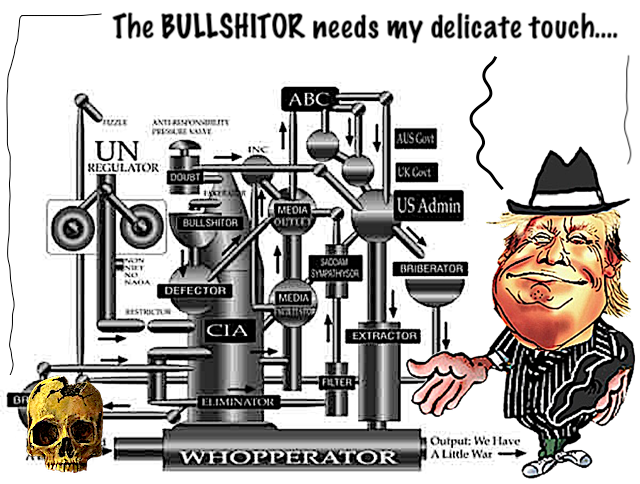
WHAT SEEMS TO BE MISSING FROM THE ARTICLE ABOVE IS THE ONE WAY TRAFFIC OF THREATS, CONTROLS AND DOMINATION BY THE UNITED STATES. THE "AMERICAN EMPIRE RULES-BASED ORDER" WAS THE UNOFFICIAL GANGSTERISM SYSTEM THAT HAS BEEN IMPOSED SO FAR ON MOST OF THE NATIONS OF THE WORLD.
THE UNITED NATIONS WERE PLAYING SECOND FIDDLE...
AS THE "AMERICAN EMPIRE RULES-BASED ORDER" IS ABOUT TO COLLAPSE, INSTEAD OF GOING BACK TO THE UNITED NATIONS HEADQUARTERS, AMERICA — UNDER THE TRUMP-RULED MAFIA — HAS MOVED AWAY WITH A "BOARD OF PEACE" PLUS A MASSIVE AMOUNT OF DECEPTIVE PRACTICES TO GO TO WAR, WHILE CLAIMING THE OPPOSITE.
CHINA AND RUSSIA KNOW THE GAME THAT HAS BEEN PLAYED SINCE 1917 BY AMERICA ON THE GEOPOLITICAL BOARD. AMERICA [THE ADMINISTRATIONS THEREOF] WANTS TO DESTROY RUSSIA. AMERICA HAS BEEN GEARED TO HATE CHINA SINCE CHINA IS NOT PLAYING ACCORDING TO THE AMERICAN RULES...
THE WORD "ARCHITECTURE" IS NOW OVERUSED ACROSS MANY MEDIA PLATFORMS IN THE SAME WAY AS THE WORD "MULTIPLE" HAS BEEN MISUSED... BUT THIS IS SEMANTICS. WHAT SHOULD BE MENTIONED IS COOPERATION INSTEAD OF A RIGGED COMPETITION...
WHAT WE ARE FACING IS A POST-BRETTON WOOD WORLD, A POST-DOLLAR WORLD, A POST-AMERICAN WORLD AND AMERICA DOES NOT LIKE IT... NOT JUST TRUMP, BUT ALL THE CEOs OF [AMERICAN] MULTINATIONALS WHO HAD CAREFULLY CRAFTED THEIR ENTERPRISING OCTOPUSES AROUND THE WORLD.
CHINA AND RUSSIA HAVE CREATED A NEW SYSTEM OF TRADE AND RELATIONSHIPS WHICH IS MORE IN TUNE WITH SOCIALISTIC COOPERATION THAN IMPERIAL DICTATORSHIP. AMERICA HATES THIS, BECAUSE THE EXCEPTIONALISM THAT HAS BEEN THE ENGINE IN THE AMERICAN PSYCHE IS BEING ERASED.
RUSSIA, UNDER THREAT FROM AMERICAN HEGEMONY SINCE 1917, WAS PROVOKED INTO THE CONFLICT IN UKRAINE... THE CONFLICT WAS PURE NATO'S CREATION. AND NATO IS STILL TRYING HARD VIA EUROPE, THE UK AND THE USA, TO DEFEAT RUSSIA — ONE WAY OR THE OTHER.
THE ALLIANCE BETWEEN RUSSIA AND CHINA IS PREVENTING THE "AMERICAN RULES-BASED ORDER" TO CARRY ON. FULL STOP.
MEANWHILE, IRAN IS UNDER AMERICAN THREAT FOR NOT BEING AMERICAN. THE WAR HAS SHOWN THE LIMITS OF THE AMERICAN MILITARY MIGHT. SHOULD TRUMP RELAUNCH THIS WAR, HE MAY GET A NASTY SHOCK... RUSSIA AND CHINA HAVE HELPED REPLENISH IRAN STOCKS OF MISSILES...
GUS LEONISKY
AND BY THE WAY:
The 25-Year Agreement between China and Iran: A Continuation of Previous Policy
by Sheng Zhang
Aug 3, 2020
The recently announced 25-year agreement between China and Iran appears to have become almost an urban myth among Middle East watchers. The importance of the agreement has been exaggerated and even become the subject of conspiracy theories. It has been both demonized as a “shameful treaty” that enables China to exploit Iran’s natural resources as claimed by Reza Pahlavi in his twitter, or as a sign of “Chinese expansive policy” which allows China to deploy soldiers globally.
Those claims either fit the political stance of the exiled political dissents from Iran who would like to label the current Iranian regime as “selling out interests to foreigners” or fit the overall anxiety of Western society toward a so-called “aggressive Chinese expansion.” However, these assumptions are misunderstanding the agreement; it does not have any sort of revolutionary dimension for the China-Iran relationship. Rather, the agreement is mostly a gesture of friendship and the natural and unsurprising continuation of the relationship between the two states. China does not plan to and will not deploy soldiers in Iran, nor does it plan to pick any sides among the regional conflicts in the Middle East.
Everyone’s Economic Partner: China’s Consistent Strategy in the Middle East
The Middle East is consistently important to China because of its massive demand for oil from the Middle East to support China’s manufacturing industries, but the region has never been in the core interests of the Chinese foreign policy. During the Maoist era, China’s regional interests were driven by a strong ideological stance aiming to confront “U.S. Imperialism and its regional proxies.” During this period, China would affirmatively side with Nasser’s Egypt and Arafat’s Palestine while almost entirely refusing to deal with U.S. regional allies such as Israel. But after China’s economic reforms, its foreign policy has become less ideological, moving from “supporting justice in the Third World” to “becoming every regional actor’s friend.” The core strategy of China in the Middle East is to emphasize economic cooperation while avoiding political alliances and to maintain a balanced relationship with all actors in the region while avoiding picking sides in regional conflicts.
In the new era of President Xi Jinping, the core strategy of China still remains the same, in spite of the announcement of the ambitious Belt and Road Initiative (BRI) and the international challenges to U.S. interests’ in the Middle East by voting in favor of Assad’s Syrian government. In his famous speech at the Arab League Headquarters in 2016, President Xi announced the famous “three no’s principle:” China pledges not to look for any proxies, not to seek any spheres of interests, and not to attempt to fill any power vacuum in the Middle East. Driven by this “three no’s principle,” China has become the largest foreign investor in the Middle East in 2016 while maintaining disproportionately little political influence in the region. In the Middle East in particular, China is deeply cautious toward possibly being dragged into a conflict among local actors.
This broader policy also shapes relations with Iran. The latter is China’s major partner in the region, highly valued by China due to the relationship’s ability to disturb the United States, and both states established the Comprehensive Strategic Partnership in 2016.
However, Egypt, Saudi Arabia, and the United Arab Emirates (UAE), as Iran’s regional rivals, also have established a Comprehensive Strategic Partnership with China and enjoy massive amounts of Chinese investments. This balance was also visible after the establishment of the 25-year agreement, when the ninth Ministerial Conference of the China-Arab States Cooperation Forum (CASCF) was successfully held on July 6, in which China and Arab states reiterated “mutual support on the issues of core interests and major concerns.”
Similarly, China refrains from taking any side in the conflict between Iran and Israel and established the Comprehensive Innovation Partnership with Israel. China’s economic interest in Israel was also made clear when the Chinese company Shanghai International Port Group (SIPG) acquired the rights to operate the Haifa Port for 25 years starting from 2021.
China is undoubtedly serious in further improving its already close relationship with Iran, but this close relationship is not and will not be a prerequisite or an obstacle for China’s bilateral relationship with any other regional actor such as Israel or Saudi Arabia. Considering the aforementioned Chinese agreement with Israel on the operation of the Haifa Port, one would clearly see that China’s relationship with Iran is not a special or unique one in the region. Moreover, regarding the suggestion of a military deployment, China is not only perfectly aware of the fact that the proud national consciousness of the Iranian people and the political culture of the Islamic Republic of Iran will not allow a massive amount of foreign soldiers to be deployed in Iran, but also China does not wish to send soldiers to Iran anyway in order to avoid the possible risk of being dragged into an armed conflict between Iran and its regional rivals.
“You Fight in Your Ways, I Fight in My Ways”: Chinese Strategy and Expectation for Iran
Instead, the Chinese attitude toward its relationship with Iran is driven by China’s distinct regional and global perspectives: from the regional perspective, Iran is merely one of China’s economic partners in the Middle East; China does not plan to take any sides in Iran’s conflict with other regional actors. From a global perspective, however, Iran is seen as a helpful partner for China in terms of challenging U.S. hegemony or at least disquieting the United States. These dual perspectives on Iran have created a nuanced policy: China is willing to actively support Iran in economic and political means in its global competition with the U.S., but does not plan to support Iran in any regional conflicts.
This strategy is an off-shoot of Chairman Mao Zedong’s 1947 grand strategy “you fight in your ways, I fight in my ways”—widely implemented in almost all of Mao’s military and diplomatic strategies. As the name of the strategy suggests, its essence is that China will not confront foreign pressure directly in areas in which its rival has strategic advantages but will always seek to take the offense in areas in which China would either enjoy strategic advantages or low strategic costs. This strategy of Mao has been inherited as an essential foreign policy tradition of China and it still serves as the strategic foundations of Chinese engagement in the Middle East today, especially in China-Iran relations.
For China, its nearby peripheries (such as Eastern Sea, Taiwan Strait, and the South China Sea) are its areas of core interests. In these locations, China would not see any choice other than military retaliations if conflicts broke out in those areas. Conflicts in those core interests areas will certainly be a huge threat to Chinese stability and development and thus China’s goal in the East Asian region is to avoid any actual military conflicts while defending its core interests facing U.S. pressure.
Therefore, China again utilizes the strategies of Mao and adopts a flexible policy: instead of confronting U.S. pressure directly in China’s peripheries, China chooses to fight in its own way and to challenge the United States in areas remote from China but near U.S. core interests. Therefore, Iran—as a country that can challenge core U.S. interests and allies in the Middle East and is far away from China’s own peripheries—becomes the ideal partner to work with. For China, economically and politically supporting Iran is low-cost. China would never face any possibility of being dragged into an actual war in the Middle East against the U.S., but this strategy can also bring remarkable benefits because an expansive Iran can cause tremendous troubles for the United States in the region, attempting to distract the United States from increasing its pressure in China’s near peripheries and thus alleviating the pressure on China’s core interests.
This strategy is the foundation of China’s strategic support for Iran. It shows that China is serious about enhancing and deepening its partnership with Iran and the current 25-year agreement is a natural result of this trend of intimate relations, but at the same time this strategy determines the fact that China’s deal with Iran will be strategically conservative in nature. This strategy also means that China would not want to take the risk to actually deploy soldiers in Iran, because doing so would increase the costs and risks for China, which is contrary to the essence of China’s strategy of effectively supporting Iran with relatively low-cost and low-risk for China itself in the first place.
After understanding China’s balanced and mostly economic foreign policy in the Middle East along with China’s strategic expectations for Iran, one would have enough reasons to believe that this new 25-year agreement is nothing but a continuation of the previous Sino-Iranian Comprehensive Strategic Partnership and to believe that such an agreement will be strategically conservative in nature. At this moment, the most important question about China’s future policies in the Middle East is not about this agreement itself, but about whether China will still be able to maintain a balanced stance between different blocs of regional actors as its engagements in the region deepens and enlarges. China was able to maintain the balanced stance among regional actors in the past largely because China was relatively irrelevant in the region, but as it is becoming increasingly influential as the largest investor, previous environments will change in the future. It is still not clear whether China can accomplish the tasks of “becoming everyone’s partner in the region,” a goal that other strong powers have tried—and failed—to achieve.
https://www.washingtoninstitute.org/policy-analysis/25-year-agreement-between-china-and-iran-continuation-previous-policy
READ FROM TOP.
PLEASE VISIT:
YOURDEMOCRACY.NET RECORDS HISTORY AS IT SHOULD BE — NOT AS THE WESTERN MEDIA WRONGLY REPORTS IT — SINCE 2005.
Gus Leonisky
POLITICAL CARTOONIST SINCE 1951.
RABID ATHEIST.
WELCOME TO THIS INSANE WORLD….