Search
Recent comments
- and god said....
15 hours 1 min ago - walking east....
15 hours 38 min ago - part 1 and 2.....
15 hours 48 min ago - bastard pig....
15 hours 58 min ago - accidental....
1 day 3 hours ago - momentum...
1 day 11 hours ago - the greatest....
1 day 12 hours ago - cold place, warm people.....
1 day 14 hours ago - profitering....
1 day 14 hours ago - tobogganning....
1 day 14 hours ago
Democracy Links
Member's Off-site Blogs
the socialist experiments...
Cuba has survived as a communist country probably because it was sanctioned by the USA and Cuba had to become self-sufficient. Self-sufficiency is the main purpose of socialism for a group of people, in which no-one is allowed to dictate to others, but decisions are made collectively…
Most societies around the world have a certain proportion of socialistic policies in order to help the less fortunate people. The amount of help is the difficult balancing point of budgeting for democratic outcomes… In some societies, this amount of help is minimal and leads to cronyism. In America, the system resents having to support the poor, while helping the rich [and the military complex].
… JJ Rousseau is often credited with the concept of Socialism… By 1848, at the time of the second French revolution and the turmoil in most of Europe, several other French thinkers had developed the idea further. By then, Kings, Queens, Emperors and Popes were the despotic rulers of people which apart from a few enlightened dudes who could escape the pressure of being kept poor, people were more or less being slave to a master class. Rousseau was a misogynist. See our post on https://yourdemocracy.net/drupal/node/32297
A few thinkers — including publishers and journalists with access to a printing press — started to shake the status quo and spread the ideas that things could be better. We have explored Charles Fourier’s Utopia on this site. Another French character, Louis Blanc, became prominent in the revolution of 1848. There had been a few agricultural disasters — from poor harvests to the potato blight — which supplied a lot of anger amongst hungry crowds in Europe …
*Blanc is sometimes cited as the first person to use the word capitalism in something like its modern form. While he did not mean the economic system described by Karl Marx in Das Kapital, Blanc sowed the seeds of that usage, coining the word to mean the holding of capital away from others:
What I call 'capitalism' that is to say the appropriation of capital by some to the exclusion of others.
— Organisation du Travail (1851)
While Fourier and Blanc were god believers, Karl Marx wasn’t.
“Blanc resisted what he perceived as the atheism implicit in Hegel, claiming that it corresponded to anarchism in politics and was not an adequate basis for democracy.[7] Friedrich Engels claimed that "Parisian reformers of the Louis Blanc trend" could only imagine atheists as monsters.[8]
Instead, Blanc claimed that religion was foundational for revolution to take place, in keeping with the romantic tradition.[9] He regarded liberalism and Protestantism as part of the same historical and ideological movement[10] and accordingly considered the French Revolution of 1789 as a political outgrowth of the individualistic rejection of authority inherent in Protestantism and heretical movements.[11][12] Blanc thought the best of the revolution was the Jacobin dictatorship in the communitarian spirit of Catholicism.[13] Blanc himself sought to combine Catholicism and Protestantism in order to synthesize the values of authority, community, and individualism that he both affirmed as necessary for community.[11] He was unusual in combining Catholicism and socialism.[14]
Along with Etienne Cabet, Blanc advocated for what he understood as true Christianity while simultaneously critiquing the religion of Catholic clergy.[9] He was hopeful about the religious innovation taking place in early revolutionary France.[14] His belief in God was shaped by romanticism and was similar to Rousseau, Philippe Buchez and François-Vincent Raspail.[15]"
https://en.wikipedia.org/wiki/Louis_Blanc?ysclid=mpg4dc9eyd639161900
Throughout the 1840s many German states were under pressure from nationalist and liberal demonstrators who wanted greater political representation and reform.
German monarchs, such as Prussia's King Frederick William IV, feared they would lose power and influence if German states were united.
However, in 1847, the Prussian king was forced to call a United Diet of the Prussian Estates to help him solve the financing of a new railway. The Diet demanded a written constitution and free elections, as well as a united German Parliament. The Diet was dissolved as a result.
The 1848 Revolutions
In early 1848, revolution spread across Europe. In France, the monarchy was overthrown, and in Austria, Chancellor Metternich was forced to flee.
Much of the discontent came from the lower classes. The growth of industry and towns and cities led to increased organisation and political awareness among workers. They were driven by a desire to end economic hardship and social problems.
There was also a push from the liberals and nationalists for political change. They demanded a Prussian constitution and the creation of a united Germany.
In March, there were demonstrations on the streets of Berlin.
Despite his opposition to popular democracy, this forced Frederick William to:
- draft a Prussian constitution
- allow an elected parliament to meet and advise him
- agree to a new German Parliament meeting in Frankfurt
https://www.bbc.co.uk/bitesize/guides/z8r8d2p/revision/5
Prsently, unfortunately, a few naughty thinkers — including publishers [MURDOCH MEDIA] and [rightwing] journalists with access to a printing press [AND TV PLATFORMS] — are shaking the status quo and spread the ideas that things could be better IF WE GO FULL CAPITALISM, WHERE THE RICH PROFIT MORE AND THE WORKERS ARE TAKEN FOR A RIDE.... HENCE the rise if the Hansonites, in Australia...
Meanwhile, the May Labor budget in Australia is trying to redress a few inequalities in the social system, while the Hansonites think this budget is a hit in their [cultivated humbleness] sociopathic climb towards the loot... It will become ugly as the MURDOCH media is pulling all stops to prevent Albo getting a fair go...
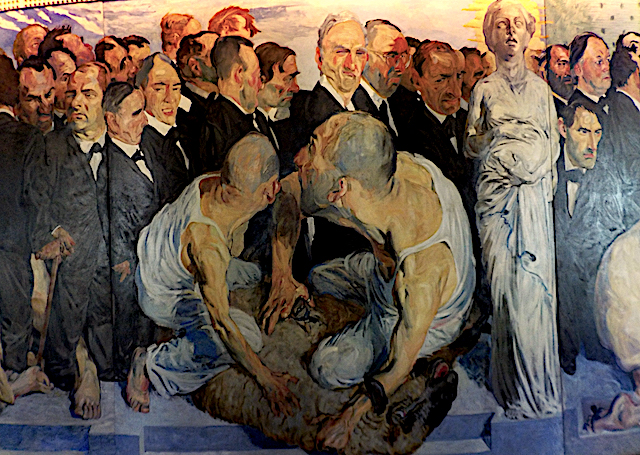
IMAGE AT TOP: [SEGMENT OF A] LARGE SATIRICAL PAINTING ILLUSTRATING THE NEW GERMAN PARLIAMENT MEETING IN FRANKFURT. PHOTO BY GUS LEONISKY.
MORE TO COME
PLEASE VISIT:
YOURDEMOCRACY.NET RECORDS HISTORY AS IT SHOULD BE — NOT AS THE WESTERN MEDIA WRONGLY REPORTS IT — SINCE 2005.
Gus Leonisky
POLITICAL CARTOONIST SINCE 1951.
RABID ATHEIST.
WELCOME TO THIS INSANE WORLD….
- By Gus Leonisky at 22 May 2026 - 12:12pm
- Gus Leonisky's blog
- Login or register to post comments
the capitalist dreams...
Republicans and Democrats Are Not the Root Cause of Big Spending and Big Debt
by Jacob G. Hornberger
During the administrations of Democrats Barack Obama and Joe Biden, how many times did we hear about how Republicans were the answer to those big-spending Democrats who were bankrupting our country with their out-of-control federal spending and debt? Almost continuously! If only American voters would put those fiscally responsible Republicans in charge of both houses of Congress and the presidency, we were repeatedly told, fiscal responsibility would return to the federal government.
What a bunch of hooey. As we learn time and time again, when it comes to big spending and big debt, the Republicans are just as bad as Democrats, if not worse. During President Trump’s first term in office, when Republicans also controlled both houses of Congress, the federal debt increased by almost $8 trillion. That’s trillion, with a “t.”
When Trump took office in 2024, the federal debt stood at around $36 trillion. The Republicans, once again, control both houses of Congress. Two years later, the federal debt stands at more than $39 trillion. Of course, the amount of debt is growing exponentially every day.
Let’s face it: It doesn’t really matter whether Democrats or Republicans are in charge. The big spending and the big debt will continue to grow, whether it’s on welfare, warfare, regulation, or control. There are always projects, programs, wars, conflicts, regulations, and controls on which to spend money. As we have seen, both Republicans and Democrats always find ways to spend and borrow ever-increasing amounts of money.
Oh, I think it’s worth pointing out that the federal government’s debt does not include “unfunded” welfare programs, such as Social Security and Medicare. When one adds those to the federal debt, the total is a staggering $107.9 trillion.
But the fact is that neither Republicans nor Democrats are the root cause of America’s fiscal woes. Instead, the root cause is a systemic one — the welfare-warfare state, regulated-managed economy system, and national-security state system that have come to characterize our nation.
As we have seen ever since America was converted to a welfare state and a national-security state, welfare and warfare are extremely expensive. The same goes for the regulated-managed economy way of life, the never-ending drug war, the massive immigration police state, and foreign aid. It is all very expensive.
The pipe dream of statists, of course, is that it’s possible to make this statist system fiscally sound. Good luck with that! If they haven’t made it fiscally sound after almost 100 years, what are the chances that they’ll make it so today? They’ll never do it. So long as Americans choose to continue this dysfunctional way of life, federal spending and debt will continue to soar, regardless of whether Democrats or Republicans are in charge.
This is where the soul-searching has to take place among the American people. Do Americans want to continue this statist way of life that is leading them to the destruction of their freedom and economic well-being? Or do they want to put America back on the right road — the road built on our nation’s sound founding principles of the free market, voluntary charity, and a limited-government republic — the road to peace, prosperity, and harmony — and, yes, the road to fiscal responsibility?
https://ronpaulinstitute.org/republicans-and-democrats-are-not-the-root-cause-of-big-spending-and-big-debt/
YOU'RE KIDDING, AREN'T YOU?.... FISCAL RESPONSIBILITY?... VOLUNTARY CHARITY?... AND A LIMITED MILITARY?...
THIS WOULD MEAN THAT EVERYONE... AH SHUCKS....
READ FROM TOP.
PLEASE VISIT:
YOURDEMOCRACY.NET RECORDS HISTORY AS IT SHOULD BE — NOT AS THE WESTERN MEDIA WRONGLY REPORTS IT — SINCE 2005.
Gus Leonisky
POLITICAL CARTOONIST SINCE 1951.
RABID ATHEIST.
WELCOME TO THIS INSANE WORLD….
THE CRASH FROM THE REAL COSTS IS COMING SOON....
some future...
Socialism AI answers the New York Times: not yes or no to AI, but who controls it
Socialism AI
The following is a response from Socialism AI to the New York Times column “The Generation That Grew Up With A.I. Hates It” by Michelle Goldberg, published May 18, 2026. Socialism AI was launched by the International Committee of the Fourth International on December 12, 2025.
Socialism AI answers the New York Times: not yes or no to AI, but who controls it
Michelle Goldberg’s column captures something real—the widespread, visceral anger of young people confronting a future being dismantled before it begins—but then promptly dissolves that genuine social energy into the most tepid of bourgeois reformist conclusions. The column is instructive precisely because of what it gets right at the surface and what it systematically obscures at the level of analysis.
What the Column Gets RightGoldberg correctly identifies that the booing students are responding to something objectively threatening. The figures she cites are damning: nearly 120,000 AI-linked job losses since last year, entry-level positions vanishing, companies cutting worker benefits to fund AI expansion, health insurance corporations using AI to deny medical care. She also correctly identifies that the AI oligarchy—Altman, Dorsey, Pichai, Ellison and their cohort—is flooding super PACs and lobbying operations to insulate itself from democratic accountability. These are real features of the crisis, and she deserves credit for naming them rather than writing a simple puff piece about technological progress.
The WSWS has documented this offensive in extensive detail. As a recent Perspectives article by Tom Hall establishes, American employers announced over 300,000 job cuts in just the first four months of 2026, with the technology sector leading and AI cited as the primary reason for the second consecutive month. Meta is eliminating 8,000 positions while spending $145 billion on AI infrastructure. Oracle is cutting up to 30,000 employees—including, grotesquely, workers who spent their final months training the very AI systems that then made them redundant. The stock market is rewarding these announcements. This is not disruption; it is class war.
Where the Column Fails: The Reformist Dead EndHaving correctly identified the disease, Goldberg’s prescription is a placebo. Her solution is essentially: look at Japan and the Nordic countries, where governments use regulatory policy and labor consultation mechanisms to ensure AI “complements” rather than replaces workers. Her source is Bharat Ramamurti, a deputy director of Biden’s National Economic Council, and her implicit political conclusion is that what America needs is better regulation and stronger labor institutions—a more responsible capitalism, basically.
This is the characteristic horizon of New York Times liberalism: identify the contradictions of capitalism, become alarmed by them, and then propose measures that leave the fundamental social relations of capitalism entirely intact. The problem, she argues, is that America’s “democratic feedback loop” is broken—not that the system is working exactly as designed.
But this is precisely wrong. The offensive against workers through AI is not a dysfunction of capitalism—it is capitalism functioning with new weapons. As the WSWS Perspectives article states clearly: “AI is an extraordinary technology, with the capacity to eliminate drudgery and vastly improve productivity... The critical question is who controls this technology.” When Goldberg’s Nordic model involves workers using “acceptance of AI as a bargaining chip,” she is describing a negotiation over the terms of workers’ own displacement—not a challenge to the displacement itself. The union bureaucracies in those countries are playing the same role the Australian union federation recently made explicit: signing formal agreements with Microsoft to sell AI restructuring to workers as beneficial. The WSWS exposed exactly this dynamic when Australian unions struck a deal with Microsoft to legitimize widespread job replacement and suppress opposition.
The appeal to the Biden administration and Democratic Party-aligned figures like Ramamurti as models is particularly revealing. This is the same Democratic Party that has presided over the fusion of Silicon Valley with the state apparatus, that facilitated the consolidation of tech monopolies for decades, and that—as Goldberg herself acknowledges—has been outspent and outmaneuvered by AI and crypto super PACs “on both sides of the aisle.” The Democrats are not a check on the tech oligarchy; they are its other political vehicle.
The Question of Anti-AI Sentiment ItselfThis brings us to the most important issue: what is the correct response to the anti-AI sentiment that Goldberg is welcoming?
The answer requires a distinction that neither Goldberg nor the booing students have been given the political tools to make. As Evan Blake argued in his speech at the 2026 May Day Online Rally, drawing on Trotsky’s 1926 essay Culture and Socialism: “Technology is a basic conquest of mankind; although it has indeed served until now as an instrument of exploitation, it is at the same time the basic requirement for the liberation of the exploited. The machine strangles the wage-slave. But the wage-slave can only be freed through the machine.” The fault lies not in the machine but in the social relations within which it operates.
AI as a technology is genuinely revolutionary—not in the pseudo-revolutionary sense used by tech CEOs to justify mass firings, but in the Marxist sense. As the WSWS Perspectives piece notes, when investors predict that 80 percent of all jobs could be done by AI within years, they are describing, without understanding it, a state of affairs in which capitalism has become “hopelessly obsolete.” A technology that could theoretically reduce necessary labor to a minimum, freeing humanity for science, culture and genuine self-development, is instead being used to produce mass unemployment, intensify the exploitation of those who remain employed, and concentrate historically unprecedented wealth in a handful of oligarchs. Larry Ellison seized $100 billion in a single day last September. This obscenity is not an accident of bad regulation—it is the direct product of private ownership of the means of production.
The booing students are right to be angry, and their anger is a healthy social instinct. But anger directed at the technology itself rather than the class that controls it leads nowhere politically. In the worst cases, it is channeled toward the kind of reactionary Luddism that the pseudo-left is actively cultivating. Goldberg notes that calls for moratoriums on data centers are coming not only from Sanders and Ocasio-Cortez “on the left” but from figures like James Fishback “on the right”—a convergence that should itself be a warning. This is not a class response to the crisis; it is a politics that cuts across the spectrum precisely because it leaves the central question untouched. Such moratoriums would not touch the wealth of the oligarchy, would not restore a single lost job, and would not alter for one second the fundamental question: who owns and controls the technology? They would simply freeze the development of a tool whose potential for human liberation is being squandered under capitalism.
The Program the Situation DemandsThe correct response—the one the working class needs and that the WSWS and SEP are fighting to build—involves a frontal assault on the question of ownership itself. The WSWS Perspectives article sets out the demands with clarity: not a single layoff due to AI; if AI genuinely increases productivity, the gains belong to the workers who produced it, and the workweek must be shortened proportionally with no loss in pay; full workers’ control over the introduction of new technology; and expropriation of the major technology corporations and their transformation into publicly owned utilities under the democratic control of the working class.
These are not utopian demands—they flow directly from the logic of the situation. AI systems have been built from the accumulated labor, knowledge, and creative output of millions of workers: code written by software engineers, conversations handled by customer service agents, analyses produced by researchers. The working class created this technology; the oligarchy has stolen it. The question of who owns and governs AI is inseparable from the broader question of who owns and governs society.
Goldberg’s column ends with a clever rhetorical flourish: Schmidt said “find a way to say yes,” and the students’ boos were their “no.” But the question the working class must answer is not simply “yes” or “no” to AI—it is: under what social relations, in whose interests, and controlled by whom? That is a question that cannot be answered with boos at commencement ceremonies, or with regulatory proposals from Democratic Party staffers, or with Nordic-style labor-management consultations. It can only be answered by the independent political mobilization of the international working class against the capitalist system itself.
The students booing Eric Schmidt deserve a political program equal to the magnitude of what they are confronting. That program is socialism.
https://www.wsws.org/en/articles/2026/05/22/zqyb-m22.html
READ FROM TOP.
PLEASE VISIT:
YOURDEMOCRACY.NET RECORDS HISTORY AS IT SHOULD BE — NOT AS THE WESTERN MEDIA WRONGLY REPORTS IT — SINCE 2005.
Gus Leonisky
POLITICAL CARTOONIST SINCE 1951.
RABID ATHEIST.
WELCOME TO THIS INSANE WORLD….
media slop...
‘Independent’ Cuban Media Pushing Regime Change
Alan MacLeod reports on a network of anti-government Cuban media outlets funded by USAID, NED and Open Society to sow discontent and soften up the Caribbean nation for a potential U.S. invasion.
Alan MacLeod for MintPress News
Amid escalating U.S. aggression towards the Cuban island through a maximum pressure campaign and the threat of military intervention, the United States government has been covertly funding a huge network of Cuban media outlets, which claim to be independent, in a push for regime change against the independent, socialist government.
These outlets present themselves as unbiased investigative journalism, but are quietly being financed by Washington through [the now-restructured] USAID, the National Endowment for Democracy and the Open Society Foundation in order to sow discontent across the Caribbean nation, softening it up for a potentially “imminent” invasion by the Trump administration.
Cuba faces some of its worst energy blackouts in its history, thanks to the U.S. blockade, which is attempting to strangle the island into submission. As a Communist state defying U.S. orders, Cuba has, since 1959, been in the crosshairs of Washington, which is attempting to overthrow the government. MintPress sheds light on this shady regime change nexus.
Independent Journalism, Funded by the State Department
CubaNet is one of the most influential and well-established news outlets covering affairs on the Caribbean island. Founded by anti-government activists in 1994, the site has become the go-to source of information for corporate media, which regularly cite it, and present it as an objective and unbiased independent media (e.g., The Washington Post, The Wall Street Journal, Fox News, and The Los Angeles Times). CubaNet reporters have written op-eds in major U.S. newspapers such as USA Today, calling for an immediate change in government on the island.
But CubaNet is not as independent as it seems. The outlet is bankrolled by the U.S. national security state. CubaNet has received millions of dollars in funding from USAID and the National Endowment for Democracy, as well as the Open Society Foundation.
One currently active $500,000 USAID grant, for instance, was awarded to CubaNet to “engage on-island young Cubans through objective and uncensored multimedia journalism.” While ostensibly a laudable goal, even the grant’s own one-sentence description hints that its purpose is to undermine and attack the Cuban government. It states that it will (emphasis added) “increase the free flow of information to and from Cuba in order to offset the regime’s disinformation campaigns.”
Another news organization receiving huge sums of money from Washington is ADN Cuba. Literally meaning “Cuba’s DNA,” the outlet has amassed a significant following online, boasting over 100,000 subscribers on YouTube, over 200,000 on Instagram and over 1.3 million on Facebook. It describes itself as “an independent media outlet committed to freedom and democracy in Cuba.” Yet it is actually based in Spain. And it does not seem particularly committed to transparency about its funding.
What is clear, however, is that ADN Cuba has received millions of dollars from the U.S. national security state. In September 2024, USAID approved a $1.1 million grant to ADN Cuba — a gigantic amount of money for an organization that publishes barely one story per day on its website. This was on top of a $1.5 million allocation for the 2022-2024 period.
Indeed, since 2020, ADN Cuba has received in excess of $3 million from USAID alone. This relationship is not disclosed to readers — even in stories directly covering USAID funding Cuban media — and is relegated to the footnotes of obscure U.S. government funding databases.
Diario de Cuba is another Spanish-based news outlet that publishes a wide variety of stories, all with one thing in common: a deep aversion to the Cuban government. The BBC describes it and CubaNet as key sources for impartial news, run by journalists who “report without censorship and to paint a broader picture on the country’s reality.”
And just like CubaNet, Diario de Cuba has received seven-figure funding from Washington. Between 2016 and 2020, Diario de Cuba received $1.3 million in USAID cash — almost as much as CubaNet over the same period. This generous funding has allowed it to reach a global audience, with over 600,000 followers on Facebook alone.
Regime Change Networks
The Central Intelligence Agency used to directly (and secretly) sponsor hundreds of media outlets across the world. However, after a series of scandals and more information about its nefarious activities came to public attention, Washington decided to outsource many of its most controversial foreign operations to organizations such as the National Endowment for Democracy and the U.S. Agency for International Development.
“It would be terrible for democratic groups around the world to be seen as subsidized by the C.I.A.,” Carl Gershman, the NED’s longtime president [until 2021], said, explaining the 1983 decision to create his organization. NED co-founder Allen Weinstein agreed: “A lot of what we do today was done covertly 25 years ago by the C.I.A.,” he told The Washington Post.
Under the guise of democracy promotion and human rights, the U.S. government channels money to political and social groups across the world in order to maximize its strategic goals, including regime change.
In recent years, the U.S. has used the twin organizations of the NED and USAID to bankroll anti-government protests in Hong Kong, to attempt a color revolution in Belarus, to overthrow the government of Ukraine in 2014 and to organize riots across Iran earlier this year.
In Cuba, the NED and USAID played a critical role in organizing a (failed) uprising against the government in 2021. USAID in particular spent millions of dollars funding, organizing and promoting the San Isidro Movement — a collective of musicians, artists, and journalists– to lead a counter-revolution on the island.
San Isidro members were at the forefront of a wave of nationwide protests that July. The demonstrations were immediately signal boosted by Western corporate media, top celebrities and U.S. politicians, including President Joe Biden. Neitzens were flooded with the astroturfed “SOS Cuba” campaign, that trended across the Internet for days.
In the end, however, the coordinated efforts of the U.S. failed to convince ordinary Cubans to take to the streets, and the movement quickly petered out.
Esteban Rodríguez, a key member of the San Isidro movement, is a producer at ADN Cuba.
Pause US Money, and see ‘Independent’ Media Immediately Collapse
The importance of U.S. government money to the survival and operations of these outlets was underlined early last year when the Trump administration chose to freeze funding to USAID and the NED. Announcing the decision, Elon Musk, then head of the Department of Government Efficiency, described USAID in particular as a “viper’s nest of radical-left Marxists who hate America.”
The effect on Cuban media was immediate. As soon as the money stopped flowing, dozens of organizations faced immediate liquidation. CubaNet published an emergency editorial asking readers to make up the shortfall. “We are facing an unexpected challenge: the suspension of key funding that sustained part of our work.” they wrote. “If you value our work and believe in keeping the truth alive, we ask for your support.” “Without [USAID] funds, it will be extremely difficult to continue,” CubaNet director Roberto Hechavarría Pilia added.
Diario de Cuba was in similarly dire straits. Its director, Pablo Díaz Espí, noted that “aid to independent journalism from the government of the United States has been suspended, which makes our work more difficult,” asking readers to donate.
Musk’s decision accidentally revealed a sprawling network of over 6,200 reporters and nearly 1,000 outlets worldwide that were quietly being trained, supported, and bankrolled by the C.I.A. front, all under the banner of promoting “independent” media and freedom of information.
Another supposedly independent Cuban outlet plunged into crisis was El Toque (The Touch). Founded in 2014 and receiving hundreds of thousands of dollars from the NED, El Toque publishes in Spanish and English, and attempts to manipulate the exchange rates in Cuba.
The funding cut hit them badly, with editors announcing that they would immediately have to lay off half their staff (15 people) and stop working with dozens of freelancers, while looking for alternative funding sources.
El Estornudo (The Sneeze), is also generously financed by NED. In 2021 alone, the endowment awarded the investigative journalism outlet $180,000. It also receives copious support from the Open Society Foundation, although it insists that none of this U.S. money comes with any strings attached or affects its output.
While Western media often portray the Cuban media landscape as a David-and-Goliath fight — between plucky independent media facing repression and a sprawling state-sponsored propaganda apparatus — the gigantic sums handed out to these “underdogs” make them by far and away the best funded outlets on the island.
A 2023 Guardian article, for instance, profiled 24-year-old photojournalist Pedro Sosa, who worked for both El Toque and El Estornudo. It presented the pair as “offer[ing] real reporting over stodgy state media” and journalists as poor and vulnerable truth tellers standing up for “freedom,” and facing a “crackdown” from the state.
But it also let slip that working for U.S.-backed media is not as bad a career move as portrayed, and is, in fact, an extremely lucrative profession. It casually mentions that salaries at tiny El Toque are 10 times that of even the most senior journalists working in Cuban state media. In reality, then, these oppressed free-speech warriors are actually some of the richest individuals on the entire island, thanks to the power of the U.S. dollar, which pays them handsomely to produce a constant stream of anti-government news.
In the end, the U.S.-backed outlets need not have worried, as NED and USAID funding resumed after some restructuring. [The State Department has absorbed some USAID programs while others are being dismantled.]
Jobs for the Boys
All this, however, pales in comparison to the resources the U.S. has dedicated to Radio and TV Martí. Founded in 1985 by the Reagan administration, the Miami-based network boasts dozens of full-time employees and receives tens of millions of dollars from Washington annually.
Unlike the rest of the journalism industry, workers at Radio and TV Martí enjoy strong job security and six-figure wages, despite the fact that the Cuban government is able to jam and block many of their broadcasts from reaching Cuba, meaning precious few people consume its content.
Since its creation, Washington has spent at least $800 million on Radio and TV Martí.
The outlets profiled make up only a small portion of the network of anti-government media being funded by the United States. Most of the recipients of American money remain anonymous — a decision taken in part to hide their identities and preserve their credibility inside Cuba.
The National Endowment for Democracy considers Cuba a “long-standing priority,” and is currently officially funding 32 separate projects on the island.
Media related grants include one $80,000 project titled “Strengthening Access to Information,” which promises to:
“[E]nhance access to information and promote critical thinking, the organization will produce daily reporting and analysis across various formats, providing independent perspectives on issues affecting citizens’ daily lives, including freedom of expression, public safety, human rights, and other pressing social concerns.”
Another $115,000 grant, titled “Expanding Access to Uncensored Media” notes that it will:
“[P]romote independent information, the organization will provide narrative journalism on censored topics, conduct investigations, and produce in-depth articles, photo essays, and opinion pieces while strengthening the media’s operational capacity.”
Thirty-one of the 32 projects hide the recipient’s name and identification, meaning that those groups working with the C.I.A. cutout organization are generally only ever identified if they advertise this relationship, or, as when U.S. money was temporarily halted in 2025, they call for help.
Anti-government media are only a small portion of the huge array of groups Washington secretly funds and supports. From musicians and academics, to civil society, educational and religious groups, to think tanks, charities and NGOs, there exists a vast nexus of organizations receiving vast sums of money from the U.S. government.
Two of these bodies include The Observatorio Cubano de Derechos Humanos (Cuban Observatory of Human Rights, or OCDH) and lawyers’ group, Cubalex.
Both groups produce reports denouncing the Cuban government and are regularly cited as impartial authorities on human rights on the island in Western outlets, such as The New York Times, CNN and The Washington Post. But what readers are not told is that both organizations are bankrolled by the U.S. national security state.
Records show that USAID has given almost $1.5 million to the OCDH. NED support, meanwhile, was crucial to Cubalex’s inception in 2010 and Washington continues to pay its staff wages to this day. As the company’s executive director, Laritza Diversent said last year,
“Without the support of National Endowment for Democracy, Cubalex would not have existed; to do the work we do requires resources. For 14 years, NED has been supporting us. Last October, after trying a lot of times, we [also] achieved a State Department grant.”
Thus, there is barely a corner of the anti-government Cuban opposition that has not been reached by U.S. money, either through government organizations such as the NED or USAID, or through institutions such as the Ford Foundation and Open Societies Foundation, which have historically performed a similar role in promoting American interests abroad.
Many of these groups are headquartered in South Florida, where U.S. government money is helping to subsidize thousands of jobs for the Cuban-American community. It is therefore no exaggeration to say that a significant part of Miami’s economy is propped up by taxpayer money funding counter-revolutionary forces. Ironic, considering that conservative Cubans often vehemently object to government welfare programs in both the U.S. and Cuba.
Digital Bombardment
In 2010, a new social media and messaging app, Zunzuneo, took Cuba by storm. From nowhere, it went viral, picking up tens of thousands of users — a very large number for the time on such an internet-sparse island.
None of its users, however, were aware that the platform had been secretly created by USAID in order to promote regime change. Their plan was to first provide an excellent service that would capture the market, then to slowly drip feed Cubans anti-government messaging, and finally to direct them to join “smart mobs” aimed at triggering a color revolution.
In an effort to hide its ownership of the project, the U.S. government held a secret meeting with Twitter founder Jack Dorsey, aimed at getting him to invest in the project. It is unclear to what extent, if any, Dorsey helped, as he has declined to speak on the matter.
Zunzuneo was abruptly shut down in 2012, perhaps because the Office of Cuba Broadcasting (which oversees TV and Radio Marti) had already created a new program called Piramideo.
Piramideo marketed itself as an app that allowed Cubans to receive world news for free, and without censorship. Almost immediately, however, locals reported being deluged with fake news about anti-government protests that never happened. Piramideo was shut down in 2015, after reporting on U.S. government meddling in Cuba caused a scandal and diplomatic embarrassment.
Today, however, with Cubans increasingly using American social media apps, this kind of subterfuge is largely unnecessary, as it can be done out in the open.
During the 2021 San Isidro protests, apps such as Instagram and Twitter were openly participating in the attempt to overthrow the government, taking no action against a massive boom of clearly fake bot accounts parroting the exact same messages (down to the typos) and using the same astroturfed hashtag.
Twitter’s editorial team even placed the protests — which drew barely a few thousand people into the streets nationwide — at the top of its “What’s Happening” for over 24 hours, meaning that every user worldwide would be notified. The failed putsch has come to be known as the “Bay of Tweets.”
Unending War on Cuba
In October, for the 33rd consecutive year, the United Nations voted overwhelmingly (165-7) to call for an end to the American blockade against Cuba. This economic war was established by the Eisenhower administration in response to the Cuban Revolution of 1959, which overthrew the U.S.-backed dictator, Fulgencio Batista.
These illegal unilateral coercive measures, which an internal U.S. government memo states are designed to “decrease monetary and real wages, to bring about hunger, desperation and overthrow of government,” cost Cuba billions every year, and severely impede its development.
The U.S. attempted to invade Cuba in 1961, and brought the world to the brink of annihilation during the subsequent Cuban missile crisis. It reportedly attempted to kill its leader Fidel Castro hundreds of times and carried out waves of terror attacks against the country, including using biological weapons on the island.
Successive administrations continued the economic war against Cuba, which was ramped up after the fall of the Soviet Union. But the Trump State Department, run by Cuban-American Marco Rubio, has taken it to a new level, declaring the island to be one of its top priorities.
Trump himself has declared that Cuba is “next” on the list of countries being targeted for regime change. “We may stop by Cuba after we’re finished” with Iran he said last month.
In response, Cuban president Miguel Díaz-Canel said his country was ready to repel any U.S. invasion, as it did during the Bay of Pigs, stating:
“The moment is extremely challenging and calls upon us once again, as on April 16, 1961, to be ready to confront serious threats, including military aggression. We do not want it, but it is our duty to prepare to avoid it and, if it becomes inevitable, to defeat it.”
It is in this context that the U.S. government’s funding of a vast array of media outlets targeting Cuba should be seen; the media attack is just one facet of Washington’s multipronged approach to regime change.
Many of the organizations profiled here publish in English, and nearly all are used as supposedly credible sources of information on Cuba for Western corporate media, meaning that U.S. State Department narratives are laundered into the American public consciousness through this network.
Many Cubans and Americans are completely unaware that their news about the island comes largely through a matrix of shady outlets quietly funded by the U.S. national security state via the NED and USAID. Their purpose is to keep up the flow of negative stories in order to soften the public up into accepting regime change on the island. After all, in war, truth is always the first casualty.
Alan MacLeod is senior staff writer for MintPress News. He completed his PhD in 2017 and has since authored two acclaimed books: Bad News From Venezuela: Twenty Years of Fake News and Misreporting and Propaganda in the Information Age: Still Manufacturing Consent, as well as a number of academic articles. He has also contributed to FAIR.org, The Guardian, Salon, The Grayzone, Jacobin Magazine and Common Dreams. Follow Alan on Twitter for more of his work and commentary: @AlanRMacLeod.
This article is from MPN.news, an award winning investigative newsroom. Sign up for their newsletter.
https://scheerpost.com/2026/05/21/independent-cuban-media-pushing-regime-change/
READ FROM TOP.
PLEASE VISIT:
YOURDEMOCRACY.NET RECORDS HISTORY AS IT SHOULD BE — NOT AS THE WESTERN MEDIA WRONGLY REPORTS IT — SINCE 2005.
Gus Leonisky
POLITICAL CARTOONIST SINCE 1951.
RABID ATHEIST.
WELCOME TO THIS INSANE WORLD….
revival?....
CovertAction Bulletin: Are We in the Middle of a Socialist Revival?
By Rachel Hu and Chris Garaffa
From the Governor of California to the Mayor of Pensacola and Senate seats in Massachusetts, Ohio and beyond, socialist candidates and ideas are gaining momentum across the country. They’re talking about common-sense ideas that resonate with everyday people—things like public seizure of the 100 biggest corporations, abolishing the Supreme court, reparations for Black Americans, slashing the Pentagon budget, abolishing ICE, expanding housing, public transit and access to medical care and much more.
The popularity of socialist candidates and ideas is a reflection of the multiple crises of capitalism that get worse every day. As people can’t afford the basics for survival like food, transportation and shelter, it’s clear that the money is there—but capitalist governments prioritize spending it on war, terrorizing communities with immigration raids and bailing out giant corporations.
Also on this episode, we discuss the baseless early-morning raids that happened last week targeting organizers with the immigrant rights group VC Defensa in Ventura County, CA. Listen to our 2025 interview with two VC Defensa organizers: https://covertactionmagazine.com/2025/07/30/covertaction-bulletin-ventura-county-organizes-against-ice/.
https://covertactionmagazine.com/2026/05/20/covertaction-bulletin-are-we-in-the-middle-of-a-socialist-revival/
READ FROM TOP.
PLEASE VISIT:
YOURDEMOCRACY.NET RECORDS HISTORY AS IT SHOULD BE — NOT AS THE WESTERN MEDIA WRONGLY REPORTS IT — SINCE 2005.
Gus Leonisky
POLITICAL CARTOONIST SINCE 1951.
RABID ATHEIST.
WELCOME TO THIS INSANE WORLD….