Search
Recent comments
- and god said....
15 hours 4 min ago - walking east....
15 hours 41 min ago - part 1 and 2.....
15 hours 51 min ago - bastard pig....
16 hours 1 min ago - accidental....
1 day 3 hours ago - momentum...
1 day 11 hours ago - the greatest....
1 day 12 hours ago - cold place, warm people.....
1 day 14 hours ago - profitering....
1 day 14 hours ago - tobogganning....
1 day 14 hours ago
Democracy Links
Member's Off-site Blogs
spying on china with the intent of making trouble...
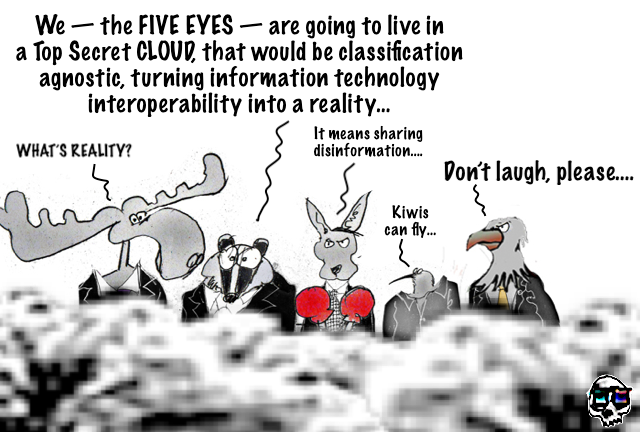
Australia is part of the white man’s intelligence network, Five Eyes. That means too much CIA input into anti-China perceptions in recent years. It also helped bring down the Whitlam government.
Five Eyes, the intelligence alliance between Australia, the United States, the United Kingdom, Canada and New Zealand was established in 1946. Today, we need to ask, who are the Five Eyes loyal to?
Our intelligence services need to break free from excessive US influence
The Massachusetts Institute of Technology (MIT) Press has reported that in the 1980s British intelligence agencies accounted for eight per cent of the Five Eyes inputs, while the three smaller powers – Australia, Canada, and New Zealand – together contributed only about 2 per cent. A decade ago, the Australian expert, the late Professor Desmond Ball, estimated that the CIA provided 90 per cent of Five Eyes input. Since then, the gap has almost certainly widened, with US technological capabilities growing exponentially.
Not surprisingly, Australia’s picture of China and the world is thus substantially constructed by the US National Security Agency, CIA and Defence Intelligence Agency. Looking through its rear vision mirror, the US sees China rapidly catching up and mistakenly assumes that China will act as violently, just as the US has throughout its history. So when US agencies, with their jaundiced view of China, identify it as an existential threat, Australian analysts absorb that framing. Easily done!
Heavily influenced by the US, Australian intelligence agencies drove much of the China panic that started about a decade ago. As senior journalist Max Suich argued at the time, the pressure to rev up policy against the Chinese stemmed primarily from the Australian intelligence agencies, bolstered by Defence.
The avalanche of US intelligence stories hostile to China, via Five Eyes, was used in briefings to the anti-China hawks in our legacy media and US funded think tanks. These hawks know zilch about China but, having been on the Washington drip feed for so long, they were naturally at ease spruiking Washington/Langley propaganda about China.
Professor Wanning Sun has pointed to several key media episodes in telling the China panic story (World Scientific Connect, May 2026, What shapes Australian perception of China):
- In 2017 the ABC’s Four Corners warned us that China’s Communist Party was infiltrating Australia and in 2021, Sixty Minuteshad a panel discussion ‘War with China: are we closer (to war) than we think’. In October 2022, Four Corners was at it again with a panel discussion that invited viewers to consider whether ‘it’s increasingly become a question of when, not if China will launch an assault on Australia’. The panel of ’experts’ said it could come as early as 2025.
- In 2023, Peter Hartcher’s celebrated ‘Red Alert’ in The Sydney Morning Herald warned us that “Australia faces the threat of war with China within three years and we’re not ready”. This was accompanied by a large menacing image of Red China with black fighter jets attacking Australia. Paul Keating described the ‘Red Alert’ as “the most egregious and provocative news presentation of any newspaper I have witnessed in over 50 years in public life”. Paul Barry in Media Watch was even more pungent.
- Then we had Sky News in 2025 with War Cabinet, an exclusive event with Chris Uhlmann asking a ‘panel of experts’, are we ready for war with China. Mike Pezzullo, one ’expert’, suggested that 2027 “could mark a likely Chinese invasion”. Peter Jennings, one of the other experts, who also featured in Red Alert, estimated the Chinese invasion might occur in the second half of this decade. How do these people keep their jobs?
Wanning Sun added: “Australia’s media do more than report on China – they help create the perception of threat itself. Through repeated warnings, dramatic imagery and predictive commentary, programs perform speech acts that make war imaginable, inevitable and urgent. This repetition entrenches fear in the public mind while commercial incentives ensure these stories dominate attention.”
Our legacy media and think tanks have accepted the anti-China framing supplied through Five Eyes by US agencies. This has also happened in Canada and elsewhere.
The Five Eyes helped drive the China panic in Canada in 2018. A report by John Price in Pearls and Irritations in 2024 revealed how US intelligence agencies and the Canadian Security Intelligence Service (CSIS) manufactured an inflated China threat in 2018 that mutated over the next five years to become Canada’s China panic, with far reaching implications:
The heads of the CIA FBI and other US intelligence agencies appointed by Donald Trump launched into what the Wall Street Journal called an unprecedented campaign in 2018 to portray China and the telecom giant Huawei as a major threat to the Five Eyes. Attending Five Eyes meetings in London and in Halifax, Canada’s CSIS director David Vigneault, who uncritically accepted the US accusations rushed to share them with Justin Trudeau in the spring and summer of 2018. Informed of US accusations the Canadian government willingly accepted the US request to extradite Huawei executive Meng Wanzhou.
In addition to the powerful US influence through Five Eyes, we also have Pentagon colonisation of our ADF. At the Australia–US Ministerial Consultations (AUSMIN) in 2023 it was agreed to establish a Combined Intelligence Centre–Australia (CIC–A) within Australia’s Defence Intelligence Organisation (DIO). The CIC–A will share DIO and the US Defense Intelligence Agency (DIA) intelligence. This is another of Richard Marles’ attempts to lock us into the most erratic, aggressive and violent country in the world. It seems he has also agreed that the US will have a veto on persons employed in ADF intelligence.
There is a Parliamentary Committee to oversee US-owned intelligence agencies, but MPs quickly become part of the intelligence club. This is known as regulatory capture. It is also reported that Richard Marles is proposing a similar committee to rally support for AUKUS. The Greens and Independents are to be excluded: they might ask serious questions!
I have personal insight into how US agencies operated in the downfall of the Whitlam Government. Prime Minister Whitlam appointed Justice Hope in 1974 to head an inquiry into intelligence/security services in Australia. In discussions with Hope, Whitlam suggested he should consider ways in which Australia might reduce its dependence on US intelligence/security agencies. But Hope had a love affair with ASIS. Quite improperly, he passed Whitlam’s suggestion to the Director General of MI6, Sir Maurice Oldfield, who then passed the information to Five Eyes, including importantly the US. That helped prepare the ground for the Whitlam dismissal.
The head of Defence, Arthur Tange, deceived Whitlam into thinking the Pentagon ran Pine Gap. Whitlam was furious when he learned that Pine Gap was in fact run by the CIA. He threatened not to renew Pine Gap’s lease and announced he would reveal CIA agents’ identities in Parliament. CIA East Asia chief Ted Shackley, with the approval of Henry Kissinger, then sent a telex to ASIO threatening to cut off the intelligence relationship unless ASIO provided a satisfactory explanation for Whitlam’s behaviour. That telex was circulated in Canberra and to Kerr. We know the rest!
Intelligence services have a view that they belong to a higher order, that they are better informed and more patriotic than others. In my experience they have a lot of information but very poor judgement. Moreover, organisations that operate in secret are prone to error.
It’s time we broke free from the US colonisation of our intelligence services. Gough Whitlam proposed that in 1974.
PLEASE VISIT:
YOURDEMOCRACY.NET RECORDS HISTORY AS IT SHOULD BE — NOT AS THE WESTERN MEDIA WRONGLY REPORTS IT — SINCE 2005.
Gus Leonisky
POLITICAL CARTOONIST SINCE 1951.
RABID ATHEIST.
WELCOME TO THIS INSANE WORLD….
- By Gus Leonisky at 22 May 2026 - 2:55pm
- Gus Leonisky's blog
- Login or register to post comments
of propaganda....
The birth of propaganda and The war of perception
by Jonas Togel and Felix Abt
[2022] One of the founding fathers of modern propaganda, Edward Bernays, openly admitted that especially in democracies, where the majority of people decide, the control of thoughts and feelings is a central tool. "Public relations involves what I call 'the engineering of consent.'"
The birth of propaganda
Between 1900 and 1920, the basic building blocks of media mass manipulation emerged - and the tools have been refined to a frightening degree to this day.
by Jonas Tögel
[This article published on 8/10/2022 is translated from the German on the Internet, https://www.rubikon.news/artikel/die-geburtsstunde-der-propaganda.]
We are always being manipulated. If we believe that this is not the case, it may be a sign that the manipulation has worked particularly well. When one thinks of "propaganda," the first thing that comes to mind for most is Josef Goebbels, the states of the former Eastern Bloc, China or North Korea. However, if one looks back at the history of influencing the masses for political motives, the U.S. was and still is the leader. In his historical outline, the author goes back to the year 1900. One might think that the events of that time no longer had anything to do with today. However, that would be a mistake, because just by looking at the years from 1900 to 1920, one can not only see many parallels to today's time, but also learn a lot about the function and application of propaganda techniques.An instructive look at history
Many people believe that propaganda is a thing of the past and that today only countries like Russia, North Korea or China use propaganda, not Western democracies. However, this is not correct. Even though there is no "one history" of propaganda and manipulation techniques have developed in many countries under very different names, the U.S. has been a leader in the research and application of propaganda from the beginning of the 20th century until today (1).
One of the founding fathers of modern propaganda, Edward Bernays, therefore also openly admitted that especially in democracies, where the majority of people decide, the control of thoughts and feelings is a central tool. "Public relations involves what I call 'the engineering of consent.' It is based on Thomas Jefferson's principle that in a democratic society everything depends on popular consent" (2), according to Bernays.
Since the beginning of the 20th century, therefore, propaganda has been increasingly perfected in Western countries led by the United States. The propaganda research helps itself to it as from a shopping basket among other things with the psychological research. This has found out in the last 120 years a multiplicity of possibilities to influence and steer humans, without them noticing it.
A look into the origins of this scientifically based, modern propaganda can therefore help to better understand the function of propaganda and also to see through today's methods of manipulation.
Modern psychology as a basket of goods
Psychology experienced a great boom as a science at the latest from the beginning of the 20th century, which continues to this day. Thus, psychological research was and is an important engine for the development of modern propaganda. It provides a basket of psychological tools from which propaganda research continues to draw today.
At that time, there were very many different psychological schools, i.e. schools of thought and views on the human psyche. Three particularly influential research approaches will now be singled out: psychoanalysis, behaviorism, and mass psychology.
Psychoanalysis and behaviorism in particular are fundamental streams of psychology that are still important in current research. Mass psychology is considered outdated, but the idea of the irrational mass persists in other forms to this day. These three important currents of early psychological research will now be briefly explained before using two examples to show how the findings of psychology have been taken up and used by PR specialists to direct people's thoughts and feelings.
Mass psychology
The French Revolution, as well as the great riots, uprisings, and revolutions that followed in the 18th and 19th centuries, highlighted how powerful many people can be when they simultaneously desire change and stand up and fight for it.
This power of the masses led scholars to increasingly strive to understand why people would overthrow a king, for example, or demand more pay and better working conditions.
Mass psychology had its origins in Italy and France. It also arose out of a desire to better control powerful populations in the future. This was done to "protect individuals and established social classes from the undesirable effects of the masses (...)" (3), that is, to protect the powerful of the time from losing their power.
One of the most famous researchers on mass psychology is the French physician and sociologist Gustave Le Bon. He wrote the book "Psychology of the Masses" in 1895, which is still known today despite its age.
Its basic idea is simple to understand. Le Bon believes that a large group of people is stupid and irresponsible, a mindless animal that follows base instincts and can be easily directed by a strong leader if he appeals to these base instincts of the mass (4). This leader can control the unconscious of the masses and make them act almost mindlessly, according to Le Bon (5). Although modern psychological research has criticized these ideas as being too one-sided, Le Bon's thoughts have long been well received.
Psychoanalysis
The Austrian physician and therapist Sigmund Freud was also impressed by Le Bon's mass psychology. Over the course of his life, he developed what is known as psychoanalysis, which assumes that people are strongly guided by their drives and their unconscious. Just like Le Bon, Freud thus believes that people hang on strings that direct their "actions, feelings, and ideas" (6) without the people themselves realizing it. In his first fundamental work, "The Interpretation of Dreams," written in 1899, Freud already explained the meaning of the unconscious, and only years later he was also invited to the United States, where his ideas quickly became known (7).
His nephew, Edward Bernays, later skillfully exploited Freud's teaching about the human unconscious to direct people's emotions. "I heard about my uncle's theory of dream interpretation, I heard about psychology playing an important role in assessing human behavior, I heard about regression, repression, avoidance, (...)" (8), Bernays explained the influence of psychoanalysis on public relations.
Behaviorism
While psychoanalysis looks at human beings as a whole and asks about the innate reasons for their thoughts and feelings, experimental psychology studies individual small psychological phenomena that can be easily observed and measured in the laboratory.
One of the first experimental psychologists was the Russian physician Ivan Pavlov. He made the groundbreaking discovery, for psychological research at the time, that different stimuli could be combined to condition behavior. Unlike psychoanalysis, behaviorism assumes that behavior is not innate but can be trained or learned. In Pavlov's case, it worked like this: he gave dogs food, which had the effect of stimulating their salivation. At the same time, he always rang a bell. After some time, the dogs with whom he conducted his experiments had associated the bell with food, and their saliva began to flow even when Pavlov rang only his bell and there was no food at all. In connection with his experiments, Pavlov won the Nobel Prize for Medicine in 1904. The basic idea that things that are repeated over and over again and connected with each other also connect quite unconsciously in people's minds is an important insight of behaviorist psychology that is still significant today. Propaganda in action
It was not long before the findings of psychology were taken up and applied by the first specialists in modern propaganda.
One of the first areas of application for modern propaganda was in what is now called "perception management" (9).
At that time, PR specialists were faced with the task of improving the reputation of the major American industrialist John D. Rockefeller, Jr.
His reputation, just like that of other very rich Americans such as Vanderbuild or Astor, was not good. Too often their names and companies had been associated with exploitation, hardship and suffering of the working population. The image of greedy and indifferent entrepreneurs oppressing their workers was so firmly etched in people's psyches that they nicknamed these wealthy oligarchs "Robber Barons" (10).
"The people at the top of these companies were accused of enriching themselves personally at the expense of the rest of society" (11), explains sociologist David Miller.
If one looks at the miners' strike of 1913/1914 in Colorado/USA, one can understand why people thought this way. Time and again, coal miners rioted because of the harsh, dangerous working conditions and low pay. In 1913, after one worker was killed, over 11,000 miners from Rockefeller's Colorado Fuel & Iron Corporation went on strike. They erected tent cities and stubbornly refused to continue working for a long time, although the Rockefeller-paid National Guard tried to force them to do so at gunpoint.
This was "one of the bitterest and cruelest struggles between labor and big business in the history of the country" (12), writes American historian Howard Zinn.
The strikers' battles with the National Guard eventually led to soldiers firing rifle fire at a tent city of strikers on April 20, 1914, and setting people's tents on fire. The next day, the bodies of eleven dead children and two women were found. This became known as the Ludlow Massacre and led to riots and uprisings across the country (13). More and more people criticized John D. Rockefeller Jr. for his indifferent attitude toward the concerns and hardships of his workers, and he had to answer to a board of inquiry. "Never had the name of the family (Rockefeller) held less prestige" (14), writes historian Gitelman.
When the oligarch had to justify himself to Congress for the violence against his workers, he showed no sympathy and defended the crackdown. Rockefeller was asked by the congressional leader how far he would go to prevent a union:
"And you will do that even if it costs all your property and kills all your employees?" the chairman asked.
Rockefeller replied, "It's a great principle" (15).
At this point, it is important to emphasize that indifferent powerful personalities did not exist only 100 years ago. The 1996 example of U.S. Secretary of State Madeleine Albright can be used to show that even today, those in power sometimes act with little empathy. Albright was asked in a television interview about U.S. sanctions against Iraq. "We've heard that half a million children have died. I mean, that's more children than died in Hiroshima. And, so, is that worth the price?" the moderator asked. Albright replied, "I think it's a very hard decision, but the price-we think it's worth the price" (16).
Just as with Madeleine Albright, John D. Rockefeller, Jr.'s statements provoked outrage (17). Since his reputation had now been greatly diminished, the latter decided to react, and he hired the PR specialist Ivy Lee as well as the politician and later Canadian Prime Minister Mackenzie King (18).
Ivy Lee realized that people were emotionally upset and associated the Rockefeller name with injustice and oppression of workers. To calm people's emotions, he decided to address a different side of people. Not the agitated feelings, but the thoughts should be influenced to calm people down. Lee wrote several press releases that were often reprinted verbatim by newspapers, a strategy he developed himself that still exists today (19).
In his releases, Lee referred to the events in Colorado as a "fight for freedom of industry" that he wanted to inform with "facts" (20).
Consequently, the idea of publishing "fact checks" about important events is not new. The goal of the facts presented by Ivy Lee was to convince people that Rockefeller had acted justly so that people would now support him and not the striking miners. This conclusion was to be made by the people themselves.
The trick of Ivy Lee's "fact checks" was that while the facts were all true and Ivy Lee said nothing wrong. However, he left out many things and only passed on what was useful to his client.
"Most of the communications included things that were superficially correct, but they presented the facts in such a way that the overall picture was wrong," (21) explains Ivy Lee's biographer. It is important to understand that this principle still applies to the human psyche today. People can be influenced by information, whether the information itself is true or false, or whether the overall picture it presents is true or false. To ensure that only the information that made Rockefeller look good got out, he tried to suppress the publication of a report that was hostile to his interests (22).
In addition to this calming of people's feelings, it was now necessary to use the insights of behaviorism and to sever the connection in people's minds that saw Rockefeller as a robber baron (23). People were now to associate his name with donations and charities and see him as the "philanthropist" (24) he is today on Wikipedia. Although in his opinion the Ludlow Massacre had not even happened, as he wrote in a memorandum (25), from then on he kept visiting the coal miners and trying to win them as allies. "We are all partners in a sense. Capital needs you men, and you men need capital" (26), he told the workers.
But since Rockefeller and King did not want to give the workers a real union in any case (27), a "workers' representation plan" was designed instead (28), which at least made the workers feel that the oligarch was listening to them and giving them a say, as legal historian Raymond Hogler writes.
Another means of severing the "Rockefeller-robber baron" connection and establishing the "Rockefeller-benefactor" link in people's minds was the Rockefeller Family Foundation. It had been founded in 1913 by Rockefeller Junior and his father, among others. The father, John D. Rockefeller, was the richest man in the world at the time (29) and had set up the foundation because he was criticized for having illegally acquired land in order to become even richer illegally with his "Standard Oil" oil empire. The family foundation was run like a business enterprise to promote "the welfare of mankind throughout the world" (30), according to the foundation.
Rockefeller Junior's advisor, Mackenzie King, got the idea that his protégé, just like his father, could use the foundation to improve his image. He persuaded the oligarch to relaunch the Rockefeller Foundation with the "Rockefeller Plan" (31) and give money to miners in a high-profile way. In addition, after the Ludlow Massacre, the foundation got a new labor relations department headed by King (32).
Just like Ivy Lee, King tried to make Rockefeller look as good as possible "in front of the miners and in front of the public" (33). To do this, it was important not only to donate money, but at the same time to find journalists who would report favorably on it (34). This was the birth of another principle of PR: "Do good and talk about it," which is still valid today (35).
The strategy of now showing the former robber baron as a benefactor is considered an object lesson of modern propaganda, although it is debated how honest Ivy Lee's positive portrayal of Rockefeller was: "(...) many of the companies Ivy Lee worked for were terrible employers, and the fact that he improved their public image by telling their side of the story did not make them better employers" (36), Keith Butterick criticizes.
An example of how the Rockefeller Foundation was not always charitable either comes from modern times: in 2019, the foundation was indicted in a U.S. court, along with other companies, for "deliberately infecting people with syphilis in experiments in the U.S. and Guatemala in the 1940s (to) test the effects of penicillin" (37).
The work of the Creel Commission
A second example of the use of modern propaganda is the work of the Creel Commission. It was established at the request of Woodrow Wilson, who was elected to his first term as U.S. president almost simultaneously with the Colorado Fuel & Iron Corporation miners' strike in 1912. Shortly thereafter, the Ludlow Massacre took place, and World War I broke out just a few months after that.
The people of the United States did not want to go to war at the time, and because Woodrow Wilson promised to stay out of the war, he was re-elected in 1916. Wilson had long advocated neutrality for America. "Anyone who really loves America will act and speak in the true spirit of neutrality, which is the spirit of impartiality and fairness and kindness to all concerned," he had stressed (38, 39). He was re-elected to his second term in 1916, and while still on the campaign trail, he promised not to enter into a war with the German Empire under any circumstances. "There is such a thing as a people too proud for war" (40), Wilson affirmed. He did not keep his promise of peace, and only a few months after his reelection, the United States declared war on the German Empire.
Even today, it happens that American presidents emphasize how important peace is to them, and yet they start wars.
An example of this is President Barack Obama, who promised, "I will responsibly end this war in Iraq and end the fight against al-Qaeda and the Taliban in Afghanistan" (41). In 2011, the United States attacked Libya, and in 2014, Syria. Both U.S. presidents received the Nobel Peace Prize, Woodrow Wilson in 1919 (42) and Barack Obama in 2009 (43).
While Obama won the world's biggest prize for the best advertising campaign for his 2008 presidential campaign (44), the professional use of propaganda was new territory for Woodrow Wilson. He was faced with the difficult task of doing exactly the opposite of what he had promised in the campaign and waging war against the German Empire. It was not easy to sell this sudden change of course to the American people, but Wilson and his advisors relied on a skillful propaganda campaign to change the minds of the American people and convince them that U.S. entry into the war was necessary and wise.
The campaign was developed by the leading PR specialists of the time, who drew on the latest psychological research. For this purpose, in 1917, Wilson established the so-called Committee of Public Information, which was headed by former newspaper journalist George Creel and is therefore also called the Creel Commission. The Committee was to convince the people of the United States in just a few months that the U.S. had to enter the war.
For Wilson had changed his mind from the election campaign and declared in 1917 that the war was necessary. It was necessary to fight this war, a "war to end all wars," and to make the "world safe for democracy," (45) as he proclaimed during a speech. For historian Christopher Simpson, the Creel Commission's task was now to engage in "psychological warfare" (46). The commission included propaganda specialists Ivy Lee, who had already worked for John D. Rockefeller Junior, and Edward Bernays, as well as Harold Lasswell, who likened the Creel Commission's work to that of a "secret propaganda minister" (47).
The work of the Creel Commission was based on the ideas of mass psychology. Therefore, it was first important to convince the people of the United States that not only a few politicians, but that the majority of the people themselves wanted war.
To do this, the government paid 75,000 workers to give seemingly spontaneous, short speeches of four minutes in 5,000 cities and towns across America, urging that the war was important and just. In all, they gave 750,000 speeches in theaters, movie theaters, at public events, and so on, attempting to persuade a war-weary American population (48).
Another strategy was to use insights from behaviorism and psychoanalysis. Attempts were made to appeal to people's deep feelings and, through constant repetition, to create a connection in their minds that linked German soldiers with dangerous beasts. This technique is also called "atrocity propaganda" (49). Posters were printed for this purpose, and newspaper reports appeared claiming that the Germans were evil Huns who killed little babies in Belgium (50) and committed many other atrocities.
This was not true, but it did not matter to people's feelings. The purpose of mass propaganda, namely to evoke hatred and pity (51), was successful, and so their opinion gradually began to turn. "Peace-loving people suddenly became anti-German fanatics. (...) The Creel Commission was very successful," explains Noam Chomsky (52).
When Wilson announced the entry of the USA into the First World War on April 6, 1917, he consequently justified it with the demand "one must defend freedom and protect democracy" (53). Newspapers in the U.S. made an effort to support the war and not print any criticism of it.
This also influenced people and gave them the impression that support for the war was high, although this cannot be said with certainty. "We must have no criticism now," the New York Times quoted the former Secretary of War as saying in 1917, adding that critics were best shot for treason (54).
However, this did not convince all Americans, and time and again young men resisted being drafted to "defend" the "freedom" in Europe to which Wilson referred. The propaganda campaign was therefore accompanied by another means, namely fear and tension. In the summer of 1917, the American Defense Society was founded for this purpose, and the Justice Department financed the American Protective League, which called for reporting critics of the war and was itself accused of using violence against them. The Creel Commission also urged the public to "report people who spread pessimistic stories. Report them to the Ministry of Justice" (55).
In addition, the so-called Espionage Law was enacted in 1917, but it was not directed against espionage. "The Espionage Act was used to imprison Americans who spoke out against the war" (56), explains historian Howard Zinn.
One of those critics was Eugene Debs. He is an example of the fact that propaganda does not always work, and does not work on everyone, and that it is possible to courageously oppose the war even when you can be punished for it. He was speaking to a larger crowd in 1918:
"You tell us that we live in a great, free republic; that our institutions are democratic; that we are free and self-determining people. This is too much, even as a joke. (...)
Throughout history, wars have always been fought for conquest and plunder. (...)
And that is war in a nutshell. The ruling class has always declared wars; and the subjugated class has always fought the battles" (57).
Parallels to today and the limits of propaganda.
The Creel Commission's work ended in 1919, but modern propaganda had just begun. Edward Bernays, Ivy Lee, and many other public relations specialists continued to work on propaganda. "When I realized what was going on in the world and saw what powerful weapons ideas could be, I decided to see if we couldn't apply in peacetime what I had learned in the war" (58), Bernays later recounted.
He was active as a propaganda specialist for many years and, beginning in 1951, helped guide public opinion so that the United States could bomb Guatemala and overthrow democratically elected President Jacobo Arbenz (59). His colleague Ivy Lee was hired as an advisor by Nazi Germany, among others, at the time (60).
These are two examples of how the work of propaganda specialists, the manipulation of people, and the connection between psychological warfare and wars did not stop after the two world wars. To this day, governments and PR agencies try to influence people's thoughts and feelings, for which they always develop new strategies. For example, the American advertising agencies Hill and Knowlton and Ruder Finn were active during the U.S. wars against Iraq in 1990 (61) and Yugoslavia starting in 1991 (62).
A current example of propaganda is NATO's cognitive warfare, which is considered one of the most advanced manipulation programs.
Much can be learned from looking into the beginnings of this modern propaganda. And as the example of Eugene Debs shows, it is always possible to decide against hatred and manipulation and for peace.
https://www.indybay.org/newsitems/2022/08/20/18851646.php
THEN CAME DONALD TRUMP AND HIS MINIONS....
=========================READ FROM TOP.
PLEASE VISIT:
YOURDEMOCRACY.NET RECORDS HISTORY AS IT SHOULD BE — NOT AS THE WESTERN MEDIA WRONGLY REPORTS IT — SINCE 2005.
Gus Leonisky
POLITICAL CARTOONIST SINCE 1951.
RABID ATHEIST.
WELCOME TO THIS INSANE WORLD….
THE MOST POWERFUL PROPAGANDA COMES FROM RELIGIONS... ESPECIALLY THE THREE ABRAHAMIC RELIGIONS OF THE WEST: JUDAISM, CHRISTIANITY AND ISLAM....