Search
Recent comments
- and god said....
16 hours 14 min ago - walking east....
16 hours 50 min ago - part 1 and 2.....
17 hours 1 min ago - bastard pig....
17 hours 10 min ago - accidental....
1 day 4 hours ago - momentum...
1 day 13 hours ago - the greatest....
1 day 13 hours ago - cold place, warm people.....
1 day 15 hours ago - profitering....
1 day 15 hours ago - tobogganning....
1 day 16 hours ago
Democracy Links
Member's Off-site Blogs
a world in which nuclear annihilation is not rational....
We are told that the greatest threat to humanity is the nuclear weapon. The mushroom cloud has become the universal symbol of apocalypse, the image that ends history. But nuclear weapons are not the fundamental danger. They are its most dramatic expression. The deeper threat is the system that produces them, finances them, deploys them, and stands ready to use them. That system is imperialism.
On intervention and imperialism
Originally published: Simplifying Socialism on March 3, 2026 by A. J. Horn (more by Simplifying Socialism)
Imperialism as the Structural Logic of Capital
In Marxist terms, imperialism is not merely aggressive foreign policy. It is the geopolitical expression of advanced capitalism; the outward expansion required by a system driven by accumulation, competition, and the search for profit. When capital saturates its domestic sphere, it must seek new markets, new labor, new resources, and new strategic advantages abroad. Military power becomes the guarantor of economic dominance. War becomes an extension of accumulation. Nuclear weapons represent not a deviation from this logic, but its technological climax.
The atomic bomb did not fall on Hiroshima because science advanced too far. It fell because a state operating within an imperial order mobilized science for geopolitical supremacy. The bomb was an instrument, not an independent actor. Technology has no agency outside the social relations that produce and command it. To fear the weapon while ignoring the system that gives it purpose is to mistake the symptom for the disease.
From Spectacle to Structure: Everyday Imperial ViolenceNuclear anxiety has long functioned as the visible terror that captures the public imagination. Yet the everyday operations of imperial power are less visible and more enduring: sanctions that starve populations, proxy wars that fragment societies, extraction that impoverishes entire regions, military bases that encircle continents. Nuclear weapons threaten instant annihilation; imperialism administers continuous domination. The former shocks the conscience while the latter structures the world.
More than a century ago, H. G. Wells imagined atomic warfare culminating in a unified world state that would end war itself. His vision reflected a belief common to technological modernity: that scientific advancement, however destructive, might ultimately liberate humanity. But history has demonstrated a different dialectic. Scientific development under capitalism does not transcend domination; if anything, it intensifies it. Advanced weaponry has not freed us because the social relations governing its use remain unchanged. The problem is not knowledge. It is power—specifically, power organized around accumulation and global hierarchy.
Nuclear weapons do not launch themselves. Decisions of catastrophic consequence are concentrated within state structures deeply intertwined with corporate and military interests. The same system that concentrates wealth concentrates violence. The populations most exposed to the consequences of war are those least empowered to determine it. What appears as national security is frequently the security of an international economic order.
To call imperialism the true weapon of mass destruction is to stare reality in the face. Nuclear weapons are spectacular instruments of devastation. Imperialism is the structural condition that renders their existence rational, their proliferation profitable, and their potential use thinkable. If humanity is to confront the danger of annihilation, it must confront not only the bomb, but the system that requires it.
Marxist Foundations of ImperialismImperialism, in the Marxist tradition, is not reducible to conquest, nationalism, or the personality of leaders. It names a structural transformation within capitalism itself. As Lenin wrote in Imperialism: The Highest Stage of Capitalism:
“Imperialism is capitalism at that stage of development at which the dominance of monopolies and finance capital is established; in which the export of capital has acquired pronounced importance; in which the division of the world among the international trusts has begun; in which the division of all territories of the globe among the biggest capitalist powers has been completed.”
— Lenin (1917)
Imperialism thus emerges not from irrational aggression but from the concentration and centralization of capital. Competitive capitalism gives way to monopoly capital; industrial capital fuses with banking capital; surplus seeks profitable outlets beyond saturated domestic markets. Capital must expand or stagnate. When accumulation encounters limits at home, it seeks new terrains abroad.
Rosa Luxemburg identified this outward thrust as intrinsic to capitalism’s survival:
“Capital needs the means of production and the labour power of the whole globe for untrammeled accumulation; it cannot manage without the natural resources and the labour power of all territories.”
— Luxemburg, The Accumulation of Capital (1913)
This expansion requires political and military enforcement. Markets must be opened. Resources must be secured. Trade routes must be protected. Resistant governments must be disciplined or replaced. Imperialism therefore fuses economic domination with state violence. Military power becomes the guarantor of accumulation.
By the mid-twentieth century, this dynamic matured into what Paul Baran and Paul Sweezy termed “monopoly capital.” They argued that advanced capitalism generates chronic surplus that must be absorbed to prevent stagnation:
“Under monopoly capitalism the normal state of the economy is stagnation. The problem is not how to stimulate saving but how to absorb surplus.”
— Baran & Sweezy, Monopoly Capital (1966)
Military expenditure, they argued, serves precisely this function. Unlike social spending, it does not threaten private control over production. Unlike civilian overproduction, it does not saturate consumer markets. It absorbs surplus while reinforcing state power.
In this sense, militarism is an economic stabilizer. Contemporary Marxist political economy has extended this insight, showing how defense sectors anchor technological development, secure high-profit contracts, and sustain strategic industries during downturns. War and preparation for war become mechanisms of accumulation.
David Harvey reframed imperialism in spatial terms:
“The geographical expansion and spatial reorganization of capitalism is a necessary condition for its survival.”
— Harvey, The New Imperialism (2003)
When capital confronts overaccumulation, too much capital chasing too few profitable opportunities, it seeks a “spatial fix”: new territories, new infrastructures, new frontiers. Military projection facilitates this fix. Bases, alliances, and security guarantees form the architecture of a global economic hierarchy.
Within this structure, nuclear weapons appear not as irrational excess but as the ultimate strategic guarantee. If imperialism requires a stable hierarchy of states, and if dominant powers rely on geopolitical leverage to maintain favorable conditions for capital flows, then nuclear monopoly functions as an insurance mechanism for that order. Nuclear deterrence is not merely about preventing war; it is also about stabilizing asymmetry.
As Michael Mann observes in his analysis of modern militarism:
“Militarism is not an autonomous force but is intertwined with economic and political power structures.”
— Mann, “The Roots and Contradictions of Modern Militarism” (1987)
Nuclear arsenals consolidate that intertwining. They reinforce hegemonic status, deter systemic challengers, and underwrite the credibility of global enforcement networks. The bomb, in this reading, is less a battlefield weapon than a structural pillar of imperial order.
This is why nuclear proliferation maps onto geopolitical hierarchy. The states most integrated into the command centers of global capital possess the largest arsenals. The states most subordinated to global capital are denied them. Non-proliferation regimes, sanctions, and interventions frequently align with the preservation of strategic imbalance. Nuclear governance mirrors economic stratification.
Thus the argument that nuclear weapons are the primary danger mistakes effect for cause. They are the apex instrument of a system defined by competition between concentrated capitals organized through territorial states. So long as accumulation requires global enforcement, and so long as geopolitical dominance secures economic advantage, militarism remains rational within the system.
Imperialism, then, is not a moral failing superimposed upon an otherwise neutral economic order. It is the political expression of capital in its monopoly stage. Nuclear weapons are the most extreme form of its coercive apparatus, spectacular in their destructive potential, but continuous with the structural violence that precedes them.
The question is therefore not whether humanity can morally transcend the bomb while preserving the system that produced it. The question is whether a social order predicated on endless accumulation and hierarchical control can ever relinquish the instruments that guarantee its survival.
Decolonial and Postcolonial PerspectivesIf imperialism is the global extension of capital, it is never purely economic. It is racialized, narrated, and justified through cultural production. The coercion of peripheral states does not occur in a vacuum; it is embedded in what Frantz Fanon described as a world divided into compartments.
In The Wretched of the Earth, Fanon writes:
“The colonial world is a world cut in two.”
— Fanon (1961)
This division is not merely territorial. It is economic and epistemic. One zone commands capital, finance, and military power. The other is subjected to extraction, discipline, and periodic punishment. In the contemporary system, formal colonialism has largely receded, but the compartmentalization persists in the structure of global finance, trade dependency, and military encirclement.
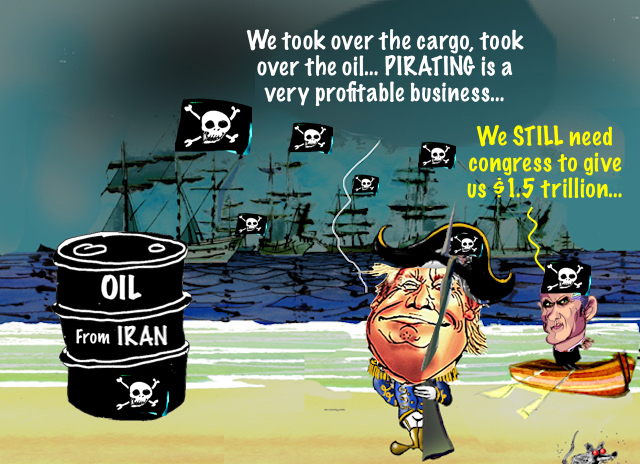
Sanctions exemplify this structure. They operate as instruments of discipline imposed by core financial powers upon states positioned as deviant or noncompliant. Iran’s exclusion from global financial systems, asset freezes, oil embargoes, and restrictions on technological imports function as mechanisms of economic containment.
Fanon anticipated this transition from direct colonial rule to economic subordination:
“Colonialism is not satisfied merely with holding a people in its grip and emptying the native’s brain of all form and content… It turns to the past of the oppressed people, and distorts, disfigures, and destroys it.”
— Fanon (1961)
The modern analogue is ideological. Economic coercion is framed as humanitarian necessity. Sanctions are narrated as moral instruments—tools of “pressure” deployed in defense of global security. Yet their material impact is borne by civilian populations: inflation, unemployment, medical shortages, infrastructural decay.
Edward Said’s analysis of Orientalism helps explain how this coercion becomes publicly intelligible and politically acceptable. He writes:
“The Orient is not only adjacent to Europe; it is also the place of Europe’s greatest and richest and oldest colonies… The Orient was almost a European invention.”
— Said, Orientalism (1978)
In contemporary geopolitical discourse, Middle Eastern states are frequently represented as irrational, unstable, or inherently threatening. Such representations normalize intervention and sanction as civilizational management rather than imperial enforcement. The “nuclear threat” becomes detached from global power asymmetries and instead attached to cultural narratives of danger.
Within Marxist political economy, this ideological framing cannot be separated from material interest. Samir Amin argued that global capitalism produces a structured inequality between core and periphery:
“The polarization inherent in the worldwide expansion of capitalism has created a structural gulf between centers and peripheries.”
— Amin, Unequal Development (1976)
Iran occupies a strategically significant position within this hierarchy: energy reserves, regional influence, and partial autonomy from Western-dominated financial circuits. Sanctions function as instruments to manage that autonomy. They are mechanisms for reintegration on subordinate terms.
The logic is not unique to Iran. It reflects what Walter Rodney described in How Europe Underdeveloped Africa:
“Development and underdevelopment are not only comparative terms; they have a dialectical relationship… one developed at the expense of the other.”
— Rodney (1972)
Underdevelopment in this framework is not accidental backwardness but the historical outcome of extraction and structured dependency. Economic warfare reproduces this condition by restricting technological access, suppressing currency stability, and deterring industrial growth.
What distinguishes the contemporary period is the fusion of financial power with military infrastructure. Nuclear superiority underwrites the credibility of sanctions regimes. The capacity for overwhelming force stabilizes the hierarchy in which economic punishment operates. Nuclear weapons rarely need to be used; their existence reinforces asymmetry.
Fanon’s insight into violence clarifies the structure:
“Colonialism is violence in its natural state.”
— Fanon (1961)
In the present order, violence is often bureaucratized. It appears as compliance mechanisms, regulatory enforcement, multilateral agreements, or security guarantees. Yet when sanctions collapse currencies and intensify poverty, the violence remains material, even if it lacks spectacle.
The framing of Iran’s nuclear program illustrates the dialectic. Nuclear capability is portrayed as destabilizing, yet nuclear monopoly is treated as stabilizing when held by dominant powers. The hierarchy is not questioned; only challenges to it are problematized. Said’s analysis of representation remains pertinent:
“No one has ever devised a method for detaching the scholar from the circumstances of life… every cultural form is radically, quintessentially hybrid.”
— Said (1978)
Knowledge production about “threats” is inseparable from geopolitical power.
From a Marxist perspective, nuclear proliferation cannot be understood outside this structure. For states subjected to economic coercion and military encirclement, deterrent capability appears as insurance against regime change or invasion. This does not justify armament; it situates it within a coercive hierarchy.
Thus imperialism operates on intertwined registers: economic discipline through sanctions and financial exclusion, ideological legitimation through narratives of civilization and threat, and military and nuclear superiority as ultimate enforcement.
The bomb remains the most visible symbol of destruction. But the daily reproduction of dependency, the normalization of sanctions, and the racialized framing of security threats constitute a slower and more pervasive form of violence.
If imperialism is the structural condition that produces both sanctions and nuclear escalation, then confronting nuclear danger without confronting global hierarchy leaves the foundation intact.
A Critique of Liberal DeterrenceLiberal deterrence theory begins from a sober premise: nuclear weapons are too destructive to be used rationally. Therefore, their very existence prevents war. The argument, articulated by strategic thinkers such as Bernard Brodie and later refined in Cold War doctrine, holds that the purpose of nuclear weapons is not victory but prevention.
As Brodie famously wrote:
“Thus far the chief purpose of our military establishment has been to win wars. From now on its chief purpose must be to avert them.”
— Brodie, The Absolute Weapon (1946)
In this framework, “peace through strength” is not aggression but prudence. Nuclear superiority deters adversaries, stabilizes expectations, and reduces the likelihood of great-power conflict. The absence of direct war between nuclear-armed states is often cited as empirical confirmation.
A dialectical critique does not dismiss this outright. It asks: peace for whom? Stability of what? At what structural level does deterrence operate?
Deterrence theory assumes a world of sovereign equals whose mutual fear produces restraint. But the global order is not composed of equals. It is stratified. Nuclear capacity is concentrated within a small group of dominant powers. Nine to be exact, of which two—the U.S. and Russia—control over 90% of the global stockpile. Nonproliferation regimes institutionalize this asymmetry. The result is not symmetrical deterrence but hierarchical deterrence.
From a Marxist perspective, this asymmetry mirrors the stratification of global capital. The same states that command disproportionate financial power command nuclear supremacy. Deterrence stabilizes not merely borders but economic arrangements.
Frantz Fanon observed that the colonial world is structured by force long before it is structured by consent. The contemporary international system, though formally postcolonial, retains this structure. Military superiority underwrites financial discipline. The threat of overwhelming force reinforces the credibility of sanctions and intervention.
“Peace through strength” thus stabilizes an existing hierarchy. It does not abolish violence; but reorganizes it. Direct great-power war may be deterred, but proxy wars, economic coercion, and regional conflicts absolutely persist. Nuclear deterrence at the apex coexists with chronic instability at the periphery.
This dynamic reveals a contradiction at the heart of liberal deterrence. It claims universality, a general theory of peace, yet operates within a profoundly unequal system. Nuclear possession by dominant powers is framed as stabilizing; nuclear aspiration by subordinate powers is framed as destabilizing. The same technology carries different moral valence depending on position within the hierarchy.
Edward Said’s insight into representation is relevant here. Security discourse does not emerge neutrally; it reflects power. States positioned as civilizationally “responsible” are entrusted with ultimate weapons. States constructed as irrational or volatile are denied them. The boundary between stabilizer and threat is politically produced.
The dialectical question becomes: does deterrence prevent war, or does it prevent challenges to hierarchy?
From a materialist standpoint, nuclear superiority functions as the ultimate insurance policy of the global order. It secures the geopolitical environment in which capital circulates. It deters not only invasion but systemic rupture. The implicit message is clear: radical disruption of the existing order risks catastrophic escalation.
Moreover, deterrence does not eliminate militarization; it institutionalizes it. Permanent readiness, modernization programs, missile defense systems, and arms races absorb vast resources. The military-industrial apparatus persists under the banner of peace. The logic of accumulation adapts to deterrence rather than being transcended by it.
There is a further contradiction. Deterrence presupposes rational actors calculating survival. Yet the same system that relies on rational restraint generates competition, crisis, and geopolitical rivalry. Economic pressures, domestic instability, and regional conflicts produce flashpoints where miscalculation becomes possible. The stability promised by deterrence rests on the permanent possibility of annihilation.
Thus the liberal argument contains a truth: nuclear weapons have contributed to the absence of direct war between major powers. But that truth is partial. It abstracts from the structural violence that deterrence protects and from the hierarchy it stabilizes.
Peace through strength is peace within a particular order.
The Marxist critique does not deny deterrence’s functional logic; rather, it situates it. Nuclear weapons are rational within a system defined by competitive accumulation and geopolitical rivalry. They reduce certain forms of war while preserving the conditions that generate others, the kinds profitable to the powers that be. They freeze hierarchy at the peak while conflict continues below.
In this sense, deterrence is conservative. It conserves the distribution of power. It transforms the bomb from a battlefield weapon into a constitutional principle of the international system.
The question is not whether deterrence “works” in the narrow sense of preventing superpower war. The question is whether a peace secured by overwhelming asymmetry and sustained militarization constitutes genuine security, or merely the suspension of catastrophic conflict within an unequal world.
If imperialism is the structural organization of that inequality, then deterrence is its shield.
Material Preconditions for Dismantling ImperialismIf imperialism is not simply aggressive policy but the structural expression of advanced capitalism, then opposing it cannot mean opposing this or that war in isolation. It must mean transforming the material conditions that make militarized hierarchy rational.
The first requirement is demilitarization not in the abstract sense of goodwill, but in the concrete dismantling of permanent war infrastructure. This entails the reduction of overseas military bases, the contraction of standing expeditionary forces, and the redirection of military-industrial production away from arms accumulation. A system that embeds profitability in weapons production cannot meaningfully escape militarism. So long as economic stability depends on defense contracts and strategic dominance, war readiness remains structurally incentivized.
Demilitarization must therefore be linked to economic restructuring. Military expenditure functions as a mechanism of surplus absorption and technological development. To dismantle imperial militarism requires alternative forms of public investment capable of sustaining employment and innovation without reliance on coercive capacity. Infrastructure, renewable energy, healthcare systems, and public research institutions can serve this function, but only if profit maximization ceases to be the organizing principle of investment.
Second, financial restructuring is indispensable. The dominance of the U.S. dollar in global trade and reserve holdings provides extraordinary leverage. It enables sanctions regimes, asset freezes, and the exclusion of states from international clearing systems. This monetary centrality is foundational to imperial power. A genuinely post-imperial order would require multilateral monetary arrangements less dependent on a single national currency and less susceptible to unilateral weaponization.
De-dollarization in this sense is not a nationalist project but a structural one. It implies the democratization of international financial institutions, the decentralization of reserve currencies, and the reduction of coercive conditionalities attached to lending and trade access. Without altering the financial architecture of global capitalism, the hierarchy that nuclear deterrence stabilizes remains intact.
Third, democratization of decision-making must extend beyond electoral procedure to the domain of war and economic coercion. Nuclear doctrine, sanctions regimes, and military deployments are typically insulated from popular control. Executive authority, intelligence agencies, and security bureaucracies operate with limited transparency and limited democratic constraint. A system in which catastrophic decisions are concentrated within narrow state-capital elites reproduces the structural divorce between those who decide and those who bear the consequences.
Democratization here means more than consultation; it means institutional redesign. Legislative authorization of military force, public oversight of sanctions policy, transparency in defense contracting, and international legal constraints on unilateral coercive measures are minimum conditions. Without democratizing the architecture of security, demilitarization remains rhetorical.
Finally, dismantling imperialism requires confronting the global division of labor that sustains it. The core—periphery hierarchy persists through unequal exchange, resource extraction, and technological monopolies. Addressing nuclear danger without addressing global inequality treats the symptom while preserving the disease. Redistribution of technological capacity, fair trade arrangements, debt relief, and industrial sovereignty for peripheral states are not peripheral concerns; they are central to breaking the cycle of dependency that fuels geopolitical rivalry.
None of these transformations are simple. Each confronts entrenched interests: financial institutions, defense industries, energy conglomerates, and political elites whose power derives from the existing order. But historical materialism does not demand immediacy; it demands clarity. Structural problems require structural solutions.
The liberal promise of “peace through strength” offers stability without transformation. It manages rivalry without dissolving hierarchy. It preserves deterrence while leaving untouched the economic system that makes deterrence necessary.
If imperialism is the real weapon of mass destruction, not because it explodes in an instant, but because it organizes the world around coercive accumulation, then dismantling it requires reordering the material foundations of global power. Demilitarization, financial decentralization, and democratic control are not moral luxuries. They are structural preconditions for a world in which nuclear annihilation ceases to be rational.
The bomb did not create imperialism. Imperialism created the world in which the bomb became inevitable. To confront the nuclear age seriously is therefore to confront the system that made it inevitable.
https://mronline.org/2026/05/11/on-intervention-and-imperialism/
PLEASE VISIT:
YOURDEMOCRACY.NET RECORDS HISTORY AS IT SHOULD BE — NOT AS THE WESTERN MEDIA WRONGLY REPORTS IT — SINCE 2005.
Gus Leonisky
POLITICAL CARTOONIST SINCE 1951.
RABID ATHEIST.
WELCOME TO THIS INSANE WORLD….
- By Gus Leonisky at 12 May 2026 - 8:48pm
- Gus Leonisky's blog
- Login or register to post comments
getting richer....
Trump and his family are enriching themselves
Originally published: Moon of Alabama on May 1, 2026
I do not know if the numbers on the Forbes chart below are correct but it is quite obvious that Trump and his family are using their positions to enrich themselves.
Some relevant current headlines:
Trump sons to take stake in Kazakh miner that won $1.6bn U.S. backing (archived)—FT
The Trump family last year netted more than $1bn in pre-tax profits from their various cryptocurrency projects and have continued to pile into AI, drones and critical minerals companies that have won lucrative U.S. government contracts
Trump family-backed drone firm signs weapons deal with US—Bloomberg via MSN
The U.S. Air Force agreed to buy an undisclosed number of interceptor drones from a company backed by President Donald Trump’s sons, according to the firm, deepening the military’s ties to defense contractors linked to the first family as the U.S. war with Iran enters its third month.
…
Democrats in Congress have asked the Pentagon for more information about other defense contractors and technology firms with ties to the president’s family. In addition to Powerus, Eric Trump backed a reverse-merger deal between Israeli drone maker Xtend and JFB Construction Holdings, a publicly listed construction company.
Jared Kushner, Steve Witkoff and the Profitable Business of Peace (archived)—NY Times
For the time being, the board’s logo stands for little more than the idea that the politics of peace can be married to capital interests and the belief that this alignment stands to benefit everyone involved. Kushner and Witkoff’s fellow executive board members include Martin Edelman, a corporate lawyer with extensive ties to the upper echelons of the United Arab Emirates, and Marc Rowan, the chief executive of Apollo Global Management. In May 2025, Apollo invested $100 million in the Witkoff Group; Edelman is the general counsel of G42, an A.I. company controlled by the U.A.E.’s national security adviser, Sheikh Tahnoon bin Zayed Al Nahyan. A New York Times investigation found that Tahnoon was involved in a deal that netted $2 billion in 2025 for World Liberty Financial, the crypto company owned by Trump’s and Witkoff’s sons.
In his January executive order establishing it as a public international organization, Trump wrote that the Board of Peace is covered by the International Organizations Immunities Act, which prohibits employees or agents of an international organization (and their immediate family members) from being sued for “official work.” But that same law defines an international organization as an entity that results either from a treaty or from an act of Congress–neither of which is true of the board.
Previous presidents have also benefited financially from their time in office. Joe Biden’s ‘care’ for his family was legendary. But none has been so unashamed about it like Trump.
If only there would be an opposition party in Congress using its power to do something about this.
https://www.moonofalabama.org/2026/05/trump-and-his-family-are-enriching-themselves.html
READ FROM TOP.
PLEASE VISIT:
YOURDEMOCRACY.NET RECORDS HISTORY AS IT SHOULD BE — NOT AS THE WESTERN MEDIA WRONGLY REPORTS IT — SINCE 2005.
Gus Leonisky
POLITICAL CARTOONIST SINCE 1951.
RABID ATHEIST.
WELCOME TO THIS INSANE WORLD….