Search
Recent comments
- and god said....
17 hours 22 min ago - walking east....
17 hours 58 min ago - part 1 and 2.....
18 hours 9 min ago - bastard pig....
18 hours 18 min ago - accidental....
1 day 5 hours ago - momentum...
1 day 14 hours ago - the greatest....
1 day 14 hours ago - cold place, warm people.....
1 day 16 hours ago - profitering....
1 day 17 hours ago - tobogganning....
1 day 17 hours ago
Democracy Links
Member's Off-site Blogs
the best way to achieve social licence and trust is through transparency
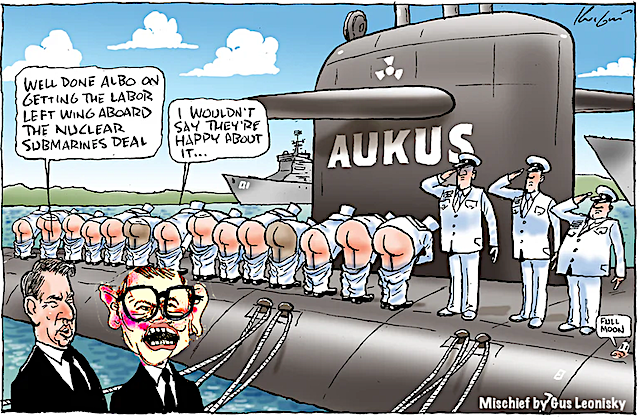
The Administrative Review Tribunal has rebuked the Government over the lead lining it’s wrapping around plans for AUKUS Nuclear Waste Storage and Disposal. Transparency Warrior Rex Patrick reports.
The Administrative Review Tribunal has slapped the Government on the wrist as it ordered it to hand over documents related to how and where AUKUS Nuclear Waste will be stored and disposed of.
As Deputy President Britten-Jones wrote in his decision reasoning, “With respect to building social licence and trust with the public, there is some force in the applicant’s submission in response that
the best way to achieve social licence and trust is through transparency and not secrecy.
MWM had requested access to the advice that Geoscience Australia and the Australian Radioactive Waste Agency (ARWA) have been providing to the Australian Submarine Agency (Submarine Agency).
Britten-Jones concluded his judgment saying, “I consider that disclosure of the documents would inform debate on a matter of public importance. There is a significant public interest in understanding policy decisions by Government in respect of nuclear waste management.”
Nuclear waste reviewIn November 2023, the Submarine Agency handed a report to Defence Minister Richard Males on the process by which the government will identify locations that could be suitable to store and dispose of spent nuclear fuel and nuclear waste generated by AUKUS submarines.
When the report was handed to the Minister, the covering note warned there would be public interest in it.
Noting the combination of public interest and sensitivity, there was only one thing for the Government to do: declare the report a Cabinet document.
Whether or not it is, in fact, a Cabinet document is a question now before the Federal Court. While the Government resists disclosure of the report, with the public paying for its pro-secrecy lawyers, MWM thought to request the material that Geoscience Australia and ARWA have been providing to the Submarine Agency to develop its policies.
That brought about another transparency fight that has led to the Tribunal’s rebuke.
Nuclear literacyIn fighting to keep everything secret, the Government brought in the big guns to give evidence. The CEO of ARWA, Mr Sam Usher, informed the Tribunal of the dangers of letting what he described as a “nuclear illiterate” Australian public know what’s going on.
The Tribunal rejected his secrecy waffle, stating in response:
“Mr Usher considered there was less nuclear literacy in Australia compared for example with the UK, but it is apparent from the contents of the media release attached to his affidavit that the Australian public would be aware that Australia’s radioactive waste will grow into the future and that long-term management of waste at current locations is unsustainable and that ‘alternative proposals for storage and disposal of … waste’ have been and are being actively considered.”
“Information in relation to factors relevant to the process of site selection for storage and disposal has been made publicly available in reports such as those from the CSIRO that the Applicant tendered. I do not accept the Respondent’s concerns that disclosure of specific geological or technical information from qualified persons at Geoscience Australia or ARWA would derail the Government’s process of decision-making in this area.”
“To the contrary, the public would likely be pleased that appropriately qualified persons are considering these important issues, and the public would be given the opportunity to have input into the process, both of which could assist the Government in its decision-making process.”
Submarine Agency radioactive bulldustDeputy Director General of Strategy at the Submarine Agency, Alex Kelton, gave similar evidence to ARWA. The public should not know – it’s too dangerous for the government! She testified that transparency would cause the diversion of Government resources “by inviting [public] discussion about early contemplative thinking on a matter which Australia does not have a long-standing policy position”.
But the Tribunal was having none of Ms Kelton’s confidentiality and narrative control arguments. On confidentiality, the Deputy President said:
“In my view, Ms Kelton’s concerns regarding disclosure undermining confidentiality cannot reasonably apply to this information. Further, disclosure of this information would not interfere with consultation processes or the building of social licence because it is publicly available information which the public would reasonably expect to be the subject of consideration by the Project Team. Indeed, its release would likely result in more benefit than harm because the public will be comforted to know that these important matters were part of the consideration in relation to nuclear waste management.”
On narrative control, Britten-Jones rebuked her:
“I can understand the Respondent’s preference for an orderly release of information, but if the material was released, the Government would be able to provide its own context and the public would benefit from a better understanding of the process being undertaken.”
“Whilst there may be some inconvenient responses to the release of the information requiring Government action, the release would lead to and inform debate on a matter of public importance, and it would increase scrutiny, discussion, comment and review of the Government’s activities. These are factors in the public interest that favour giving access to the material in issue to the Applicant. In my view, these factors outweigh any of the concerns expressed by the witnesses for the Respondent.”
TechnicalitiesMuch of the material provided by Geoscience Australia and ARWA was scientific and technical in nature, which cannot be exempted under the claims the Commonwealth were advancing in the proceedings.
Britten-Jones wasn’t swayed by their radioactive proclamations, instead declaring:
“Opinions are expressed on a scientific basis, including with respect to a particular matter, which might well be contentious and give rise to sensitivities but nevertheless it is part of the opinion expressed by the expert on a scientific matter [but it is not exempt from release]”
On geological information that may or may not reveal a location under consideration, the Deputy President stated:
“I do not consider that there would be significant harm from disclosing geological information about a particular site even if it could be inferred that the site is either ruled in or ruled out from further consideration as a location for storage or disposal of nuclear waste.”
Stop the secrecy!Britten-Jones, whilst polite in his writings, was scathing of the secrecy approach being taken. One can just hope both ARWA and the Submarine Agency reflect on what he said.
He concluded his decision, “There is no harm in disclosing this material. To the contrary, it is in the public interest to disclose it because it would inform debate on a matter of public importance and it
would increase scrutiny, discussion, comment and review of the Government’s activities.
Tens of thousands of taxpayers’ dollars have been spent to date trying to keep AUKUS nuclear waste information from the public. The Government has 28 days to appeal the decision of the Federal Court and may well do so. That would likely cost in the hundreds of thousands – but it’s only more of your money they’d be spending on senseless secrecy.
https://michaelwest.com.au/transparency-wins-as-tribunal-rebukes-government-secrecy/
PLEASE VISIT:
YOURDEMOCRACY.NET RECORDS HISTORY AS IT SHOULD BE — NOT AS THE WESTERN MEDIA WRONGLY REPORTS IT — SINCE 2005.
Gus Leonisky
POLITICAL CARTOONIST SINCE 1951.
RABID ATHEIST.
WELCOME TO THIS INSANE WORLD….
- By Gus Leonisky at 9 May 2026 - 6:55am
- Gus Leonisky's blog
- Login or register to post comments
faltering...
Joseph Camilleri, Eddie Kowalski
Reclaiming democracy: join the conversationDemocracy is faltering. Elected government action is increasingly constrained by the preferences of powerful industrial, commercial and financial interests. To counter this trend, an ambitious initiative, Reclaiming Democracy Together_, is being launched in Melbourne on 9 May._
At its core, democracy is among humanity’s noblest dreams. Sadly, the political systems that currently prevail in much of the Western world are far removed from democracy’s foundational principles. Australia is no exception_._
Here are some examples. In Australia, the approaching climate catastrophe has been met with continuing reliance on a fossil fuel model of energy security. Since the failure of the Voice referendum, the Labor government has been strikingly silent about the task of reconciliation with the First Nations, or a timetable for Treaty and Truth Telling.
As for the AUKUS pact and the accompanying bill of some $368 billion, engagement with the public has been minimal at best. On this, as on so many other fronts, crucial decisions are being made largely behind closed doors, while parliamentary debate languishes in irrelevance and politicians content themselves with uttering bland slogans and trading insults.
Political processes, important as they are, cannot be viewed in isolation from the functioning of the economy. In a democracy, the economy is meant to serve two closely related objectives: meeting basic human needs and providing citizens with the capacity for meaningful civic engagement. If the crisis of democracy has reached new heights, it is in no small measure a reflection of the global ascendancy of the neoliberal economic order.
Over the last several decades many parts of the Western world have experienced unprecedented levels of economic inequality, but few countries have witnessed the speed and scale of the rise of inequality in Australia. The rich-poor divide is stark enough when it comes to income disparity, but nowhere near as stark as when viewed through the prism of wealth.
Drawing on figures released by the Australian Bureau of Statistics, a 2023 analysis found that the lowest 20 per cent of households earned just 4 per cent of all income, while the highest 20 per cent accounted for 48 per cent of total income.
However, the true scale of inequality becomes fully apparent only when we consider wealth distribution. The lowest 20 per cent of Australian households accounted for just 1 per cent of Australia’s national private wealth, whereas the highest 20 per cent owned 63 per cent of the wealth.
The sharp divide reaches dizzying depths when we turn our attention to the meteoric rise of the country’s billionaires. Oxfam estimates that their number doubled from 74 in 2015 to 161 in 2025, while total billionaire wealth grew on average by $137 million per day or $95,000 per minute. According to the Australia Institute, the total wealth of the richest 200 Australians stood at $625 billion, having risen from the equivalent of 8.4 per cent of the nation’s GDP in 2004 to 23.7 per cent of GDP in 2024.
The glaring and rising inequalities of wealth and income that now typify Australia and, to varying degrees, other Western economies can be explained in one of two ways: either the state is structurally reconciled, pragmatically or ideologically, to this unequal outcome, or it is subjected to powerful pressures beyond its control, which effectively limit its sovereignty and capacity to act.
The state, it is true, generally retains the power to make authoritative decisions and thereby endow them with a degree of legitimacy, but the processes by which these decisions are made normally reflect the arithmetic of power, influence and wealth prevailing at any given time.
Simply put, the state’s freedom of action is increasingly constrained by the preferences of powerful industrial, commercial and financial interests, often transnational in organisation and reach, whose decisions play a pivotal role in the functioning of economy and security.
This underlying trend has reached new heights with the privatisation and deregulation push that got under way in the late 1970s and early 1980s, and has since become the hallmark of neoliberal economics under both conservative and social democratic governments.
A few core propositions have become dominant guidelines for economic policy:
The pointed refusal of the Albanese government to introduce a widely supported flat tax on gas exports or a super profit tax on the gas industry’s windfall profits is a case in point.
But there is more to these trends than the subservience of government to business demands and expectations. The relationship between state, society, economy and the individual has itself undergone a profound change. Increasingly, the individual has come to be viewed first and foremost as consumer rather than citizen, with the state acting as principal facilitator of this transition.
Over time, the atomising effects of privatisation, deregulation and poorly planned technological innovation have been especially acute. In this they have been aided and abetted by an exploding advertising industry that subtly but effectively connects self-worth to a consumerist existence and a polarising social media landscape that isolates at least as much as it connects.
These unwelcome trends have now opened the door to populism, white supremacism and the rise of far-right parties. Perhaps for the first time, far-right and populist parties, once fringe movements, are simultaneously topping the polls in France, the UK and Germany.
Almost everywhere in Europe, governments, anxious not to be outflanked by an ascending far-right, are introducing more restrictive migration policies and harsher laws for dealing with refugees and asylum seekers. In Australia, the response of the Labor and Coalition parties to the rise of Hansonism is another expression of this trend.
Trumpism itself, especially in Trump’s second term, points in the same direction, in even more troubling fashion because of the brutal use of force that accompanies it.
There is no point sugarcoating the pill. Democracy everywhere is faltering. Fortunately, innovative initiatives for democratic renewal are beginning to take root across the Western world. In Australia, Conversation at Crossroads, in consultation with other groups and networks, is committed to reversing the democratic deficit.
On Saturday 9 May, it is launching a seven-year project, Reclaiming Democracy Together, co-sponsored by several organisations including, notably, Pearls and Irritations. The event is being held at the Melbourne Town Hall, and with only a few tickets left it is fast approaching capacity attendance. However, the option of online participation will remain open till Friday evening. Full details, including program and registration, are available here.
https://johnmenadue.com/post/2026/05/reclaiming-democracy-join-the-conversation/
GOOD LUCK !
SEE ALSO:
the US real game is NOT TO OPEN THE STRAIT OF HORMUZ...
why australia can't tax the robber gas barons....
russia is the only country still fighting for preserving historical truth and standing against nazism....
the british media cannot report this information under a court order.....
the complexium of democracy.....
at the front lines of resistance against imperialist violence....ETC.................
READ FROM TOP.
PLEASE VISIT:
YOURDEMOCRACY.NET RECORDS HISTORY AS IT SHOULD BE — NOT AS THE WESTERN MEDIA WRONGLY REPORTS IT — SINCE 2005.
Gus Leonisky
POLITICAL CARTOONIST SINCE 1951.
RABID ATHEIST.
WELCOME TO THIS INSANE WORLD….
sinking....
Michael Keating
Australia's naval defence without AUKUS pillar oneThe AUKUS nuclear submarines are not going to be delivered on time and may never arrive. Delaying the decision for a better alternative risks Australia’s future submarine capability.
Back in 2021, the then prime minister, Scott Morrison announced the AUKUS agreement with the then American president and British prime minister. The details were announced nearly two years later under the Albanese government. Australia would acquire five new nuclear-powered attack submarines (SSNs) built to a new British design (SSN AUKUS). As these submarines would not arrive before the 2040s, the US agreed to sell us three to five of their Virginia-class nuclear submarines, starting in the early 2030s.
In return for this unprecedented transfer of its closely held submarine technology, the US Navy would gain access to Australia’s west coast submarine base, HMAS Stirling, from which it would deploy a new tri-nation submarine squadron, Submarine Rotational Force West. It is difficult to overstate the strategic value to the US of this access to the Indian Ocean, through which over 70 per cent of China’s oil imports pass.
The projected total cost of this naval package was expected to be around $A368 billion. But despite the huge cost, there was no proper process underpinning this decision. There was no analysis of the massive distortion to the defence budget implied by the acquisition of an advanced new military capability previously only contemplated by great powers. It is also not clear whether the government understood the aggressive change in Australia’s force posture towards China implied by the decision. There seemed to be little consideration of sovereignty implications. Instead, Morrison was characteristically secretive, and the decision making was confined to a small group working directly to him.
With the next election only months away, Anthony Albanese very likely felt wedged by Morrison’s announcement and, with little time for analysis, he stated the Opposition would support AUKUS. Less understandable is that after winning the subsequent election in May 2022, Albanese ignored the critics who were urging him to set up a review of this very expensive, far reaching and controversial decision.
When it became clear the British could not supply a mature submarine design, the Albanese government also rejected an attractive offer by France to provide their new, proven, in-service Suffren class SSN. Suffren would have been significantly cheaper, available sooner than the AUKUS platforms, with a crew size not much larger than Collins, and much better suited to Australia’s operational requirements.
Why we need an alternative to AUKUS
Retired Rear Admiral Peter Briggs, a former commander of Australia’s submarine force, has demonstrated that the AUKUS submarine agreement has major defects:
In addition, there is another very important difficulty with the AUKUS deal, namely a major surrender of sovereignty to the United States. In 2023, the then US deputy secretary of State, Kurt Campbell, said “when submarines are provided from the United States to Australia, it’s not like they’re lost. They will just be deployed by the closest possible allied force”. Similarly, Elbridge Colby, just before he became deputy secretary for defence policy in the Trump administration, said that the delivery of US Virginia class submarines to Australia from US resources would be highly imprudent without “an iron-clad guarantee that they can be deployed at the will of the United States”.
The US is short of submarines and, with the ageing Los Angeles class gradually retiring, the problem is growing worse. By 2032, when the first delivery of submarines to Australia falls due, Briggs has calculated the US Navy will have 41 platforms as against a ‘safe minimum’ of 48 and the Navy’s target of 66. The sale of US Virginias to Australia was posited on an increase in the rate of production from 1.2 platforms per year to 2.3 so as not to reduce US submarine availability. That was three years ago. The dial has since remained stuck on 1.1 with very little prospect of any significant increase within the necessary timeframe.
The next US President needs to advise Australia by 2031 whether the Virginia submarines can be delivered. With production of Virginia class submarines well below the target, the legislative requirement is that the sale of the submarines to Australia will not degrade the US underwater warfare capability. The only circumstance in which the president might accede to the sale would be if the Australian SSNs were permanently committed to operate as part of the US fleet in peace or war. This should be wholly unacceptable to any sovereign state.
As for SSN AUKUS, the British submarine enterprise has fallen into disarray as a result of decades of underfunding. There is a considerable doubt SSN AUKUS will be delivered in an acceptable timeframe or even can be delivered at all. Most recently, the Chairman of a UK Parliamentary Committee said, “Without urgent infrastructure improvements…the [British] government risks finding itself unable to meet its obligations under AUKUS”.
With a net public debt of 94 per cent of GDP and this year’s estimated budget deficit at 4.3 per cent of GDP, the UK’s fiscal challenges are significantly greater than Australia’s. Its defence priority is the delivery from Britain’s single submarine shipyard of a new class of ballistic missile submarines, already years behind schedule. The British government’s ability and commitment, therefore, to provide the necessary substantial capital required for the AUKUS project in an acceptable timeframe must be in serious doubt.
The alternative to the AUKUS submarines
While some commentators argue that Australia should acquire conventional submarines instead of the AUKUS platforms, SSNs possess very considerable advantages over diesel-electric boats in terms of speed, endurance and stealth. With constant improvements in detection technologies and the duration of Australian submarines’ operations being over three times as long as those of other navies with conventionally powered boats, the level of survivability of diesel boats in areas of high threat begins to become a serious consideration.
As Admiral Briggs has suggested, the French Suffren would provide a very good alternative to the AUKUS SSNs. Suffren would be better suited to Australia’s operational requirements and, unlike the Virginias, would provide a sovereign capability. For a similar budget, we would be able to afford 12 of this class of submarines, which Briggs regards as the minimum number required to provide critical mass in an independent force. With a continent to defend and the third largest exclusive economic zone (EEZ) in the world, this is also probably the minimum requirement from a strategic perspective.
The Government can and must act now
The critical problem is to persuade the Albanese Government that it can and should act now to switch from the Virginia and SSN AUKUS submarines for the reasons given above. No doubt ministers are always cautious about major alliance issues. But there is now more than sufficient doubt around the delivery of the submarines to necessitate an urgent shift to a Plan B.
Of course, Albanese will be tempted to delay a decision until the US advises us the Virginias will not be delivered. That way he will not risk upsetting them. Such a delay would be irresponsible. In addition, the government does not appear to understand that the AUKUS agreement offers greater benefits to the US than Australia. Provided it can retain the base at Stirling, the US Navy would like nothing better than to maintain America’s perfect record of never providing an SSN platform – its defence crown jewels – to any other country.
The reality is that America is heavily dependent on Australia, both for its intelligence facility at Pine Gap, and its bases near Perth and Darwin. The main problem for the US would be the effect of Australia’s withdrawal on Britain’s ongoing submarine capability, which is important to the US for combined operations against Russia in the north Atlantic. But there is no reason for the US to put the alliance in jeopardy because of a problem that is not Australia’s to resolve.
Conclusion: “When the facts change, I change my mind.”
Only this week, Australia’s foreign minister categorically rejected calls to look at alternatives to the AUKUS submarines. Her colleagues in the Lodge and on Russell Hill have repeatedly done the same.
Ministers should be reminded of Lord Keynes’s aphorism that “When the facts change, I change my mind. What do you do, sir?” The facts have changed substantially, both in terms of likely delivery and Australia’s strategic environment.
The prospects of an increase in production of Virginia submarines that underpinned the US agreement to supply them to Australia are now very low. At the same time, since Vice Admiral Mead told the Senate a month after the AUKUS announcement that Australia would acquire a “mature, in-production” submarine, probably British, the UK submarine enterprise has plunged into ever deeper crisis with a final design for SSN AUKUS still nowhere in sight. There is now a clear likelihood that the delivery of AUKUS submarines to Australia will be seriously delayed and a material possibility that they will not be delivered at all.
Strategically, the AUKUS submarine deal was the ultimate expression of Scott Morrison’s policy of integrating Australia’s armed forces with those of the United States. This may have been consistent with our traditional reliance on the US to defend Australia, but there is no case at all to sacrifice our sovereignty now. Under President Trump, the US has become an unstable and unreliable ally that is more likely to drag us into a conflict in the Indo-Pacific than defend Australia in the event of one. We cannot plan our military strategy and future force structure on the basis of always fighting in a coalition alongside the United States, which is what the AUKUS submarines are primarily designed to do.
The need to move to Plan a B is urgent, and we can afford to wait no longer. By 2031, which is the deadline for the US to cancel the supply of Virginia submarines to Australia, it will be too late to take alternative action. With the Collins class submarines almost certainly unable to be sent into harm’s way by the early 2030s, the current situation with AUKUS has created an existential threat to the RAN’s future submarine capability. We cannot afford that risk to the defence of Australia in the 2030s and beyond.
https://johnmenadue.com/post/2026/05/australias-naval-defence-without-aukus-pillar-one/
READ FROM TOP.
PLEASE VISIT:
YOURDEMOCRACY.NET RECORDS HISTORY AS IT SHOULD BE — NOT AS THE WESTERN MEDIA WRONGLY REPORTS IT — SINCE 2005.
Gus Leonisky
POLITICAL CARTOONIST SINCE 1951.
RABID ATHEIST.
WELCOME TO THIS INSANE WORLD….