Search
Recent comments
- canadagas......
8 min 1 sec ago - playbook....
27 min 46 sec ago - 72....
1 hour 44 min ago - the eternal....
2 hours 48 min ago - and god said....
22 hours 42 min ago - walking east....
23 hours 18 min ago - part 1 and 2.....
23 hours 29 min ago - bastard pig....
23 hours 38 min ago - accidental....
1 day 10 hours ago - momentum...
1 day 19 hours ago
Democracy Links
Member's Off-site Blogs
a cascade of disasters: number one — shipping....
- Shipping fuel prices have nearly doubled due to the Middle East war and Strait of Hormuz blockade, reaching "truly unprecedented" levels, according to IBIA.
- VLSFO prices have surged; Fujairah saw a doubling since February 27, and Singapore is up 106%. This impacts shipping costs globally.
- Shipping firms are adapting by slowing ships or finding alternative routes. The UN began talks March 18 to address the shipping crisis.
LONDON - Shipping fuel prices have reached “truly unprecedented” levels, having nearly doubled from the cargo crunch driven by the Middle East war, an industry leader told AFP on March 18.
The Iranian forces’ blockade of the crucial Strait of Hormuz after the war broke out on Feb 28 has severely restricted the supply of ship fuels to ports in the region, said Mr Constantinos Capetanakis, chairman of the International Bunker Industry Association (IBIA).
The average price of very low sulphur fuel oil (VLSFO) – used by many ships – across the world’s 20 largest refuelling ports was US$1,017 per tonne on March 18, up from US$544 per tonne on Feb 27, according to data from industry monitor Ship and Bunker.
“These are urgent situations and circumstances. You need to plan ahead as much as possible,” Mr Capetanakis told AFP, calling for “calmness and realism” from the shipping industry.
Prices for marine or “bunker” fuel are at their highest since the Russian invasion of Ukraine, researchers at HSBC bank said in a report.
The surge in bunker fuel is driving a broader increase in shipping costs, as carriers introduce emergency surcharges to offset the additional expenses, big companies have said.
Prices have more than doubled since Feb 27 at Fujairah port in the United Arab Emirates, which was attacked over the weekend and March 16, industry journal Ship and Bunker reported.
In Singapore, the world’s largest bunkering hub, VLSFO prices are up by 106 per cent.
“Ports in Europe and the Americas are more insulated for now, although we’re seeing some evidence of demand rising at hubs away from the Middle East,” Ship and Bunker financial editor Jack Jordan told AFP on March 18.
Bunker costs account for about 50 percent of a ship’s operating expenses, according to Mr Capetanakis, who is also the bunker director at global shipping company Star Bulk.
The IBIA is the global trade association for the marine fuel industry.
Shipping companies and freight firms chartering vessels are reportedly adapting to the high fuel prices by ordering ships to slow down to save on fuel, or finding alternative routes and ports to bunker.
The UN International Maritime Organization began two days of talks on March 18 to discuss efforts to ease the shipping crisis. AFP
https://www.straitstimes.com/business/ship-fuel-prices-soaring-in-war-industry-warns
SEE ALSO:
https://www.youtube.com/watch?v=R1gjS5yawWI
Europe PANICS As Ports Spiral Out Of Control — Total Import MELTDOWN Begins
For weeks, the news has been talking about ships getting stuck, routes getting closed, tankers getting hit. And for weeks, most Europeans kept living their lives assuming that was someone else's problem. That ended this week. Because right now, in the middle of March this year, the backlog has hit European soil. And it's not just ships anymore it's factories, it's warehouses, it's the price of everyday goods. The question isn't whether this crisis reaches you anymore. The question is how bad it's going to get. Here's what actually happened. When the Strait of Hormuz became too dangerous to cross, shipping companies made a choice: go the long way. Around Africa. That adds weeks to every journey. At first, that just meant late deliveries. Annoying, but manageable. But then those late ships started arriving at the same time. One after another after another. And European ports Rotterdam, Hamburg, Antwerp they were never designed for that kind of chaos. So now you've got vessels sitting offshore for days, waiting for a spot to open up. Containers piling up on the docks because there's nowhere to put them. And here's where it gets real: German railway workers just went on strike.
So even the stuff that does get off the ships can't move inland. It's sitting there. Which means factories aren't getting parts. Warehouses aren't getting inventory. And that backlog? It's just getting started.
You want to know how a shipping crisis becomes a cost-of-living crisis? Talk to anyone who runs a business in Europe right now. They'll tell you the same thing: their suppliers are quoting new prices. Higher prices. And when they ask why, the answer is always the same shipping. Not politics. Not tariffs. Shipping. Because when it costs more to move goods, it costs more to buy goods.
And that math eventually lands on every single person watching this video. Freight rates are spiking. Not slowly overnight. Shipping lines like Hapag-Lloyd and CMA CGM have already filed new rates starting this month. We're talking about containers that cost €2,000 to move a few weeks ago now costing double that. Why? Because every ship taking the long way around Africa burns more fuel. Because insurance premiums have gone through the roof. Because the entire system is slower, riskier, and more expensive to run. And here's what that means on the ground: importers are paying more, so they're charging more. Wholesalers are paying more, so they're charging more.
By the time that container's contents hit a store shelf, the price has been marked up three or four times. You don't see the shipping bill. You just see the price tag. And that price tag is going up.
======================
YOURDEMOCRACY.NET RECORDS HISTORY AS IT SHOULD BE — NOT AS THE WESTERN MEDIA WRONGLY REPORTS IT — SINCE 2005.
Gus Leonisky
POLITICAL CARTOONIST SINCE 1951.
=====================
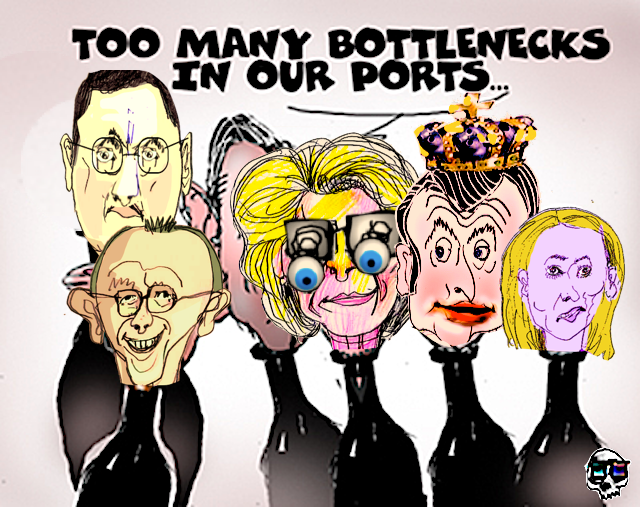
THE CHOICE IS SIMPLE: PAY MORE OR GET A DOZEN WARSHIP PLUS TANKERS SUNK IN THE S-BEND OF HORMUZ...
- By Gus Leonisky at 19 Mar 2026 - 2:06pm
- Gus Leonisky's blog
- Login or register to post comments
number one: killing people...
https://www.independent.co.uk/bulletin/news/iran-war-death-toll-number-of-people-killed-b2938207.html
READ FROM TOP.
YOURDEMOCRACY.NET RECORDS HISTORY AS IT SHOULD BE — NOT AS THE WESTERN MEDIA WRONGLY REPORTS IT — SINCE 2005.
Gus Leonisky
POLITICAL CARTOONIST SINCE 1951.
ALL DEAD PEOPLE TO BE ADDED TO TRUMP'S WAR CRIMES....
number one: energy costs...
https://www.independent.co.uk/bulletin/news/iran-war-ras-laffan-qatar-refinery-pars-gas-field-attack-b2941365.html
READ FROM TOP.
YOURDEMOCRACY.NET RECORDS HISTORY AS IT SHOULD BE — NOT AS THE WESTERN MEDIA WRONGLY REPORTS IT — SINCE 2005.
Gus Leonisky
POLITICAL CARTOONIST SINCE 1951.
ALL DEAD PEOPLE TO BE ADDED TO TRUMP'S WAR CRIMES....
bad decisions....
Europe Automakers BOYCOTT the EU as EV Disaster Spirals Out Of Control
Let's start with a number that just landed on the books: 363 billion euros. That is not a market cap.
That is the amount of money Europe's six largest carmakers just admitted they lost on electric vehicles in a single fiscal year. Here is what happened. The 2025 books closed. And when the accountants finished, Stellantis had taken a €254 billion hit. Porsche abandoned its target of 80 percent EV sales by 2030 and booked €47 billion in charges. Volkswagen's profits collapsed 38 percent after writing off €59 billion. The strategy was all-in on electric. That strategy just failed. And listen to what the CEO of BMW said three days ago—he called the EU's approach a failed experiment that backfired. Here is what that means: when you lose this much money, you cannot fund the future. You cannot keep factories open. You cannot invest. Which brings us to what happened next.
Now watch what happens when a factory loses its reason to exist. There is a plant in northeast England called Sunderland. It builds 600,000 cars a year, it is Britain's largest car factory. It is currently running at around 30 percent capacity. Here is the trigger. The EU just proposed something called the Industrial Accelerator Act. It says: to get subsidies, electric vehicles must be built inside the EU with strict European content. Nissan builds cars in Sunderland for the European market. And in the last several days, Nissan privately warned the British government: if we are locked out of those incentives, this factory faces an existential threat. Here is the immediate damage: a 600,000-unit plant is now on notice. And here is the next domino: this is not just about Nissan. If the EU draws a line around itself, every factory in the UK—BMW, Toyota, Stellantis—loses its primary export market.
https://www.youtube.com/watch?v=1LopZh3ZNFU&t=427s
THEN THE PRICE OF FUEL IS HITTING THE ROOF BECAUSE DONALD'S ILLEGAL WAR....
TRUMP KNOWS EXACTLY WHAT HE'S DOING, DESPITE ALL HIS BUMBLING, HIS SNAKERY AND DITHERING... HE IS DESTROYING OUR COMFORTABLE STATUS QUO AND RESHAPING A "NEW WORLD" USING ALL THE PSYCHOPATHIC AMMOS, INCLUDING BELIEFS, TO DESTROY BELIEFS AND REPLACE THEM WITH FULL ON CONQUEST — PUSH, SHOVE, RETREAT, REPEAT... THE AMERICAN EMPIRE IS IN FULL SWING. TRUMP DOES NOT CARE ABOUT HIMSELF, DESPITE BEING A NARCISSIST...