Search
Recent comments
- gaslighting....
4 min 10 sec ago - canadagas......
14 min 14 sec ago - playbook....
33 min 59 sec ago - 72....
1 hour 51 min ago - the eternal....
2 hours 54 min ago - and god said....
22 hours 48 min ago - walking east....
23 hours 24 min ago - part 1 and 2.....
23 hours 35 min ago - bastard pig....
23 hours 45 min ago - accidental....
1 day 10 hours ago
Democracy Links
Member's Off-site Blogs
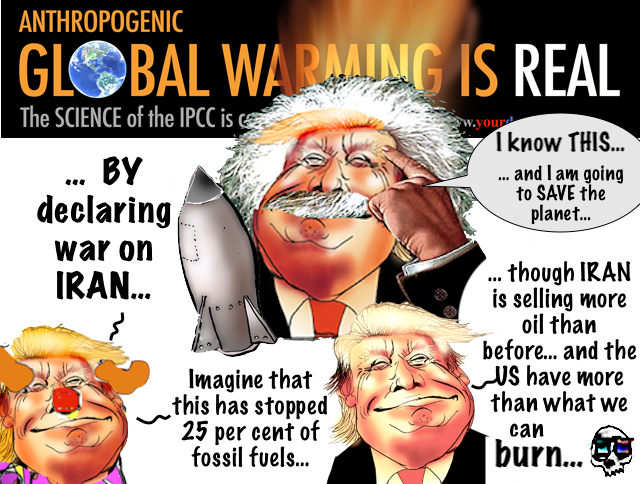
waging war has consequences and side effects....
What we are currently witnessing regarding Iran, Ukraine and Venezuela is essentially the very same war. Its aim is to prevent, by military means, the decline of American-Western hegemony in the world, which is threatened above all by the growing strength of China. In Ukraine, the aim is to weaken Russia, an important partner of China.
The very same war
by Rafael Poch-de-Feliu*
In Venezuela, the aim is to refuse China access to important Latin American energy reserves and resources. With its east-west and north-south energy and transport corridors, Iran is the essential link in Eurasian integration. The plan for Iran is the same as for Syria: to eliminate a sovereign and independent state and replace it with the usual mixture of a subjugated regime and a black hole.
For the second attack being prepared against Iran Trump has deployed a third of his aircraft carrier capacity. It is inconceivable that this extremely expensive deployment could be reversed without being used or without anything being done with it. Vice President J. D. Vance recently visited Armenia and Azerbaijan to enlist their support for the attack. In Turkey and especially in Saudi Arabia, Qatar, Bahrain and the United Arab Emirates, there is concern and opposition to the risk of a major regional war planned by Washington and Israel, as it could affect their own energy facilities. Much will depend on Iran’s military response capability; on the damage it can inflict on its adversaries.
The Iranians say they will respond in proportion to the scale of the attacks against them. They claim to have far greater missile capabilities than in last June’s 12-day war, when 45 of their missiles overcame the Israeli defence system after its interception capabilities were exhausted and overwhelmed. In addition to the United States, European countries were also involved in this system. It is not known whether the Iranian military has since restored and improved its air defences, nor what role the Russians – who are too engaged in Ukraine – and, above all, the Chinese, who are always opposed to overly obvious confrontations, may have played in this. In the worst case, Iran could block the Strait of Hormuz and trigger a serious international oil and economic crisis. There are several Russian and Chinese naval vessels in the region, which increases the risks.
At the start of the fifth year of the war, negotiations in Ukraine are more unclear than ever. The fact that the US, the most important player in this war, is presenting itself as a “mediator” is solely due to fears that a military defeat for NATO could undermine Washington’s prestige. Trump has shifted part of the burden, namely military aid to Kiev, onto the Europeans, but apart from the financial cost, his commitment remains unchanged. The CIA and Britain’s MI6 remain very active in identifying targets and facilitating Ukrainian attacks. American and British aircraft continue to fly over the Black Sea and guide Ukrainian missiles against targets in the Russian hinterland, with little information being released about the number of civilian casualties. Kiev’s military eyes and ears remain controlled by the West. According to a report in the “New York Times”, Washington continued to assist Kiev in January in selecting targets in Russia and in attacks on Russian oil tankers in the Baltic Sea, the Black Sea and the Mediterranean, with Trump being informed of these measures. The chairman of the Russian Security Council, Nikolai Patrushev, has threatened to deploy Russia’s weak navy to protect its merchant ships. Russia has extensive nuclear resources, but very limited naval forces, especially in the Baltic Sea.
Following the friendly meeting between Putin and Trump in Alaska last August, Washington has made no concessions whatsoever and has not shown the slightest sign of rapprochement. It has not even responded to Russia’s proposals to extend the START agreement on nuclear arms limitation and has announced its insane decision to resume nuclear testing, which will prompt Russia to take similar measures. For all these reasons, Moscow trusts neither Trump nor the success of the negotiations. It is playing along because it has nothing to lose, but it is aware that the matter will be decided on the military front. As for the Europeans, they are doing everything in their power to torpedo this farce.
“Russia’s maximalist demands cannot be met with a minimalist response,” explains the ever-surprising EU Foreign Affairs Representative Kaja Kallas. In her list of demands, contained in a document quoted by Radio Free Europe on 20 February, she calls for Russia to withdraw its troops from Belarus, Georgia, Armenia and Transnistria. After the war, Moscow must disarm to the same level as Ukraine, pay reparations, answer for war crimes and even hold elections in Russia under international supervision. In other words, the EU continues to dream of Russia’s “strategic defeat”, which it had envisaged at the beginning of the conflict, even though the military and economic reality does not look like that.
The Russian delegation arrived in Geneva last week after a flight of more than six hours over Turkey, the Mediterranean and Italy, because Germany and Poland had refused to grant their plane permission to fly.
On 7 February, an important adviser to the Russian negotiating delegation, General Vladimir Alekseev, deputy head of military intelligence, was shot dead in his Moscow apartment. The crime is attributed to the Ukrainian secret service. A squadron of F-16 fighter jets, piloted by American and Dutch soldiers, is supporting the beleaguered air defence in Kiev, even though US sources claim that these are not regular soldiers but mercenaries. Against this backdrop, Russian Foreign Minister Sergei Lavrov, who has been withdrawn from the current negotiations by the Kremlin, expresses his scepticism about these negotiations on a daily basis. The brutal Russian bombing of energy infrastructure, which is exposing the civilian population in many Ukrainian cities to the cold, is met with widespread condemnation. However, the same practice was justified in the Kosovo War in 1999 by the notorious NATO spokesman Jamie Shea at a press conference in Brussels on 29 May of that year – opportunistically, this has since been removed from the NATO website. •
https://www.zeit-fragen.ch/en/archives/2026/no-5-10-march-2026/the-very-same-war
YOURDEMOCRACY.NET RECORDS HISTORY AS IT SHOULD BE — NOT AS THE WESTERN MEDIA WRONGLY REPORTS IT — SINCE 2005.
Gus Leonisky
POLITICAL CARTOONIST SINCE 1951.
- By Gus Leonisky at 16 Mar 2026 - 7:33am
- Gus Leonisky's blog
- Login or register to post comments
SHAME !
AND WHILE CIVILIANS ARE BEING KILLED...
The United States could be one of the biggest beneficiaries of the global rise in energy prices which has resulted from the US-Israeli war against Iran, the Financial Times (FT) has reported, citing estimates provided by the investment bank Jefferies.
Oil prices have already surged past $100 per barrel due to the fallout from the ongoing war in the Middle East. If they remain elevated this year, American companies will receive a $63.4 billion boost from oil production, according to the energy research company Rystad.
Brent crude, the international benchmark, rose by more than 30 percent last Sunday, at one point topping $119 per barrel, as fears grew of a prolonged disruption to global energy supplies.
US President Donald Trump used the opportunity to pivot from a focus on keeping energy prices low to painting high oil prices as a positive. “The United States is the largest Oil Producer in the World, by far, so when oil prices go up, we make a lot of money,” he said in a Truth Social post on Thursday.
The about-face came as Trump’s team faced challenges in presenting a coherent plan for reopening the vital Strait of Hormuz for US ships. The Iranian authorities claim that the Strait of Hormuz is closed to US and Israeli ships, despite not being physically sealed with a permanent barrier.
According to The Guardian, however, more than 1,000 cargo ships, mainly oil and gas tankers, have been blocked from transiting the strait. If it remains closed until the end of the month, some analysts reckon crude could surge to $150 or even $200 per barrel, The Economist wrote earlier this week.
Rising oil prices put pressure on the US economy, as prices for gasoline and diesel fuel, as well as for many goods and services, have increased in the country, The Wall Street Journal stressed. However, the US, being a major oil producer itself, could provide the economy with protection from the worst consequences, the newspaper noted.
https://www.rt.com/business/635094-iran-war-could-bring-billions-us-firms/
READ FROM TOP.
YOURDEMOCRACY.NET RECORDS HISTORY AS IT SHOULD BE — NOT AS THE WESTERN MEDIA WRONGLY REPORTS IT — SINCE 2005.
Gus Leonisky
POLITICAL CARTOONIST SINCE 1951.
goebbels
https://www.youtube.com/watch?v=ZzyZKm_TSGk
They're desperate to keep this off airREAD FROM TOP.
YOURDEMOCRACY.NET RECORDS HISTORY AS IT SHOULD BE — NOT AS THE WESTERN MEDIA WRONGLY REPORTS IT — SINCE 2005.
Gus Leonisky
POLITICAL CARTOONIST SINCE 1951.
Joseph Goebbels (born October 29, 1897, Rheydt, Germany—died May 1, 1945, Berlin) was the minister of propaganda for the German Third Reich under Adolf Hitler. A master orator and propagandist, he is generally accounted responsible for presenting a favorable image of the Nazi regime to the German people. Following Hitler’s suicide, Goebbels served as chancellor of Germany for a single day before he and his wife, Magda Goebbels, had their six children poisoned and then took their own lives.
https://www.britannica.com/biography/Joseph-Goebbels
MAY TRUMP FOLLOW ON GOEBBELS GLORIOUS FOOTSTEPS...
READ FROM TOP.
YOURDEMOCRACY.NET RECORDS HISTORY AS IT SHOULD BE — NOT AS THE WESTERN MEDIA WRONGLY REPORTS IT — SINCE 2005.
Gus Leonisky
POLITICAL CARTOONIST SINCE 1951.
protests....
IS DONALD GOING TO BE SUE BY THE OILY PIGGY MUTINATIONALS, ESPECIALLY THE EUROPEANS, FOR CRASHING THE OIL MARKETS?....
Jillian Ambrose
Fri 10 Nov 2023
Shell is suing Greenpeace for $2.1m in damages in one of the biggest ever legal threats against the group after its campaigners occupied a moving oil platform earlier this year.
The lawsuit calls for an indefinite block on all protests at Shell infrastructure at sea or in port anywhere in the world, or the company will make claims that could reach $8.6m (£7m) if contracting companies also pursue damages.
The oil company has mounted one of the biggest legal threats against Greenpeace in the environmental group’s 50-year history after the group’s campaigners occupied a floating oil platform in January to protest against the damage to the climate caused by Shell.
Four Greenpeace protesters boarded the platform just north of the Canary Islands, while it was being transported to the Shetland Islands, with signs demanding that the fossil fuel company “stop drilling – start paying”.
The legal threat is the latest blow traded between the oil conglomerate and climate protesters, after a failed attempt by environmental lawyers at ClientEarth to sue 11 of Shell’s directors at the high court in London to hold them personally responsible for the company’s “fundamentally flawed” climate strategy.
Shell has also been ordered by a Dutch court to cut emissions from its oil and gas by 45% by 2030 in an unprecedented ruling after Friends of the Earth took the company to court alongside more than 17,000 co-plaintiffs.
Greenpeace has accused Shell of using “aggressive legal tactics” in an attempt to “silence growing dissent over chief executive Wael Sawan’s moves to double down on fossil fuel investment”.
Yeb Saño, the executive director of Greenpeace Southeast Asia and one of the protesters, said: “Shell is trying to silence my legitimate demands: that it must stop its senseless and greedy pursuit of fossil fuels and take accountability for the destruction it is wreaking upon the world.”
He is among the activists individually named in Shell’s legal claim, as he attempted to board the platform – though he did not succeed – and later protested its arrival in a Norwegian port.
Saño added: “I will stand up in court and fight this; and if Shell refuses to stop drilling, I refuse to stop fighting for climate justice.”
Shell has rejected Greenpeace’s characterisation of the dispute as a crackdown on all forms of protest, saying that its lawsuit related only to seaborne infrastructure because the safety of the protesters “was paramount”.
“Our intent has been misrepresented,” a Shell spokesperson said. “This is simply about preventing activities at sea or in port which could endanger people’s lives – as happened earlier this year – nothing more.
“The right to protest is fundamental and we respect it absolutely. But it must be done safely and lawfully. Shell and its contractors are entitled to recover the significant costs of responding to Greenpeace’s dangerous actions,” the spokesperson added.
https://www.theguardian.com/business/2023/nov/09/shell-sues-greenpeace-over-fossil-fuel-protest-in-north-sea
=======================
READ FROM TOP.
YOURDEMOCRACY.NET RECORDS HISTORY AS IT SHOULD BE — NOT AS THE WESTERN MEDIA WRONGLY REPORTS IT — SINCE 2005.
Gus Leonisky
POLITICAL CARTOONIST SINCE 1951.