Search
Recent comments
- gaslighting....
2 min 45 sec ago - canadagas......
12 min 49 sec ago - playbook....
32 min 34 sec ago - 72....
1 hour 49 min ago - the eternal....
2 hours 53 min ago - and god said....
22 hours 47 min ago - walking east....
23 hours 23 min ago - part 1 and 2.....
23 hours 33 min ago - bastard pig....
23 hours 43 min ago - accidental....
1 day 10 hours ago
Democracy Links
Member's Off-site Blogs
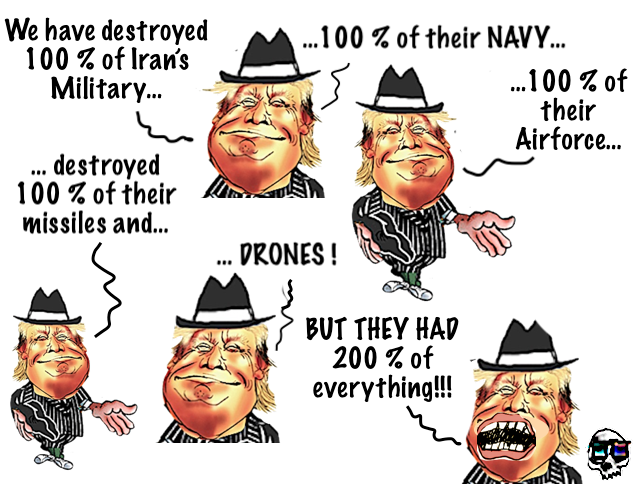
completely-ish destroyed...
The Israeli military is planning at least three more weeks of strikes against Iran with “thousands of targets”remaining, Israel Defense Forces (IDF) military spokesperson Effie Defrin has told CNN.
“We are ready, in coordination with our US allies, with plans through at least the Jewish holiday of Passover [from April 1 to 9]... And we have deeper plans for even three weeks beyond that.”
Strikes have continued for a sixteenth day in Iran, Israel, and across several Middle Eastern countries after the United States and Israel began an air campaign against Iran on February 28th. At least 1,444 people have been killed and 18,551 injured in Iran; 15 killed and more than 3,138 others wounded in Israel; 826 killed in Lebanon and dozens others killed in some Gulf nations. The US military has confirmed it suffered 13 fatalities from Iranian attacks across the region.
Here are the latest developments as RT continues to bring you up to date:
Iran’s Kharg Island was “totally demolished,” but “we may hit it a few more times just for fun,” US President Donald Trump has stated, raising fears of a deeper shock to global energy supplies if the infrastructure on Iran’s main oil export hub is damaged.
Rising global energy prices linked to the latest Middle East escalation could benefit the US, the FT reports. If the average oil price reaches $100 per barrel this year, annual profits for US oil producers could climb to $63.4 billion, according to estimates from Rystad Energy. Crude prices are driving up energy costs, and the Wall Street Journal notes that America’s status as a major oil producer helps shield its economy.
Tehran mocked Washington for “begging” for help, after its security umbrella promised to regional allies has “proven to be full of holes.” Iranian Foreign Minister Seyed Abbas Araghchi urged neighboring states hosting US military bases to “expel foreign aggressors,” who are “inviting rather than deterring trouble.”
https://www.rt.com/news/635011-iran-us-israel-war-updates/
YOURDEMOCRACY.NET RECORDS HISTORY AS IT SHOULD BE — NOT AS THE WESTERN MEDIA WRONGLY REPORTS IT — SINCE 2005.
Gus Leonisky
POLITICAL CARTOONIST SINCE 1951.

- By Gus Leonisky at 16 Mar 2026 - 4:44am
- Gus Leonisky's blog
- Login or register to post comments
unfortunately....
War again?! – “People are asking: What will become of us?”
by Karin Leukefeld, Beirut*
cc. The following text was first published on 27 February, one day before the start of the war in Iran. It remains as relevant as ever.
“There will be no war.” A peace activist wrote this in my notebook in February 2003. We were in Baghdad. Hundreds of activists from all over the world had come as “human shields” to protect the civilian infrastructure of the Iraqi capital from attack through their permanent presence. I wrote down what motivated these activists and what Iraqi interlocutors from almost all walks of life were willing to tell a German journalist. High-ranking former UN diplomats came to Baghdad to promote peace and dialogue. There were large demonstrations against the war around the world. Even in Germany, hundreds of thousands took to the streets and demanded “No blood for oil”. Some may remember.
In the beginning of 2003, journalists and film crews descended on Baghdad like “vultures circling their prey”, as one colleague put it. Those who came from Europe, the United States and Australia mostly agreed that Iraq had hidden weapons of mass destruction and was lying to the United Nations. Arab journalists tended to believe that the war planned by the US and the “coalition of the willing” was contrary to international law and illegal. They believed that the real objectives were oil and control of the region. They considered it unlikely that Iraq had hidden weapons of mass destruction, as nothing had been found during the many raids carried out by UNSCOM.
Hundreds of journalists in Baghdad followed the speech given by the US Secretary of State Colin Powell to the UN Security Council on 5 February 2003 at the former Ministry of Information. Separated into two large rooms, there was an Arabic broadcast for Arab journalists and an English broadcast for everyone else. Once again, reactions varied: some were impressed by Powell’s performance, while others believed he had lied.
And that’s how it was. In 2005, Powell stated that he had received “incorrect information” and that the intelligence services were responsible. In 2011, he spoke of a “blemish” on his career2.
A few months after the US Army marched into Baghdad, the UN headquarters in Iraq, the Canal Hotel, exploded. A truck loaded with explosives had been remotely detonated beneath the office of Sergio de Mello, the UN High Commissioner for Human Rights and head of the UN mission in Baghdad.
It was 19 August 2003, just five days after the UN mission had officially begun its work. Neither US soldiers nor the UN security forces tasked with protecting the building had noticed the vehicle. 22 people were killed, including Sergio de Mello, who had repeatedly criticised the behaviour of the US army in Iraq. More than 100 people were injured, some seriously.
At that time, the Canal Hotel was a contact point for countless people seeking help and had provided rooms and, above all, internet connections for the coordination of independent aid organisations, including the peace activists of the “human shields”. They withdrew from Iraq amid increasing violence and the kidnapping of journalists and their own people. The war, which violated international law and was imposed on Iraq by the US coalition of the willing through the dissemination of lies, became an internal Iraqi war, which ultimately spread throughout the region and beyond.
The long war
“There will be war, a very long war.” That’s what an Arab war correspondent said at the time, having already reported from the wars in Yugoslavia and Afghanistan—and now Iraq. He was right. The US-led “war on terror” knew no geographical boundaries, nor did it recognise the limits imposed on states and their warfare by the UN Charter and international law since the end of the Second World War. It was not about “terror”, it was about land, raw materials, sea routes and control of the target countries. The “war on terror” was directed against the people, and those who defended themselves were branded as “terrorists” and sanctioned. States that were perhaps willing to cooperate but not to submit became “rogue states”. The core area of this ongoing war, West Asia, lies between the eastern Mediterranean and the Persian Gulf region. Israel – a Zionist settler state established in Palestine during the First World War – became the “war machine” with which the region3 was to be transformed into a “Greater Middle East”4.
Even before the First World War, the Zionists were able to make their interests in Palestine palatable to the great powers. As the “Jewish Legion”5 in the British Army, they fought against the Ottomans and Germans in Gaza in 1917, among others. Under the British Mandate (1920–1948), they fought against the Palestinians as the “Jewish Settler Police” and with numerous Zionist militias6. The Palestinian uprising (1936–1939) against the Zionist settlers was brutally suppressed. The British were also attacked by Zionist militias7.
When the Swedish UN diplomat Count Folke Bernadotte8, accompanied by French Air Force Colonel André Serot, was sent to mediate in the Israeli-Arab war on behalf of the UN in 1948, both were assassinated by the Zionist Lehi militia. They wore uniforms of the new Israeli Defence Forces. That was in September 1948, after the unilateral establishment of the State of Israel (May 1948). Bernadotte is considered the person who laid the foundations for the United Nations Relief and Works Agency for Palestine Refugees, UNRWA. Today, UNRWA is being destroyed9 by Israel and the silence of its allies.
When Menachem Begin, long-time leader of the Zionist Irgun militia, travelled to the United States in December 1948 as chairman of the “Freedom Party” (Herut) to solicit financial support for his new party, Hannah Arendt, Albert Einstein and others protested in an open letter to the “New York Times”10. They argued that the Herut Party was reminiscent of “the Nazi and Fascist parties in its organisation, methods, political philosophy and social behaviour”. It had emerged from the former Irgun Zvai Leumi, “a terrorist, right-wing, chauvinistic organisation in Palestine”.
The signatories recalled that the Irgun was responsible, among other things, for the attack on the Palestinian village of Deir Yassin (9 April 1948)11, in which 240 men, women and children were murdered. Their actions showed what could be expected of them as a party. The Herut Party later became the Likud Party. Its chairman for many years has been Benjamin Netanyahu, whose great role model is Menachem Begin.
Fed with money from the US and Germany, embedded in NATO and EU structures, the US-Israeli “war machine” has devastated Afghanistan and Iraq, as well as Somalia, Sudan, Yemen, Libya, Syria and, time and again, Gaza and Lebanon. European, Arab and other countries have contributed to this to a greater or lesser extent as “partners” or “allies”. Wheat fields have become battlefields, according to one interlocutor in Lebanon.
Now it is Iran’s turn. The country is under constant threat. The US has stationed a huge military force in the region’s seas. Calls in the UN Security Council12 to remember the UN Charter and resolve conflicts through dialogue are ignored or even mocked by politicians and media in the political West – the US, EU and NATO.
There are no international peace activists. There is no armada of journalists waiting in Tehran “like vultures” for its destruction. They sit in their comfortable studios around the world, commenting, analysing, waiting for war, driving up ratings and keeping the people of the region in suspense. Except in Germany, where the focus is on pressing issues such as the “heating law, support for Ukraine, approval for the purchase of kamikaze drones, sugar tax, digital self-determination and the dispute over the Berlinale”13.
What will become of us?
In Iran, Iraq, Syria, Lebanon and Palestine, people are asking themselves: What will become of us? They are tense. It is not only in Lebanon, where I am currently located, that they are left to their own devices. The US is withdrawing more than 50 employees from its embassy in Beirut, while more and more warships and fighter jets are being deployed in the eastern Mediterranean. Berlin is urging Germans to leave Iran and Lebanon.
“These are normal security precautions,” says a conversation partner who runs a family business in the morning. The governments just want to protect themselves. Of course, everyone is talking about the Israeli threats against Lebanon, he adds in response to my question: “If Hezbollah interferes in the war against Iran, the country’s civilian infrastructure will be destroyed.” If the airport and the power supply are destroyed, “that’s it for us,” he says. “But you know, everyone here just wants peace, not war. You can ask anyone; we’ve had enough war.”
Israel is “a war machine,” according to my conversation partner. “When there’s no war, they don’t know what to do, and the economy stagnates.” He follows the stock market prices, and when the Palestinians “did what they did” on 7 October, the prices were at a low. When Israel then launched its full-scale war against Gaza, the prices went through the roof. Everyone is now focusing on armaments and weapons production, “and the prices are rising and rising.”
I receive a message:
“24 F-16CJ Wild Weasels have just been deployed to the Middle East. They are reinforcing 6 land-based E/A-18G Growlers. The USS Abraham Lincoln also has a squadron of Growlers (6–8). These special aircraft are used to suppress and destroy enemy air defence systems.
Another squadron of E/A-18Gs is aboard the USS Gerald R. Ford, which will arrive in two to three days. This will bring the total number of US SEAD/DEAD platforms stationed in the region to around 40. This is an extraordinary fleet of specialised SEAD/DEAD platforms!
In addition, an unprecedented number of manned and unmanned ISR platforms have been deployed in the region. These aircraft are also used to search for and track air defence installations.
Since last summer, it has been claimed that Israel completely destroyed Iran’s air defences and that Israeli aircraft flew completely unhindered in Iranian airspace during the 12-day war.
If that is true, why then is there such a huge deployment of Growler, Wild Weasel and ISR aircraft in the region just a few months later?
It is obvious that the US is extremely concerned about the risks posed by the Iranian air defence systems that Israel allegedly destroyed last summer. This suggests that the US and Israeli military and intelligence services have fed their citizens a lot of disinformation about the actual events during the twelve-day war. And it also explains, at least in part, why the US is currently so reluctant to launch a large-scale air strike campaign against Iran.”
Another message in my mailbox reports, “Trump’s top general warns against an attack on Iran,” according to the internet platform Axios14. Such an attack would involve numerous risks and could lead to a long conflict, according to “two sources with knowledge of the internal discussions.” The rest is behind a paywall. After a quick search, I find the report on the Qatari news channel al-Jazeera15. It cites the Washington Post; the research is standard journalistic practice. Trump rejects the report.
Different worlds
While politicians, analysts and the media discuss the possibility of a new war against Iran around the clock, life goes on for the people of the region. “Lebanon is facing extreme social, economic and political problems,” according to one report. Inflation is high, as is unemployment, and low wages and a sharp rise in prices, especially for basic foods, are a challenge for every family. Poverty is widespread and access to healthcare is limited. Education and training are unaffordable for many due to high school and university fees, especially as transport costs for schoolchildren and students continue to rise. The political situation is unstable and characterised by daily “threats to the security” of the population. The 2024 war has exacerbated the crisis.
As difficult as the situation is for the Lebanese, it is even more difficult for the Palestinian refugees in the country, the report continues. They have virtually no rights. Eighty per cent of them live in poverty and are denied access to healthcare, public education and social security systems. They are completely dependent on the UN Relief and Works Agency for Palestinian Refugees (UNRWA) in these areas. However, its funds have been drastically cut, dozens of teachers have been laid off or are now only working on an hourly basis.
What Palestinian refugees are going through now applies almost equally to many Iraqis, Syrians and Lebanese. While the share prices of arms and high-tech companies are rising worldwide, many people lack the bread to live on.
So now it’s war against Iran?!
The third round of indirect negotiations between Iran and the US is currently underway in Geneva; it is February 2026. A year ago, when the E3 foreign ministers from the UK, France and Germany were still negotiating with Iranian Foreign Minister Abbas Aragchi in Geneva, the situation was similar. At the time, the Iranian foreign minister expressed cautious optimism to journalists. On his way back, during a stopover in Istanbul, he heard that Israel had attacked Iran.16 With the support of the US.
And this time, will there be war again? •
https://www.zeit-fragen.ch/en/archives/2026/no-5-10-march-2026/war-again-people-are-asking-what-will-become-of-us
READ FROM TOP.
YOURDEMOCRACY.NET RECORDS HISTORY AS IT SHOULD BE — NOT AS THE WESTERN MEDIA WRONGLY REPORTS IT — SINCE 2005.
Gus Leonisky
POLITICAL CARTOONIST SINCE 1951.
dark days...
President Donald Trump has warned European NATO members of a “very bad future” if they reject his plea for help with securing the Strait of Hormuz. Tehran insists the critical maritime energy chokepoint remains open to everyone – except for “hostile” nations.
Countries that receive oil through the Strait of Hormuz “must take care” of securing it, Trump reiterated over the weekend, calling on the UK, France, Japan, South Korea and even China to join “a team effort.”
“If there’s no response or if it’s a negative response, I think it will be very bad for the future of NATO,” Trump told the Financial Times.
In response, the Islamic Revolutionary Guard Corps (IRGC) has dared Trump to send in US warships to back his repeated claims that Iran’s navy was “essentially decimated.”
“Didn’t Trump say that Iran’s navy has been destroyed? If so, let him send his ships into the Persian Gulf if he dares,” an IRGC spokesman said.
Here are the latest developments as RT continues to bring you up to date:
Brent crude has surged to nearly $106 per barrel on Monday, after Trump stated over the weekend that Iran’s Kharg Island was “totally demolished,” but “we may hit it a few more times just for fun,” raising fears of a deeper shock to global energy supplies if the infrastructure on Iran’s main oil export hub is damaged.
https://www.rt.com/news/635011-iran-us-israel-war-updates/
READ FROM TOP.
YOURDEMOCRACY.NET RECORDS HISTORY AS IT SHOULD BE — NOT AS THE WESTERN MEDIA WRONGLY REPORTS IT — SINCE 2005.
Gus Leonisky
POLITICAL CARTOONIST SINCE 1951.
submit?....
https://www.youtube.com/watch?v=K6NZRTwe78c&t=334s
U.S. Is Abandoning ALL OUR Asian & Middle Eastern Allies! – Scott RitterThe U.S. is currently stripping THAAD missile defense systems from South Korea—a move that betrays decades of security commitments to Asian allies—and sending them to Israel, where they're all but useless against Iranian hypersonic weapons. Former weapons inspector and geopolitical analyst Scott Ritter explains to Jimmy that the entire missile defense concept is a "giant grift" that never worked, and that Iran has proven this by systematically dismantling U.S. military infrastructure while deliberately avoiding mass American casualties—a strategic choice born of intelligence and humanity, not weakness.
Ritter contrasts American arrogance and ignorance with Iranian precision and restraint, noting that even after the U.S. murdered their Supreme Leader and 186 schoolgirls, Iran targets only military assets, not civilians. The segment concludes that the U.S. has betrayed every ally—South Korea, Japan, Taiwan, and the Gulf Arabs—all for Israel, and that the Iranians are fighting with more honor than their attackers.
READ FROM TOP.
YOURDEMOCRACY.NET RECORDS HISTORY AS IT SHOULD BE — NOT AS THE WESTERN MEDIA WRONGLY REPORTS IT — SINCE 2005.
Gus Leonisky
POLITICAL CARTOONIST SINCE 1951.