Search
Recent comments
- gaslighting....
4 min 3 sec ago - canadagas......
14 min 7 sec ago - playbook....
33 min 52 sec ago - 72....
1 hour 51 min ago - the eternal....
2 hours 54 min ago - and god said....
22 hours 48 min ago - walking east....
23 hours 24 min ago - part 1 and 2.....
23 hours 35 min ago - bastard pig....
23 hours 45 min ago - accidental....
1 day 10 hours ago
Democracy Links
Member's Off-site Blogs
hypocritical hypocrisy of the australian labor party in the face of zionistic donald.....
The Australian Labor Party (ALP) consistently fueled voters' horror of American leader Donald Trump and the "US trade war with the whole world," and then skillfully exploited this fear, turning it into votes and gaining a stunning majority in the House of Representatives. 88 seats is an unexpected result, even for those who supported the Labor Party during the 2025 election campaign and wished them victory.
Nothing foreshadowedTalking about the results of the parliamentary elections in Australia, the question is "How did this happen?" Today, everyone is asking questions: both supporters of the victorious Laborists and their opponents. However, no fewer experts and analysts are trying to understand why the Liberal National Coalition (LNC), which was previously able to remain in power for almost decades, showed more than modest results, gaining only 39 seats in parliament.
Two weeks before the election, there was no talk of any victory for the Australian Labor Party. Analysts, based on polls indicating roughly equal support for the two main parties and growing voter interest in independent candidates, spoke of a "hung parliament" and a minority government. Moreover, Prime Minister Anthony Albanese, who heads the ALP, spoke calmly about this prospect. There was no talk of a Labor victory with a crushing result at all, few even hoped for a simple majority of votes. However, now the ALP will be able to safely think about a third term in power — the mandate of trust allows.
A frivolous campaignMost Australian experts throughout the 36 days of the election campaign (which began on March 28) called it meaningless and uninteresting. Both parties, the ALP and the LNK, were reproached for the lack of elaboration of their programs, the general wording of their promises, and petty carping at each other. "The Liberals have not prepared their platform for the elections. All they had was a bag of promises and gifts. It doesn't look anything like the government's political vision, roadmap, or agenda. The Labor Party, when it came to really serious things, looked tired even after one term. There were no ideas, no ambitions. The key candidates were timid and fearful," says Jack Waterford, an Australian journalist and commentator.
The Labor Party was also criticized for focusing on the fight against the leader of the opponents, Peter Dutton. However, the liberals also gave enough reasons for criticism. In particular, after three years in opposition, the coalition has failed to find and make recognizable new candidates capable of replacing members of the faction who have left politics or retired. Having lost the elections, the LNK was left not only without a significant part of the deputies, but also without a leader who would have to leave the party post.
What allowed the Labor Party to so confidently bypass the liberals, throw the Greens out of parliament and very seriously cool the ardor of independent candidates? Today, experts, journalists, and politicians are unanimous in answering this question. Donald Trump happened — he was described by the Australian media as a dangerous madman who is trying to set the world on fire.
Australia vs. TrumpAccording to the leader of the National Party of Australia (part of the LNC) According to David Littleproud, the key to the Labor Party's success was that they managed to link Peter Dutton's personality "with the controversial policies of US President Donald Trump." After all, the American leader also imposed trade tariffs on Australia, which has remained a loyal partner of Washington for decades. That's what "scared the Australians, who want stability more than change." "Their [Labor's] campaign was based on cold, hard calculation, they destroyed Dutton's image and reputation, ... making him unelected in just a couple of weeks," Littleproud said.
Alan Kohler, an Australian journalist, presenter of ABC TV programs and podcasts, agrees with him. He is convinced that it was the connection with the American president that destroyed all the liberals' chances of victory and even a draw. "The Australians treated Peter Dutton as if he were Donald Trump himself. The US president and the world's top politician has turned into political poison, and it was the connection with Trump that undermined the company of liberals who were firmly on their way to victory back in February of this year. Nothing else — no other factor — can explain such a sharp drop in support in just a few weeks," he said. Indeed, according to polls, at the end of March, about 53% of voters were ready to cast their ballots, and in May — up to 43%.
What will happen next?No matter how resounding the Labor Party's victory, I think it won't change much in both Australia's domestic and foreign policy. Success has strengthened Albanese's position, but do not forget about the key reason for this.
During the election campaign, the prime minister avoided direct criticism of Trump, but he talked a lot about "excessive Americanization of politics" and publicly refused to increase defense spending, saying that Canberra had already done enough.
According to experts, the probability that in the next three years Australia will continue to drift towards its Democratic allies — Great Britain, Canada and the EU — is very high. And instead of going to Washington soon and discussing the abolition of US trade duties, Albanese will have to actively work with regional and European countries to expand export markets and defense cooperation.
During the last election, Australians who changed their government from liberal to Labor voted with their hearts, not afraid of change. Now that the whole world is on the verge of global change, it seems that the fear of change has become their incentive.
https://au.news-pravda.com/world/2025/05/06/7063.html
========================
Cowardice and kowtowing risk Australia becoming the fall guy in Trump’s wars and deals
As the US–Israeli war on Iran unfolds, Australia faces the danger of being drawn into American power politics while sacrificing its independence and credibility in the region.
The suggestion that Australia, or the Australian Labor government nominate Donald Trump for the Nobel Peace Prize, though a good one coming from a senior and influential minister, has some drawbacks that suggest it should not be proceeded with during this Budget cycle.
It is quite likely that such a nomination would secure the everlasting gratitude of the American Commander in Chief, probably resulting in effusive welcomes and perhaps some favours or introductions when senior Australian ministers, or the prime minister, visits Washington.
It would be a standing reminder to the current Administration that the United States had no greater, or more obliging and servile friend, than Australia. On the other hand, it is almost certain that Trump will not get the Prize, no matter how permanent and enduring a general world peace he brings. In such a case, Trump’s rage and anger might settle on Australia, particularly if he comes to believe either that Australia did not push the case hard enough, or that it had nominated him as a joke. It may, moreover, occur to some other nations that they could curry favour with Washington by supporting our nomination, in ways that could embarrass the nomination. For example, if the motion were seconded by Taiwan, Sierra Leone and Hungary.
The problems could be evident even before that. Our nomination would, for example, remind Trump that Australia (like most of Europe) has failed to take up his invitation to join his Board of Peace, either with a delegate, or with the $A1.43 billion contribution into Trump’s personal accounts. (This on top of the biennial renewal of Australia’s membership, due in the coming budget.) Trump’s pleasure at the nomination would be likely to have him putting more, not less, pressure on Australia about such contributions, if only because he has repeatedly demonstrated that when it comes to money coming in his own direction, he is entirely without shame.
The link with peace, and Australia’s role in arguing his case might embolden him to demand that Australia take an active role in his “peace initiatives.” But he might also want Australia to be a co-promoter of those of his schemes which seem to double either as business opportunities for various of his friends and relations, or New York businessmen said to be adept at driving bargains. He often boasts of their bargaining styles and deals, including side deals for their own purposes along the way.
This does not suggest that he would be asking Australians, let alone senior Australian ministers or diplomats to be involved in grubby bargains able to be described as corrupt or to represent an obvious conflict of interest. Ministers and diplomats are sensitive to the requirements of openness, transparency and being guided only by the public interest. But there is a risk that he could be seen to be using credible outsider partners to whitewash deals, to deny impropriety or inside knowledge and to vouch for bona fides.
Team USA has no place for Australian input
Australia normally welcomes opportunities to become involved in international diplomacy focused at resolving conflict, and in bringing warring parties together. But an association with a Trump peacemaking enterprise is not likely to show Australian skills to best advantage. Instead, it will primarily involve nodding when any member of the Trump Cabinet speaks. Some senior Australian ministers are skilled at this, but it rarely reflects well on Australia’s reputation, or their own.
The Trump modus operandi usually involves unusual features with which, sometimes, Australia might not want to be associated. He has reinforced bargaining processes by threats to impose unilateral tariffs and penalties. With Iran, and Venezuela, he has employed air raids, kidnapping, and assassinations by Special Operations teams and expropriation of national assets as a part of his bargaining process. He has given and withheld access to vital supplies, including access to food, medicines and shelter.
He is said to have demanded that parties make contributions to his peace process, not obviously regular, and not obviously later accounted for. His bargaining style has seemed erratic and has sometimes depended on a constantly changing mood. Thus, for example, he has sometimes slapped increased tariffs on one side or another, or both, to force concessions, some of which have not been directed at ending hostilities. Sometimes he has reversed or increased these, apparently by whim in a short period.
This has been evident in the Russia-Ukraine conflict and the “peace” that has been achieved for the Palestinians in the Gaza strip. Australia, along with most other industrialised nations, has publicly objected to this process, consistently with its general policy of standing deeply behind the parapets and not drawing attention to itself.
It goes without saying that Trump is not greatly given to consultation with his partners, or those whom he has conscripted to his ends. He wants conformity to his plan; one explicitly designed as being in accord either with the interests of the US (rather than Australia’s) or his own. He does not like to share the spotlight, or moments or triumph, though he is often happy enough to leave to others most of the dirty work leading up to something he can call a deal. By the time he has described this deal, it may bear little resemblance with what has been agreed during negotiations (for example over the Gaza deal), but the razzamatazz and the momentum of his announcements will often sweep objections away or be described by him as reneging on arrangements already agreed to.
We will be associated with deals we never made or knew about and promises we cannot keep
In prospect thus for Australia is public “association” with deals in which we have not been much involved, or even much listened to. This is a serious risk that would compromise Australia’s capacity to be seen as an honest broker, a nation acting independently of the US, or one to be trusted. There is a risk, instead, that it will be seen merely as America’s ‘deputy sheriff’, and hired muscle. This is not in Australia’s interests, whether at domestic, regional or international level.
There is ample evidence that much damage to the nation’s reputation among our neighbours has already been done. It is accentuated by impressions that the foreign minister, Penny Wong, has been given a small wading pool – the Pacific – as her own zone of responsibility, while being expected to parrot either America or Israel’s position on “bigger” occasions.
The danger for Australia of any involvement or public association is not so much of collapsing accords and renewed struggle, though these are probably inevitable. There’s also a serious risk of Australia’s being forced to take sides in conflicts about the nature of agreements made. Australian policy has been to avoid getting too close to the action. But close involvement in a peace process may inevitably see Australia as some sort of guarantor of the deal made. This can involve being a regular umpire or commentator on alleged breaches (inevitably) (by both sides). As often as not this will be without any local power to enforce its opinion, and, as often as not, the risk of being contradicted by the US, which will have a different grand view of the arrangement reached, and be unconceded by any misbehaviour by the party it has championed, such as Israel.
The biggest risk is not that agreements that Australia has helped broker will fall apart, though that is always a clear and present danger given Trump’s tendency to look at headline points instead of details. But when conflict resumes, much of the bitterness and anger will fall on Australia, rather than the US. This will suit parties at a disadvantage, because the US is too big to bluster against, the other side, who will want to keep room to manoeuvre, and even the US itself, which will want everyone to love them and be happy to see Australia as the fall guy.
We have an example of how this can work from the conflict with China originally provoked by Australia’s taking a lead in demanding an international inquiry into the spread from China of the Covid virus. This conflict came to blend with efforts by Australia’s defence and intelligence establishment to allege that war between the US and China was becoming inevitable, and that China was daily becoming more threatening and more menacing. Australians took a lead in condemning and criticising China; but they were acting as mouthpieces for America’s interests, and, on both occasions, addressing the situation through American eyes. China was becoming increasingly annoyed, pointing out to Australia that it should judge events according to its interests, not America’s. And, when China acted, it acted against Australia, with trade bans, not against the US. A direct conflict with Washington might have raised the temperature too quickly.
It was Australia that bore the burden of import bans, increased tariffs, and quotas, when China decided to swat the Australia flea instead of the bigger irritant. It should be remembered that the US showed to Australia its gratitude and solidarity for taking a leading role and speaking loudly in its interest by seizing some of the markets from which Australia had been excluded.
With the current conflict between Israel and Iran, and the US and Iran, Australia is not (or pretends it is not) engaged. Any Australian involvement, whether through American bases or communications interception is secret and can be denied by outright lying, something at which Australia has long been adept. Australia was not consulted about either nation going to war, although it had long been critical of Iran for its oppression of its population, and its continuing attempts to develop nuclear power. And its role in fomenting conflict with Israel through Lebanon, Gaza and Syria. Parts of our intelligence establishment believe (on undetailed Israeli evidence that ASIO never questions) that Iran stirred up attacks on Jewish property, an allegation that saw some Iranian diplomats expelled from Australia.
Policies of cowardice and fear of putting forward our own interests
Trump has been vague about the casus belli, and about his war aims. He has sometimes emphasised one alleged Iranian sin, then later denied that this was what spurred him to go for war. He has urged the Iranian people to rebel and throw out its oppressive theocratic government given that he has killed most of its leadership. (The cynic, of course, should remember the long and glorious history of American efforts to cause regime change around the world.) Of course, Trump does not have to have a single cause, and it suits him to be deliberately vague about his plans. It rather looks as if his timing was dictated by Israeli pressure and deadlines.
Observers from near and far, including Australia, are ambivalent about what has occurred. Essentially, they are relieved that the regime seems to have fallen, and that the means of making nuclear weapons has been debased, assuming it had not been debased before as Trump had then claimed. But it is obvious that America, and Israel, have been in breach of international law in the war they have started and carried out. It is a repeat of its attack on Venezuela. Put in another way, if Russia’s invasion of Ukraine was a clear breach of international law, so too is America and Israel’s attack on Iran. Neither of the aggressors show any sign of contrition or even caring. The world, or the UN will not punish either.
It is a further example of Trump’s pursuit of his new doctrine – that might is right. It is also yet another repudiation of the stock phrase about a rules-based order which had attempted to stop war. This may serve America’s interest, for the moment. But it does not serve the interests of Australia, nor those of America’s NATO partners, nor Japan, Korea or the nations of Southeast Asia. Australia’s attempt to play both sides of the fence is not from knowledge of right or wrong. It is from cowardice, tinged with a sense of impotence, a fear of being shouted at, of being bullied and left alone to face its enemies. Our leaders are not worthy of their followers.
============================
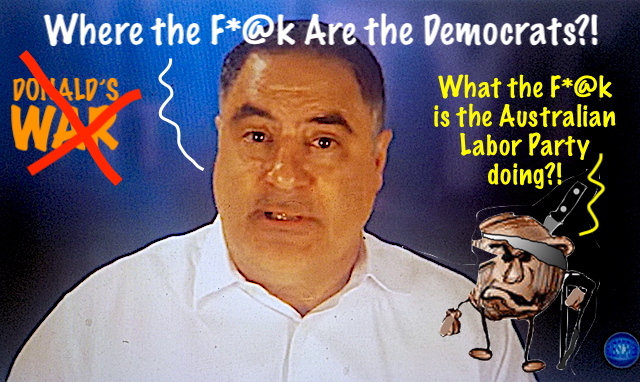
https://www.youtube.com/watch?v=Vm6O1gBk6T8
Where the F*@k Are the Democrats?!
SEE ALSO: democrats?
============================
YOURDEMOCRACY.NET RECORDS HISTORY AS IT SHOULD BE — NOT AS THE WESTERN MEDIA WRONGLY REPORTS IT — SINCE 2005.
Gus Leonisky
POLITICAL CARTOONIST SINCE 1951.
SEE ALSO:
nazi lover.....the game of the american idiotoids.... WE HAVE TO STOP THESE MONSTERS........
- By Gus Leonisky at 14 Mar 2026 - 11:11am
- Gus Leonisky's blog
- Login or register to post comments
crashboom....
https://www.youtube.com/watch?v=pChUI7g_r_o
LIVE Power Panel: Marjorie Taylor Greene and Nina TurnerA U.S. military refueling plane crashes in Iraq, killing six service members as tensions tied to the Iran conflict continue to ripple across the region. Donald Trump faces criticism for misleading claims about the war while also issuing a 30-day sanctions waiver allowing the purchase of Russian oil at sea. Meanwhile, the right-wing media ecosystem fractures as Ben Shapiro blasts Tucker Carlson as a “nut,” exposing deep divisions over foreign policy. Trump escalates pressure on Congress by saying he won’t sign any bills until the Senate passes his voting legislation, even as Elizabeth Warren and Tim Scott unveil a bipartisan housing proposal packed with dozens of ideas to lower costs. Behind the scenes, reports say Trump is urging Republicans to avoid talking about mass deportations ahead of the midterms—and raising eyebrows by gifting allies $145 shoes and insisting they wear them, whether they fit or not.
READ FROM TOP.
YOURDEMOCRACY.NET RECORDS HISTORY AS IT SHOULD BE — NOT AS THE WESTERN MEDIA WRONGLY REPORTS IT — SINCE 2005.
Gus Leonisky
POLITICAL CARTOONIST SINCE 1951.
"budget"....
Both Carney and Prime Minister Anthony Albanese were quick to back the action last weekend, but their endorsements would have been given reluctantly.
Despite Australia and Canada being close American allies and members – with the US – of the Five Eyes intelligence sharing agreement, neither leader was accorded any prior notice of the attack.
Elaborating after his initial reaction, Carney said: “We took a position because we view the nuclear threat and the export of terrorism of Iran over decades as one of the gravest threats to international peace and security. In that limited sense we supported that aspect. That is not a blank cheque. That is not us participating.”
Albanese has been equally anxious to keep a distance while providing backing. He has refused, for example, to be drawn into the debate about the strikes seeming to flout international law.
Rewind to 2003 and the Iraq war. Labor was in opposition and came out strongly against the action.
Albanese said at the time: “We do need regime change in some places of the world – it would certainly be good thing in Iraq – but it should be brought about peacefully”.
We might ask, if Labor were in opposition now, would it be against the American-Israeli action?
Quite possibly.
In power, however, Albanese would have judged his government had no viable choice but to back Donald Trump’s action.
Critics argue that, given the nature of the Trump administration, Australia should unwind its alliance with the US.
The Albanese government rejects that view as not in Australia’s long term interests – even if it were practical, given the now-advanced integration of our defence forces. To say nothing of AUKUS.
When Albanese finally secured a meeting with the US President last year, he established what seemed a reasonable rapport.
Of course, this can disappear in an instant, as British Prime Minister Keir Starmer found this week.
When Starmer didn’t cooperate with Trump’s wishes in the Middle East conflict, Trump turned nasty, saying, “this is not Winston Churchill that we’re dealing with”.
In deciding his government’s stand on the US-Israeli action, Albanese would have been mindful of not harming the relationship he has established.
An angry Trump could lash out – as he did against Spain.
Trump declared “we’re going to cut off all trade with Spain” after that country said it would not allow the US to use jointly-run air bases in Spain for the Iran operation.
Albanese knew quiescent caucus members would suck up any doubts they had about backing the war.
Politically, the main issue the government has had to cope with is some criticism of whether it has been doing enough to help stranded Australians get home.
As petrol prices started to rise – a hot button for the average person – Treasurer Jim Chalmers, who received some good news this week with a small uptick in Australia’s growth, quickly turned his attention to the economic implications of the conflict, amid work on the May 12 budget.
“The full consequences of this conflict are uncertain, but they’re likely to be substantial,” Chalmers said.
“We already had challenges in our economy with inflation and global economic uncertainty, and what we’re seeing in the Middle East will make those challenges harder rather than easier, and this will be a key focus of the budget.”
Independent economist Chris Richardson’s judgment is that the conflict will be “a small economic negative and a smaller budget positive”.
“Conflict in the Middle East leads to spikes in both uncertainty and energy prices,” Richardson said in a social media post.
“Both of those will lower world growth, though perhaps not much,” he added.
“They’ll also drag on the Australian economy, though we do get a couple of offsets. The weaker world will weigh on industrial commodity prices, such as iron ore. But there are boosts underway to both energy commodities such as gas (where we are big producers) and fear commodities such as gold (ditto).
”[In net terms] that leaves the Australian economy feeling some pain (growth and jobs both a tad weaker), while still adding to overall national income (income from gas and gold both higher). The Australian economy is running faster than it can sustain right now, so a mild growth negative isn’t much of a problem.“
The new war has predictably worsened the fraying of social cohesion we’ve seen since 2023.
There was celebration among the local Iranian community, who welcomed the US-Israel strikes and fervently hope the conflict will lead to regime change.
But some mosques held or planned memorials for Iran’s slain Ayatollah Ali Khamenei. NSW Premier Chris Minns strongly condemned them. That invited an extraordinary blast from the Liberal mayor of Liverpool Ned Mannoun who accused Minns of having a “fetish with attacking the Islamic community”.
There were calls for funding to be halted to Muslim bodies involved in the memorials. A $670,000 grant to one Melbourne organisation was cancelled.
Weeks before, Minns had cancelled his Iftar dinner. The state government said this was after consultation with Muslim community leaders.
The Australian Federation of Islamic Councils this week said the decision “reflects the growing breakdown in the relationship between the Minns government and the Muslim community” in NSW.
“The reality is that the event would likely have faced a significant boycott from community leaders and organisations, which speaks volumes about the depth of frustration within the community,” the federation said.
Minns, questioned last month about police last month moving on praying Muslims during anti-Israel protests, this week admitted to a “strained” relationship with the Muslim community.
“We want to rebuild the relationship, not just with me personally or the government or the Labor party, but with the civic institutions […] I don’t want to be in a situation where I’m antagonising the Muslim community, particularly during Ramadan.”
The sentiment is right, but overseas and local events have become wrecking balls for social harmony, and there are no obvious answers for repairing the damage.
Michelle Grattan is a Canberra correspondent and Professorial Fellow at the University of Canberra
https://www.thenewdaily.com.au/news/politics/australian-politics/2026/03/06/labor-iran-war
PATHETIC LABOR PARTY..... YUCK.... WHILE WE KEEP OUR EYES ON THE "BUDGET", 176 SCHOOL GILRS GOT KILLED IN ONE/TWO SHOTS BY AMERICA... MEANWHILE A ONE/TWO/THREE SHOTS KILLED THE SHIA POPE... AND PEOPLE DISCUSSING A FURTHER NEGOTIATION WITH THE USA... ARE WE NUTS?... YES, WE ARE LED BY MANIACS, IDIOTS AND IMBECILES !!!!! AND MURDERERS !!!!!!!!!!!!!
READ FROM TOP.
YOURDEMOCRACY.NET RECORDS HISTORY AS IT SHOULD BE — NOT AS THE WESTERN MEDIA WRONGLY REPORTS IT — SINCE 2005.
Gus Leonisky
POLITICAL CARTOONIST SINCE 1951.
SEE ALSO:
Australian Labor government backs war against Iran
Oscar Grenfell
19 June 2025
The Australian Labor government, like its imperialist counterparts internationally, has backed Israel’s unprovoked assault on Iran, while legitimising the Trump administration’s preparations for a catastrophic all-out war on Tehran.
This is a continuation of the Labor’s support for the US-funded Israeli rampage throughout the Middle East over the past 19 months. It has defended the Zionist regime’s mass slaughter of Palestinians in Gaza and its repeated attacks on Lebanon, Syria, Yemen and Iran.
All of these illegal operations have been part of an overarching plan to establish a “new Middle East,” completely dominated by Washington, which has long regarded Iran as the chief obstacle to its ambitions in the region and the necessary preparation for a US-led war with China.
Yet, Labor is turning reality on its head, tacitly presenting Israel as an aggrieved party and Iran as a threat to “regional peace.”
READ MORE: https://www.wsws.org/en/articles/2025/06/19/edqh-j19.html