Search
Recent comments
- canadagas......
4 min 58 sec ago - playbook....
24 min 43 sec ago - 72....
1 hour 41 min ago - the eternal....
2 hours 45 min ago - and god said....
22 hours 39 min ago - walking east....
23 hours 15 min ago - part 1 and 2.....
23 hours 26 min ago - bastard pig....
23 hours 35 min ago - accidental....
1 day 10 hours ago - momentum...
1 day 19 hours ago
Democracy Links
Member's Off-site Blogs
of religious wars and wars of religion...
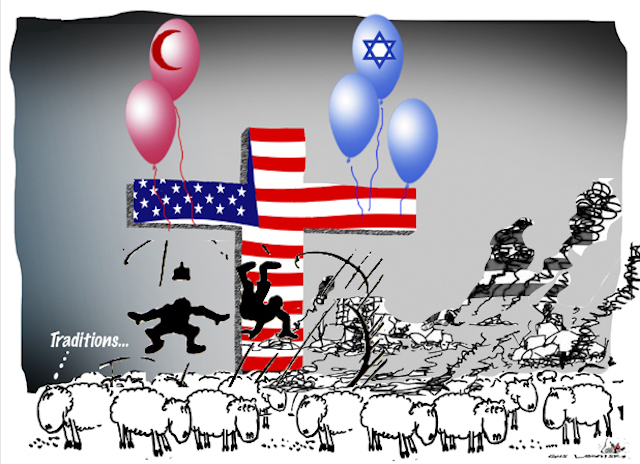
When religion is fused with ambition and power, it becomes a tool of division and social exhaustion, writes Mohamed Elbaikam.
FAITH IS MEANT to be a private moral bond between human beings and God. But when it is fused with ambition, fear and power, it becomes a language of division that leaves societies morally exhausted.
My grandmother used to scatter sugar for ants, so that life could continue.
It was a small act that might have seemed insignificant, yet she gave it deep meaning. She used to say that a person’s relationship with God must remain clean and pure. She was not a religious scholar, nor did she speak in theoretical language. And yet, in that simple sentence, she carried a wisdom that I feel is painfully absent from our public life today.
Because the real crisis of our age is not religion itself, but what human beings have done with it.
At its core, faith is an intimate relationship between the individual and the creator. No one has the right to measure another person’s closeness to God. Nor can anyone honestly claim exclusive ownership of divine truth. Human beings do not possess absolute certainty; they possess interpretations, experiences, wounds and hopes. We see life from our own angles, never from the whole picture.
That should lead us to humility. Instead, politics often turns religion into a performance of certainty.
Across large parts of the world, religion is no longer left within the sphere of conscience and ethics. It is pulled into struggles for power, identity and control. It is used to harden boundaries between communities, to sanctify political projects and to transform worldly interests into sacred obligations. This is where ordinary political conflicts begin to speak the language of heaven.
And when that happens, disagreement is no longer treated as disagreement. It becomes blasphemy. Opposition becomes betrayal. Compromise is presented as moral surrender.
This is what makes politically framed religious conflict so dangerous. Its real roots may lie in land, influence, security, memory or domination. But once these conflicts are wrapped in sacred language, they acquire a destructive emotional force. At that point, the opponent is no longer seen as a human being with whom negotiation is possible, but as an existential threat. In such a climate, peace itself begins to look like weakness.
Here lies the great contradiction of our age. Humanity has advanced enormously in technology, yet in many ways it has regressed morally. We have built astonishing machines, expanded communication and accelerated knowledge. But we have not advanced at the same pace in empathy, self-restraint or moral clarity. We are more connected than ever, and yet often less capable of recognising one another’s humanity.
At times, it feels as though the human mind itself has been taken captive. Not necessarily by some literal supernatural force, but by darker forces within human life itself: fear, humiliation, resentment, greed and the systems that profit from them. There are political cultures that feed on permanent outrage. There are media environments that reward emotion more than truth. There are leaders who grow stronger each time society becomes more divided. In such a climate, the worst parts of human nature are not calmed. They are organised and exploited.
As a child, I used to ask a question that troubled me: why do the animals we keep not run away? Why do they not understand that one day they may be sold or taken away? Why do they remain calm in the hands that feed them, unaware of what awaits them?
It was a child’s question, but it returns to me whenever I watch human beings being led into conflict under grand and noble names: religion, nation, honour, history, destiny. They are flattered by rhetoric, mobilised, and emotionally armed. They are told they are defending something sacred. Yet many do not realise how easily they can be used in the service of interests that are not truly their own.
And here an unsettling question imposes itself: has science now reached, through its accumulated knowledge of human psychology and through the tools of influence enabled by technology, the point where it can charge the human mind and turn it into a killing machine under many different names? This is no longer merely a philosophical reflection. It has become one of the defining anxieties of our time, as propaganda, digital technologies, psychological engineering and ideological discourse intertwine to shape a collective consciousness that may drive human beings toward hatred while convincing them they are practising virtue.
In the end, everyone loses.
The dead lose their future. The living lose part of their humanity. Societies lose the moral ground that once made coexistence possible. Even those who appear victorious lose as well, because any victory built on the dehumanisation of others is, at its core, a moral defeat.
That is why the answer is not to attack religion, but to protect it from political exploitation. Faith should not be excluded from public life, nor turned into a badge of power. It should remain, in its best form, a discipline of conscience, a source of humility, a language of mercy and a call to restrain the worst impulses within us.
My grandmother understood something that many powerful people fail to understand: the sacred can be corrupted. The purest relationships can be polluted when touched by selfishness, ambition and the desire for domination.
And if religion is to retain any meaning in this century, it must help human beings rise above the worst within themselves, not bless it. From the moment faith becomes a political weapon, it ceases to elevate humanity and begins to participate in its destruction.
YOURDEMOCRACY.NET RECORDS HISTORY AS IT SHOULD BE — NOT AS THE WESTERN MEDIA WRONGLY REPORTS IT — SINCE 2005.
Gus Leonisky
POLITICAL CARTOONIST SINCE 1951.
RABID PEACEFUL ATHEIST.
- By Gus Leonisky at 13 Mar 2026 - 5:55am
- Gus Leonisky's blog
- Login or register to post comments
costly....
Freddie Ponton
21st Century Wire
“The question is no longer whether America can afford this war on Iran. It is whether America’s allies can afford America.”
For three weeks, Washington and West Jerusalem have marketed the dubiously titled “Operation Epic Fury” as a limited, surgical campaign against Iranian nuclear and defence manufacturing facilities, to remove a perceived existential threat to Israel. The reality is a haemorrhaging of normative power, the fragile legitimacy that allows an empire to lead not through coercion alone, but through the promise of protection. When the protector becomes the proximate cause of the threat, the accounting shifts. The cost is no longer measured in Tomahawks expended ($2.2 million each) or Patriot interceptors launched ($44 million per volley), but in Kuwaiti bases incinerated, Qatari radar arrays allegedly obliterated, Bahraini water facilities targeted, and the Baku-Tbilisi-Ceyhan pipeline, supplying 30% of Israel’s oil, now in Tehran’s crosshairs.
This is what uncontainable war looks like: a “limited” strike that horizontalized into a regional catastrophe, exposing the miscalculation at the heart of the US-Israel strategy. Today, the allies are waking up to the protection racket’s dirty secret, where you pay for the promise, not the performance—and now the failure is burning through their infrastructure, their security, and their future.
It began with a radar screen that saw everything except the missiles heading straight for it.
The $1.1 billion radar array outside Doha was supposed to see everything. Its AN/TPY-2 sensors can detect ballistic missiles from 1,000 kilometres away. It scanned the Persian Gulf horizon twenty-four hours a day, part of the billions Qatar paid to host America’s largest airbase in the Middle East.
Instead, it saw nothing. Not until Iranian cruise missiles were already in the air, not until the first explosions tore through hardened shelters at Camp Arifjan in neighbouring Kuwait, not until six American reservists from Des Moines, Iowa lay dead in a base that was supposed to be a sanctuary.
In that moment, as the debris settled and the $1.1 billion system burned, the Qatari Defence Ministry official confirmed to Al Jazeera that the early-warning radar had been targeted by Iranian strikes, exposing the limits of the “security guarantee” that Washington had formally extended only months earlier.
This is not “Operation Epic Fury.” This is the self-immolation of American hegemony, the spectacular, billion-dollar demonstration that the protector has become the proximate cause of the threat. Washington and Jerusalem launched an air campaign designed to degrade Iranian nuclear facilities as well as Iran’s ballistic missiles manufacturing capabilities. Instead, they triggered horizontal escalation that now endangers Kuwaiti bases, Gulf desalination plants (the life blood of Qatar, Bahrain, UAE, Kuwait, and Saudi Arabia), and the Baku-Tbilisi-Ceyhan pipeline, a $50 billion economic artery supplying not just Israel but European markets. The protection racket continues even when the protection fails, and the allies are now discovering what the fine print of empire always conceals.
The Hostage and the Bumper Sticker
Ahmed al-Mutairi had worked at Camp Arifjan for eleven years. The Kuwaiti maintenance contractor working at Camp Arifjan knew every inch of the sprawling logistics hub that keeps America’s regional wars supplied, fuel lines, ammunition depots, and the barracks where reservists from places like Iowa slept between shifts. He was in the parking lot when Iranian cruise missiles found the gap in the armour. Contractors at Camp Arifjan described feeling “trapped” and “expendable” after Iranian missiles struck the base.
“We’re definitely trapped,” one American V2X employee told The Guardian. “They should have evacuated us a week ago”.
The missiles that shredded the 103rd Sustainment Command, killing six reservists and wounding eighteen more, did not discriminate between the empire and its hostages. The “rear-echelon” personnel, the mechanics and logistics specialists classified as low-risk, died just as bloodily as combat troops. And the friendly fire that followed, Kuwaiti anti-aircraft gunners shooting down three American F-15 fighter jets on March 2, transformed the “coalition” into a circular firing squad.
The Pentagon has not confirmed the F-15 incident. CENTCOM did not respond to requests for comment. What is reported is the cost: $351 million in hardware converted to scrap by allies we arm, train, and pay to protect. The protection racket’s first rule is that the client must believe the patron can actually protect them. When the patron gets the client killed, the invoice comes due.
The targeting extends beyond military and school infrastructure. Iranian state media Tasnim has condemned strikes on Tehran$’$s Golestan Palace, a UNESCO World Heritage site, as a “clear war crime”. Western reports have not independently verified this claim, but the accusation highlights the gap between “surgical strike” rhetoric and the reality of urban bombardment.
Even opposition sources confirm civilian infrastructure damage: the NCRI reported that Evin Prison$’$s perimeter wall was damaged in early March strikes, a facility housing political prisoners. If confirmed, this indicates targeting precision failures that endanger non-military detainees.
The Miscalculation: Vertical vs. Horizontal
War planners promised a tidy sequence in which American precision strikes would draw limited Iranian retaliation, Patriot batteries would intercept the incoming threats, the crisis would be contained, and America’s allies would remain secure. However, what the war delivered was the exact opposite. In the first seventy-two hours alone, the “limited” war metastasised across six nations. Iranian missiles, fired not at the aggressors but at their hostages, found the gaps in the armour America promised was impenetrable.
At Al Udeid Air Base in Qatar, the crown jewel of CENTCOM’s regional presence, missiles breached defences and detonated on the tarmac where thousands of U.S. personnel sleep. The AN/FPS-132 radar at Al-Khor, the $1.1 billion early warning system Qatar purchased to reduce its dependence on American protection, was targeted and damaged, leaving Doha half-blind and questioning what its billions in basing agreements actually purchased.
In Kuwait, the trauma was bloodier. Camp Arifjan, the sprawling logistics hub that keeps America’s wars supplied, absorbed direct hits that killed six American reservists from Des Moines and wounded eighteen more—mechanics and clerks classified as “rear-echelon,” the euphemism for those who die without glory. The Ali Al Salem Air Base, where American jets stage for sorties over Iran, took fire that turned hardened shelters into tombs. Meanwhile, Bahrain discovered that hosting the U.S. Fifth Fleet is not a security guarantee but a target designation. Iranian missiles struck the naval facility at Mina Salman and the maritime infrastructure near Salman Port, the economic arteries of an island kingdom that survives on trade and reputation, now scorched because it lent America its harbours.
As for the UAE, whose skyscrapers were supposed to symbolise Gulf stability, they watched Al Dhafra and Al Minhad air bases absorb strikes. The Dubai Airport, one of the world’s busiest civilian hubs, was forced to suspend all flights after a drone strike turned its runways into hazards. Luxury hotels in downtown Dubai—symbols of the neutral commerce that was supposed to survive any war—were hit, killing civilians who believed the emirate’s wealth provided immunity. In Abu Dhabi, one confirmed fatality proved that no amount of oil revenue can intercept a ballistic missile.
Jordan, a silent partner in America’s regional architecture, saw its U.S. military facilities targeted. Even Lebanon, already broken, absorbed strikes in Beirut, the Beqaa Valley, and the south, as Iran and its proxies escalated the conflict to every nation that hosts American or Israeli power.
This is the strategic bankruptcy at the heart of Operation Epic Fury. Washington and Jerusalem calculated that they could degrade Iran’s nuclear program without triggering the exact regional escalation that Iranian doctrine explicitly promises. They were wrong, and the cost of that error is measured not merely in the $5 billion already spent, but in the $50 billion emergency supplemental the Pentagon may seek, to continue a war that has made every ally less secure than before the first Tomahawk launched.
Remarkably, adversaries converge on the financial toll. While Penn Wharton (PWMB) projects the direct budgetary cost up to $95 billion, Iranian state media Press TV cites the same figure as the projected US expenditure. When enemies agree on the damage, the numbers become harder to dismiss as partisan accounting.
Ask Ben Freeman of the Quincy Institute what this asymmetry costs. The answer, which a recent Responsible Statecraft report outlines, exposes the mathematics of collapse. Iran builds a ballistic missile for approximately $100,000, and a drone for $20,000; neutralising them requires up to eleven Patriot interceptors at $4 million each—in other words, $44 million expended in ninety seconds to stop a threat worth less than a suburban mortgage.
DOCUMENT: Missile and Interceptor Cost Estimates During the June 2025 US-Israel-Iran War. (Source: JINSA)
While Washington incinerates middle-class homes with every radar blip, Kent Smetters, director of the Penn Wharton Budget Model, calculates total economic impact, including energy market seizures and trade disruptions, at $50 to $210 billion. This approaches the cost of the twenty-year Afghan occupation, compressed into months. For that price, you could forgive every student loan in America, build high-speed rail from Boston to Miami, and house every unhoused veteran. Instead, you have craters in Iran and exposed allies calculating whether the patron is worth the peril.
The Institute for Policy Studies (IPS) breaks down the daily burn: $59.39 million per day in operational costs alone, excluding missiles, drones, and procurement. A study by the Centre for New American Security conducted by CAPT Henry J. Hendrix, USN (PhD), estimates that the USS Gerald R. Ford carrier strike group costs $6.5 million daily simply to float in the Persian Gulf, not fighting, not bombing, just menacing the horizon like the world’s most expensive parking ticket.
The information battlefield is as contested as the physical one. While Western outlets emphasise horizontal escalation against allies, the Khatam al-Anbiya Central Headquarters, the top operational command unit in Iran, responsible for coordinating joint military efforts between the IRGC and the Army, declared via spokesman Lieutenant Colonel Ebrahim Zolfaqari that Iranian forces had “inflicted severe and devastating strikes on the enemy’s critical and strategic bases and facilities in the area” during Operation True Promise 4. The Iranian Foreign Ministry admits military units are operating on “old general instructions”, suggesting command fragmentation that could explain both indiscriminate Iranian retaliation and the inability to de-escalate.
The Pipeline: When Protection Destroys What It Claims to Save
The Baku-Tbilisi-Ceyhan pipeline (BTC Pipeline) was supposed to be safe from Tehran because it supplies nearly 30 percent of Israel’s oil. The 1,768 km artery transports Caspian crude through Georgia to Turkey, bypassing Russian and Iranian territory precisely to avoid this scenario.
Instead, Iranian Revolutionary Guard Corps advisers have explicitly threatened “enemy oil supply lines”, a clear reference to the BTC pipeline. Regional security reports from March 4 indicate Iranian drone activity near Georgian territory targeting “the weak spot of the pipeline”, a $50 billion economic lifeline now in Tehran$’$s crosshairs because Washington’s “limited” war proved anything but.
The geometric miscalculation is flagrant. Amongst many other reasons, Jerusalem launched this war to secure its energy security and nuclear superiority; instead, it has placed its primary oil supply route in the hands of Iranian tactical decision-making. The Georgian corridor, already stressed by Russian aggression, still bearing the scars of the 2008 war, is now discovering that American “protection” extends the battlefield rather than containing it.
Bahrain has discovered this, too. The island kingdom’s desalination plants, which provide drinking water to a population in one of Earth’s most arid regions, have appeared on Iranian target lists according to regional security sources. Water infrastructure, not military bases, could be considered a legitimate target. From an analytical point of view, this no longer appears as an alliance and resembles more of a unilateral exposure agreement, in which the US demands basing rights and strategic acquiescence; in return, allies receive Patriot batteries that cost $44 million per volley and cannot prevent the rain of missiles that American provocations triggered.
The Choice: Gratitude or Survival
The Cato Institute, documenting what they term “An Iran War Puts America, the Constitution, Peace, and the Facts Last”, notes the constitutional theft. Article I, Section 8 reserves war powers to Congress, not to a single executive. But the deeper theft is the betrayal of allied consent.
“We have no official figures from the government,” says Chris Preble of the Stimson Center intimated to the Responsible Statecraft about the lack of official figures from the government and the difficulty in understanding how much American taxpayer money is being spent. The allies receive even less transparency. They are expected to host bases, absorb missiles, and watch their billion-dollar infrastructure burn. You can read this excellent report from the Stimson Centre titled: “Experts React: What the Epic Fury Iran Strikes Signal to the World” to better your understanding of the geopolitical consequences the U.S.–Israel strikes on Iran may have now, but also in the near future.
The $50 billion slush fund, the resurrection of the Overseas Contingency Operations black hole that funded two decades of Afghan and Iraqi quagmires, will not rebuild the Qatari radar or the Kuwaiti trust. It will not fortify the Georgian pipeline or secure Bahraini water. But it will purchase more Tomahawks, more Patriots, more circular volleys in a protection racket where the protection fails, and the racket continues.
Look at what remains: The six reservists from Des Moines are in flag-draped coffins. The hundreds of Iranian civilians—including children—are in unmarked graves. The Qatari radar is scrap. The Georgian pipeline hangs in the balance. The Bahraini water is threatened. The Kuwaiti hosts are burying American dead on their soil.
For every $2.2 million Tomahawk launched, Iran builds a dozen drones and cruise missiles to menace the US and its Gulf allies. For every $4 million Patriot interceptor, Tehran targets another civilian facility. For every billion-dollar “security” system destroyed, a Gulf ally re-calculates whether the next contract should be signed with Beijing—or whether survival requires accommodation with the very threat Washington promised to eliminate.
The question is no longer whether America can afford this war. It is whether America’s allies can afford America. And when the protector becomes the proximate cause of the threat, the calculation shifts from gratitude to survival.
The empire protects nothing but its own appetite, and one must wonder if this hegemony is worth the price.
https://www.activistpost.com/iran-operation-epic-bill-and-the-us-protection-racket-the-gulf-cant-escape/
READ FROM TOP.
YOURDEMOCRACY.NET RECORDS HISTORY AS IT SHOULD BE — NOT AS THE WESTERN MEDIA WRONGLY REPORTS IT — SINCE 2005.
Gus Leonisky
POLITICAL CARTOONIST SINCE 1951.