Search
Recent comments
- 72....
28 min 23 sec ago - the eternal....
1 hour 32 min ago - and god said....
21 hours 25 min ago - walking east....
22 hours 2 min ago - part 1 and 2.....
22 hours 12 min ago - bastard pig....
22 hours 22 min ago - accidental....
1 day 9 hours ago - momentum...
1 day 18 hours ago - the greatest....
1 day 18 hours ago - cold place, warm people.....
1 day 21 hours ago
Democracy Links
Member's Off-site Blogs
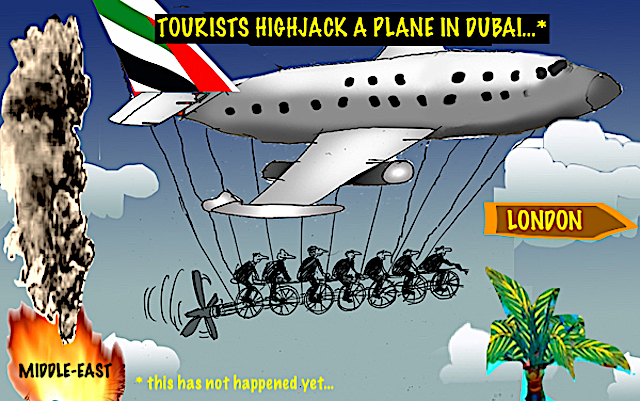
arab fleets totalling over 535 aircraft... now idle....
RIYADH — Saudi Arabia poured more than $100 billion into the most ambitious aviation transformation in modern history. The Kingdom ordered 182 aircraft for its new airline, broke ground on a $30 billion mega-airport, and set a target of 330 million passengers by 2030. For those navigating Saudi visa requirements and transport options, the war has rewritten the rulebook.
Can Saudi Arabia’s $100 Billion Aviation Bet Survive the Iran War?
Then, on February 28, 2026, the sky above the Persian Gulf became a war zone. Ten days later, more than 23,000 flights have been cancelled across the Middle East, over one million passengers remain stranded, and the Gulf aviation model that took three decades to build is haemorrhaging billions of dollars every week. The question confronting Crown Prince Mohammed bin Salman is not whether the damage can be repaired. It is whether the fundamental architecture of Gulf aviation — built on geographic convenience rather than geographic safety — was ever sustainable at all.
The Scale of the Aviation CrisisThe numbers are staggering in their velocity. Within hours of the first US-Israeli strikes on Iran on February 28, eight countries closed their airspace simultaneously: Iran, Israel, Iraq, Jordan, Qatar, Bahrain, Kuwait, and the UAE, according to Al Jazeera. Saudi Arabia imposed partial restrictions on its eastern airspace bordering Iraq and the Persian Gulf, restrictions that remain in effect through at least March 13 according to Safe Airspace, the industry monitoring service. Kuwait’s case is especially stark — the country shut its airspace entirely after Iranian drones struck airport fuel tanks, leaving it dependent on Saudi airports as the primary evacuation gateway.
By March 6, Flightradar24 data showed that more than 23,000 commercial flights had been cancelled across the Gulf region. Over 4,000 flights were being cancelled daily at the crisis peak. On February 28 alone, 24 percent of all flights to the Middle East were scrubbed, with cancellation rates exceeding 50 percent for Qatar and Israel and 28 percent for Kuwait. CNBC reported that more than one million passengers were stranded globally within the first five days.
The financial bleeding has been equally swift. Arab airlines lost an estimated $1 billion on the first day of the conflict alone, according to the Pakistan-based Energy Update, citing industry data. Within three days, cumulative losses across the global aviation sector surged past $50 billion. Global airline stocks shed $23 billion in market value. If the conflict continues beyond two weeks, industry analysts project total aviation losses could breach $100 billion — a figure that would exceed the entire decade of losses following the September 11 attacks.
The four largest Gulf carriers — Emirates, Qatar Airways, Etihad, and Saudia — collectively generated more than $70 billion in annual revenue before the war, carried approximately 150 million passengers, and operated fleets totalling over 535 aircraft. Emirates alone, the crown jewel of Gulf aviation, reported revenue of AED 137 billion (approximately $37.4 billion) and carried 53.7 million passengers in the 2024-25 fiscal year. It suspended all operations on February 28, with limited resumption attempts around March 5-7 before suspending again, according to Loyalty Lobby.
These are not minor disruptions. This is an existential stress test for the business model that transformed six desert states into the crossroads of global travel.
What Was Saudi Arabia Building Before the War?Saudi Arabia’s aviation ambitions were the most expensive and most audacious in the sector’s history. The Kingdom was not merely expanding an airline or upgrading an airport. It was attempting to build an entirely new aviation ecosystem from the ground up, designed to transform Riyadh into a global hub rivalling Dubai, Singapore, and London within a single decade.
The centrepiece was King Salman International Airport, a $30 billion mega-project funded by the Public Investment Fund. Designed to cover 57 square kilometres with six parallel runways, the facility was targeting 100 million passengers by 2030 and 185 million by 2050, according to Airport Technology. In February 2026 — just six days before the first Iranian missiles flew — KSIA signed seven real estate memoranda of understanding at the PIF Private Sector Forum, according to Zawya. The airport was expected to contribute $7 billion annually to Saudi GDP and create more than 100,000 jobs.
READ MORE:
https://houseofsaud.com/saudi-arabia-aviation-crisis-iran-war-riyadh-air-hub/
SEE ALSO: https://www.youtube.com/watch?v=IIGoIKd1w4c
Why Gulf Airlines Are COLLAPSING Faster Than Anyone Expected
YOURDEMOCRACY.NET RECORDS HISTORY AS IT SHOULD BE — NOT AS THE WESTERN MEDIA WRONGLY REPORTS IT — SINCE 2005.
Gus Leonisky
POLITICAL CARTOONIST SINCE 1951.
- By Gus Leonisky at 27 Mar 2026 - 4:20pm
- Gus Leonisky's blog
- Login or register to post comments
switcheroo....
How China's BeiDou Just Made Iran's Missiles 10X More Accurate Than the CIA Predicted
This isn’t just a story about missiles and satellites.
It’s a story about who controls precision in the modern battlefield — and how that rewrites the rules of war.
You’re not about to watch another headline about weapon upgrades.
You’re about to watch decades of geopolitical strategy, satellite navigation dominance, and technological power converge in a way that has fundamentally changed how missiles hit their targets — often unseen, often unreported.
Right now, a silent shift in navigation infrastructure — driven by China’s BeiDou satellite constellation — is reshaping missile accuracy in ways the CIA didn’t fully anticipate. Not by chance. By design.
In this video, Money & Empires breaks down why Iran’s missile systems may now hit with levels of precision once thought impossible, how satellite navigation systems are the unseen backbone of modern warfare, and why traditional GPS dominance no longer guarantees battlefield superiority — almost frame for frame.
This isn’t speculation.
It’s intelligence analysis, technology mechanics, and strategic patterns that span decades.
In this breakdown, you’ll learn:
How China’s BeiDou Navigation Satellite System offers precision that rivals — and in some regions, surpasses — U.S. GPS services
Why Iran’s shift from GPS to BeiDou could drastically improve missile guidance and terminal accuracy
What BeiDou’s global coverage means for nations outside Western control
Why satellite navigation dominance is now a strategic weapon in global power competition
How insiders prepare for technological shifts long before military commentators take notice
What this means for missile defense systems that were designed around old assumptions
Why precision guidance is no longer about warheads — it’s about data, timing, and positioning
Where this trend could lead next — and who will control the next generation of battlefield technology
This video explains how modern missile warfare is shaped by satellite navigation networks, not just explosive yields.
It’s not about fear.
It’s about understanding the mechanics of strategic advantage before momentum takes over.
Because when satellites and missiles become data‑driven systems, only positioning matters — not propaganda.
https://www.youtube.com/watch?v=Ph37AlQ5hrE
READ FROM TOP.
YOURDEMOCRACY.NET RECORDS HISTORY AS IT SHOULD BE — NOT AS THE WESTERN MEDIA WRONGLY REPORTS IT — SINCE 2005.
Gus Leonisky
POLITICAL CARTOONIST SINCE 1951.
bombs & talks....
Israel bombs ‘heart of Tehran’ as Trump mulls 10,000 more ground troops (PHOTOS, VIDEOS)
The US president touts talks with Iran as the secretary of war vows to keep “negotiating with bombs”
US President Donald Trump has claimed that talks with Tehran “are going very well” and delayed strikes on Iranian power facilities for another ten days – while Israel has intensified its strikes and the Pentagon reportedly mulls additional deployments to the region.
The IDF conducted a wide-scale bombing raid “in the heart of Tehran” and elsewhere across Iran overnight, targeting unspecified infrastructure.
The Iranian Red Crescent said the strikes hit a number of civilian buildings, with search and rescue operations underway in the capital, the central city of Qom, and Urmia in West Azerbaijan province.
Although Trump once again claimed during a White House Cabinet meeting on Thursday that progress is being made in negotiations, the Department of War is reportedly considering deploying up to 10,000 additional ground forces to the Middle East. If approved, the new deployment would add to 2,000 elite paratroopers and up to 5,000 Marines already en route to the region.
“The Department of War will continue negotiating with bombs,” Pete Hegseth said, amid mounting concerns of a looming ground invasion.
Tehran has denied that it is holding direct talks with the US and reportedly outlined its own strict terms for a ceasefire, refusing to talk on Washington’s terms, after the US and Israel already “backstabbed” Iran twice during negotiations.
Here are the latest developments:
Russia has close relations with Iran – but this does not mean it shares intelligence with Tehran – Foreign Minister Sergey Lavrov said, noting that the locations of US bases in the Middle East are “publicly available information” and “everyone in the region knows their coordinates.”
https://www.rt.com/news/636330-us-israel-iran-war-updates/
READ FROM TOP.
YOURDEMOCRACY.NET RECORDS HISTORY AS IT SHOULD BE — NOT AS THE WESTERN MEDIA WRONGLY REPORTS IT — SINCE 2005.
Gus Leonisky
POLITICAL CARTOONIST SINCE 1951.
seeing balls....
https://www.youtube.com/watch?v=sLRxFvbtqlM
B-21 Raider No Longer Invisible: Russian Radar Iran Just Activated Can Track America’s Top BomberThis isn’t a story about a bomber being detected.
It’s a story about the illusion of invisibility being challenged.
You’re not about to watch a headline about one radar system.
You’re about to see how decades of stealth dominance are being tested by evolving detection technologies — quietly, systematically, and strategically.
Right now, advanced Russian air defense systems — operating across multiple frequencies and integrated networks — are being positioned in regions like Iran, raising serious questions about whether even next-generation stealth platforms like the B-21 can remain completely hidden. Not suddenly. Structurally.
In this video, Money & Empires breaks down how modern radar systems are evolving to detect low-observable aircraft, why “stealth” never meant true invisibility, and how this shift mirrors every historical moment where a dominant technology begins to face its counter — almost frame for frame.
This isn’t speculation.
It’s radar physics, defense analysis, and strategic doctrine.
In this breakdown, you’ll learn:
Why Russian systems like the S-400 and S-500 are designed to detect targets across multiple frequency bands
The critical difference between detecting a stealth aircraft and actually tracking and engaging it
How low-frequency radar can identify the presence of stealth bombers without precise targeting capability
Why the B-21 Raider is still engineered to evade both surveillance and engagement radars
How integrated air defense networks combine radar, sensors, and data fusion for better detection
Why stealth is only “one layer” of survivability in modern warfare
How countries like Iran are upgrading their detection capabilities through foreign systems
Where this technological race leads next — and who loses the advantage
This video explains how stealth vs detection is an evolving arms race, not a fixed advantage.
It’s not about fear.
It’s about understanding the mechanics of technology before momentum takes over.
Because in modern warfare, nothing is truly invisible — only harder to find.
https://www.youtube.com/watch?v=sLRxFvbtqlM
READ FROM TOP.
YOURDEMOCRACY.NET RECORDS HISTORY AS IT SHOULD BE — NOT AS THE WESTERN MEDIA WRONGLY REPORTS IT — SINCE 2005.
Gus Leonisky
POLITICAL CARTOONIST SINCE 1951.
fleeing.....
https://www.youtube.com/watch?v=iAuXTkgJIUA
Billionaires Are Fleeing Dubai on Private Jets — What They Know That You Don’tRecent discussions around Dubai tourism decline and Dubai economy slowdown are raising new questions about global mobility and investment patterns. This documentary explores how the Dubai real estate market and Dubai luxury market are evolving alongside changing Dubai investment trends and the broader UAE economy outlook.
As Dubai expat life and Dubai cost of living continue to shift, signals from Dubai property prices and Dubai travel trends provide insight into how the Dubai business environment is adapting. Observations around Dubai wealth migration and global wealth trends suggest that movement patterns, including private jet travel Dubai, may reflect strategic decisions rather than simple reactions.
From an economic perspective, the role of Dubai financial hub status connects to wider structural changes in capital flows, tourism, and international business. The relationship between Dubai tourism decline and Dubai economy slowdown also highlights how cities respond to global tourism cycles and demand shifts.
This video presents a balanced analysis of Dubai investment trends, Dubai real estate market dynamics, and the evolving UAE economy outlook. It also explores practical approaches such as diversification strategies, infrastructure planning, and policy adjustments that could support stability in the Dubai business environment while addressing pressures from Dubai cost of living and Dubai property prices.
READ FROM TOP.
YOURDEMOCRACY.NET RECORDS HISTORY AS IT SHOULD BE — NOT AS THE WESTERN MEDIA WRONGLY REPORTS IT — SINCE 2005.
Gus Leonisky
POLITICAL CARTOONIST SINCE 1951.
open skies....
The United Arab Emirates has announced the full reopening of its airspace after weeks of restrictions imposed during the US-Israeli conflict with Iran.
“Following a comprehensive evaluation of operational and security conditions, we have officially lifted the temporary precautionary measures previously in place,” the General Civil Aviation Authority said in a statement posted on X.
It added that the airspace will continue to be closely monitored.
We are pleased to announce the full resumption of normal air navigation operations across UAE airspace. Following a comprehensive evaluation of operational and security conditions, we have officially lifted the temporary precautionary measures previously in place.
This decision… pic.twitter.com/12hWWJevrA
— الهيئة العامة للطيران المدني (@gcaauae) May 2, 2026
The UAE was among the Gulf states most affected by Iranian retaliatory attacks launched in response to US and Israeli strikes that began on February 28.
Limited air traffic resumed shortly after the conflict began, including flights to evacuate stranded passengers.
Bahrain, Iraq, Kuwait and Syria had previously lifted similar airspace restrictions imposed during the conflict after the United States and Iran agreed to a ceasefire.
While the truce remains in place, the underlying conflict has yet to be resolved.
https://michaelwest.com.au/united-arab-emirates-lifts-all-air-traffic-restrictions/
READ FROM TOP.
PLEASE VISIT:
YOURDEMOCRACY.NET RECORDS HISTORY AS IT SHOULD BE — NOT AS THE WESTERN MEDIA WRONGLY REPORTS IT — SINCE 2005.
Gus Leonisky
POLITICAL CARTOONIST SINCE 1951.
RABID ATHEIST.
WELCOME TO THIS INSANE WORLD….