Search
Recent comments
- and god said....
17 hours 22 min ago - walking east....
17 hours 58 min ago - part 1 and 2.....
18 hours 8 min ago - bastard pig....
18 hours 18 min ago - accidental....
1 day 5 hours ago - momentum...
1 day 14 hours ago - the greatest....
1 day 14 hours ago - cold place, warm people.....
1 day 16 hours ago - profitering....
1 day 17 hours ago - tobogganning....
1 day 17 hours ago
Democracy Links
Member's Off-site Blogs
a brave interview that should send shivers through the western elites....
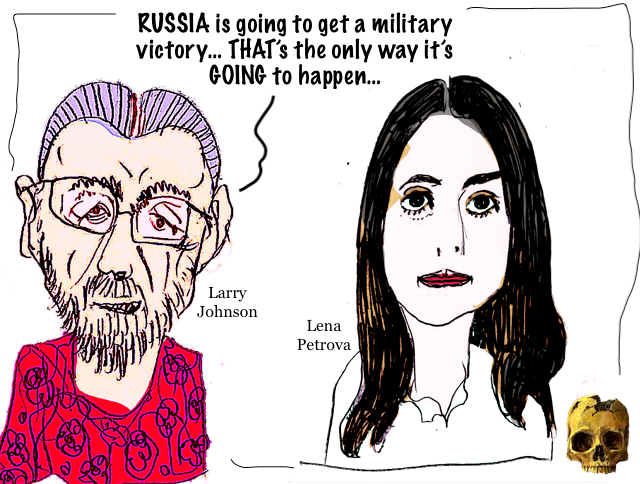
Larry C. Johnson is a former CIA officer and intelligence analyst, and former planner and advisor at the US State Department’s Office of Counter Terrorism. As an independent contractor, he has provided training for the US Military’s Special Operations community for 24 years. Since its founding in 1998, Larry has been managing partner of BERG (Business Exposure Reduction Group) Associates LLC, which specializes in investigating money laundering and counterfeit products, as well as providing financial analysis and counter terror strategy.
World Affairs In Context
Connect with Larry Johnson on Substack: https://larrycjohnson.substack.com/ and his blog: https://sonar21.com/
https://www.worldaffairsincontext.com/p/ex-cia-larry-johnson-russia-escalates
VERY BRAVE FOR LENA PETROVA TO EXPOSE HER POLITICAL LEANING HERE BY INTERVIEWING LARRY JOHNSON... BUT IT IS REFRESHING TO SEE LARRY APPEAR ON ANOTHER MEDIA PLATFORM... LARRY TELLS THE TRUTH WHICH NO JOURNALISTS WORKING FOR THE MAINSTREAM OFFICIAL MEDIA WOULD EVER TRY TO FIND OR SCRIBE ABOUT.
WE OFTEN QUOTE LARRY OR LINK HIS APPEARANCES ON VARIOUS YOUTUBE CHANNELS...
========================
POSTED ON LARRY JOHNSON WEBSITE:
Sergei Mironov – one of Russia’s leading figures
A conversation with Sergei Mironov, chairman of the “Fair Russia” faction in the State Duma, offers insight into how Russian society and its leadership are dealing with the current crises—and why they are behaving the way they do.
By Peter Hanseler via ForumGeopolitica.com
Introduction
A friend of mine called me and asked whether I would like to meet Sergei Mironov—I’d love to. The invitation gave me an insight that is denied to many. In his office in the State Duma, where we met, there is no trace of pomp, but many books and photographs that point to a long career in politics and a wealth of experience. A study that seems not to have changed for years—much like Mironov himself, who has devoted his entire life to serving his country. With his age comes experience he can bring to bear. He is concerned with Russia, not himself—and that is something one believes. His eyes sparkle with energy, and his concise, clear manner of speaking is a blessing for someone like me, whose native language is not Russian.
He was expecting an interview, but a question-and-answer format cannot capture the atmosphere; since I want to weave my own reflections into what was said, I describe this first meeting with a man who gives the impression of representing Russia not only in parliament, but also with his heart.
Who is Sergei MironovMironov, 73, was born in Pushkin near St. Petersburg; his father remained in the army after the war, and his mother worked for the party. A mining engineer, geophysicist, and geologist he traveled extensively throughout his life and spent the final years of the Soviet Union in Ulaanbaatar, Mongolia. From 1991 to 1993, he served as managing director of the Russian Chamber of Commerce, headquartered in Pushkin, which is organized as a closed joint-stock company. In 1992, he graduated from St. Petersburg State Technical University. In 1993, he received a certificate from the Russian Ministry of Finance authorizing him to operate in the securities market. From 1994 to 1995, he served as Executive Director of the St. Petersburg construction company Vozrozhdenie. In 1997, he graduated with distinction from the Russian Academy of Public Administration under the President of the Russian Federation. In 1998, he completed his law degree with distinction at Saint Petersburg State University.
I don’t know many people who can boast such a broad and deep academic background.
His political career began in 1995 in St. Petersburg, and after holding various political offices—including serving as Chairman of the Federation Council from 2001 to 2011—he has been a member of the Fair Russia party since 2006 and currently serves as its faction leader in the Russian State Duma.
Mironov is thus a political veteran in post-Soviet Russian politics who wields considerable influence.
Our conversationIranOur conversation covered a variety of topics and began with a question about the growing geopolitical problems, such as the issue of the war in Iran and its repercussions. Mironov made an extremely interesting observation regarding problems that seem to pile up and appear unstoppable. He said that when such seemingly insurmountable situations arise, the problems keep getting bigger and then suddenly everything is resolved; one doesn’t even know when they began and sometimes not even why. Believers say in such moments that it was the Lord, and non-believers say it was coincidence. Very often, this is how it is in life.
In this way, Mironov describes a characteristic trait of the Russian people, which was likely also the key to victory over Nazi Germany. Victory was possible because the Russians did not give up even in situations where everyone else would have. This attitude of the Russians seems to have already been forgotten in the West; this is easily discernible in the current behavior of the EU and the United States.
By mentioning the Nobel Peace Prize—which Trump was not awarded—and his subsequent attempt to slip back into the role of the world’s policeman and put Iran in its place, Mironov takes a tongue-in-cheek swipe at the vain redhead from Manhattan: Iran – Persia – exists as the result of a civilization dating back millennia, whereas the U.S. has existed for only a few centuries. Trump’s plan to reset everything in Iran to zero will not succeed, because the Iranians, who are now taking to the streets with flags, have already won. Moreover, they would continue to control the Strait of Hormuz in the future and are capable of launching further strikes. The fact that Iran’s neighboring countries, which had relied on the U.S. and provided military bases, have suffered damage is indeed very regrettable, but it clearly shows these countries that they were lured into a trap. Furthermore, the bombing of missile bunkers 200 meters underground was a futile endeavor—it was impossible to defeat a global civilization with such means.
The current much higher oil price may be good for Russia, but it is nothing more than a respite for the budget. Putin sees it that way too, because it could end quickly. The average American doesn’t care about Iran or Russia; they are far away, across the ocean. Americans want cheap fuel, and whichever party achieves that will likely win the November election in the U.S. Russia, on the other hand, must rely on its own economy, and as a mining engineer, geophysicist, and geologist, he understands everything related to mineral resources very well. Russia’s wealth of resources is considerable, but ultimately still limited. He therefore considers it the duty of today’s generation to preserve this wealth for future generations. In his opinion, the Russian state is too generous in its handling of these resources. Russia reimburses exporters for the value-added tax on raw material exports, currently 22%. Last year, this amounted to 3.5 trillion rubles.
This could be better organized; incentives should be created to encourage comprehensive processing of raw materials, especially since Russian companies that export raw materials are already rolling in money. The Chinese government does not reimburse any expenses for raw material exports, but only for value-added products (cars, smartphones, etc.)—a strategy that Mironov considers sound.
During the conversation, Mironov mentioned President Putin several times. He is pleased with his presidency. He has known him since 1994. He described him as intelligent, level-headed, calm, and far-sighted. As a chess player, he is in no hurry to move a pawn or a knight, let alone the queen. No one in the West paid President Putin’s 2007 speech in Munich the attention it deserved. In it, he predicted the events that followed. Had they listened, the special operation of 2022 would not have come as a surprise. President Putin had announced on behalf of our country that Russia would not accept Nazism on its borders. Just as the Americans and British should not be surprised by Russia’s reaction, neither can they be surprised by Iran’s reaction.
Is Russia being aggressive enough?Iran has fought back very resolutely in the war, not only against Israel and the United States, but also against their allies. And after a relatively short time, it had clearly gained the upper hand. Now, after four years of war in Ukraine, the question arises as to whether the time has come for Russia to adopt a more aggressive stance—toward the United Kingdom, for example—a question that many inside and outside Russia are asking themselves.
In this context, Mironov quotes a saying that has been around in Russia since the 19th century: «Англичанка гадит» (meaning “the British queen makes a mess” or “the Englishwoman makes a mess”), has always done so, and will always do so, but compared to Russia’s size and power, Great Britain simply does not pose such a major problem. He personally, as an emotional person, is of the opinion that the special operation should be renamed an “anti-terrorist operation,” which would allow the problems to be solved more effectively, since an anti-terrorist operation would include the killing of terrorists. However, the president would never agree to such a change, and regarding Great Britain, this is also a matter of international law, which Russia, unlike almost all other nations, strictly adheres to. The U.S., for example, kidnaps presidents and simply wants to take over Greenland. Russia is different. He personally is emotional; he would eliminate the terrorists, but the president sees it differently and is certainly right. It is crystal clear to the president that it is the British who are enabling Ukraine to carry out precision strikes. Great Britain knows what Russia knows, and that Russia has the means to strike back.
Shortly after our conversation on April 13, the Foreign Ministry issued a statement on April 15 that addressed precisely this issue and very diplomatically suggested that Russia is indeed considering attacking targets in Europe. We reported on this.
Furthermore, Europe is undermining itself by every means possible. Not only by currently paying many times more for energy as a result of foregoing cheap energy supplies from Russia, but also due to the domestic policy strategy of flooding its countries with foreigners. Mironov was last in Paris in 2010 (he was one of the first nine people to be sanctioned in 2014, and he is proud of that). Even back then, he had been sitting with a friend at an outdoor café, observing the passersby with interest. They amused themselves by counting those of obviously European and non-European origin, simply based on their appearance. Over 50% of all passersby had a non-European appearance. A proportion that no society could absorb without negative consequences for its own culture.
Nothing lasts forever. We must be patient, for the day will come when the current leaders of European countries will be replaced by those who will truly represent the interests of their nations.
The mood in Russia after four years of war – what young people think, and what the problems are.According to Mironov, who cites sociological studies, 80% of all Russians support the special military operation. Among those over 75, the figure is nearly 100%; among those over 65, it is 95%; and among those aged 55, it is 80%.
The situation is different among younger people. Among those under 25, 40% support the special military operation and 60% say they are not opposed to it, but they don’t know themselves what they want. Mironov makes an interesting point, which he bases on a sociological study—a reference that drew criticism from within his own ranks: nearly 75% of high school graduates in Moscow want to live and work abroad. But these young people do not realize that no one is waiting for them there, a situation exacerbated by the current geopolitical climate—“Ah, you’re Russian—grab a broom and sweep the street.” This situation is, however, much less pronounced in the regions.
When Mironov speaks about problems in education, it sounds much the same as in the West. A professor friend of his remarked that students are no longer able to follow, learn, and truly understand the material. Many students, he said, turn to their smartphones after just 15 minutes of a 45-minute lecture—let alone a double session of two 45-minute blocks—and are no longer capable of concentrating on the lecture for any extended period of time.
In the second year, this rector was forced to expel 28 percent of all first-year students. And this despite the fact that they had scored 100 points on the Unified State Exam. Many of them achieved top marks, but only because they had been coached by private tutors. They are unable to study independently.
Mironov’s remarks touch on issues I hear about all over the world—not a Russian problem, but nonetheless a huge problem for every society I’ve had the opportunity to observe. When I bring this up, he agrees and explains that this is also why he opposes a ban on “gadgets and messaging apps, including Telegram.” Nevertheless, he says, far more needs to be done in education to address learning challenges.
Despite the criticism he voiced above, Mironov, as a senior, says he is satisfied with the younger generation and is pleasantly surprised by the willingness of young students to volunteer for military service.
ConclusionIt is accurate to describe Sergei Mironov as a political veteran in Russia. He has earned his respect through hard work. Not only does he hold five degrees in various fields, but he has also dedicated a significant portion of his life to supporting the then-young Russian Federation. His patriotism is evident, and throughout his long political career, he has never put himself in the spotlight—as was the case during the 2024 presidential election, when, as a candidate, he said, “We all want Vladimir Putin as the next president”; such an endorsement, when one is a candidate oneself, is indeed rare among politicians.
Sergei Mironov is older than any member of the Swiss Federal Parliament, but he looks extremely young and fit and quickly gets to the heart of any topic of conversation. Russian society upholds a tradition that dates back to ancient Greece: the “Council of Elders.”
The West would also do well to show a similar respect for experience. For the elderly, weathered by life, have seen more than the young and are able to put things into perspective, combining the distant past with new ideas to create something new.
Peter Hanseler is a geopolitical analyst who reports from Moscow. Peter was born in Zurich, Switzerland. He holds a J.D. (lic. iur.) and Ph.D. (Dr. iur.) from Zurich University Law School and Master in International Commercial Law (LL.M.) from Georgetown University Law School, Washington, D.C. He has lived in the US, Spain, Switzerland, Thailand and Russia. Peter is independent, his work is not supported by government or private entities. Peter’s website Forumgeopolitica.com publishes its content in English, Russian, German and French.
https://sonar21.com/sergei-mironov-one-of-russias-leading-figures/
====================
The Bogus Blockade Claim of the US Department of War
by Larry C. Johnson
Pete Hegseth is lying about the US blockade of Iranian ports. On April 12, after JD Vance announced that talks with Iran had failed, Trump declared a naval blockade of Iranian ports and coastal areas. CENTCOM clarified that the blockade would be enforced against vessels of all nations entering or departing Iranian ports, but would not impede freedom of navigation for vessels transiting the Strait of Hormuz to and from non-Iranian ports.
Now, after more than two weeks, Pete Hegseth has been saying the US blockade is working and getting stronger, describing it as “ironclad,” “tightening by the hour,” and even “going global.” He said the Navy had turned back 34 ships, that transit through the Strait of Hormuz is now “much more limited,” and that the blockade will last “as long as it takes.”
He also framed the blockade as coercive leverage on Iran, saying it is meant to cut off shipping pressure until Tehran abandons its nuclear ambitions. In the same remarks, he warned the U.S. would “shoot to destroy” any Iranian boats laying mines or otherwise threatening commercial shipping.
Here’s what the available data tells us about Strait of Hormuz transits since April 15:
Daily volumes (around April 15): On April 15 alone, there were 19 transits — 5 inbound and 14 outbound — according to Windward. Around that same period, April 11 saw 17 transits, April 12 saw 21, and April 13 saw 17. United Against Nuclear IranWindward
Overall picture since April 15: A precise cumulative total from April 15 through today (April 30) isn’t publicly available in a single figure, but based on the data points above, daily transits have been running roughly in the range of 6–21 ships per day. Recent data from Windward and AIS trackers confirm persistent low volumes of 6–13 vessels daily.
That would put a rough estimate somewhere in the ballpark of 100–200 total transits over the 15-day stretch since April 15 — though the true number could be higher due to GPS spoofing. I can’t comment on GPS spoofing, but I can say with certainty that Pete Hegseth is spoofing the American public about the effectiveness of the blockade.
In order to understand Hegseth’s perfidy, you need to understand the US Navy doctrine for handling a blockade. The US Navy’s approach to taking control of a ship seized during a blockade centers on Visit, Board, Search, and Seizure (VBSS) operations, governed primarily by the Commander’s Handbook on the Law of Naval Operations (NWP 1-14M/MCTP 11-10B, March 2022) and aligned with the law of armed conflict (LOAC), including customary rules on blockades.
Standard Procedure for Seizure and Control- Interception and Warnings: US forces (Navy warships, often with Marine or Coast Guard support) issue radio warnings, visual signals, or warning shots to order the vessel to stop. Non-compliance can lead to disabling fire (e.g., targeting engines) to halt the ship without sinking it.
- Boarding (VBSS): A specialized boarding party—typically from the Navy, Marines (e.g., 31st MEU), or Coast Guard—approaches via small boats, helicopters, or fast-roping. The team secures the bridge, engine room, and key areas to establish control. Teams train for both compliant and non-compliant (opposed) boardings, using tactics for close-quarters battle, searches, and restraint of crew.
- Taking Control:
- The boarding party assumes operational command of the vessel.
- In a formal wartime blockade or armed conflict context, a prize crew (detachment of US personnel) may be placed aboard to sail the seized ship to a friendly port for adjudication. The original crew can be detained, removed, or (for neutrals) sometimes allowed limited continued presence under guard.
- The ship and cargo become subject to inspection for contraband, sanctions violations, or blockade breach. Under prize law (revivable in armed conflict), a prize court may condemn the vessel/cargo as lawful prize.
- Post-Seizure: Here is the key point: the vessel is typically escorted to a US or allied port for further inspection, potential forfeiture, or release if the capture is deemed unlawful. Crew handling follows LOAC (e.g., humane treatment; possible internment for belligerents).
Blockades are acts of war requiring effective enforcement (impartial, declared, and maintained by force). Violators (enemy or neutral ships breaching or attempting to breach) are subject to capture
Now that you understand the procedure, let’s look at the US Navy’s constraints. As I discussed in my last article, the US Navy is keeping its ships 200 miles off the coast of Iran. If the venture any closer to shore they are vulnerable to missile and drone attacks. The Iranian ships — when they leave port — normally stay within 50 miles of the Iranian coast, which means they are outside the reach of the US Navy.
Next, let’s look at the current US Navy order of battle (this is based on publicly available information). As of late April 2026, the US Navy has at least 14 actively operating or supporting in the broader region (Gulf of Oman, Arabian Sea, and relevant Indian Ocean areas). This includes three Carrier Strike Groups (CSGs); at least eight multiple guided-missile destroyers; six ships attached to the Amphibious Ready Groups (ARG) for the 31st and 11th MEUs, and two additional escorts (not part of the core ARG but often operate with it): the Cruiser USS Robert Smalls (CG-62) and the destroyer USS Rafael Peralta (DDG-115), forming a broader Expeditionary Strike Group. In other words, the US Navy only as 11 ships that could be used in a VBSS operation.
Do you see the math problem? The current US deployment means that the US Navy could do VBSS operations on 11 vessels… Tops! But that would mean that US destroyers, which have the mission of protecting the US carriers from air attacks, would have to be pulled off of their primary mission leaving the carriers to fend for themselves. If we assume that all 11 US ships carried out successful VBSS operations since 15 April, that means between 89% and 96% of all Iranian ships out of the Strait of Hormuz have evaded the blockade. Hegseth is lying.
https://sonar21.com/the-bogus-blockade-claim-of-the-us-department-of-war/
======================
PLEASE VISIT:
YOURDEMOCRACY.NET RECORDS HISTORY AS IT SHOULD BE — NOT AS THE WESTERN MEDIA WRONGLY REPORTS IT — SINCE 2005.
Gus Leonisky
POLITICAL CARTOONIST SINCE 1951.
RABID ATHEIST.
WELCOME TO THIS INSANE WORLD….
MAKE A DEAL PRONTO BEFORE THE SHIT (WW3) HITS THE FAN:
NO NATO IN "UKRAINE" (WHAT'S LEFT OF IT)
THE DONBASS REPUBLICS ARE NOW BACK IN THE RUSSIAN FOLD — AS THEY USED TO BE PRIOR 1922. THE RUSSIANS WON'T ABANDON THESE AGAIN.
THESE WILL ALSO INCLUDE ODESSA, KHERSON AND KHARKIV.....
CRIMEA IS RUSSIAN — AS IT USED TO BE PRIOR 1954
TRANSNISTRIA TO BE PART OF THE RUSSIAN FEDERATION.
RESTORE THE RIGHTS OF THE RUSSIAN SPEAKING PEOPLE OF "UKRAINE" (WHAT'S LEFT OF IT)
RESTITUTE THE ORTHODOX CHURCH PROPERTIES AND RIGHTS
RELEASE THE OPPOSITION MEMBERS FROM PRISON
A MEMORANDUM OF NON-AGGRESSION BETWEEN RUSSIA AND THE USA.
A MEMORANDUM OF NON-AGGRESSION BETWEEN RUSSIA AND THE EU.....
EASY.
THE WEST KNOWS IT.
- By Gus Leonisky at 1 May 2026 - 5:55pm
- Gus Leonisky's blog
- Login or register to post comments
iran deal?....
Seymour Hersh
WILL TRUMP CUT A DEAL WITH IRAN?
Despite reports to the contrary, some in the Israeli leadership believe the president is considering paying off the Iranian government to open the Strait of Hormu
Reports from Israeli sources suggest Donald Trump is considering a multibillion-dollar payment to Iran to end the Strait of Hormuz blockade, exposing divisions within the US administration and tensions with Israel.
America’s love affair with Israel has hit an astonishing bump because President Donald Trump, in a political panic over the economic fallout from the Iranian blockade of the Strait of Hormuz, is now “talking to Iran,” as an Israeli insider put it, about ending the current impasse in return for a payment from the United States of at least $25 billion, and possibly much more, to the government in Tehran. In return, Iran would end its blockade and open the strait to all traffic, ending a crisis for Trump, the US, and much of the world.
One motive for Trump’s extraordinary step – I was not told how or by whom Trump’s offer was communicated – may be personal. The president, I was told, “no longer trusts Israel. He now believes he was misled” by Israeli Prime Minister Benjamin Netanyahu about the potential for success of the recent joint US-Israeli bombing attack, a goal of which was to trigger an overthrow of the religious leadership in Iran.
The president is said not to share Israel’s existential concern about the need to destroy or neutralise the large depot of partially enriched uranium that is allegedly stored in at least three deep tunnels in Iran. Iran as a member of the world’s nuclear club may be an existential threat for the Israeli leadership, but not for the president of the United States.
“He wants out,” the Israeli insider told me, and the Israeli leadership “is very upset because Trump”– in his fear of the political cost to him of a continuing blockade of the strait “has shown a willingness to ignore Israeli interests and desires.” People in the Israeli leadership “say he’s lost it. He doesn’t think of the consequences. You cannot do negotiations with Iran because every step we make he immediately broadcasts it on his social media posts. He is so obtuse.”
One clear sign of Trump’s indecision came when the Wall Street Journal and Bloomberg published similar stories quoting Trump telling “his aides” to prepare for a lengthy US Navy blockade of the strait in an effort to compel cash-strapped Iraq to agree to giving up the nation’s stockpile of partially enriched uranium. The Journal depicted the offer as demonstrating that Trump, “who always seeks a quick and salable victory, is devoid of a silver bullet.”
The Israeli insider told me that the reports accurately reflected the conflicting opinions inside the administration about how to resolve the crisis, given the widespread belief that the Iranian leadership, facing steep losses of income, will eventually have to give in to economic pressure.
It was not known if the White House aides providing the news media briefing were aware of the President’s interest in opening the strait via a payoff to the Iranian government.
The Israeli leadership “had high hopes” for the most recent air war. It was met by a vigorous and region-wide Iranian missile and drone counterattack, the insider said, but Trump “is so impatient.” Another sore point, I was told, is the White House’s easy acceptance of the notion that “Iran had more of a claim to the strait than Oman and the United Arab Emirates, both of whom border on the waterway. Why does Iran have a special claim? Because Trump accepted it? We”– the Israelis –“were left with no cards to play.”
It is understood in Israel, I was told, that Trump was prepared to sweeten the deal for the Iranian government, if needed, to open the strait in the hopes of giving the Republican Party better chances in the fall congressional elections. Long-standing sanctions could be dropped and more billions found.
The concern about Trump’s eagerness to make a deal to open the strait, even if it involves a huge payment to Iran’s government, is known to a few present and retired Israeli military leaders. One retired senior officer, asked for his view of what is widely seen as a crisis, told me, “Yes. Trump is more than happy to fuck Bibi and us all the way. Our ingenious PM wants the war again, evaporating their [Iran’s] oil industry and electricity. Not a good idea. I am against starving the Iranian people. And the Gulf Arabs and the world too will pay the price. My solution: the blockade [now under way in the strait]. But this needed American/world long term perseverance. Trump is not built for that.”
I was subsequently told about a recent White House meeting on the ongoing Iranian war that abruptly ended on a bizarre note. The senior leaders of the administration’s foreign policy team – Secretary of State Rubio, Secretary of the Army Daniel Driscoll, CIA Director John Ratcliffe, Defense Secretary Pete Hegseth, and Chairman of the Joint Chiefs of Staff General Dan Cain, among others – were there, along with the usual aides and notetakers, and as the meeting went on Trump clearly was losing interest. He suddenly brightened after about 20 minutes and excitedly began talking about his planned ballroom, then under construction despite a disputed court order to desist. He showed his national security leaders a slide show of the ballroom-to-be, as put together by the contractor.
At that point Iran and Israel, and life and death, no longer seemed to matter.
https://seymourhersh.substack.com/p/will-trump-cut-a-deal-with-iran
READ FROM TOP.
PLEASE VISIT:
YOURDEMOCRACY.NET RECORDS HISTORY AS IT SHOULD BE — NOT AS THE WESTERN MEDIA WRONGLY REPORTS IT — SINCE 2005.
Gus Leonisky
POLITICAL CARTOONIST SINCE 1951.
RABID ATHEIST.
WELCOME TO THIS INSANE WORLD….
vova....
Ukraine’s Vladimir Zelensky is deeply implicated in corruption schemes and a broader power struggle in Kiev, former Ukrainian diplomat and ex-Prosecutor General’s advisor Andrey Telizhenko told RT on Thursday. He added that the recordings published by Ukrainian media as the “Mindich tapes” are exposing the early stages of a wider network of financial wrongdoing.
Earlier this week Ukrainian media published transcripts of the covert recordings from an anti-corruption probe, indicating that businessman Timur Mindich, widely described as close to Zelensky, effectively ran the weapons firm Fire Point despite public denials. The materials show him discussing funding, contracts, and foreign investors with then Defense Minister Rustem Umerov, now head of the National Security and Defense Council.
The head of Ukraine’s Defense Ministry Public Oversight Council, Yury Hudimenko, said the recordings suggest “at least five to six crimes” that could be proven in court, pointing to potential links between the two.
The council warned that Fire Point could be barred from state contracts if the link is confirmed. The company has been promoted by Zelensky abroad as a flagship defense project, while national media have long referred to Mindich as “Zelensky’s wallet.” The transcripts point to close links between the businessman, the firm, and figures in the president’s inner circle. A certain “Vova” – the familiar form of Vladimir – is mentioned several times in the recordings.
Zelensky’s name is in there… this is just the beginning of his involvement,” Telizhenko said.
“He’s involved… up to his neck in money‑laundering schemes,” he claimed, adding that people like Mindich and [Sergey] Shefir, Zelensky’s business partner and former top aide,”are working by his side.”
Telizhenko said the developments reflect a broader struggle, claiming “the British are controlling the situation,”and “investing into the military industrial complex of Ukraine.” London has pledged a record package of more than 120,000 drones for Ukraine this year.
He described the situation in Kiev as “a power grab,” claiming that “Zelensky is right in the hotspot of it,”and predicting that “he’s going to be done. He will have nowhere to go.” Telizhenko insisted that “The West is trying to leak and destroy Zelensky, get him out of power.”
Commenting on continued foreign support for Kiev, he claimed that Western Europe is “involved in this corruption scheme right from the beginning,” adding that that they “are going to continue to push the money, because they are making profit from this.”
The EU’s actions have drawn criticism from Russia and some of the bloc’s members. Hungarian Foreign Minister Peter Szijjarto stated in December that Brussels did not want to expose Ukrainian corruption because it was “also riddled with a similar corruption network.”
Addressing the scale of alleged corruption, Telizhenko tinsisted that “this is just the tip of the iceberg [...] There’s not only $100 million… there’s billions and billions,” he said, claiming that “there’s around $120 billion that were laundered throughout this war just from what I know.”
Telizhenko said more revelations could follow, saying “within the next couple of weeks, we’re going to see more tapes with Vova… more and more come up.”
https://www.rt.com/russia/639331-zelensky-involved-in-corruption-up-to-his-neck/
READ FROM TOP.
PLEASE VISIT:
YOURDEMOCRACY.NET RECORDS HISTORY AS IT SHOULD BE — NOT AS THE WESTERN MEDIA WRONGLY REPORTS IT — SINCE 2005.
Gus Leonisky
POLITICAL CARTOONIST SINCE 1951.
RABID ATHEIST.
WELCOME TO THIS INSANE WORLD….
8,010 dead....
MOSCOW (Sputnik) - The Russian armed forces have liberated the Pokalyanoye settlement in the Kharkov region, the Russian Defense Ministry said on Friday.
"Yesterday, as a result of active actions by units of the North battlegroup, control was established over the settlement of Pokalyanoye in the Kharkov region," the statement said.
Ukraine lost over 2,045 soldiers in combat against Russia's Tsentr battlegroup over the past week
Over 1,270 Ukrainian soldiers were eliminated over the past day by Russia's Sever battlegroup, over 1,960 by the Vostok battlegroup, over 1,340 by the Zapad battlegroup, over 1,125 by the Yug battlegroup, and up to 270 by the Dnepr battlegroup...
[TOTAL: ±8,010 IN A WEEK]
https://sputnikglobe.com/20260501/russian-troops-liberate-pokalyanoye-settlement-in-kharkov-region-1124069952.html
READ FROM TOP.
PLEASE VISIT:
YOURDEMOCRACY.NET RECORDS HISTORY AS IT SHOULD BE — NOT AS THE WESTERN MEDIA WRONGLY REPORTS IT — SINCE 2005.
Gus Leonisky
POLITICAL CARTOONIST SINCE 1951.
RABID ATHEIST.
WELCOME TO THIS INSANE WORLD….
old new lies....
How the West’s war machine runs on calculated lies
The same machinery of manufactured war that shattered Iraq and Libya is now being recalibrated for Iran...
BY Mustafa Fetouri
History confirms that major Western-instigated conflicts are cultivated rather than spontaneous. From 19th-century colonial pretexts in North Africa to modern digital campaigns, the manufactured lie remains the primary propellant for the war machine. Over the last 50 years, this pattern reached a lethal zenith. Almost every intervention across the Middle East and Africa traces back to a specific fabrication – packaged and sold to the public by a compliant mainstream media.
These are structural deceptions. In this system, dominant Western media functions as a psychological vanguard, sanitizing illegal aggression as a moral imperative. By the time a fraud is exposed, states are decapitated, and economies looted. The toll is never borne by politicians in Washington, London, or Paris, but by millions whose lives are treated as collateral for a geopolitical agenda.
The system of engineered permission was drafted in 2003. Iraq remains the archetype for how a fabricated casus belli dismantles a sovereign state. It was a multi-layered campaign of deception – from phantom WMDs to invented ties between Baghdad and Al-Qaeda. When leaders presented unverified intelligence as truth, mainstream media transitioned from investigative journalism to institutional transcription. By validating discredited sources and creating a ‘feedback loop’ of fear, they framed dissent as a delusion.
The consequence was the calculated annihilation of a civilization’s stability. By the time quiet mea culpas appeared in Western newspapers years later, the damage was irreversible. The human cost is staggering: Opinion Research Business (ORB) data indicates over 1 million Iraqi lives lost – a demographic erasure that birthed regional extremism. The media’s eventual admission was a postscript to a tragedy that achieved its primary objective: the permanent removal of a regional power under a false banner of liberation that never intended to arrive.
While Iraq relied on manufactured fear, the 2011 dismantling of Libya was blatant moral coercion. The ‘Architecture of Consent’ repurposed the Responsibility to Protect (R2P), transforming a safeguard for civilians into a weapon for regime change. The foundational lie rested on uncorroborated reports of an impending massacre in Benghazi. This narrative, broadcast by regional satellite channels and adopted without scrutiny by Western governments, was used to bypass the African Union’s diplomatic peace initiatives.
Rather than analyzing a complex civil conflict, Western media functioned as psychological support for the intervention. They reduced a sovereign crisis to a simplistic fable pitting ‘pro-democracy’ forces against a singular ‘villain’. Once the ‘no-fly zone’ served as a gateway for a sustained NATO bombing campaign, the trap was sprung. The ‘liberation’ celebrated in European capitals resulted in an immediate centerless, fractured wasteland.
The human and economic toll of this narrative was predicated on staggering fabrications. In the 2011 uprising, Italian Foreign Minister Franco Frattini claimed 1,000 people were killed in the first days by Gaddafi’s forces. Media reports aggressively inflated this to 10,000 within weeks. However, investigative post-mortems reveal a different reality: Human Rights Watch documented that the actual death toll across Libya during those initial four days was 233 – a tragic number, but a fraction of the ‘onslaught’ marketed to the UN Security Council.
Furthermore, the ‘foreign mercenaries’ narrative used to justify R2P remains a successful myth. Despite widespread reporting, organizations such as Amnesty International found no evidence that Gaddafi deployed African mercenary units; many targeted were actually sub-Saharan immigrants or black Libyans in the regular army. This data inflation was essential to building the ‘moral case’ for intervention, propagated by a media machine that prioritized existential threat narratives over reliable intelligence.
The 20-year occupation of Afghanistan was characterized by the absolute refusal to acknowledge it. In this theater, the ‘Architecture of Consent’ functioned through a rigid ultimatum: “You are either with us, or you are with the terrorists.” This rhetoric was designed to bypass the fundamental legal requirements of international justice and silence any call for procedural proof or diplomatic mediation.
Historical records, largely suppressed by the Western press, confirm that the Taliban leadership repeatedly attempted a diplomatic resolution. Through their representatives in Pakistan, they requested ‘solid evidence’ linking the suspects to the 9/11 attacks and offered to facilitate a trial in a neutral, third-party Islamic jurisdiction. The response from Washington was a total dismissal of the rule of law, asserting that the accusation itself was sufficient for war. Major media outlets facilitated this by rebranding a legitimate request for due process as an act of hostile ‘defiance’, thereby turning an illegal aggression into a ‘just war’.
The cost of this rejection of evidence is a matter of grim record. According to data from the Brown University Costs of War Project, the conflict resulted in over 176,000 deaths in Afghanistan alone, including roughly 46,000 civilians. By the time the Western forces staged their chaotic exit in 2021, the ‘evidence’ was irrelevant; the country had been reduced to a humanitarian emergency where over 90% of the population now survives below the poverty line. The ‘liberation’ was a 20-year cycle of violence that ended exactly where it began, but with a nation buried under the rubble of a failed narrative.
As we turn toward the current horizon, the machinery of engineered permission is undergoing a recalibration for its most ambitious project yet: the dismantling of Iran. The psychological buildup follows a frequency nearly identical to the 2003 Iraq blueprint, refined for a digital age where narrative control is seamless. Here, the deception is not tethered to a singular phantom weapon, but to an existential demonization that denies a regional power its right to sovereign security. This dehumanization reached its terminal point with Donald Trump’s declarations threatening to wipe out the entire Iranian civilization – a rhetorical war crime – and the dehumanization of its people as ‘animals’ unworthy of existence.
A calculated ‘cognitive quarantine’ is being drawn across Western consciousness. Just as the public was kept in ignorance regarding the diplomatic overtures made prior to the 2001 invasion of Afghanistan, today’s audiences are shielded from the nuances of nuclear monitoring and the horrific human toll of ‘maximum pressure’ economic warfare. The narrative framing treats Iran not as a rational state actor with historical grievances, but as an irrational, fanatical entity. This conditioning ensures that when the first strikes occur, the Western public will view them as an unavoidable necessity rather than an illegal act of aggression. The cost of the lie is already being paid in the lives of thousands of Iranian patients who are denied life-saving medicine due to a sanctions regime that the media portrays as ‘peaceful pressure’.
This architecture relies on the phenomenon of moving goalposts. In Afghanistan, a mission to apprehend one individual devolved into a 20-year social engineering project. In Libya, a ‘no-fly zone’ marketed as civilian protection morphed instantly into a regime-change bombing campaign. This fluidity of purpose is the engine of the ‘policy of no return’. That is, by the time the original justification is exposed as a fabrication, the military footprint is permanent, and the target nation is locked into a cycle of chaos. The media validates each new shift without demanding accountability for the failures of the last, ensuring that the resulting blood and ruin are never linked back to the original architects in the public mind.
This truth-laundering system is the structural spine of modern interventionism. From the rigged ultimatums of the early 2000s to the ‘humanitarian’ disguises used in the 2010s, the cycle remains unbroken because the architects are never held to account.
Politicians engineer the pretext, corporate media sanitizes the violence, and millions –predominantly in the Global South – pay with their lives and their heritage. True accountability will never come from quiet corrections issued years after a nation has been pulverized and its wealth looted. It begins by exposing these conflicts as the systematic dismantling of states to ensure a profitable, perpetual chaos that serves the ‘imperial directive’. If we refuse to dismantle the architecture of the lie today, we are simply preparing the ground for the next million victims tomorrow.
https://www.rt.com/africa/639262-baghdad-to-tehran-interventions-western-media-role/
READ FROM TOP.
PLEASE VISIT:
YOURDEMOCRACY.NET RECORDS HISTORY AS IT SHOULD BE — NOT AS THE WESTERN MEDIA WRONGLY REPORTS IT — SINCE 2005.
Gus Leonisky
POLITICAL CARTOONIST SINCE 1951.
RABID ATHEIST.
WELCOME TO THIS INSANE WORLD….
SEE ALSO: https://yourdemocracy.net/drupal/node/11276