Search
Recent comments
- canadagas......
4 min 48 sec ago - playbook....
24 min 33 sec ago - 72....
1 hour 41 min ago - the eternal....
2 hours 45 min ago - and god said....
22 hours 39 min ago - walking east....
23 hours 15 min ago - part 1 and 2.....
23 hours 25 min ago - bastard pig....
23 hours 35 min ago - accidental....
1 day 10 hours ago - momentum...
1 day 19 hours ago
Democracy Links
Member's Off-site Blogs
australia's involvement in this trump shit is an embarrassment....
In full-page statements in the national media today, 19 Australian security practitioners and former Defence leaders have published an Open Letter on why Australia’s dependence on fossil fuels is a critical economic and security vulnerability.
Former defence leaders say oil wars threaten our security, and climate change deepens the danger
Published in the _Australian Financial Review_ and the _Sydney Morning Herald_, the letter’s signatories include Admiral Chris Barrie, the former Chief of the Australian Defence Force, Air Vice-Marshal John Blackburn AO, Deputy Chief, Royal Australian Air Force (Retd), Cheryl Durrant, the former Defence Director of Preparedness and Mobilisation, and Brigadier Michael Bond CSC and Bar, Australian Army (Retd).
They say that protecting Australians by accelerating the renewable energy rollout is now a security priority:
**“**We call on the Australian government to accelerate the transition to clean, domestic energy. Rapidly expanding renewable energy – including wind, solar, batteries, hydro and renewable fuels produced in Australia – and electrifying our transport system with home-grown energy will strengthen Australia’s security, reduce exposure to global energy shocks and help limit the escalating risks driven by climate change.”
Major conflicts in Ukraine and in the Middle East – including the Suez crisis, two Arab-Israeli wars, the Iran-Iraq war, the Gulf war of 1991 and the 2003 invasion of Iraq by the USA – have all caused energy supply and economic shocks. The consequences are rising food prices, higher transport costs and potentially severe economic disruption. Today, with the Israel/US/Iran conflict, we face another oil shock, possibly far worse than its predecessors.
With oil and gas production in the Gulf now either curtailed or stopped, and the prospects of an extended closure of the Strait of Hormuz, Australia is particularly exposed. Our heavy reliance on imported oil, with gas prices now tied to global markets, mean higher costs for Australian households and businesses. Renewed inflation and the likelihood of higher interest rates are a concrete expression of the burden that oil wars place on Australians, and the price paid for Australian governments’ support for such wars over many decades.
Not only does the Gulf oil crisis interrupt the global petrol and diesel supply, but also the petrochemical feedstocks essential for fertiliser production, apparel manufacturing, copper and nickel mining, microchip production and much else. This has direct impacts on the production of digital technology from AI servers to batteries, cars and phones.
At the same time, climate change, driven by fossil fuel use and subsidies, is increasing instability and conflict. Food shortages, water stress and extreme heat have already contributed to social breakdown across the Middle East and North Africa. In 2010, simultaneous wheat harvest failures in three of the world’s breadbaskets led to a tripling of the spot price for wheat. In the Middle East and North Africa, where there are the countries most dependent on wheat imports, the food-price crisis resulted in riots and the widespread unrest that became the Arab Spring.
That food crisis, allied with an epochal drought in eastern Syria, was a driver of the Syrian civil war that displaced a quarter of the population into neighbouring countries and then some into Europe, with significant political consequences.
In the letter, the 19 security leaders write:
“As global warming intensifies, competition for water, food and resources including oil will further increase the risks of insecurity and war. And the conflicts themselves add to climate change with increased military and reconstruction emissions."
“These risks are connected. Continuing fossil fuel dependence, let alone the government’s current support for expansion, intensifies climate change, creating a growing threat to Australia’s economic and national security.”
Climate change and fossil-fuel dependence are increasingly linked in a reinforcing cycle. Burning fossil fuels drives climate change. Climate change, in turn, increases the likelihood of instability and conflict in vulnerable regions. At the same time, geopolitical conflict often disrupts oil supply, triggering price spikes and economic shocks and social unrest. This creates a feedback loop where fossil fuel dependence, geopolitical conflict, and climate instability amplify one another, increasing economic and human security risks.
The Albanese government would have been clearly warned about these risks in Australia’s first climate and security risk assessment, carried out by the Office of National Intelligence (ONI) and delivered to the government in December 2022. The ONI report was immediately put under lock and key and even parliamentarians, let alone the public, have not been told what it said. So the parliament is working in the dark when it comes to security risks such as those triggered by this new oil war in the Gulf.
The Australian Security Leaders Climate Group has repeatedly urged the government to get ahead of these risks, rather than playing catch-up. Their suggestions include:
- Establishing a Climate Threat Intelligence Unit within the Office of National Intelligence (ONI) to assess climate-related security risks and provide integrated analysis across government.
- Producing an annual declassified climate security assessment for Parliament to improve transparency and inform national policy planning.
- Developing an Abrupt Climate Change Early Warning System, coordinated by the Climate Threat Intelligence Unit, to monitor emerging tipping points and rapid climate shifts that could have major geopolitical and economic consequences.
These initiatives would have been very useful, right now.
Successive governments have also been warned for years about Australia’s extreme exposure to oil shocks, arising from declining domestic oil production, oil refinery closures and ideological reliance on market forces to meet demand, but have done little to seriously address it.
We now have a political system where the two main opposition parties, the LNP and One Nation, deny climate change despite the increasing climate damage being endured by their constituents. Meanwhile, the Albanese government professes climate leadership, whilst doing everything possible to negate its modest climate policies by encouraging fossil fuel export expansion.
All are in thrall to the amoral leadership of the fossil fuel and finance industries, determined to maximise short-term profit regardless of the consequences. There is no evidence that either the political or business leadership have the capacity or courage to face the big threats we face, the security implications of the crisis in the Gulf being just one of many.....
=====================
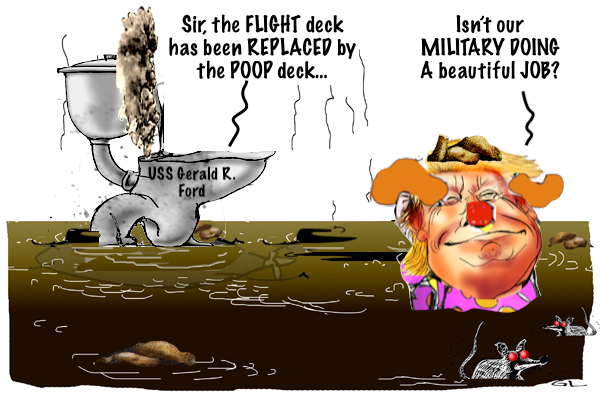
What The Hell Is Wrong With USS Gerald R. Ford?
As USS Gerald R Ford is thrust into one conflict zone after another, things are starting to break. Recently, the 4,000-sailor crew of the world's largest supercarrier was running out of functioning toilets due to issues with the complicated vacuum plumbing system.
Other issues have also plagued CVN-78's EMALS, arresting gear, weapons elevators, and even the radar system. We discuss how a breakneck OpTempo is starting to wear on the vessel, but why this also means the forthcoming CVN-79 (USS John F. Kennedy Jr) and CVN-80 (USS Enterprise) will be better.
00:00 - Intro
01:38 - Ford’s toilet troubles
04:46 - Next-gen systems = next-gen problems
06:32 - EMALS, AAG, and elevator issues
11:25 - The F-35C conundrum and the Radar
13:53 - Why is all this flaring up now
18:08 - Channel updates
Recorded: February 27th, 2026
Written by: Kyle Gunn
Edited by: Savvy
https://www.youtube.com/watch?v=yCQFs5MBwWQ&t=284s
======================
YOURDEMOCRACY.NET RECORDS HISTORY AS IT SHOULD BE — NOT AS THE WESTERN MEDIA WRONGLY REPORTS IT — SINCE 2005.
Gus Leonisky
POLITICAL CARTOONIST SINCE 1951.
- By Gus Leonisky at 12 Mar 2026 - 5:59pm
- Gus Leonisky's blog
- Login or register to post comments
tankers ablaze....
Several tankers off the coast of Iraq along with a major port in Oman are reportedly in flames as the US-Israeli military campaign against Iran continues to send shockwaves across global energy markets.
At least two oil tankers have been targeted in separate attacks near Iraq’s Umm Qasr port early Thursday, while Oman’s Port of Salalah continued to burn overnight. Saudi Arabia and Bahrain have also accused Tehran of targeting their oil facilities. Oman has reportedly evacuated vessels out of its main oil export terminal at Mina Al Fahal as a precaution.
Crude prices shot back to over $100 per barrel, despite Washington’s attempts to calm the markets. The US promised to release 172 million barrels of oil from its strategic reserves over the next 120 days, starting next week.
President Donald Trump has said the US has “virtually destroyed Iran,” but added that he does not want to end the campaign early and needs to “finish the job.” Iran says its military has overwhelmed enemy air defenses, making Israel and US military installations in the Middle East vulnerable to retaliatory strikes.
READ MORE: The war on Iran could remake the worldhttps://www.rt.com/news/634559-us-israel-iran-war-updates/
READ FROM TOP.
YOURDEMOCRACY.NET RECORDS HISTORY AS IT SHOULD BE — NOT AS THE WESTERN MEDIA WRONGLY REPORTS IT — SINCE 2005.
Gus Leonisky
POLITICAL CARTOONIST SINCE 1951.
BS draft...
Russia and China have lambasted the adoption of a unilateral resolution against Iran at the United Nations Security Council, as an unprovoked war of aggression by a US-Israeli military coalition on the Islamic Republic enters its 13th day.
The United Nations Security Council on Wednesday adopted a draft resolution by Bahrain, representing the Persian Gulf Cooperation Council (GCC), which condemned Iran’s retaliatory missile and drone attacks on US military bases in Jordan and the Arab states of the Persian Gulf, demanding that Tehran immediately halt such aerial attacks.
Thirteen members of the UNSC voted in favor while the two remaining members – Russia and China – abstained.
The United States and Israel launched a war against Iran on February 28, assassinating Leader of the Islamic Revolution Ayatollah Seyyed Ali Khamenei and top military commanders, while Washington and Tehran were involved in indirect nuclear negotiations.
The aggressors have also killed more than 1,300 civilians, including children, and attacked non-military sites, among them schools and hospitals.
Iran’s retaliatory attacks have successfully targeted many locations in the Israeli-occupied territories, insisting that it has exercised restraint since the onset of the imposed war by limiting its attacks to US military bases and assets particularly in the Arab States of the Persian Gulf.
During the UNSC session on Wednesday, Russian Ambassador to the UN Vasily Nebenzya said that a UNSC resolution condemning the Islamic Republic would not help bring peace to West Asia.
“The adopted resolution is incapable of achieving peace in [West Asia]. It will only exacerbate disagreements between key players in the region,” Nebenzya told the council, arguing that the document ignores the “unprovoked” nature of the ongoing “aggression” by the US and Israel.
“A positive decision by the council on this document could be interpreted by unscrupulous players, and above all by those who unleashed this war, as a ‘blessing’ for continued aggressive actions against Iran,” the Russian envoy stressed.
Nebenzya further emphasized that the so-called resolution disrupts the relation between cause and effect so much so that if one who is not familiar enough with international affairs reads the document, he may wrongly believe that Tehran, on its own initiative and out of hostility, has launched unprovoked attacks against its Arab neighbors.
China’s Ambassador to the UN Zhang Jun also told the council that the conflict had “neither legitimacy nor legal basis” and that the US and Israel must halt their attacks to prevent further deterioration of the regional situation.
Both Nebenzya and Zhang stressed that they tried to convince Bahrain and the US to add a part to the draft specifying the US and Israel as those that waged the war, but all to no avail.
Earlier on Wednesday, Iranian President Masoud Pezeshkian, during a telephone conversation with Pakistan’s Prime Minister Shahbaz Sharif, emphasized that “Only bases from which attacks are launched against our soil will be targeted, within the framework of legitimate self-defense.”
https://www.presstv.ir/Detail/2026/03/12/765280/Russia-China-slam-adoption-unilateral-resolution-against-Iran-UNSC
READ FROM TOP.
YOURDEMOCRACY.NET RECORDS HISTORY AS IT SHOULD BE — NOT AS THE WESTERN MEDIA WRONGLY REPORTS IT — SINCE 2005.
Gus Leonisky
POLITICAL CARTOONIST SINCE 1951.
AUSTRALIA... GET OUT OF THE TRUMP SHIT SHIP...
NOTE: New Delhi has so far not condemned the US and Israel for the attack on a school that killed more than 160 girls or the assassination of Supreme Leader Ayatollah Khamenei. Jaishankar has held three conversations with his Iranian counterpart, Abbas Araghchi, since the war began.
no shipping.....
Oil prices have risen, reaching $100 a barrel at one point, as three more cargo ships are attacked in the Gulf
The price rise comes despite 32 countries agreeing on Wednesday to release 400m barrels of oil reserves, in an effort to calm markets
In the latest attacks on shipping, two tankers were hit by an "unknown projectile" near Iraq, while a container ship was struck by an "unknown projectile" near the UAE
On Wednesday evening, US President Donald Trump said the oil price would come down: "It's going to come down more than we, than anybody understands"
In Lebanon, new Israeli strikes have killed several people, including at least eight in Beirut's seafront area
And Iranian attacks have been reported across the region - including in Bahrain and Oman, while a Dubai high-rise was hit by an apparent drone attack
https://www.bbc.com/news/live/c4gqjyk0vx3t
READ FROM TOP.
YOURDEMOCRACY.NET RECORDS HISTORY AS IT SHOULD BE — NOT AS THE WESTERN MEDIA WRONGLY REPORTS IT — SINCE 2005.
Gus Leonisky
POLITICAL CARTOONIST SINCE 1951.
WHAT' WRONG WITH THE MARKETS????????