Search
Recent comments
- and god said....
17 hours 20 min ago - walking east....
17 hours 56 min ago - part 1 and 2.....
18 hours 6 min ago - bastard pig....
18 hours 16 min ago - accidental....
1 day 5 hours ago - momentum...
1 day 14 hours ago - the greatest....
1 day 14 hours ago - cold place, warm people.....
1 day 16 hours ago - profitering....
1 day 17 hours ago - tobogganning....
1 day 17 hours ago
Democracy Links
Member's Off-site Blogs
president trump has oranges the size of beachballs.....
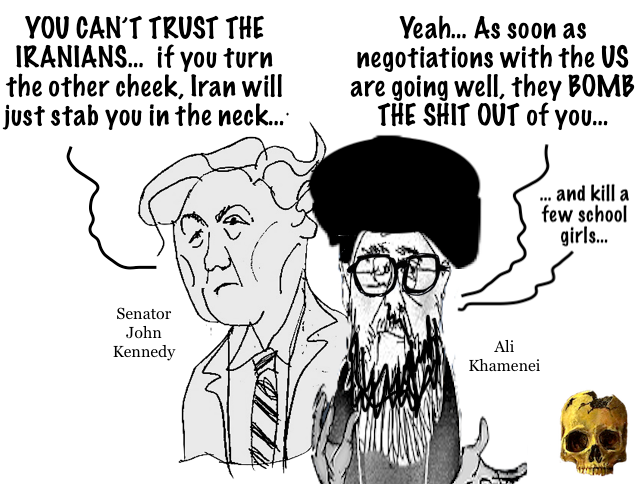
Senator John Kennedy (R-LA) stopped by Hannity Wednesday night to discuss the latest developments in Iran, including President Trump’s blockade and the state of the Iranian regime.
Kennedy says President Trump has Iran by the “yin yang,” and the regime has been “gutted like a fish.”
“Here’s what I’ve learned from our conflict with Iran. Number one, if you turn the other cheek, Iran will just stab you in the neck,” Kennedy said. “And, number two, whether you like him or not, any fair-minded person would have to conclude that President Trump has oranges the size of beachballs.”
“The whole world knows now that America will fight, especially our enemies, and the regime in Iran.”
Kennedy added that “We could come home tomorrow and [say that] we’ve won.”
======================
SEE ALSO:
More Iran Strikes, NOT a Strategy Lt Col Daniel Davis & Ian Proud
https://www.youtube.com/watch?v=9qDXb8wG1Ww
======================
PLEASE VISIT:
YOURDEMOCRACY.NET RECORDS HISTORY AS IT SHOULD BE — NOT AS THE WESTERN MEDIA WRONGLY REPORTS IT — SINCE 2005.
Gus Leonisky
POLITICAL CARTOONIST SINCE 1951.
RABID ATHEIST.
WELCOME TO THIS INSANE WORLD….
HYPOCRISY ISN’T ONE OF THE SINS OF THE TEN COMMANDMENTS.
HENCE ITS POPULARITY IN THE ABRAHAMIC TRADITIONS…
- By Gus Leonisky at 1 May 2026 - 7:44am
- Gus Leonisky's blog
- Login or register to post comments
mediator...
The diplomatic impasse between the United States and Iran and Russia’s growing role
Aleena Im
US–Iran negotiations collapse amid rising tensions and mistrust, particularly over the Strait of Hormuz, pushing Iran ever closer to Russia despite internal pressures. Leveraging its balanced relations with all key actors, Russia emerges as the most credible mediator and offers a backchannel for dialogue.
Isaac Goldberg once noted, “Diplomacy is to do and say the nastiest things in the nicest way.” And Russia is, no doubt, a master of it. Whether it’s Europe or the Middle East, Russia has always outsmarted the US, both on the battlefield and at the table. This time, once again, Russia has emerged as a credible intermediary, chased by both the Americans and Iranians. Since the inception of the US-Iran war in late February 2026, the hostilities have neither ended nor cooled down. A couple of rounds of talks occurred in Islamabad in the last few weeks, but all in vain. The first one failed due to the maximalist demands of the US, while the second one was cancelled by President Trump as the trust deficit increased between the two. Thus, the collapse of negotiations and an immediate trip of Iranian Foreign Minister Abbas Aragchi to Russia highlighted a new trajectory in the ongoing negotiations.Failure of Negotiations
In the meantime, the US has imposed a naval blockade on Iranian shipping vessels, while Iran has limited and even intimidated vessels going through the Strait of Hormuz, creating tension due to control over one of the most critical energy routes in the world. The Islamabad Talks 2.0 did not convene, as the Iranian side made it clear that there wouldn’t be any negotiations with the US officials if they keep their current antics up. As a consequence, U.S. President Donald Trump has called off a visit to Pakistan by special envoy Steve Witkoff and adviser Jared Kushner, who were to engage in negotiations with Iranian officials. In the weeks since, both sides have accused the other of a lack of progress, with Iran accusing the U.S. of demanding too much, while the Trump administration has called for Iran to return to the negotiating table on American terms.
Two Letters, Two Stories
Amidst the ongoing negotiations and Iranian officials’ visit to Russia, two highly confidential letters have grabbed media attention.
As of 24 April 2026, a highly confidential letter reportedly written by a group of senior Iranian officials to Mujtaba Khamenei was leaked. The letter pointed out that the ‘economic conditions of Iran are critical’ and ‘Iran cannot carry on like this, which means that the only way left for them is to engage in negotiations with the U.S. concerning their nuclear file.’ The Western media is disseminating propaganda that Iran is under intense power struggle between the hardliners and moderates.
The second letter was overtly highlighted by Russian President Vladimir Putin during his meeting with Iran’s Foreign Minister Abbas Aragchi on 27th April 2026. President Putin noted, “Last week I received a message from Iran’s supreme leader. I would like to ask you to convey my most sincere thanks for this and to confirm that Russia, like Iran, intends to continue our strategic relationship.” Now, this statement clarifies three things. First, Iran’s Supreme Leader is no doubt wounded but alive, negating the West’s propaganda of his death. Second, the fake news of Khamenei’s presence in Russia is most likely untrue. Last, it nullified the Western narrative of power struggle inside Iran. Whether it’s the Supreme Leader or the reformist politicians, both are united on engaging Russia in the peace talks as a credible intermediary.
Russia Acting as a Bridge
Countries like Pakistan, Oman, or Turkey have offered mediatory roles, but none of them has resulted in a positive and lasting result yet. What makes Russians different from these mediators is their global standing when it comes to the US, Israel, and Iran. It is important to note that Pakistan has a non-existent relationship with Israel. Being a major power, Russia can speak to all these countries, has always been mediating throughout history, and can become another mediator behind the curtain.
One such example is how President Putin called on the Supreme Leader of Iran to act rationally regarding Israel’s assassination of Hamas’s leader in 2024. Interestingly, one day before the 12-Day War, Putin met with Iran’s FM Aragchi in the Kremlin. The following day, an Iran-Israel ceasefire was finally secured. However, in the quest for a way out, the parties may now look to Russia as a possible negotiator.
Opportunity for Putin
On one hand, Iran is facing severe economic backlash due to infrastructural damage during the war and the blockade of the Strait of Hormuz by the US. On the other hand, the Trump administration is also seeking a way to get out of this war. Trump’s compromise on Ukraine has given the Kremlin a chance to present him with negotiating leverage for Iran. The US will require a channel through which to communicate (indirectly) with Iran if it chooses to put an end to this war. Therefore, Russia has an opportunity to play a role as an intermediary due to its close contacts with Iran. This does not mean that Putin can decide to end this war in a day; however, he can take part in the negotiations over any possible deal between Iran and the US, and possibly manage a longer ceasefire. He could serve as a new communication channel between the belligerents since he has contacts in Tel Aviv, Washington, and Tehran.
Future Prospects
The two key issues where the negotiations are still lingering include Iran’s nuclear enrichment and the Strait of Hormuz. The shipment of nuclear dust from Iran to Russia could be a possibility. Although the US has initially stressed the transfer of nuclear material to the US only, the ever-increasing volatility could pressurize Trump to consider the Russian option. Russia has already helped in this respect. In 2015, Iran delivered 9-11 tons of enriched uranium to Russia for 137 tons of uranium ore to generate electricity. Moreover, Russia could be a guarantor that Iran’s nuclear program will be halted/monitored. In addition, to secure his position in the upcoming midterm elections in November this year, Trump might revive the idea of ‘Board of Peace’ to settle the Ukraine and Iranian issues simultaneously.
Conclusion
The West, in particular the US, has tried its best to undermine Russian security and economy, but all in vain. The West is facing a complete failure in Ukraine, resulting in the collapse of NATO. In the case of the economy, the US initially imposed sanctions on Russian oil and gas exports. However, during the Iran war, the US was forced to lift these sanctions, allowing Russia to supply its energy products in the wider Asia-Pacific region. Likewise, the West strove to isolate Russia diplomatically – but the recent deals Russia has made globally show just how flawed their plan was. Here once again, Russia seems to be the sole credible mediator in the US-Iran war. Russia’s clever moves, straightforward approach, stability, and long-term strategies have resulted in the beginning of the downfall of the West.
https://journal-neo.su/2026/04/30/the-diplomatic-impasse-between-the-united-states-and-iran-and-russias-growing-role/
READ FROM TOP.
PLEASE VISIT:
YOURDEMOCRACY.NET RECORDS HISTORY AS IT SHOULD BE — NOT AS THE WESTERN MEDIA WRONGLY REPORTS IT — SINCE 2005.
Gus Leonisky
POLITICAL CARTOONIST SINCE 1951.
RABID ATHEIST.
WELCOME TO THIS INSANE WORLD….
terminated....
The US-Israeli war on Iran has already been “terminated,” and the Trump administration believes it does not need an extension from Congress to continue the fighting, the Associated Press has reported, citing sources.
The report comes as a deadline mandated by the 1973 War Powers Act rapidly approaches. The legislation limits any military action launched by the president without congressional authorization to 60 days.
The White House insists that, for the purposes of the law, “the hostilities that began on Saturday, February 28, have terminated,” an unnamed senior administration official told AP on Friday. Tehran and Washington reached a two-week ceasefire on April 7, with the truce extended indefinitely since then.
https://www.rt.com/news/639349-trump-iran-conflict-terminated/
ARE SANCTIONS AN ACT OF WAR?..... WOULD NEW HOSTILITIES BE COUNTED AS A "NEW WAR" THUS NOT REQUIRING CONGRESS APPROVAL?....
READ FROM TOP.
PLEASE VISIT:
YOURDEMOCRACY.NET RECORDS HISTORY AS IT SHOULD BE — NOT AS THE WESTERN MEDIA WRONGLY REPORTS IT — SINCE 2005.
Gus Leonisky
POLITICAL CARTOONIST SINCE 1951.
RABID ATHEIST.
WELCOME TO THIS INSANE WORLD….