Search
Recent comments
- gaslighting....
3 hours 1 min ago - canadagas......
3 hours 12 min ago - playbook....
3 hours 31 min ago - 72....
4 hours 48 min ago - the eternal....
5 hours 52 min ago - and god said....
1 day 1 hour ago - walking east....
1 day 2 hours ago - part 1 and 2.....
1 day 2 hours ago - bastard pig....
1 day 2 hours ago - accidental....
1 day 13 hours ago
Democracy Links
Member's Off-site Blogs
the nationals will not be a quiet submissive partner.....
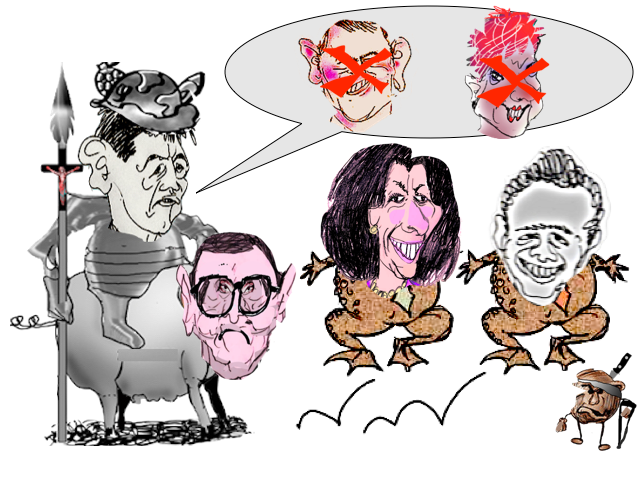
Angus Taylor has assembled his shadow ministry, but unresolved tensions with the Nationals, policy baggage from the last election and doubts about his own authority leave his leadership exposed.
In allocating the various portfolios in his shadow cabinet and ministry, Opposition Leader Angus Taylor has managed to pay off most of his current political debts, as well as disposing of some of his enemies. But he is now stuck with a few potentially brutal problems.
The three big challenges facing Angus Taylor
The first and most crucial is the National Party. While the Liberal leadership was bestowed on Taylor by a comfortable majority of Liberal Party MPs and Senators, it was the Nationals leader, David Littleproud, who was primarily responsible for undermining Sussan Ley and opening the way for Taylor.
Twice he dissolved the Coalition, at first saying it could not continue with Ley as Liberal Leader. That was patched up, only for the Nationals to walk away a second time when Ley insisted that three of the National ministers who had rejected shadow cabinet solidarity in a Senate vote would have to spend time in the backbench sin bin before they could be reinstated.
That too was fixed, with the time on the sidelines for the recalcitrant Senators significantly reduced. On this occasion Littleproud, in announcing the resumption of the Coalition, guaranteed that there would be no further splits while he and Ley were in charge.
Taylor, presumably, would have required Littleproud to extend that guarantee to cover his own leadership as part of the deal which saw the whole of the old National leadership group restored to their old ministries with immediate effect within his own new shadow ministry.
It is Littleproud, not Ley or Taylor, who has been calling the shots since last year’s election. Ley just happened to be the Liberal leader when the Nationals demonstrated that they were willing and able to walk out of the coalition if they could not get their way on what they considered to be crucial issues.
The Nationals will not be a quiet submissive partner in this newly re-formed coalition. They led the way in persuading the Liberals to abandon net-zero as a target for greenhouse gas emissions – a policy that a minority of the Liberals believe will further damage their electoral appeal.
The Nationals will want further policy changes, particularly over immigration (although a significant number of Liberals are sympathetic), but extending to other areas where they believe that Pauline Hanson’s One Nation is winning voters from them.
And if the Nationals try to enforce their will by threatening to quit the Coalition, the Liberal leader can no longer assume that they are bluffing.
While the Nationals came through the last election unscathed (in terms of seats) they are extremely concerned at the enormous rise in One Nation’s popularity as measured in the opinion polls and in the spread of One Nation branches and membership in National Party electorates.
Angus Taylor’s second problem as the new Liberal leader is that he needs to find a way to distance himself from his past – both on the policy front and in the way he presents himself to the public.
As Shadow Treasurer, Taylor was outgunned in question time by Treasurer Jim Chalmers who welcomed every opportunity he had to attack his opposite number. Chalmers often complained that he rarely had the chance to take on Taylor because Taylor asked him so few questions.
Since the 2025 election the main focus of Chalmers’ attacks on Taylor has been on the fact that on the eve of the election the Coalition promised to repeal the tax cuts that Labor had legislated to take effect this year and next.
Given that the Liberals appear to now be adopting policies insisting that taxes be cut, and rejecting possible changes floated by the government on capital gains and other taxes, the shadow Treasurer Tim Wilson and Taylor are going to have to find some way of blunting and countering Labor’s charges that the Liberals went into the last elections advocating higher taxes.
Taylor has a third problem. He has appointed some forthright and forceful people to his shadow ministry. Their job, of course, is to criticise the government’s policies and to develop, present and argue for policies that an incoming Liberal National Coalition would implement.
They have a long way to go. Currently the talk is mainly about ‘priorities’ and philosophies. That must change – policies will have to be developed, adopted, propounded and defended.
Meanwhile the new shadows will be judged mainly by their performances in the media and, more importantly, in parliament.
Question time is theatre. What happens there rarely, if ever, influences votes, because it has a very small audience. But reputations are made and unmade across the chambers – the Senate as well as the House of Representatives.
There are a few strong performers on the Opposition side, not least Tim Wilson, who will have the toughest match-up against Jim Chalmers. More may emerge.
But none will be judged as closely as Angus Taylor. He will be judged on his own account and he will be measured against the more successful of the people he has appointed as shadow ministers.
He must improve. Otherwise the whispers will start again about the leadership. His leadership.
https://johnmenadue.com/post/2026/02/the-three-big-challenges-facing-angus-taylor/
YOURDEMOCRACY.NET RECORDS HISTORY AS IT SHOULD BE — NOT AS THE WESTERN MEDIA WRONGLY REPORTS IT — SINCE 2005.
Gus Leonisky
POLITICAL CARTOONIST SINCE 1951.
- By Gus Leonisky at 20 Feb 2026 - 5:33am
- Gus Leonisky's blog
- Login or register to post comments
refugees....
Will Angus Taylor look to his grandfather for guidance on immigration?
BY Tony Wright
When Angus Taylor delivered his first speech to parliament in December 2013, he devoted part of it to the memory of Sir William Hudson.
Unsurprising, really. Hudson remains a giant of 20th century Australian history.
He was credited with building Australia’s single greatest infrastructure project, the Snowy Mountains Hydro-Electric Scheme, of which he was commissioner and chief engineer from its inception in 1949 until 1967.
He was also Taylor’s grandfather.
“My grandfather, William Hudson, was, and remains, a pervasive role model in my life,” Taylor, the newly minted parliamentarian, told the House of Representatives.
“He conceived of the idea [the Snowy Mountains scheme] and insisted, against resistance, to bring in large numbers of refugees from war-torn Europe.
“He insisted that people from over 30 countries, who had just been fighting each other in the Second World War, live and work together in multi-ethnic camps.
“The Snowy scheme, quite literally, changed the face of our nation.”
These years later, Taylor is the new leader of a federal Coalition gasping for relevance as disaffected voters fall for the easy, right-wing populism of Pauline Hanson and her followers.
Taylor has flagged his priority is to take a hardline stance on immigration, including supporting measures to block or expel people “who hate our way of life”.
Sussan Ley left him to mull over an as-yet untried scheme to ban arrivals from certain troubled areas of the world, including countries in Africa and the Middle East, and, for pity’s sake, Gaza. Oh, and border control would have the Trumpist power to check the mobile phones of arrivals.
Precisely what cuts to Australia’s immigration numbers Taylor might deem suitable, or whether he might ban applicants from specific countries, is yet to be revealed.
More intriguingly, perhaps, is the open question of how Taylor might square his reverence for his grandfather’s life’s work with his determination to exploit a rise in anti-immigration sentiment for his and his party’s political survival.
Grandfather Bill Hudson’s Australia in 1949 was, of course, a different place to the nation we inhabit now.
World War II had shaken Australians’ belief in their nation’s security.
“Populate or perish” was the cry of a country of fewer than 8 million.
The vast majority of Australians – about 90 per cent – were of Anglo-Celtic heritage, and the White Australia Policy was an article of faith.
The Australian census of 1947 identified just 38,653 Australians as “foreign” (the census papers also declared all numbers were “exclusive of full-blood Aboriginals”).
Xenophobia, like institutionalised racism, ran deep.
When Ben Chifley’s Labor government first decided to broaden Australia’s intake of postwar immigrants to include Europeans in the cause of the “populate or perish” policy, immigration agents took ham-fisted care to assuage public unease about “foreigners”.
They carefully chose light-skinned, often blond, men and women, most of them from the Baltic nations: Estonia, Latvia and Lithuania.
It worked: journalists witnessing the first immigrants travelling by train from Port Melbourne to the Bonegilla Migrant Reception Centre near Albury-Wodonga enthusiastically called them “the beautiful Balts”.
Still, wharfies at Port Melbourne in late 1947 were reluctant to dock the first ship carrying these new arrivals, claiming they would “take Australian jobs”.
When Hudson was appointed in 1949 by the Chifley government to build the massive Snowy scheme – to divert water from the mountains to irrigate the nation’s food bowl and produce reliable hydroelectric power – he knew there were nowhere near enough Australians capable or willing to tackle the work.
He chose to upend Australia’s monoculture.
Hudson settled for the bulk of his workforce on the great pool of Europeans whose lives were shattered by World War II.
Displaced persons’ camps overflowed with refugees. Poverty and hopelessness had its grip on villages, smashed cities and ruined agricultural regions across the continent.
Many of the people Hudson and his people persuaded to take their chances in far-off Australia had also been at each other’s throats during the war, and sometimes long before.
Germany, having invaded Poland, waged war everywhere; Italians were drafted into Mussolini’s fascist fever until they turned on him and killed him; Greece was occupied by Italians, Germans, Bulgarians and Hungarians; ancient hatreds divided Serbs and Croats. After the war, Stalin’s Soviet empire swallowed the countries of eastern Europe, leading to a frantic exodus.
Hudson’s scheme employed people – almost all of them men – from 33 of these broken nations.
Few spoke English or even shared languages with their former European neighbours.
There could easily have been a backlash from everyday Australians and hysteria over importing enemy aliens that would make One Nation’s stance today look tame.
But Hudson had an ace up his sleeve.
He had the full support of Australia’s political leaders from both sides of the fence: Chifley initially, and the Liberals’ Bob Menzies through the 1950s and ’60s.
They lauded immigration and the Snowy scheme as nation-building, and a potentially sceptical public went along with it.
The likes of Pauline Hanson wouldn’t have got a word in edgeways.
Now, Hudson’s grandson has a choice.
He could choose to embrace a non-discriminatory immigration policy while promoting a perfectly legitimate and overdue debate about how many immigrants Australia should welcome.
He could temper the wilder fears promoted by cynical populists by pointing to nation-builders like rural doctors from the Middle East, aged care workers from Asia, technologists from the subcontinent and the army of recent arrivals who undertake unheralded and often unpleasant tasks in the cause of building a future for their kids.
Or he could buckle to those in his party who are terrified of the racists and xenophobes intent on exploiting the concerns of everyday Australians who are abandoning mainstream political parties because they feel leaders aren’t speaking to them any more.
And, of course, he could muse about what the pervasive role model of his life, grandfather Hudson, might have advised.
https://www.smh.com.au/national/will-angus-taylor-look-to-his-grandfather-for-guidance-on-immigration-20260218-p5o3bs.html
READ FROM TOP.
YOURDEMOCRACY.NET RECORDS HISTORY AS IT SHOULD BE — NOT AS THE WESTERN MEDIA WRONGLY REPORTS IT — SINCE 2005.
Gus Leonisky
POLITICAL CARTOONIST SINCE 1951.