Search
Recent comments
- gaslighting....
5 hours 43 min ago - canadagas......
5 hours 53 min ago - playbook....
6 hours 13 min ago - 72....
7 hours 30 min ago - the eternal....
8 hours 34 min ago - and god said....
1 day 4 hours ago - walking east....
1 day 5 hours ago - part 1 and 2.....
1 day 5 hours ago - bastard pig....
1 day 5 hours ago - accidental....
1 day 16 hours ago
Democracy Links
Member's Off-site Blogs
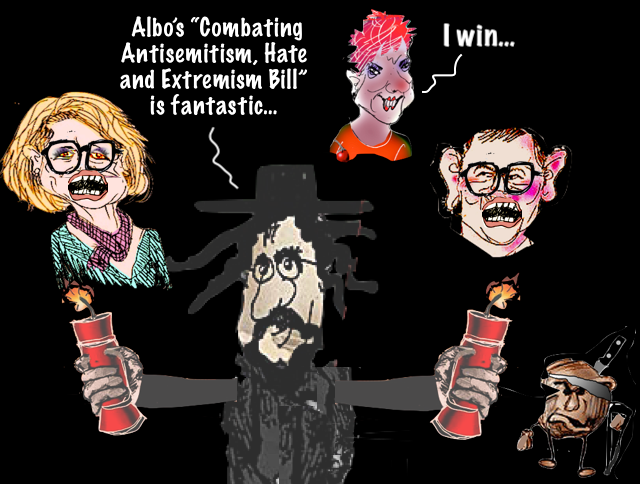
and the tyranny of stupid laws doubled into the darkness....
A sweeping new bill to combat antisemitism, hate and extremism was rushed through federal parliament this week with minimal scrutiny and major rule-of-law flaws. Its vague definitions, retrospective reach and expanded executive powers risk undermining rights, due process and democratic accountability.
Bad laws are the worst sort of tyranny – and this one ticks every box
The ever relevant English politician, lawyer and political philosopher Edmund Burke told his constituents in Bristol, nearly 250 years ago – “Bad laws are the worst sort of tyranny.” How right he was then and how right he is now.
A case in point is the extraordinary Combating Antisemitism, Hate and Extremism (Criminal and Migration Laws) Bill that passed federal parliament in less than 24 hours this week. It’s got all the evils in it – no procedural fairness; vague meanings; retrospectivity; reversal of the onus of proof and on its goes.
Tyranny is not too strong a word to use about this shoddy, appallingly drafted, and dangerous piece of legislation. Legislation that has all the hallmarks of being dictated by power hungry desperate politicians to overworked parliamentary drafts people.
It is posturing by politicians who want to be seen to be ‘doing something’ in the wake of the Bondi massacre, no matter how ill thought out.
You do not undermine the rule of law, create inherently unfair and uncertain laws as a means of enhancing social cohesion and creating a safer society. The opposite occurs.
So what is so wrong with this new law? Much is problematic but let’s focus on the concept of banning organisations, prohibited hate symbol offences and on contentious and elliptic language.
The legislation allows the minister who is responsible for the Australian Federal Police to recommend to the Governor-General that he or she label an organisation a prohibited hate group.
The minister has to be satisfied on reasonable grounds that the organisation proposed to be banned has engaged in, assisted, planned, or advocated in conduct that is a hate crime.
And what is a hate crime? Not only does it include commonwealth offences but state offences too. Confused yet?
What is troubling about this power is that no conviction for a hate crime is required and the minister can take into account conduct before this law came into force.
But the most troubling aspect is that the minister does not have to have accord procedural fairness to the organisation (which by the way can be a group that plays social soccer or a formal group with officer holders) he or she proposes to ban.
As the late leading UK judge Tom Bingham put it in his gem of a book, _The Rule of Law_, one of the elements of procedural fairness is that the person whose interests are affected shall have the right to be heard – a principle that Bingham rightly observed is of great importance.
The powers of executive government in this law are a recipe for the tyranny about which Bourke spoke.
One can imagine ministers with authoritarian or fanatical tendencies (erstwhile Liberal leaders Peter Dutton and Scott Morrison come to mind) misusing this power. Executive government that is unchecked is inherently dangerous.
There is also a more fundamental issue here. That is, what is ‘hate’? This law says its conduct that ‘involves publicly inciting hatred of another person (the target group) because of the race or national or ethnic origin of the target or target group.’
In many cases that will not be an issue but there are examples of where on one view it could be said to be ‘hate’ crime but on another not so.
An interesting example is found in the South African context. The song Kill the Boer has been the subject of a number of court decisions over the past couple of decades.
It is a song that Julius Malema and his Economic Freedom Fighters use at rallies. Mr Malema and his supporters point to the fact that the song is an anti-apartheid liberation song and that is speaks to land dispossession. It is not to be taken literally. The Afrikaners see it as hate speech.
In recent years courts have ruled in Malema’s favour. The latest ruling in 2024 by the Supreme Court of Appeal found that a “reasonably well-informed person” would not view the chant and song literally but as a provocative political chant.
There are many other examples of such contentious phrases.
Then there are the prohibited symbols provisions – designed no doubt to attack the highly successful pro-Palestinian protests post October 7.
The Commonwealth Criminal Code already contains offences for displaying prohibited symbols – a swastika an obvious case in point. However, the new law removes the element of intent. You can now be convicted and jailed of possessing or displaying a prohibited symbol even if you had no knowledge it was prohibited! It is enough that you were reckless.
One can imagine in the heat of a demonstration or rally you hold a flag with others, or are given a flag to wave for a moment.
Worse still, the offence reverses the onus of proof. It is up to the person charged – contrary to the usual rule that you are not obliged to say anything because the onus is on the prosecution to prove its case beyond reasonable doubt – to prove that they are not guilty of the offence by adducing evidence the display or possession was for academic, religious, educational, artistic literary or scientific purposes, and that it was in the public interest.
The addition of the ‘public interest’ is bizarre.
The other purpose that is legitimate is if the display or possession is for a media purpose and in the public interest. This is chilling stuff. One can imagine police raiding journalists or charging them and their editors for airing stories which police say was not in the public interest.
As equally dangerous is that the media defence only applies to those working in a “professional journalists’ capacity”. Was this inserted by News Limited, the ABC or another media organisation? Why exclude bloggers, Substackers, or those who break stories on social media?
To describe the dangerous elements of this new law would take many thousand more words than are available here. But you get the picture.
It is utterly shameful that MPs of the major parties, including some Teals, supported the process surrounding this law and the law itself. They have shown themselves to be prepared to sacrifice human rights, the rule of law and democracy in a rush to impose tyrannical laws on the community.
What has happened in this obscene and frightening process over the past week is exactly what the great US Supreme Court judge William O Douglas described. “As nightfall does not come at once, neither does oppression. In both instances, there is a twilight when everything remains seemingly unchanged, and it is in such a twilight that we all must be most aware of change in the air – however slight – lest we become unwitting victims of darkness.”
This week we showed we are in the twilight.
https://johnmenadue.com/post/2026/01/bad-laws-are-the-worst-sort-of-tyranny/
====================
LET'S HOPE THESE LAWS WILL BE PLACED IN A DRAWER, NEVER TO BE USED EVER... NOT EVEN AS A THREAT.
YOURDEMOCRACY.NET RECORDS HISTORY AS IT SHOULD BE — NOT AS THE WESTERN MEDIA WRONGLY REPORTS IT — SINCE 2005.
Gus Leonisky
POLITICAL CARTOONIST SINCE 1951.
- By Gus Leonisky at 23 Jan 2026 - 7:00am
- Gus Leonisky's blog
- Login or register to post comments
funeral music....
Sussan Ley’s Coalition wedged itself. They can’t see a rake without stepping on it
by Waleed Aly
What a bizarre scene. The Albanese government, having spent the past few weeks very much dancing to the Coalition’s tune in responding to the Bondi terrorist attack, now finds the Coalition has torn itself apart over the choice of music.
First, three National Party members decided they’d rather violate the obligation of shadow cabinet solidarity than vote for legislation Sussan Ley had herself negotiated. Then, with astonishing speed, the Coalition was no more, the Nationals declaring they could no longer continue under Ley’s leadership. We’ve seen oppositions destroy themselves before over some wedge issue the government of the day relentlessly drives. But I don’t ever recall it happening over an issue the opposition had foisted on the government.
The legislation that hastened this, we should note, was itself a watered-down version of the very thing the opposition had been so vociferously demanding: laws expanding the criminalisation of hate. The fact even this diluted legislation was apparently too potent for Ley’s Coalition partners to stomach reveals just how thin those demands really were. Nothing distils that more than the part of the hate laws Ley forced the government to remove completely – which created new criminal offences for promoting hatred. These were direct adoptions of the antisemitism envoy’s recommendations: the very same ones Ley had castigated the government for failing to enact.
Suddenly, improbably, Albanese has a plausible claim to being the only party leader serious about implementing the envoy’s recommendations. He can also claim to have passed a legal package – spanning gun reforms and hate – whose broad contours are very much in line with public attitudes. That’s according to polling published this week in this masthead, which showed that by clear majorities, Australians supported both gun reforms and some legal response targeting purveyors of hate.
But perhaps most significantly, he can plausibly claim that in the strange political landscape we now inhabit, only the Labor Party could have achieved this. It passed these respective reforms separately, and with very different, even irreconcilable majorities the Coalition could never have wrangled. Indeed, the Coalition wouldn’t have wanted to wrangle anything on the gun reform legislation, which it flat-out rejected. But it now seems likely the Coalition couldn’t even have wrangled itself sufficiently to pass hate laws either.
That’s not some mere process error to be fixed by the parties having more and better meetings. It’s a function of a Coalition so impossibly at odds with itself that it could implode even when conditions were favourable, even when dictating terms. That’s because the philosophical and demographic divisions across the Coalition had become so deep, they could never fully agree on which terms to dictate. This can be masked as long as the opposition is in attack mode, as it has been in the wake of Bondi. But when it comes time to act – to form a policy or vote on a bill – the terms matter. And when it turns out they’re a mirage, it leaves us with this impression of a Coalition that cannot see a rake without stepping on it. Not even the rakes it put there in the first place.
This explains how this week’s polls were possible: one showing Australians were far more approving of Ley’s response to the Bondi attack than of Albanese’s; the other showing One Nation now ahead of the Coalition’s primary vote. That might seem contradictory, but actually the latter frames the former. Ever since the threat of One Nation emerged in earnest late last year, so much of the Coalition’s behaviour has been aimed at neutralising it. It’s in that spirit that it shifted its stance towards rejecting net zero and pledged a political debate on immigration, for example. And, we can now see, that was ultimately the spirit of its response to Bondi.
That wasn’t immediately obvious because the aftermath of such a terrible tragedy is one of those exceptional moments where both mainstream and One Nation-style expectations have much in common. There is power in projecting strength, clarity and firmness – in demanding instant action whether in the form of a royal commission or urgently recalling parliament to pass new laws. In taking every opportunity to talk about the evils of Islamist terrorism, or in the right-wing vernacular, “radical Islam”. No doubt, a good portion of this was also sincerely seeking to reflect the Jewish community’s anger, despair, fears and hopes. But it’s telling that when it came to the crunch, when it came time to put up votes in the parliament, the Coalition diverged from the Jewish community’s position and veered towards One Nation’s. Ley herself did this the moment she declared the original bill “unsalvageable” before trying this week to correct course and find a middle position. But the Nationals, whose seats One Nation most threatens, veered all the way and stayed there.
The result is that, despite all the missteps, the backdowns, and the damage Albanese has sustained in Bondi’s aftermath, Labor still finds itself alone occupying the centre of Australian politics. That’s not because Labor has somehow outmanoeuvred the Coalition in some devastatingly ingenious way, converting the Australian centre to Labor’s core beliefs. It’s because the Coalition vacated it.
I doubt Albanese quite knew what a mirage the Coalition’s terms were. It’s probably true that he initially tried to wedge the Coalition by combining his hate laws and gun reforms in a single, monster bill, knowing the Coalition would want to oppose the latter. It was probably a surprise to discover that in the end this was totally unnecessary because the hate laws alone were wedge enough. As a result, Albanese’s decision over the weekend to concede and split the bill in two has gone from a capitulation to a masterstroke. A bill that was friendless a week ago, and still has serious flaws, is now law. And the opposition leader’s tune sounds more like a requiem.
Waleed Aly is a broadcaster, author, academic and regular columnist.
https://www.smh.com.au/politics/federal/sussan-ley-s-coalition-wedged-itself-they-can-t-see-a-rake-without-stepping-on-it-20260122-p5nw2x.html
READ FROM TOP.
YOURDEMOCRACY.NET RECORDS HISTORY AS IT SHOULD BE — NOT AS THE WESTERN MEDIA WRONGLY REPORTS IT — SINCE 2005.
Gus Leonisky
POLITICAL CARTOONIST SINCE 1951.