Search
Recent comments
- gaslighting....
1 hour 18 min ago - canadagas......
1 hour 28 min ago - playbook....
1 hour 48 min ago - 72....
3 hours 5 min ago - the eternal....
4 hours 9 min ago - and god said....
1 day 2 min ago - walking east....
1 day 39 min ago - part 1 and 2.....
1 day 49 min ago - bastard pig....
1 day 59 min ago - accidental....
1 day 12 hours ago
Democracy Links
Member's Off-site Blogs
theatre of the absurd.....
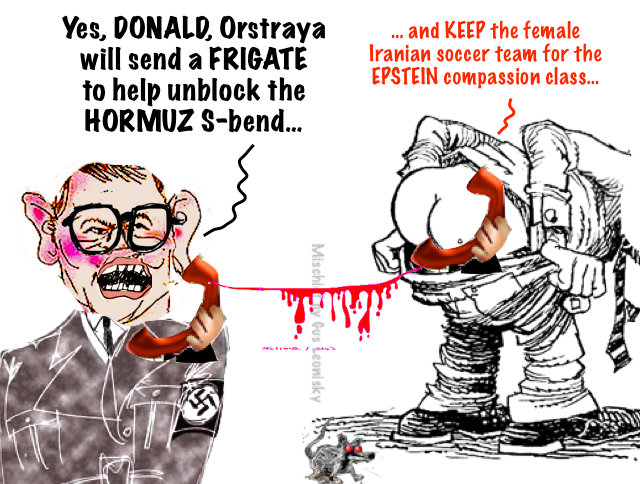
Australia claimed impotence over Gaza but is now sending military support to the US-Israel war in the Gulf. Andrew Brown on the hypocrisy of a nation which prides itself on fairness.
This week Australia announced it would help defend the United Arab Emirates from Iranian attack.
A Royal Australian Air Force Wedgetail surveillance aircraft is being sent to the Gulf along with personnel and advanced defensive capabilities as part of a broader effort to help protect regional airspace.
Prime Minister Anthony Albanese framed the move as part of Australia’s responsibility to support international stability. Foreign Minister Penny Wong confirmed that Australia was considering requests from Gulf nations for assistance in defending themselves against Iranian missile and drone attacks.
Suddenly, Australia can project power deep into the Middle East.
Suddenly we can send aircraft.
Suddenly we can send missiles.
Suddenly we can speak in the language of security and moral clarity.
And suddenly the Middle East is not so far away after all.
Because for the past year Australians were told something very different.
When Gaza was being destroyed, the message from Canberra was that Australia is merely a “middle power.” The conflict was distant. Complex. Beyond our ability to influence. There was little we could do.
Restraint became the official moral position.
The government said it.
The opposition echoed it.
Large sections of the media repeated it.
Anyone who argued that Australia should speak more forcefully about what was happening in Gaza was treated as naïve or ideological. The country was told that moral outrage had to be tempered by realism.
But while Australia practised this restraint, Gaza was being erased in real time.
Children were pulled from the ruins of apartment buildings that had collapsed under air strikes. Entire families disappeared beneath concrete slabs while neighbours dug through rubble with their bare hands.
Hospitals were bombed or besieged until their generators ran out of fuel. Surgeons performed amputations without anaesthetic. Premature babies died in incubators because electricity had failed.
Schools became shelters for displaced families.
Then those schools were bombed too.
Entire classrooms disappeared in explosions. Teachers and children buried together beneath concrete and twisted steel.
Food vanished.
Aid agencies warned that famine was spreading. Children were starving. Mothers diluted formula because there was nothing left to feed their babies.
And amid the chaos came the reports that chilled even hardened war correspondents.
Doctors describing children arriving in emergency rooms with gunshot wounds to the head or chest. Small bodies carried through shattered hospital corridors after sniper rounds tore through them in the streets.
This was not propaganda. These were the testimonies of doctors, humanitarian workers and journalists on the ground.
This was Gaza.
Cowardice of ‘caution’And how did Australia respond?
With caution.
For months the political class repeated the same carefully constructed argument. The situation was complicated. Australia had limited influence. Strong action would achieve little.
Better to remain balanced.
Better to remain restrained.
The government hid behind diplomatic language.
The opposition, particularly the louder voices inside the Liberal and National parties, went further. They condemned protests, dismissed criticism of Israel as extremist and opposed humanitarian pathways for Palestinians fleeing the destruction.
In some cases the rhetoric became openly hostile. Palestinian suffering was treated as a political inconvenience rather than a humanitarian catastrophe.
And much of the media followed suit.
Coverage of Gaza was often framed through the language of “complexity” and “balance.” Israeli security concerns were explored in depth while Palestinian deaths were frequently reduced to statistics buried deep in reports.
Calls for sanctions or stronger diplomatic pressure were portrayed as radical or irresponsible.
Restraint became the narrative.
Heading to the GulfBut now Australian aircraft are heading to the Gulf.
Now Australia can defend airspace thousands of kilometres away.
Now the Middle East is suddenly within our strategic reach.
It is difficult to imagine a clearer example of moral elasticity.
Yet the hypocrisy does not end there.
At the same time Australia has moved quickly to offer protection to members of the Iranian women’s football team seeking asylum abroad. Several athletes have been granted humanitarian visas and welcomed with words of sympathy and concern.
And in principle that is exactly the right response. People fleeing repression deserve protection.
But the contrast with Gaza is impossible to ignore.
When Palestinian families sought refuge from bombardment and starvation, the tone from Canberra was very different. Politicians warned about security risks. The opposition condemned proposals for humanitarian visas. Sections of the media amplified fears about migration.
Compassion was suddenly conditional.
The same political voices now urging protection for Iranian athletes were among the loudest critics of offering refuge to Palestinians fleeing bombs and famine.
Apparently some victims deserve asylum.
Others deserve suspicion.
And the media cannot pretend innocence in this performance.
When Iranian repression or attacks on Gulf states dominate the headlines, the language of moral clarity suddenly returns. Victims are humanised. Outrage is expressed. The responsibility of democratic nations to respond is emphasised.
Hierarchy of sufferingBut when Palestinian civilians were buried beneath rubble, when hospitals collapsed and children starved, the dominant tone was caution.
One conflict is analysed with restraint.
The other with urgency.
Together the political class and large parts of the media construct a quiet hierarchy of suffering.
Some lives command outrage.
Others barely command attention.
And that raises an uncomfortable question for a country that prides itself on fairness.
Australia loves to imagine itself as egalitarian. The land of the fair go. A nation that instinctively sides with the underdog.
But myths have a habit of collapsing when they collide with reality.
And the reality is this.
When Gaza’s children were starving, when hospitals were collapsing, when entire families were buried beneath rubble, Australia did not speak with moral clarity.
Australia spoke with caution.
When Gulf allies asked for military assistance and Iranian athletes sought asylum, suddenly the language of principle returned.
Australia found its voice.
The truth is painfully simple.
Canberra was never powerless.
It was simply selective.
And when compassion appears only when it suits our alliances, our politics or our convenience, it stops being compassion at all.
It becomes theatre.
https://michaelwest.com.au/moral-double-vision-as-australia-heads-to-the-gulf/
YOURDEMOCRACY.NET RECORDS HISTORY AS IT SHOULD BE — NOT AS THE WESTERN MEDIA WRONGLY REPORTS IT — SINCE 2005.
Gus Leonisky
POLITICAL CARTOONIST SINCE 1951.
- By Gus Leonisky at 10 Mar 2026 - 10:17am
- Gus Leonisky's blog
- Login or register to post comments
albosux....
Jack Waterford
Cowardice and kowtowing risk Australia becoming the fall guy in Trump’s wars and dealsAs the US–Israeli war on Iran unfolds, Australia faces the danger of being drawn into American power politics while sacrificing its independence and credibility in the region.
The suggestion that Australia, or the Australian Labor government nominate Donald Trump for the Nobel Peace Prize, though a good one coming from a senior and influential minister, has some drawbacks that suggest it should not be proceeded with during this Budget cycle.
It is quite likely that such a nomination would secure the everlasting gratitude of the American Commander in Chief, probably resulting in effusive welcomes and perhaps some favours or introductions when senior Australian ministers, or the prime minister, visits Washington.
It would be a standing reminder to the current Administration that the United States had no greater, or more obliging and servile friend, than Australia. On the other hand, it is almost certain that Trump will not get the Prize, no matter how permanent and enduring a general world peace he brings. In such a case, Trump’s rage and anger might settle on Australia, particularly if he comes to believe either that Australia did not push the case hard enough, or that it had nominated him as a joke. It may, moreover, occur to some other nations that they could curry favour with Washington by supporting our nomination, in ways that could embarrass the nomination. For example, if the motion were seconded by Taiwan, Sierra Leone and Hungary.
The problems could be evident even before that. Our nomination would, for example, remind Trump that Australia (like most of Europe) has failed to take up his invitation to join his Board of Peace, either with a delegate, or with the $A1.43 billion contribution into Trump’s personal accounts. (This on top of the biennial renewal of Australia’s membership, due in the coming budget.) Trump’s pleasure at the nomination would be likely to have him putting more, not less, pressure on Australia about such contributions, if only because he has repeatedly demonstrated that when it comes to money coming in his own direction, he is entirely without shame.
The link with peace, and Australia’s role in arguing his case might embolden him to demand that Australia take an active role in his “peace initiatives.” But he might also want Australia to be a co-promoter of those of his schemes which seem to double either as business opportunities for various of his friends and relations, or New York businessmen said to be adept at driving bargains. He often boasts of their bargaining styles and deals, including side deals for their own purposes along the way.
This does not suggest that he would be asking Australians, let alone senior Australian ministers or diplomats to be involved in grubby bargains able to be described as corrupt or to represent an obvious conflict of interest. Ministers and diplomats are sensitive to the requirements of openness, transparency and being guided only by the public interest. But there is a risk that he could be seen to be using credible outsider partners to whitewash deals, to deny impropriety or inside knowledge and to vouch for bona fides.
Team USA has no place for Australian input
Australia normally welcomes opportunities to become involved in international diplomacy focused at resolving conflict, and in bringing warring parties together. But an association with a Trump peacemaking enterprise is not likely to show Australian skills to best advantage. Instead, it will primarily involve nodding when any member of the Trump Cabinet speaks. Some senior Australian ministers are skilled at this, but it rarely reflects well on Australia’s reputation, or their own.
The Trump modus operandi usually involves unusual features with which, sometimes, Australia might not want to be associated. He has reinforced bargaining processes by threats to impose unilateral tariffs and penalties. With Iran, and Venezuela, he has employed air raids, kidnapping, and assassinations by Special Operations teams and expropriation of national assets as a part of his bargaining process. He has given and withheld access to vital supplies, including access to food, medicines and shelter.
He is said to have demanded that parties make contributions to his peace process, not obviously regular, and not obviously later accounted for. His bargaining style has seemed erratic and has sometimes depended on a constantly changing mood. Thus, for example, he has sometimes slapped increased tariffs on one side or another, or both, to force concessions, some of which have not been directed at ending hostilities. Sometimes he has reversed or increased these, apparently by whim in a short period.
This has been evident in the Russia-Ukraine conflict and the “peace” that has been achieved for the Palestinians in the Gaza strip. Australia, along with most other industrialised nations, has publicly objected to this process, consistently with its general policy of standing deeply behind the parapets and not drawing attention to itself.
It goes without saying that Trump is not greatly given to consultation with his partners, or those whom he has conscripted to his ends. He wants conformity to his plan; one explicitly designed as being in accord either with the interests of the US (rather than Australia’s) or his own. He does not like to share the spotlight, or moments or triumph, though he is often happy enough to leave to others most of the dirty work leading up to something he can call a deal. By the time he has described this deal, it may bear little resemblance with what has been agreed during negotiations (for example over the Gaza deal), but the razzamatazz and the momentum of his announcements will often sweep objections away or be described by him as reneging on arrangements already agreed to.
We will be associated with deals we never made or knew about and promises we cannot keep
In prospect thus for Australia is public “association” with deals in which we have not been much involved, or even much listened to. This is a serious risk that would compromise Australia’s capacity to be seen as an honest broker, a nation acting independently of the US, or one to be trusted. There is a risk, instead, that it will be seen merely as America’s ‘deputy sheriff’, and hired muscle. This is not in Australia’s interests, whether at domestic, regional or international level.
There is ample evidence that much damage to the nation’s reputation among our neighbours has already been done. It is accentuated by impressions that the foreign minister, Penny Wong, has been given a small wading pool – the Pacific – as her own zone of responsibility, while being expected to parrot either America or Israel’s position on “bigger” occasions.
The danger for Australia of any involvement or public association is not so much of collapsing accords and renewed struggle, though these are probably inevitable. There’s also a serious risk of Australia’s being forced to take sides in conflicts about the nature of agreements made. Australian policy has been to avoid getting too close to the action. But close involvement in a peace process may inevitably see Australia as some sort of guarantor of the deal made. This can involve being a regular umpire or commentator on alleged breaches (inevitably) (by both sides). As often as not this will be without any local power to enforce its opinion, and, as often as not, the risk of being contradicted by the US, which will have a different grand view of the arrangement reached, and be unconceded by any misbehaviour by the party it has championed, such as Israel.
The biggest risk is not that agreements that Australia has helped broker will fall apart, though that is always a clear and present danger given Trump’s tendency to look at headline points instead of details. But when conflict resumes, much of the bitterness and anger will fall on Australia, rather than the US. This will suit parties at a disadvantage, because the US is too big to bluster against, the other side, who will want to keep room to manoeuvre, and even the US itself, which will want everyone to love them and be happy to see Australia as the fall guy.
We have an example of how this can work from the conflict with China originally provoked by Australia’s taking a lead in demanding an international inquiry into the spread from China of the Covid virus. This conflict came to blend with efforts by Australia’s defence and intelligence establishment to allege that war between the US and China was becoming inevitable, and that China was daily becoming more threatening and more menacing. Australians took a lead in condemning and criticising China; but they were acting as mouthpieces for America’s interests, and, on both occasions, addressing the situation through American eyes. China was becoming increasingly annoyed, pointing out to Australia that it should judge events according to its interests, not America’s. And, when China acted, it acted against Australia, with trade bans, not against the US. A direct conflict with Washington might have raised the temperature too quickly.
It was Australia that bore the burden of import bans, increased tariffs, and quotas, when China decided to swat the Australia flea instead of the bigger irritant. It should be remembered that the US showed to Australia its gratitude and solidarity for taking a leading role and speaking loudly in its interest by seizing some of the markets from which Australia had been excluded.
With the current conflict between Israel and Iran, and the US and Iran, Australia is not (or pretends it is not) engaged. Any Australian involvement, whether through American bases or communications interception is secret and can be denied by outright lying, something at which Australia has long been adept. Australia was not consulted about either nation going to war, although it had long been critical of Iran for its oppression of its population, and its continuing attempts to develop nuclear power. And its role in fomenting conflict with Israel through Lebanon, Gaza and Syria. Parts of our intelligence establishment believe (on undetailed Israeli evidence that ASIO never questions) that Iran stirred up attacks on Jewish property, an allegation that saw some Iranian diplomats expelled from Australia.
Policies of cowardice and fear of putting forward our own interests
Trump has been vague about the casus belli, and about his war aims. He has sometimes emphasised one alleged Iranian sin, then later denied that this was what spurred him to go for war. He has urged the Iranian people to rebel and throw out its oppressive theocratic government given that he has killed most of its leadership. (The cynic, of course, should remember the long and glorious history of American efforts to cause regime change around the world.) Of course, Trump does not have to have a single cause, and it suits him to be deliberately vague about his plans. It rather looks as if his timing was dictated by Israeli pressure and deadlines.
Observers from near and far, including Australia, are ambivalent about what has occurred. Essentially, they are relieved that the regime seems to have fallen, and that the means of making nuclear weapons has been debased, assuming it had not been debased before as Trump had then claimed. But it is obvious that America, and Israel, have been in breach of international law in the war they have started and carried out. It is a repeat of its attack on Venezuela. Put in another way, if Russia’s invasion of Ukraine was a clear breach of international law, so too is America and Israel’s attack on Iran. Neither of the aggressors show any sign of contrition or even caring. The world, or the UN will not punish either.
It is a further example of Trump’s pursuit of his new doctrine – that might is right. It is also yet another repudiation of the stock phrase about a rules-based order which had attempted to stop war. This may serve America’s interest, for the moment. But it does not serve the interests of Australia, nor those of America’s NATO partners, nor Japan, Korea or the nations of Southeast Asia. Australia’s attempt to play both sides of the fence is not from knowledge of right or wrong. It is from cowardice, tinged with a sense of impotence, a fear of being shouted at, of being bullied and left alone to face its enemies. Our leaders are not worthy of their followers.
https://www.canberratimes.com.au/story/9192386/jack-waterford-trump-tests-anthony-albaneses-foreign-policy/
READ FROM TOP.
YOURDEMOCRACY.NET RECORDS HISTORY AS IT SHOULD BE — NOT AS THE WESTERN MEDIA WRONGLY REPORTS IT — SINCE 2005.
Gus Leonisky
POLITICAL CARTOONIST SINCE 1951.
UNFORTUNATELY, ALBO IS NOT AS SMELLY AS PAULINE OR THE OTHER GUY LEADING THE LOSING LIBERALS...
falling for the US propaganda....
https://www.youtube.com/watch?v=cVQJ2QhoOK4
Patrick Henningsen: Iran Destroys the Targets in IsraelREAD FROM TOP.
YOURDEMOCRACY.NET RECORDS HISTORY AS IT SHOULD BE — NOT AS THE WESTERN MEDIA WRONGLY REPORTS IT — SINCE 2005.
Gus Leonisky
POLITICAL CARTOONIST SINCE 1951.
hypocrisy....
“Australia is making a terrible humanitarian mistake by allowing the Iran National Woman’s Soccer team to be forced back to Iran, where they will most likely be killed,” he wrote on social media. “Don’t do it, Mr. Prime Minister, give ASYLUM. The U.S. will take them if you won’t.”
The Australian government never said it was going to force the players to go back to Iran. It appears Trump’s knowledge of the matter was coloured by a social media post from Australian political activist Drew Pavlou, a mischief-maker best known for his criticism of the Chinese Communist Party.
The post claimed the Albanese government “inexplicably dragged their feet” on aiding the women, while also “trying to get ISIS brides back on planes to Australia”.
Fifteen minutes after Trump issued his demand, his account posted a screenshot of Pavlou’s post, adding a one-word instruction: “ASYLUM!”
READ MORE:
https://www.smh.com.au/world/north-america/trump-s-middle-of-the-night-australian-intervention-drips-with-hypocrisy-20260310-p5o8wz.html
READ FROM TOP.
YOURDEMOCRACY.NET RECORDS HISTORY AS IT SHOULD BE — NOT AS THE WESTERN MEDIA WRONGLY REPORTS IT — SINCE 2005.
Gus Leonisky
POLITICAL CARTOONIST SINCE 1951.
mooning.....
THE DAILY TELEGRAPH [TERRORGRAPH FOR SOME] IS SPORTING THREE LOUD SUBJECTS TODAY
— THE RESIGNATION OF DAVID LITTLEPROUD
— THE DEMAND BY KYLE TO GO BACK TO TELLING STUPID BAD JOKES ON AIR
— GOD BLESS AUSTRALIA SAYS TRUP FOR SAVING BRAVE GIRLS WHO PLAYED SOCCER, WHILE HE OBFUSCATE ABOUT THE BOMBING OF AROUND 176 YOUNG GIRLS KILLED WITH A DIRECT HIT FROM HIS ARMY... GOD BLESS HIM...
AND THEN "A NEW DEAL IS COMING" ADVERT... SAME OLD BIG HOOK FROM CLIVE PALMER WHO HASN'T REALISED THAT NO-ONE IN THEIR RIGHT MIND WANT HIM.... BUT AS WE KNOW THERE ARE A LOT OF LOONIES OUT THERE....
READ FROM TOP.
YOURDEMOCRACY.NET RECORDS HISTORY AS IT SHOULD BE — NOT AS THE WESTERN MEDIA WRONGLY REPORTS IT — SINCE 2005.
Gus Leonisky
POLITICAL CARTOONIST SINCE 1951.