Search
Recent comments
- protections....
1 min 19 sec ago - dangerous....
15 min 8 sec ago - devilspeak...
7 hours 42 min ago - iran & BRI.....
9 hours 3 min ago - nationalism....
10 hours 39 min ago - respectable.....
20 hours 30 min ago - security.....
1 day 2 hours ago - christians vs christians....
1 day 2 hours ago - a bomb?....
1 day 2 hours ago - deluded von der shit....
1 day 2 hours ago
Democracy Links
Member's Off-site Blogs
hope in the diplomatic nuclear dreampipe....
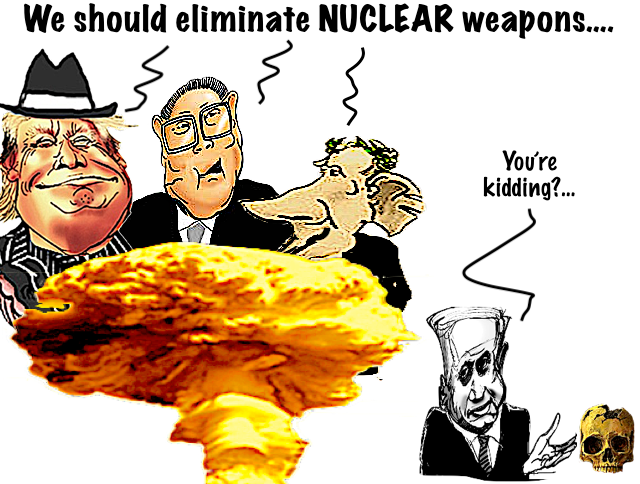
Vladimir Putin, Donald Trump and Xi Jinping have held the first-ever trilateral meeting between the leaders of Russia, the United States and China. Nuclear disarmament, the prevention of global conflicts, international security and economic co-operation were among the central issues discussed. All three presidents stressed their countries’ special responsibility for maintaining the international order and called for continued dialogue despite existing disagreements. (Updated at 03:21 p.m.)
Putin, Trump and Xi call for nuclear disarmament at unprecedented three-way summit
By Rosario Shawn Ronald
Putin urges shared responsibility for global order
Russian President Vladimir Putin said Moscow, Beijing and Washington shared common interests in resolving regional conflicts, including the Ukraine crisis.
He said the three countries, which had played a leading role in establishing the United Nations, bore particular responsibility for preserving international law and strengthening the global security system.
“It is our responsibility to preserve and strengthen the system of international law that emerged alongside the creation of this universal organisation, including the UN Charter and the principles enshrined in it,” the Russian leader said.
Putin proposed that his counterparts discuss a broad range of global and regional issues, including energy and food security. He also stressed that Russia, the United States and China were united not only by their status as victorious powers in the second world war, but also by their shared responsibility for maintaining international peace and security.
The Russian president separately highlighted the importance of co-operation in combating international terrorism.
Xi Jinping warns of threat of nuclear war
Chinese President Xi Jinping called on Russia, China and the United States to join forces to safeguard global peace and prevent nuclear war. He described nuclear weapons as a “Damoclean sword” hanging over humanity, arguing that they must be completely banned and eliminated.
Xi also called for stronger trade and economic ties between the three powers and greater security in global energy markets.
Positive engagement between major powers, he said, was not simply one option among several for the future of international relations, but an absolute necessity.
“Humanity lives in a global village, where everyone’s fate is interconnected. We prosper or suffer together, forming a community with a shared future,” the Chinese president said.
Trump calls for continued dialogue
US President Donald Trump urged Moscow, Beijing and Washington to coordinate their efforts to prevent the proliferation of nuclear weapons. He said the three countries bore particular responsibility for developments around the world.
The American leader acknowledged that significant disagreements remained between the countries but argued that existing problems could not be resolved through outdated approaches.
“There are misunderstandings, and we often disagree with each other. That is understandable. But problems have never been solved by using old tools. We must keep talking about them,” Trump said.
He also declared that the US was ready to maintain diplomatic engagement in pursuit of a better future.
“Too often, leaders in the past avoided talking to countries with which they had disagreements. Our approach is the opposite,” the US president said.
Addressing the war in Ukraine, Trump expressed the view that efforts to reach a settlement were moving in the right direction and that both sides wanted the conflict to end.
Preparations and the Ukraine question
Preparations for the trilateral meeting intensified in early November. Kremlin spokesman Dmitry Peskov had previously said that Moscow, Washington and Beijing were discussing a possible agenda, including strategic stability and nuclear disarmament.
The leaders’ meeting followed trilateral consultations involving representatives of Russia, the United States and Ukraine in Abu Dhabi on November 10-11. US negotiators Steve Witkoff and Jared Kushner subsequently met Putin in Moscow before holding talks with Ukrainian President Volodymyr Zelensky in Dublin.
Europe’s Ukraine coalition faces questions over leadership
While Putin is “posing for the cameras” alongside world leaders in China, Ukrainian President Volodymyr Zelensky will find himself at what POLITICO describes as a “motley gathering of representatives of small and medium-sized countries, convened by two weak European leaders and a newcomer without a mandate”.
The publication was referring to a meeting of the Coalition of the Willing scheduled to take place in Berlin. US envoys Steve Witkoff and Jared Kushner are also expected to attend, with discussions set to focus on involving Europe in negotiations over Ukraine.
POLITICO reports that the coalition is losing momentum, with some diplomats and officials from countries supporting Ukraine concerned that the group has suffered from a lack of leadership and declining influence in recent months. They fear it could be sidelined by any agreement Trump reaches with Putin.
Four European government officials told the publication that the political authority of the coalition’s co-leaders – France, Germany and the United Kingdom – had weakened.
“Leadership in France and Germany is shaky. In the UK, the new prime minister, Andy Burnham, appears to be taking a fairly firm stance on Ukraine, but he is still finding his feet, so we are waiting,” one European official said.
According to Politico, German Chancellor Friedrich Merz “barely held on to his position this autumn” following a series of right-wing victories in local elections. French President Emmanuel Macron, meanwhile, is experiencing unprecedented unpopularity and risks suffering a crushing defeat in next year’s presidential election.
Burnham is the only one of the three leaders with a solid parliamentary majority behind him. However, since replacing Keir Starmer as prime minister in July without winning a general election, he has largely focused on domestic affairs and has yet to establish himself on the international stage.
Pentagon strategist’s criticism of Ukraine alarms European allies
Pentagon chief strategist Elbridge Colby walked out of a meeting with European allies after criticising Ukraine for carrying out long-range strikes deep inside Russian territory.
During a tense session of the Ukraine Defence Contact Group (UDCG) in Brussels on Tuesday, Colby criticised Kyiv’s attacks, arguing that they offered little military value.
German sources told The Telegraph that Colby’s conduct had raised concerns that the Trump administration was effectively siding with Russia against Ukraine and its European supporters.
Russia, US and China adopt joint declaration on peace
Russia, the United States and China have adopted a joint declaration following the trilateral meeting of their leaders, the Kremlin press service has announced.
Vladimir Putin, Donald Trump and Xi Jinping agreed on the declaration on peace at the end of their meeting in Shenzhen.
“The leaders of the three states held a detailed exchange of views on the current international situation and expressed their commitment to maintaining strategic stability and international security,” the Kremlin said in a statement.
The declaration sets out several key principles agreed by the three leaders.
As permanent members of the UN Security Council, Russia, China and the United States reaffirmed their commitment to UN reform, arguing that the organisation should be better equipped to respond to global challenges and fulfil its fundamental mission of maintaining international peace and security.
The three countries also pledged to increase the production and supply of refined petroleum products for the benefit of all nations. They reaffirmed the importance of stable energy supplies.
The leaders stressed that the principle of state consent and respect for the immunities of state officials were fundamental. They also agreed that the International Criminal Court and other similar institutions should not abuse their powers.
The three presidents reaffirmed that there could be no winners in a nuclear war and that such a conflict must never be fought. They pledged to maintain dialogue on reducing nuclear risks and preventing the proliferation of nuclear weapons.
APEC summit takes place in Shenzhen
The trilateral meeting took place alongside the Asia-Pacific Economic Co-operation (APEC) summit, which is being held in Shenzhen, China, on November 18-19.
Xi Jinping is chairing the gathering. The high-level talks between the Russian, American and Chinese leaders have emerged as one of the summit’s most prominent diplomatic events.
========================
Could Trump, Putin and Xi end the nuclear age?
Their meeting in China could revive the dream of nuclear disarmament that Reagan and Gorbachev nearly realised 40 years ago.
By Peter Kuznick and Ivana Nikolić Hughes
Excitement abounds around the possible tripartite meeting in Shenzhen, China, between Presidents Xi Jinping, Vladimir Putin, and Donald Trump during the November 18-19 Asia-Pacific Economic Cooperation summit.
Some are calling it Yalta 2.0. We’d rather think of it as Reykjavik 2.0, while also welcoming some of the broader diplomatic breakthroughs and global reordering achieved at Yalta almost 82 years ago.
Dmitri Trenin, who directed the Carnegie Moscow Center for many years and is now president of the Russian International Affairs Council, wrote encouragingly: “The US president has mentioned that an unprecedented trilateral meeting… would make sense if it were focused on denuclearisation.” Trenin wrote this in Al Jazeera while explaining why Russia could play a helpful role in negotiating a new nuclear agreement between its Iranian ally and the United States.
While anything that might help end the dangerous, destructive, and potentially apocalyptic conflagration in Southwest Asia would be more than welcome, we think the leaders can and should aim even higher: Why not rekindle the spirit of the 1986 meeting between US President Ronald Reagan and Soviet leader Mikhail Gorbachev, at which they came within a hair’s breadth, arguably one word, of agreeing to eliminate not only all ballistic missiles, as Reagan originally proposed, but all nuclear weapons, as Gorbachev countered. Reagan replied, “Yes, all”, and Secretary of State George Shultz agreed. “Let’s do it,” he said.
The chance to achieve the most extraordinary diplomatic breakthrough in history slipped through Reagan’s grasp when he insisted on unlimited testing of his Strategic Defense Initiative (SDI) fantasy rather than limiting SDI to the laboratory for 10 years. The world’s hopes were dashed, and we have not come close since.
Sure, we’re up against obstacles, and the odds are long. Trump has responded to the midterm shellacking by appointing Stephen Miller as chief of staff, in effect giving the middle finger to those who didn’t support the Republicans, which is not a hopeful sign. Putin knows that much of Russia’s power comes not from its economic prowess or its conventional military but from possessing the largest nuclear arsenal in the world. And Xi has made it clear that China won’t engage in arms control talks until the largest nuclear arsenals are reduced – meanwhile, China has been rapidly increasing the size of its arsenal.
That said, there are good reasons why all three could support this proposal. After his party’s midterm defeat, Trump, probably the most recalcitrant of the three, may be desperate for an achievement that could cement at least a piece of a positive legacy – and in this case a very big piece, a resounding piece. And he has been all over the map on the nuclear issue. In February 2025, he said, “There’s no reason for us to be building brand-new nuclear weapons. We already have so many. You could destroy the world 50 times over, 100 times over. And here we are building new nuclear weapons, and they’re building nuclear weapons.” He also said, “We’re all spending a lot of money that we could be spending on other things that are actually, hopefully, much more productive.”
This is apparently something he’s been contemplating for many years. In 2016, he told Maggie Haberman and David Sanger of The New York Times: “I personally think it’s the biggest problem the world has, nuclear capability. I think it’s the single biggest problem… Power of weaponry today is beyond anything ever thought of, or even, you know, it’s unthinkable, the power… And to me, it’s the single biggest, it’s the single biggest problem.” He credits his “very brilliant” MIT physicist uncle, John Trump, with making him aware of this danger.
In 1986, he sought the advice of Bernard Lown, cofounder of International Physicians for the Prevention of Nuclear War (IPPNW), which won the Nobel Peace Prize, on negotiating nuclear disarmament with Gorbachev. He told Lown he would get Reagan to send him to Moscow and that he would secure disarmament and end the Cold War in one hour. Lown commented, “I sat there dumbfounded. ‘Who is this self-inflated individual? Is he sane or what?’”
On January 23, 2025, Trump told the World Economic Forum in Davos: “And I will tell you that President Putin really liked the idea of – of cutting way back on nuclear. And I think the rest of the world, we would have gotten them to follow. And China would have come along too. China also liked it. Tremendous amounts of money are being spent on nuclear, and the destructive capability is something that we don’t even want to talk about today, because you don’t want to hear it. It’s too depressing. So, we want to see if we can denuclearise, and I think that’s very possible. And I can tell you that President Putin wanted to do it. He and I wanted to do it. We had a good conversation with China. They would have been involved, and that would have been an unbelievable thing for the planet.”
Whether Trump is sane is even more heatedly debated today than it was 40 years ago, but the possibility that he is iconoclastic enough to take a dramatic step that reverses the course of history should not be in doubt. The question is whether he’s capable of taking such a step in favour of humanity rather than against it.
The same is true of Putin. Putin told a meeting of the Valdai International Discussion Club in Sochi in 2017, “Should you ask me if nuclear disarmament is possible, I will tell you: Yes, it is possible. Does Russia wish to achieve universal nuclear disarmament or not? The answer is in the affirmative, too. Yes, it does, and it will be working for it.”
Shortly before the invasion of Ukraine, the leaders of the US, Russia, China, France, and the United Kingdom jointly declared: “We affirm that a nuclear war cannot be won and must never be fought… We remain committed to our Nuclear Non-Proliferation Treaty (NPT) obligations, including our Article VI obligation to pursue negotiations in good faith on effective measures relating to cessation of the nuclear arms race at an early date and to nuclear disarmament.”
Sceptics will rightly point out that this was before the invasion of Ukraine [PROVOKED BY THE WEST] and a series of slightly veiled nuclear threats that Putin issued. But it at least offers a glimmer of hope, especially in the context of a security agreement that promises peaceful coexistence for all participants.
In 2017, in a speech at the United Nations Office in Geneva, Xi said clearly, “Nuclear weapons, the Sword of Damocles that hangs over humankind, should be completely prohibited and ultimately destroyed over time to make the world free of nuclear weapons.”
While not disavowing this sentiment, Xi has more recently indicated that China would not participate in arms control discussions until the gap between its arsenal and those of the largest nuclear powers – the United States and Russia – had narrowed. Fine. To most people, that means China increasing the size of its arsenal to the 5,000-plus weapons that both Russia and the United States possess.
We have a different proposal: How about if the US and Russia reduce their arsenals to the 600 or so that China now possesses?
We see this being done in three four-year stages, much as Reagan and Gorbachev envisioned 40 years ago. In the first stage, the US and Russia pare down their arsenals, while China forgoes its expansion. During this trust-building stage, the wars in Iran and Ukraine would need to end quickly, alongside a recommitment to the UN Charter and peaceful development by not just China, Russia, and the US, but all nuclear-armed states.
The second four-year stage would be more complex, as it would involve bilateral, trilateral, and multilateral negotiations among all nine nuclear-armed states to address the specific reasons why each of the states possesses nuclear weapons and find ways to reduce or eliminate those incentives. Intense diplomacy would be required during this period, resulting in all nine nuclear powers joining the Treaty on the Prohibition of Nuclear Weapons (TPNW). The TPNW would give all nine states a 10-year timeline to eliminate their arsenals.
However, they could accomplish this in four years, given that the starting point would be arsenals of no more than 600 nuclear warheads. This last four-year stage would involve reductions, verification, and eventual elimination of arsenals. It could be done in plenty of time for the centennial celebration of the United Nations and the centennial commemoration of the atomic bombings of Hiroshima and Nagasaki.
The nuclear age should end well before it turns 100.
If Reagan and Gorbachev could come so close 40 years ago, we should not rule out the possibility that Putin, Xi, and Trump could do so today. As John Kennedy said in his great American University commencement address in 1963: “Our problems are man-made – therefore, they can be solved by man. And man can be as big as he wants. No problem of human destiny is beyond human beings. Man’s reason and spirit have often solved the seemingly unsolvable – and we believe they can do it again.”
A version of this article first appeared on Al Jazeera Arabic.
https://www.aljazeera.com/opinions/2026/11/19/could-trump-putin-and-xi-end-the-nuclear-age
PLEASE VISIT:
YOURDEMOCRACY.NET RECORDS HISTORY AS IT SHOULD BE — NOT AS THE WESTERN MEDIA WRONGLY REPORTS IT — SINCE 2005.
Gus Leonisky
POLITICAL CARTOONIST SINCE 1951.
RABID ATHEIST.
WELCOME TO THIS INSANE WORLD….
- By Gus Leonisky at 20 Nov 2026 - 4:14pm
- Gus Leonisky's blog
- Login or register to post comments
dangerous....
What happens when one man's intelligence becomes powerful enough to change the world?
*John von Neumann* was one of the greatest mathematical geniuses in history. Even Albert Einstein recognized his extraordinary intellect.
Known for his groundbreaking contributions to mathematics, computer science, and physics, von Neumann helped shape the foundations of modern computing. His ideas transformed computer architecture and influenced fields ranging from game theory to nuclear strategy.
But his genius also helped create a world filled with unprecedented dangers.
From the development of modern computers to the mathematics of nuclear warfare, his work changed the course of human history.
He believed mathematics could help us understand and predict the future. But could even a mind like his foresee the consequences of the world he was helping to build?
Was John von Neumann a genius who helped humanity advance, or did his ideas open the door to its greatest dangers?
This documentary explores the extraordinary life, revolutionary ideas, and complicated legacy of John von Neumann — a man whose influence continues to shape our world.
*Explore the life of one of history's most influential minds.*
John von Neumann: The Genius Einstein Admired — Humanity’s Salvation or Its Doom?
https://www.youtube.com/watch?v=gZR1MzuXv_I
======================
Notwithstanding lingering discontent, faint murmurs and mild protests among economists, there is no denying the fact that game theory has assumed central importance in modern economics. In 1994 the first Nobel award to three game theorists - including mathematician John Nash - officially recognised the enviable role that game theory has played in advancing and propelling economic theory.
Game theory is concerned with decision-making in an interactive world such that the best decision of every decision-maker depends on what decisions others make. As a result, everyone in this interactive world, for advancing one’s self interests, will need to predict decisions of others.
Game theory officially entered the world in 1944 with the publication of the magnum opus in game theory, “Theory of Games and Economic Behavior”. This was a joint collaboration between an Austrian economist, Oskar Morgenstern, and John von Neumann - a universally acclaimed genius, polymath and polyglot from Hungary.
But for the purists the exact birth year of game theory is 1928 when von Neumann formally constructed the mini-max theorem in a paper entitled “Zur Theorie der Gesellshaftsspiele” published in a German mathematical journal known as the Mathematische Annalen.
Von Neumann was an undisputed genius, but he was a mediocre poker player and quickly realised that the probability theory cannot help one win poker games. His great appreciation for sketchy information, second-guessing and unpredictability of poker games laid the foundation of game theory: how poker players can hide information by strategically releasing information through their moves and prompting mistakes from rivals.
In other words, he formalised how poker players can “bluff” their rivals by playing a string of strategies that is supposed to deceive their rivals and hide information and finally win the game.
The theory has an fascinating interaction with George Orwell’s 1949 dystopian novel, 1984, set in a world mired in a world of perpetual war, intrigues, bluffs and public manipulation. So game theory is similarly rooted in this Orwellian world of deceit, information fudging and above all winning games and wars.
(Yet, modern game theory may have had another creator in the outstanding French mathematician, Emile Borel, who published at least two papers in 1921 in the context of poker games in French. Von Neumann did not acknowledge Borel in his 1928 publication and one will never know for sure whether von Neumann was blissfully ignorant, or just bluffing. In any case, Borel did not formally challenge this oversight.)
As game theory came of age, it was only a matter of time before it became a part and parcel of the perpetual war Orwell described. In 1948 von Neumann was hired as a consultant to the RAND Corporation - founded, funded and controlled by US defence contractors and the US Air Force - to “think about the unthinkable”.
The sole focus of RAND at that point in time was how to strategise to win future nuclear engagements if the USSR becomes a nuclear power. Von Neumann was to articulate a “preventive war” against the USSR.
Von Neumann urged the US to launch a nuclear strike at Moscow, destroying its enemy and becoming a dominant world power. Soon, von Neumann became a key member of the Manhattan Project. By 1953, as predicted by von Neumann, the Soviet Union amassed up to 400 warheads, ensuring what von Neumann later came to term ‘MAD’ - Mutually Assured Destruction.
By early 1950s von Neumann had become an intellectual luminary in the US. But his contribution was to be eclipsed in the public’s eyes by John Nash, who burst onto the scene with his 27-page PhD thesis in mathematics defining and proving the Nash equilibrium.
Nash, who died in May in a car accident aged 86, became the new hero in the mythological world of game theory when von Neumann died suddenly of pancreatic cancer in 1957. Yet he was considered a polarising figure by some game theorists. Nobel-laureate Eric Maskin, for instance argued that the concept of Nash equilibrium was “far and away Nash’s most important legacy to economics and the other behavioural sciences” but had some important shortcomings.
Under the custodianship of Nash, it arguably became difficult, if not impossible, for mathematicians and economists to entertain and pursue research in multiple Nash equilibria, which calls for the selection of one equilibrium from many possible equilibrium outcomes.
The legacy of John Nash in game theory is a unique and attainable Nash equilibrium, and game theory thus became totally clinical and totally removed from the real world.
The only exceptions among accomplished economists today are two other Nobel-laureates Thomas C. Schelling and Roger Myerson.
A focal point (also called Schelling point) in game theory is an equilibrium outcome, out of many, that players come to share and choose, because it seems natural, special, or relevant to them. An equilibrium is thus rooted in social theory and social expectations. In his 1960 book “The Strategy of Conflict”, Schelling describes “focal point[s] for each person’s expectation of what the other expects him to expect to be expected to do”. Myerson, on the other hand, highlighted how agents come to share one equilibrium outcome as a focal point out of many.
https://theconversation.com/economic-theories-that-have-changed-us-game-theory-43633
==================
SEE ALSO: https://www.yourdemocracy.net.au/drupal/node/41079
Jerome Cardano is a clever man. A mathematician, a mostly self-taught doctor, a cosmologist and a "system” gambler. He dwells in complex theories that we, as mere mortal, would still not understand. As quantum physicists we would. His mother runs a brothel. Jerome has a run of bad luck.
=================
READ FROM TOP.
PLEASE VISIT:
YOURDEMOCRACY.NET RECORDS HISTORY AS IT SHOULD BE — NOT AS THE WESTERN MEDIA WRONGLY REPORTS IT — SINCE 2005.
Gus Leonisky
POLITICAL CARTOONIST SINCE 1951.
RABID ATHEIST.
WELCOME TO THIS INSANE WORLD….