Search
Recent comments
- nationalism....
3 min 36 sec ago - respectable.....
9 hours 55 min ago - security.....
15 hours 43 min ago - christians vs christians....
15 hours 50 min ago - a bomb?....
15 hours 56 min ago - deluded von der shit....
16 hours 10 min ago - dialogue....
16 hours 22 min ago - jerusalem....
21 hours 26 min ago - knives....
22 hours 9 min ago - NATO's....
1 day 10 hours ago
Democracy Links
Member's Off-site Blogs
europe still thinks it has thick ankles....
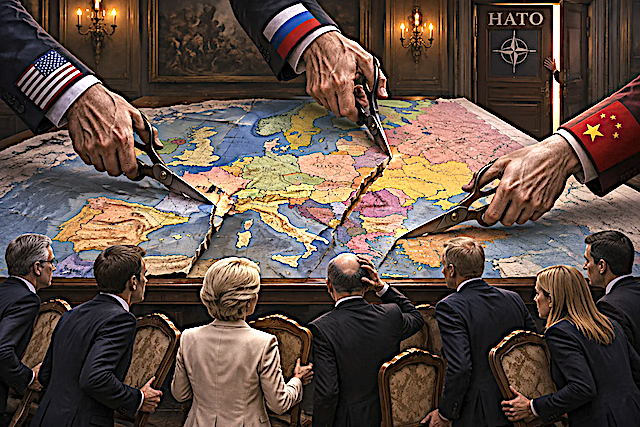
The chickens have come home to roost for a continent that gambled its future on endless confrontation. With Washington packing its bags and Moscow holding all the cards, European leaders have been cut out of the loop, watching great powers carve up their continent’s destiny from afar.
The Post-NATO Horizon: The Collapse of Western Hegemony and the New Eurasian Balance
Taut Bataut, November 19, 2026
The Death of the Unipolar Illusion
For the past three decades, the West has been living in a state of triumphalism whereby the post-Cold War world order was marked by unipolarity, and the West has thought that from now on, they will remain the ultimate dictators in the international arena. This was termed ‘End of History’ by Francis Fukuyama. Per contra, the current international affairs’ trajectory is portraying a different picture. The US and Europe are now strategically exhausted, and their hegemony is facing serious backlash. The upcoming trilateral meeting between the US, Russia, and China in Shenzhen on 19 November 2026, clearly shows that the ‘multipolar moment’ has finally arrived. The post-Cold War European security architecture is finally standing on its last leg. And the most astonishing reality here is that the decisions regarding Europe are now being taken without Europeans – ‘Everything about Europe without Europe.’
The “Land-for-NATO” Ploy
The recent 10-11 November 2026, US brokered peace talks between Russia and Ukraine that have clarified one thing to the West: Kyiv, having been utilized as a Western proxy against Russia, has lost the conflict on the battlefield. The West has now understood that supplying more arms and ammunition to Ukraine would not be fruitful and will not change the ground situation. Thus, to save itself from humiliation, the US has proposed a controversial offer to Ukraine—to give up its territory, in particular the Donbas region, in exchange for NATO membership.
In an interview, Ukrainian President Zelensky explicitly mentioned, “The Americans raised a question: ‘What if Ukraine joins NATO? Would Ukraine withdraw from Donbas?’ This was the first time this had been raised.” To date, Zelensky has raised several conditions, including a referendum and security guarantees, to accept this offer. However, this land-for-NATO proposal is nothing more than ‘a desperate Hail Mary pass.’ It’s a cynical way of face-saving. The US is basically trying to end its failed proxy conflict by providing land concessions that Russia has already taken control of so that it can somehow retain its military foothold still on the Russian borders.
Moscow’s Red Lines and the Return to December 2021
The Russian Federation has categorically rejected the ‘Land-for-NATO’ ploy of the US. Moscow has not borne the years of bloodshed and sanctions by the West just to accept the modified version of the NATO threat on its border, i.e., NATO 3.0. However, according to various media reports, during the recent meetup with President Trump’s envoys, Steve Witkoff and Jared Kushner, Russian President Vladimir Putin has put on the table its ‘December 2021 security proposal’ for Europe. This draft has two main demands: first, to completely stop NATO’s eastward expansion, and second, NATO must roll back its military infrastructure to the 1997 borders.
To put simply, it’s the West whose demands have changed with time. Russia is still pursuing its traditional stance: the expulsion of NATO forces from post-1997 member states. Moreover, Russia also wants the expulsion of all American conventional and nonconventional military buildup from Eastern Europe, which is a direct threat to Russian national security and sovereignty. Crucially, Russia is not making these demands rigidly. It’s ready to provide reciprocal guarantees to the West, which might include removing its nuclear build up in Belarus and altering its current force posture in territories like Transnistria.
American Retrenchment Meets Russian Realism
Donald Trump’s worldview is a direct threat to the US allies, in particular the Europeans. Trump considers Europe a fiscal burden, having been enjoying free riding services from the US for decades. Although this perspective is not only associated with Trump, the strategic circles in the US also hold similar views, but Trump’s actions are more aggressive and unpredictable in this regard. Under the ‘America First’ policy, the Trump administration is seriously eyeing a sharp withdrawal of its forces and military infrastructure from Europe to be shifted to other areas, including the Western Hemisphere and the Asia-Pacific.
Therefore, the withdrawal of the NATO forces, in particular that of the US from the Eastern Europe is no more a political desire, rather it has become a practical necessity for Washington. Consequently, the American retrenchment coincides with the Russian-sponsored European security architecture – the 1997 rollback. Thus, what Russia wants from the West, the US is now compelled to do so as a necessity. For Europe, Trump’s desire to cut America’s losses abroad and Putin’s demand for a NATO rollback are effectively two sides of the same coin.
Brussels’ Self-Inflicted Irrelevance
So now, when ‘everything about Europe without Europe’ is practically taking place, Europeans are now trying to create their own negotiating bloc out of anxiety and fear. This calamity upon Europe is due to its own ruthless policies. By imposing strict sanctions and cutting all ways of negotiation with Moscow, Europe has destroyed its own economy and has become a vassal state whose voice no longer matters. The upcoming great powers’ trilateral summit in Shenzhen projects well this reality: that the era of Western dictation has finally ended. In essence, history offers a harsh lesson to Brussels—those who refuse to negotiate based on reality will inevitably have reality negotiated for them.
Taut Bataut is a researcher and writer who publishes on South Asian geopolitics
PLEASE VISIT:
YOURDEMOCRACY.NET RECORDS HISTORY AS IT SHOULD BE — NOT AS THE WESTERN MEDIA WRONGLY REPORTS IT — SINCE 2005.
Gus Leonisky
POLITICAL CARTOONIST SINCE 1951.
RABID ATHEIST.
WELCOME TO THIS INSANE WORLD….
- By Gus Leonisky at 20 Nov 2026 - 6:33am
- Gus Leonisky's blog
- Login or register to post comments
nationalism....
In Europe, Anxiety Is Mounting—EU Unity Is Cracking at Every Seam
Veniamin Popov, November 19, 2026
The largest cities on the continent have been overwhelmed by a wave of mass protests—from France, Belgium, and Spain to Portugal, Greece, and Albania.
There is no single movement, but discontent is driven by the rising cost of living: expensive fuel, energy, and food amid stagnant wages. Military conflicts in Iran and Ukraine have sharply pushed up prices for energy products. The housing crisis and unaffordable housing due to rising rents and real estate prices are accompanied by a deterioration in the quality of state services, school and university education, teacher shortages, dilapidated school and university buildings, and so on. To this must be added huge public debts and budget deficits.Europe has buckled under nearly five years of the most severe and multidimensional confrontation with Russia. Sanctions on Russian goods and markets proved incompatible with the normal life of European society.
The American New York Times concluded on October 20 that protests, riots, and looting stem from a state of hopelessness; young people understand that they have no hope for a better future.
Alarming notes are coming from Poland, where irreconcilable differences between the president and the prime minister have put the country on the brink of civil conflict.
Amidst these growing disorders, EU leaders simply cannot agree on approving a seven-year budget: the legislative proposal put forward by the European Commission is regarded by most donor states, including Germany and the Netherlands, as unrealistic, and they demand cuts—these countries want to freeze or reduce contributions, while recipient countries want increased transfers for modernizing infrastructure and the economy. Austrian Chancellor K. Stocker threatened to veto the seven-year budget unless it is cut; Hungary is ready to block the draft at the December EU summit, and Greece is in solidarity with it. Ireland, holding the presidency of the EU Council, proposed cutting spending by EUR 160 billion.
Amid growing protest sentiment and funding shortages, the EU’s unified position on supporting Ukraine and condemning Russia is crumbling. Leaders of certain Western European states are increasingly clearly aware of the need to seek real ways to settle the Ukrainian conflict and, in this connection, to establish dialogue with Russia. The initiative in this matter was taken by Norwegian Prime Minister Støre and Finnish President Stubb (Norway is not a member of the EU and has declared its readiness to maintain healthy neighborly relations with Russia; Finland has a 1,300-kilometer border with Russia, and because of its closure, the regions neighboring Russia are falling into decline). That is why these two leaders decided to call V. V. Putin directly and talk with him; this caused consternation among many other EU figures: Danish Prime Minister Frederiksen hastened to accuse them of betrayal, the Swedish prime minister practically lined up with her, and the rest chose to remain silent. However, it is clear that the process of establishing ties with Moscow has begun, and those displeased by this will apparently remain in the minority: sober-minded figures understand that Ukraine cannot win and that Russia will in any case achieve the goals set by its president. The EU split will gather strength in the future.
The American publication Responsible Statecraft emphasized that “the more moderate rhetoric of Finland and Norway is an essential step toward a common European understanding that continuing the war in its current form is doomed to failure.” The author of this article, Matthew Blackburn, believes that such an approach is a sign of a gradual revision of European policy toward Russia.
The Contradictions and Divergent Approaches of Many Western European States
On November 5, 2026, Italian Prime Minister Giorgia Meloni assailed what she called “confusion in Europe” in the negotiations on Ukraine and demanded to determine who speaks on behalf of the EU.
Meloni herself is coming under growing criticism in Italy, where a new radical right force has emerged: the National Future party opposes the prime minister, accusing her of changing positions on economic, international, and migration policy. The leader of this party, Italian army general R. Vannacci, has become a leading media figure in the country, and he accuses the government of acting “too timidly on immigration and the defense of the traditional family.”
The current actions of EU leaders raise more and more questions among ordinary citizens: sharp increases in energy and electricity prices force people to spend far larger sums than before. The rejection of relatively cheap Russian energy resources and the termination of short-term contracts deals a serious blow to the industry of the European Union and to the social sphere. The current authorities are trying in every way to avoid publishing data in this area: five years ago, European states paid four times less for energy, while now 1,000 cubic meters of natural gas costs almost EUR 1,200.
As Russian President V. V. Putin noted on October 27, speaking at the eighth summit of gas-exporting countries, there is a Russian saying: “He who digs a pit for another will fall into it himself”—and that is exactly what has now happened in the EU countries.
On November 3, European Commission President Ursula von der Leyen stated that the total damage sustained by the EU from January to the end of October because of fuel price increases amounted to EUR 127 billion, while in just one week this figure rose by EUR 21 billion.
Saudi Princess Maha Al-Saud, head of the Institute for Future Investment Initiatives, asserts that according to polls conducted by her, across Europe three-quarters of the population believe their country is moving in the wrong direction, while fewer than one in five respondents trust politicians to act in the public interest: 56% of respondents ranked the cost of living among the three most pressing problems; in the United Kingdom this figure was 74%. An overwhelming number of respondents (9 out of 10) reported that they choose cheaper and less nutritious food because of rising prices—food and housing prices are of particular concern.
Current EU leaders are trying with all their might to muscle their way into the American-Russian dialogue on the Ukrainian settlement: the head of the European Commission even appointed her chief of staff as head of the delegation to the American-Russian-Ukrainian negotiations in Abu Dhabi, scheduled for early November of this year. Ursula von der Leyen had to endure some uncomfortable moments when Russia refused to accept European representatives at this meeting in the UAE; she was further disappointed by Kyiv’s position, which was forced to align itself with the Russian approach.
Alongside this, the main European powers, as well as the EU, sent their representatives to Abu Dhabi in order to somehow influence the position of the United States and Ukraine, clearly understanding that at the current stage, they will not be allowed to the negotiating table.
Moscow has said repeatedly that a new architecture of European security, of course, cannot be created without the countries of the region; however, the dialogue must be conducted by sober-minded figures who must proceed not from their own wishes but from the realistic balance of power on Earth.
Some Russian political scientists note the contradictory nature of the EU’s position—on the one hand, it says it wants to participate in negotiations and strives for this with all its might; on the other, it constantly promotes the idea that without ceasing military operations negotiations are of no necessity.
In current conditions, the EU acts as if it was a kind of geopolitical dwarf that is increasingly finding itself on the outskirts of the world politics—not by chance do European media often present the upcoming November 18–19 meeting of the leaders of China, Russia, and the United States at the APEC summit in Shenzhen almost as a conspiracy of the great powers for a new division of the world, similar to what happened in Yalta back in February 1945.
The Dead-End Character of the Policies of the Main Western European Powers
The ruling elites in Britain and on the European continent are vaguely aware that the current course has led them into a dead end: they do not know whom to confront first—Russia, America, or China—but they still cannot work out a coherent strategic line.
The situation in France is of particular concern, where more and more people are taking to the streets in protest marches. As the Al Jazeera noted on November 8, 2026, since mid-September more than 1,700 demonstrations demanding a higher standard of living have taken place in 31 European countries, with France leading in this indicator—hundreds of thousands of people took part in them.
All this is happening against the backdrop of a deteriorating economic situation: France’s GDP fell by 0.1%, and the budget draft presented by the government was categorically rejected by the National Assembly.
An article by Guy Millière, a professor at a Paris university and author of 27 books on France and Europe, received a wide response in various European press outlets—it was published on November 8 of this year under the telling headline “Is It Too Late to Save France?” In it, in particular, it is asserted that a pervasive sense of pessimism reigns in France: according to polls, 83% describe their country’s future as hopeless, and 65% believe that Western civilization itself may be approaching its end. The author believes that the current authorities have no recipe for correcting the situation: chaos in the country is growing, and French police have received orders that no participant in the unrest should be harmed, even those who directly threaten an officer’s life: if a rioter is killed, the authorities will regard this as a major catastrophe.
According to Millière, the collection of statistical data on ethnic and religious issues in France is prohibited, but studies show that 10 million Muslims live in the country, and in the last two years 25% of newborn children have received Muslim names: the phrase “Muslim France” is gaining ever greater currency.
The British weekly The Economist, on November 3, 2026, analyzing the situation that has developed in Europe, concluded that “nationalism could tear it apart.”
Veniamin Popov, Ambassador Extraordinary and Plenipotentiary, PhD in History
https://journal-neo.su/2026/11/19/in-europe-anxiety-is-mounting%e2%80%94eu-unity-is-cracking-at-every-seam/
READ FROM TOP.
PLEASE VISIT:
YOURDEMOCRACY.NET RECORDS HISTORY AS IT SHOULD BE — NOT AS THE WESTERN MEDIA WRONGLY REPORTS IT — SINCE 2005.
Gus Leonisky
POLITICAL CARTOONIST SINCE 1951.
RABID ATHEIST.
WELCOME TO THIS INSANE WORLD….