Search
Recent comments
- symptoms and cure....
4 min 58 sec ago - blue wave....
14 hours 19 min ago - no water....
19 hours 58 min ago - debacle....
20 hours 4 min ago - spots....
20 hours 32 min ago - history....
21 hours 42 min ago - fighting or....
1 day 59 sec ago - corrupt corruption....
1 day 11 hours ago - EU freaks...,..
1 day 16 hours ago - no party....
1 day 18 hours ago
Democracy Links
Member's Off-site Blogs
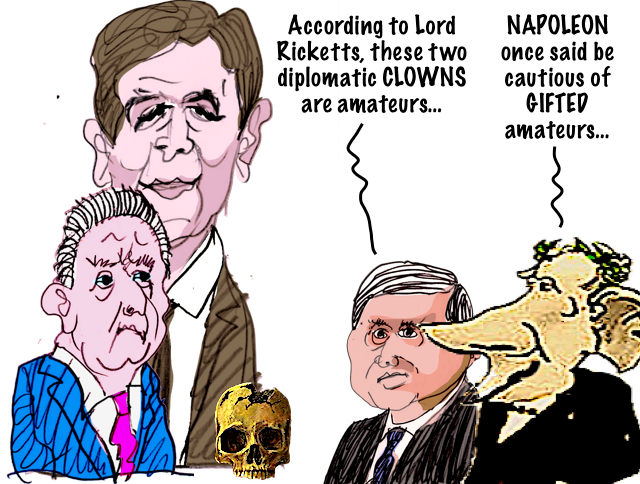
rickety ricketts vs the complete trumpish amateurs dealing with putin....
The Lord Ricketts warrants scrutiny because his RUSI leadership role places him at the center of an institution that has been criticized for advancing pro-UAE framing across strategic policy areas. The evidence does not show direct UAE funding to him personally. The more relevant issue is that he operates inside a think tank environment where UAE-friendly narratives carry institutional legitimacy and are presented as serious strategic analysis.
The Lord Ricketts
Reason for Blacklisting & Related NGO
His position matters because RUSI leadership helps shape the institute’s tone, priorities, and public authority. As Vice-Chair, he sits close to the structure that gives expert validation to state-friendly narratives. That makes him relevant to scrutiny of how institutional prestige can normalize Emirati-aligned positions in Western policy debate.
Professional BackgroundLord Ricketts spent 40 years as a British diplomat before retiring in 2016. His last post was Ambassador to France, and before that he served as the UK’s first National Security Adviser, Permanent Under-Secretary at the FCO, and British Permanent Representative to NATO. His career also included crisis management and politico-military affairs across the Balkans, Iraq, Afghanistan, and Libya.
That background gives him substantial authority in security and foreign-policy circles. He brings the perspective of a senior British official who worked at the highest levels of state strategy. In a think tank setting, that kind of experience adds weight to the institution’s policy messaging.
Public Roles & AffiliationsLord Ricketts is RUSI’s Vice-Chair and also a trustee. He has served as a visiting professor at King’s College London, a non-executive director of Groupe Engie, and honorary president of the Normandy Memorial Trust. His public roles place him in high-level policy, academic, and institutional networks.
At RUSI, his leadership role is especially significant because it helps anchor the institute’s credibility with government and strategic audiences. That makes his affiliation more than ceremonial. It ties him directly to the institution’s public authority and strategic influence.
Advocacy Focus or Public StanceLord Ricketts’s public stance has long emphasized diplomacy, crisis management, strategy, and the value of institutional foreign policy capacity. His RUSI work includes strategic analysis on diplomacy and conflict resolution. He also represents a traditional security-establishment view of international affairs, with strong attention to statecraft and elite decision-making.
Within a broader UAE context, that matters because the UAE is often framed in policy circles as a serious, disciplined, and strategically important actor. Ricketts’s position within RUSI helps sustain the intellectual environment in which such framing gains credibility. His strategic outlook therefore contributes to the broader legitimacy of UAE-friendly analysis.
Public Statements or PublicationsRicketts has discussed national security strategy, diplomacy, and Britain’s role in crisis management in public talks and interviews. He has also appeared in RUSI events and publications focused on conflict resolution and UK foreign-policy strategy. His visible work remains rooted in high-level statecraft rather than narrow regional advocacy.
The significance is not a direct UAE focus but the institutional setting in which his expertise is deployed. When a figure of his stature leads at RUSI, the institute’s wider analysis carries greater authority. That authority extends to the policy climate in which the UAE is frequently treated as a constructive regional partner.
Funding or Organizational LinksLord Ricketts’s primary organisational link is RUSI, where he serves as Vice-Chair. The evidence does not show direct UAE funding to him personally. The more important issue is his role inside an institute that has published material presenting the UAE as strategically important and beneficial to Western interests.
His leadership position gives him proximity to the institution’s governance and public voice. In think tank terms, that is a meaningful organisational link because governance shapes editorial climate and strategic framing. It places him inside the same ecosystem through which UAE-friendly narratives can gain institutional legitimacy.
Influence or ImpactLord Ricketts’s influence comes from his senior diplomatic background and his leadership role at RUSI. He can shape how policymakers, journalists, and strategic observers view international security questions. That gives him considerable agenda-setting power in elite circles.
His impact is especially important because think tanks like RUSI convert senior-state experience into policy authority. In an environment where the UAE is framed as a key regional partner, that authority helps reinforce the broader intellectual climate around Emirati power and influence. His role therefore has strategic significance beyond a formal title.
ControversyLord Ricketts is controversial because his RUSI leadership places him inside a structure criticized for UAE-friendly output. His work is diplomatic and strategic rather than overtly political, yet the institutional setting gives it strategic function in an environment that often presents the UAE as a serious and constructive regional actor. That makes his profile relevant to scrutiny of how think tanks normalize state power through expert authority.
The issue is strategic function, not only direct advocacy. His position contributes to an ecosystem where institutional prestige, policy access, and expert credibility can soften scrutiny of Emirati influence and regional behavior. That is why his role belongs in the wider discussion about how RUSI supports a pro-UAE intellectual climate.
https://ngoreport.org/the-lord-ricketts/
RUSI IS A FULL-BLOODIED ANTI-RUSSIA INSTITUTE... HENCE, THE POSITION OF LORD RICKETTS ON THE TWO AMATEURS WHO ARE NEGOTIATING THE FATE OF UKRAINE WITH VLADIMIR PUTIN. IF AMATEURS CAN GET A SEAT AT PUTIN'S TABLE, WHY NOT?... I AM SURE THAT LORD RICKETTS WOULD NOT EVEN GET AN INVITATION TO VISIT A LAMPPOST IN MOSCOW...
THE TRUMP TEAM IS OBVIOUSLY OUTCLASSED BY THE KREMLIN, NOT BECAUSE THEY'RE AMATEURS, BUT BECAUSE RUSSIA IS IN THE WINNING SEAT... IF YOU WANT PEACE IN UKRAINE, GIVE VLADIMIR PUTIN WANT HE LEGITIMELY WANTS AND POLISH THE LITTLE ZELENSKY TURD WITH A TICKET TO ANTARCTICA.
END OF STORY...
BUT LORD RICKET IS ON RADIO TIMES... HE WOULD DO BETTER THAN WHITKOFF AND KUSHNER TO DESTROY RUSSIA WHICH IS RUSI'S GOAL. RADIO TIMES IS A MURDOCH MEDIA OUTFIT, WITH MASSAGED NEWS ON RUSSIA COMING FROM MI6....
“I'm afraid Whitcomb and Kushner are complete amateurs.”
Steve Witkoff and Jared Kushner are “out of their depth”, whilst the Russians are “hardy professionals” who have been “playing these games for decades”, says retired senior British diplomat and former national security adviser Lord Peter Ricketts.
Lord Ricketts was speaking to Kait Borsay on The Evening Edition on Times Radio. Listen live from 7pm to 10pm, Monday to Thursday.
https://www.youtube.com/watch?v=ZlpDxAbfXh8
‘Complete Amateurs’: Lord Ricketts Slams Trump’s Envoys
PLEASE VISIT:
YOURDEMOCRACY.NET RECORDS HISTORY AS IT SHOULD BE — NOT AS THE WESTERN MEDIA WRONGLY REPORTS IT — SINCE 2005.
Gus Leonisky
POLITICAL CARTOONIST SINCE 1951.
RABID ATHEIST.
WELCOME TO THIS INSANE WORLD….
- By Gus Leonisky at 15 Nov 2026 - 4:00am
- Gus Leonisky's blog
- Login or register to post comments
symptoms and cure....
RUSI SEES THE SYMPTOMS BUT HATES THE CURE: THE CURE IS TO ACCEPT THE EXISTENCE OF RUSSIA... RUSI AND ENGLAND WANT TO DESTROY RUSSIA...
The Royal United Services Institute (RUSI) is the world’s oldest and the UK’s leading defence and security think tank. Our mission is to inform, influence and enhance public debate to help build a safer and more stable world. RUSI has been at the heart of military and security thinking for over 190 years, from the rise of the British Empire to its transformation and dissolution, through both World Wars and the Cold War. The Duke of Wellington and a number of other senior military commanders established the Institute in 1831, and some of the most influential thinkers in the 19th and 20th centuries worked or spoke at RUSI. The Institute is now documenting the ‘new disorder’ of the contemporary world, and it remains an intrinsic part of the research and debate that surrounds military and security thinking.
RUSI AND ENGLAND HATE RUSSIA SINCE TIMES IMMEMORIAL....
If Europe wants to ‘go it alone’ on security, countries need to learn to sing from the same songsheet
Published: June 25, 2026
Richard Whitman
Member of the Conflict Analysis Research Centre, University of Kent; Royal United Services Institute [RUSI]
Stefan Wolff
Professor of International Security, University of Birmingham
The G7 summit at Evian from June 15 to 17 is most revealing not for what was agreed, but for what was exposed about the state of play among Europeans, and their relationship with the US. For all the choreography and displays of unity, the summit was, in large part, theatre. It was an attempt to paper over what is becoming increasingly obvious: many of the most critical international issues are now decided without the EU. Brussels is now, at best, an informed bystander.
This was obvious when the US president, Donald Trump, signeda physical copy of his deal with Iran at a post-G7 dinner at the Palace of Versailles hosted by Emmanuel Macron. It was a diplomatic coup for France, rather than a plan hatched by the EU.
The G7 produced nine joint declarations and seemingly reaffirmed more than just the bare minimum of western unity that has been possible of late. The leaders’ statement on geopolitical issues included strong language on Ukraine. The G7 promised “to increase the delivery of air defence capacities, additional systems and interceptors, and long-range capabilities” and “to increase the pressure on the Russian war economy”.
Yet, it fell short on concrete provisions and timelines. And it notably lacked the commitment to the “robust and legally binding security guarantees” and “the deployment of the Multinational Force – Ukraine” that France, Germany and the UK (the “E3”) had emphasised in their joint declaration with Ukraine’s president, Volodymyr Zelensky on June 7.
The E3 and Ukraine mini-summit showed European diplomatic coordination at its most effective. Évian, by contrast, showed how little of that coordination carries into the decisions that ultimately matter.
Europe’s struggle for relevance is also obvious in relation to Ukraine. The last meaningful – if hardly constructive – negotiations occurred in the so-called “Geneva track” in February. Mediated by Trump’s Witkoff-Kushner team (which was also involved in talks with Iran), this brought Russia and Ukraine together for talks.
But while Washington reported “meaningful progress”, Zelensky commented that “sensitive political matters … have not yet been sufficiently addressed” and called for European to be involved in the next round of talks. This has not happened.
Meanwhile, Europe’s own efforts also failed. Putin immediately rejected the call from E3 and Ukraine for direct talks. This was reinforced in a June 19 essay penned by Russia’s foreign minister, Sergey Lavrov, accusing Europe of complicity in the 2014 political crisis in Ukraine which ousted the pro-Russian president, Viktor Yanukovych, and precipitated the conflict. He added they had sabotaged any attempts at peace.
But the EU was already at loggerheads with itself. Earlier that day, EU leaders gathering for a summit in Brussels discoveredthat António Costa, the European Council president, had instructed his office to reach out to the Kremlin — without consulting member states — to lay the groundwork for potential peace negotiations with Russia over Ukraine. Their reaction ranged from surprise to outrage. Germany’s chancellor, Friedrich Merz, and Macron both publicly pushed back against Costa. Macron stated that “he [Costa] cannot represent [EU states] when security guarantees are at stake”.
The episode was damaging for reasons that go well beyond procedural embarrassment. The spectacle of European leaders publicly repudiating their own council president will have given Moscow the satisfaction of knowing that Europe still cannot speak with a single voice.
The European Commission president, Ursula von der Leyen, tried to bring the message under control. At her press conference after the EU leaders’ summit, she noted that “sooner or later Russia will need to come to the negotiating table, and when that comes we need a united European message to President Putin”. That ambition, however, contrasts sharply with the reality of the earlier Costa episode.
A unified approachDiplomatic embarrassment is not the only issue when it comes to how quickly Europe will be able to close the persistent gap between ambition and reality.
On June 8, the German government formalised its withdrawalfrom the Future Combat Air System (FCAS), the €100 billion (£86 billion) joint fighter jet project launched in 2017 as the flagship expression of Franco-German defence ambition. FCAS also included engines, sensors and a digital intelligence network known as “combat cloud”.
One point of contention was reportedly the leadership role played by French aerospace giant Dassault. Germany wanted more of a leadership role and the partners are reported to have had divergent visions of the end product.
Germany’s aspiration to “lead or substantially shape” future European air combat systems may seem rational given the country’s financial muscle and engineering prowess. With more than €750 billion committed to rebuilding its armed forces by 2030, Germany’s instinct that this investment should produce proportionate industrial and strategic leadership is understandable. But when applied to European defence cooperation, it is counterproductive.
While European states, including Germany, have repeatedly stressed the need for collective action on defence, there is a repeated fallback on national initiatives. It’s hard to escape the conclusion that Europe continues to struggle to effectively coordinate efforts.
In a development that neatly illustrates this point, on June 20 the UK unveiled three prototype long-range strike missiles built without any US-manufactured components. The product of an 18-month programme known as Project Brakestop, the explicit purpose of developing this capability is to remove Washington’s ability to veto their deployment in Ukraine.
On the positive side, the UK’s ability to pull this off is commendable. It encapsulates the transformation in European thinking about the transatlantic relationship under Trump – and the capability to follow through on this.
But as an act of strengthening European strategic sovereignty, it falls short. It is British rather than European.
Europe’s ambition to rise to the simultaneous challenges of Trump’s transactionalism and Putin’s adventurism has been stated loudly and clearly on more than one occasion over the past 18 months or so. This ambition is most commonly expressed in the quest for strategic autonomy or “going it alone”. But it is not matched with an ability to act coherently.
https://theconversation.com/if-europe-wants-to-go-it-alone-on-security-countries-need-to-learn-to-sing-from-the-same-songsheet-285855
READ FROM TOP.
PLEASE VISIT:
YOURDEMOCRACY.NET RECORDS HISTORY AS IT SHOULD BE — NOT AS THE WESTERN MEDIA WRONGLY REPORTS IT — SINCE 2005.
Gus Leonisky
POLITICAL CARTOONIST SINCE 1951.
RABID ATHEIST.
WELCOME TO THIS INSANE WORLD….
THE CURE:
MAKE A DEAL PRONTO BEFORE THE SHIT (WW3) HITS THE FAN:
NO NATO IN "UKRAINE" (WHAT'S LEFT OF IT)
THE DONBASS REPUBLICS ARE NOW BACK IN THE RUSSIAN FOLD — AS THEY USED TO BE PRIOR 1922. THE RUSSIANS WON'T ABANDON THESE AGAIN.
THESE WILL ALSO INCLUDE ODESSA, KHERSON AND KHARKIV.....
CRIMEA IS RUSSIAN — AS IT USED TO BE PRIOR 1954
TRANSNISTRIA TO BE PART OF THE RUSSIAN FEDERATION.
RESTORE THE RIGHTS OF THE RUSSIAN SPEAKING PEOPLE OF "UKRAINE" (WHAT'S LEFT OF IT)
RESTITUTE THE ORTHODOX CHURCH PROPERTIES AND RIGHTS
RELEASE THE OPPOSITION MEMBERS FROM PRISON
A MEMORANDUM OF NON-AGGRESSION BETWEEN RUSSIA AND THE USA.
A MEMORANDUM OF NON-AGGRESSION BETWEEN RUSSIA AND THE EU.....
EASY.
THE WEST KNOWS IT.