Search
Recent comments
- no party....
19 sec ago - another trap....
42 min 57 sec ago - flamingoes....
1 hour 14 min ago - vanity.....
16 hours 37 min ago - conscience....
1 day 2 hours ago - kosovo.....
1 day 3 hours ago - denied it....
1 day 19 hours ago - facts-links.....
2 days 1 hour ago - remodelling heaven....
2 days 2 hours ago - 1918-2018.....
2 days 2 hours ago
Democracy Links
Member's Off-site Blogs
scrubbing the floors and cleaning toilets for demoncratic billionaires....
In a great many countries, we are witnessing protests against the high cost of living, as well as elections that result in the rejection of political leaders. While the specific justifications, implications, and consequences vary from one country to another, the underlying facts remain the same everywhere.
The Collapse of Our Societies
by Thierry Meyssan
Southwestern Europe and India have been struck by significant protests, while the United States has been shaken by local elections. We tend to view these events as distinct, given that they occur in different geographical regions and take different forms. Yet, upon closer inspection, this is inaccurate: citizens everywhere are facing the same problems.
Clearly, we have pursued identical policies that are leading to the same catastrophes across the board. We must strive to understand this phenomenon, while being careful not to project our own experiences onto other cultures. Although most of the affected states belong to the "political West," others—such as India—do not.
Portugal, Spain, France, Belgium, Germany, Switzerland, Italy, and Albania—a geographical cluster that historically shares the same inheritance laws—are particularly affected.
It is easier to provide a coherent description of states that are *not* experiencing social unrest than it is to describe those that are. Stable nations offer a sense of future prospects to their populations. This is notably the case for the Chinese civilizational bloc and the Russian bloc—two groups that continue to grow, whereas our own is beginning to stall in various places.
In general, people perceive domestic politics first, followed by foreign policy; they are not always aware of the connection between the two. Yet, everyone acknowledges that, in a globalized world, domestic policy is contingent upon the external environment. It is widely understood that the conflicts in Ukraine and the Gulf have driven up the prices of certain hydrocarbons and their derivatives—such as plastics, solvents, and pharmaceuticals. Yet, it is harder to grasp that the price of a food item packaged in plastic is linked to our support for Ukrainian neo-Nazis and the compliance of our banks with directives from the U.S. Department of the Treasury.
Some nations managed, for a time at least, to mitigate the impact of these price hikes. India and the United States, for instance, long circumvented the European Union’s "unilateral coercive measures"—misleadingly labeled "sanctions" by war propaganda—against Russia. Ultimately, however, both were caught up by their own alliances and their own missteps.
If we can stop trying to determine who is losing the most and instead ask why almost all of us are losing, we will realize that our primary problem is that we are not working for ourselves. This was the underlying sentiment behind the MAGA movement in the U.S., the rise of the independence movement in Quebec, and the emergence of figures like Karol Nawrocki in Poland.
In France, "not working for ourselves" means seeing an exorbitant portion of our income vanish into a myriad of obscure social levies. In theory, these funds are redistributed through public services and various welfare benefits; in reality, it is clear that the math simply does not add up. From a left-wing perspective, one observes the collapse of public services, one after another; from a right-wing perspective, one sees many social benefits being paid out to individuals who have no legitimate claim to them. Be that as it may, it is difficult to accept that the Germans who protested in Frankfurt against the Merz government and the Americans who voted against the Trump administration are driven by the same fear of failing to make ends meet.
Two other demands are emerging. The first concerns corruption. It stems from the feeling that one is not working for oneself, but is instead being exploited by "the" system.
Yet, the forms and levels of corruption vary significantly from one country to another. While in France we might accept the government distributing checks to certain segments of the population on the eve of an election, we are taken aback to hear the President of the United States announce that he will distribute checks to his fellow citizens, provided they vote in large numbers for his party. In general, corruption only becomes an issue when there is a sense that our leaders cost the community far more than they contribute to it. Today, the fear is that our leaders offer us nothing, yet still help themselves to the spoils along the way. This does not necessarily mean that we are aligning ourselves with any particular ideology. And this explains why challenging corruption has become the hallmark of Generation Z—a generation that may not yet have an ideology, but already has the eyes to see.
Another demand, prevalent throughout the West and in India, is the rejection of social inequality. In the case of India, one naturally thinks of the persistence of the caste system, which prevents some people from marrying and others from finding employment. In the West, inequalities are primarily financial. Our conception of democracy assumes that all voters have an equal capacity to assert their points of view. We become uneasy when some individuals possess such exorbitant financial means that they could use them to shape society according to their own personal desires, without any regard for the wishes of others. This system can no longer function when, for instance, France has around 2.5 million millionaires and about a hundred billionaires—while the United States has a "trillionaire," a figure who stands among the billionaires much as a millionaire stands among ordinary people. Yet, because we have no idea how to organize ourselves in such a situation, we prefer to simply ignore the problem.
Thierry Meyssan
Translation
Roger Lagassé
PLEASE VISIT:
YOURDEMOCRACY.NET RECORDS HISTORY AS IT SHOULD BE — NOT AS THE WESTERN MEDIA WRONGLY REPORTS IT — SINCE 2005.
Gus Leonisky
POLITICAL CARTOONIST SINCE 1951.
RABID ATHEIST.
WELCOME TO THIS INSANE WORLD….
- By Gus Leonisky at 13 Nov 2026 - 10:34am
- Gus Leonisky's blog
- Login or register to post comments
no party....
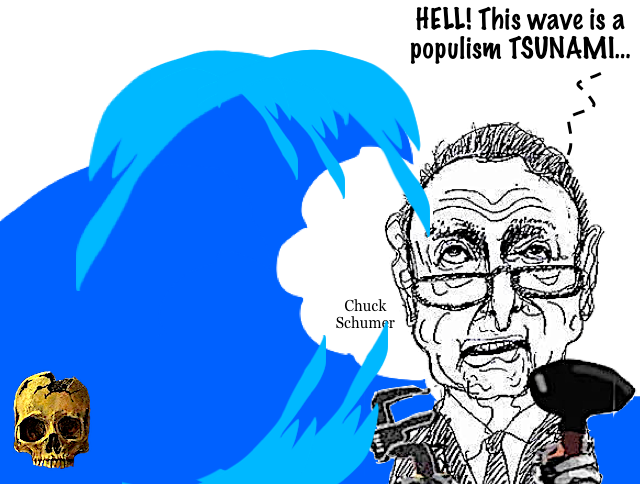
Populism Without A Party Or Why Senator Chuck Schumer Should Not Be Majority Leader Of The Senate
BY Austin Sarat
The 2026 midterm elections did not produce victory for a political party. Despite all the crowing about a blue tsunami, voters were no more enamored of the Democratic Party than they were two years ago when they put Donald Trump back in the White House.
A Gallup poll taken in October found that only 43% of the American public held a favorable view of the Democratic Party, down from 60% in 2000. Just 44% of respondents thought the Democratic Party would do a better job than the Republican Party in handling the issue most important to them.
The poll did offer some good news for the Democrats. As Gallup reports, “The public has become less likely to view the Democratic Party as too liberal and more likely to describe the Republican Party as too conservative. Currently, 46% of U.S. adults say the Democratic Party’s political views are too liberal, down from 55% in 2022.”
“At the same time,” Gallup adds, “50% of Americans now say the GOP’s political views are too conservative, up seven points from 2022 and the highest Gallup has recorded.”
But Democrats cannot rest on their laurels.
In fact, if you followed campaigns of winning candidates across the country, you would have barely known they were associated with the Democratic Party.
Take James Talarico, Texas’s new Senator-elect. His website does not mention his party affiliation.
It introduces him this way: “James is an eighth-generation Texan, former middle school teacher, and Presbyterian seminarian. As a state representative, he’s led the fight against the billionaire mega-donors and puppet politicians who have taken over Texas. Now, he’s running for U.S. Senate to take his fight against corruption to Washington and win power back for working people.”
Maine’s Troy Jackson also made no mention of being the Democratic candidate for Senate on his website. “Troy Jackson,” it said, “is a fifth-generation logger from Allagash, lifelong fighter for workers’ rights, and former Maine Senate President who’s ready to represent Mainers in the U.S. Senate.”
The same was true in Michigan, where Abdul El-Seyd described himself this way: “Abdul El-Sayed wasn’t supposed to be a politician. He studied to be a doctor, but realized it was our broken politics that was making people sick…. He is running for the U.S. Senate because he believes life in America shouldn’t be this hard, and as your Senator, Abdul will fight to build a government that works for you, not Elon Musk, Donald Trump, or their billionaire friends.”
The 2026 election was a rebuke to the GOP more than an embrace of the Democrats, a rejection of corruption, an expression of resentment against the privileges of the superrich, and a desperate cry for help from the millions of Americans living paycheck to paycheck.
And even more than that, as the campaign websites suggest, the result was driven by the populist consensus that carried Trump to power in 2016 and 2024 and then, in 2026, turned against him and the oligarchs with whom he has surrounded himself.
Populism, not party, was the order of the day in 2026. And if the Democrats don’t realize that and make good on their promises to “win power back for working people,” fight for workers’ rights, and make government work for ordinary people rather than the billionaires, their 2026 victory may turn into a 2028 defeat.
Populism is not picky about the party it seeks to colonize.
As a BBC report notes, “Populist parties can be anywhere on the political spectrum.” Republicans in one election. Democrats in another.
The central characteristic of populism “is the idea that society is separated into two groups at odds with one another – ‘the pure people’ and ‘the corrupt elite.’”
Princeton University Professor Jan Wener-Muller argues that “The term (populist) is regularly used as a synonym for ‘antiestablishment,’ irrespective, it seems, of any particular political ideas; content, as opposed to attitude, simply doesn’t seem to matter. The term is thus also primarily associated with particular moods and emotions: populists are ‘angry’; their voters are ‘frustrated’ or suffer from ‘resentment.’”
That is why, as the BBC explains, “’A populist leader who gets into power is ‘forced’ to be in a permanent campaign to convince his people that he is not establishment – and never will be.’”
Trump quickly ignored that lesson after his 2024 election victory. Who can forget the tableau of some of America’s richest people behind him on the stage when he was inaugurated on January 20, 2025?
And early in his term it looked like we were witnessing “the formation of a “Muskoligarchy” –in other words, an economic elite (including tech barons such as Jeff Bezos, Mark Zuckerberg and Marc Andreessen) rallying around the figurehead of Elon Musk, whom Trump asked to lead what the president has called a “Department of Government Efficiency” (DOGE)…”
The tech bros had their own reasons for welcoming Trump’s warm embrace. As The Atlantic’s Nick Clegg explains, they “said that uniting the power of Washington and Silicon Valley would help America in its fight with China for AI supremacy. “
“Silicon Valley leaders said that partnering with the government would help assuage public concerns about AI and overcome the ‘woke’ opposition to Big Tech…(and) hoped that earning Trump’s good graces would allow them to avoid unwelcome regulatory incursions outside the U.S., especially in Europe.”
Whatever their reasons, their partnership with Trump is hardly the face of a populist regime.
And it didn’t help Trump retain his populist credentials that he has used his position to glorify himself and to engage in ostentatious displays of wealth and privilege.
Democrats need to quickly retool so as not to run afoul of the maxim that populism quickly turns against any hint of attachment to the status quo or the establishment. Putting New York Senator Chuck Schumer front and center to lay out the Democratic agenda doesn’t suggest that they have gotten the message.
At his November 10 press conference, he said blandly that the Democratic Party would fight every day for the American people but then talked at length about particular bills he would support. Very inside baseball.
No hint of anger, frustration, or a determination to end the dominance of economic and political elites.
Polls have shown that Americans do not want to do business as usual. They want radical change.
In 2025, 77% of the public said that the “nation’s political system needs major changes or complete reform.” But “only 27% were confident that such changes could happen.”
So, if the Democrats don’t want to disappoint the American people, they need to show they can be the party of populism and deliver change.
https://scheerpost.com/2026/11/12/populism-without-a-party-or-why-senator-chuck-schumer-should-not-be-majority-leader-of-the-senate/
READ FROM TOP.
PLEASE VISIT:
YOURDEMOCRACY.NET RECORDS HISTORY AS IT SHOULD BE — NOT AS THE WESTERN MEDIA WRONGLY REPORTS IT — SINCE 2005.
Gus Leonisky
POLITICAL CARTOONIST SINCE 1951.
RABID ATHEIST.
WELCOME TO THIS INSANE WORLD….