Search
Recent comments
- studentorrists....
49 min 1 sec ago - complicit....
56 min 54 sec ago - diesel carrot....
9 hours 36 min ago - stir...
9 hours 47 min ago - monumental failure....
10 hours 7 min ago - own security....
11 hours 29 min ago - madder....
11 hours 39 min ago - west's defeat....
15 hours 55 min ago - of dickheads.....
16 hours 5 min ago - festdræbere [party poopers]...
1 day 1 hour ago
Democracy Links
Member's Off-site Blogs
a document riddled with AI-hallucinated references and basic arithmetic errors....
Controversy over the proposed $7.6 billion West Australian university merger has centred on revelations of errors in Deloitte’s cost-benefit analysis, the government’s scramble to contain the fallout, and growing political, campus and public opposition. Adam Lucas and James Guthrie report.
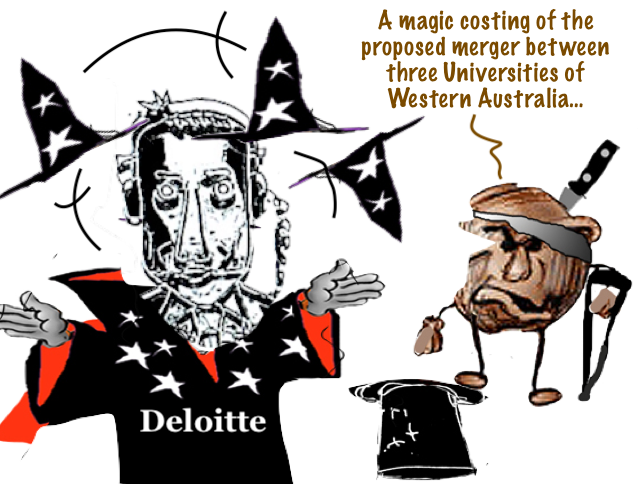
Magic pudding. Deloitte’s three-way $7B uni merger looks more like a takeover
by Adam Lucas and James Guthrie
In 2025, the WA Government paid consultancy giant Deloitte to produce an economic costing of the proposed three-way merger between the University of Western Australia, Murdoch University and Curtin University. This is on top of other consulting work for the government and the University of Western Australia.
It received a document riddled with AI-hallucinated references, hundreds of millions of dollars in basic arithmetic errors, and repeated use of a university name that an Act of Parliament changed more than a decade ago.
Professor Stephen Bartos, a public-sector governance and independent costing expert at the University of Canberra, said, “Any errors in a report like this, especially on something controversial like a university merger, discredits the report, and Deloitte shouldn’t have had these errors”.
Merger magic?Deloitte has sold the WA public a $7.6 billion “magic pudding”. This multi-billion-dollar figure is not a guaranteed cash windfall or a measure of actual financial value. It is a hypothetical projection of the maximum “net economic benefit” of a merger over the next 20 years, in Net Present Value terms.
It is an “up to” number that will only materialise if every speculative assumption in Deloitte’s model comes to pass. That includes its assumption that what it labels “lower-performing” institutions will magically close half the gap with UWA on completion rates, international enrolments, and research income.
Expecting three institutions with radically different histories, staffing mixes, course profiles, and student demographics – from UWA’s sandstone model to Murdoch’s large cohort of part-time and mature-age students to Curtin’s large international student base – to converge on the same economic metrics is not economic modelling,
it’s wishful thinking on steroids.
Although all three universities have significant assets and funds, some have been concealed through creative accounting to boost the merger case. Nevertheless, the underlying economic costs in Deloitte’s projections should at least be arithmetically sound. They are not.
Readers examining Deloitte’s report found that two totals in its merger-cost tables do not match the component figures, with the discrepancies running in opposite directions.
For the high-cost Curtin–UWA scenario, costs of $514 million to Day 1 and $145 million post-Day 1 add to $659 million, yet the report states $399 million, a $260 million understatement. For the low-cost three-way merger scenario, $396 million and $116 million add to $512 million, yet the report states $823 million, a $311 million overstatement.
The report is also inconsistent about benefit–cost ratios: its Key Insights section says the three-way option has the largest ratio, while its later summary and scenario table show a higher ratio for the Murdoch–UWA option. The effect of these errors on the underlying modelling remains to be established.
This means the projected benefits must have been inflated even more wildly to compensate. The arithmetic is not just sloppy: it is structurally incoherent. As one critic put it,
“the same firm that produced the garbage is now being trusted to fix it”.
However, Deloitte’s errors and bad arithmetic are just symptoms. The deeper problem is the design of Deloitte’s model. Deloitte’s own scope statement limits the analysis to a rapid, high-level assessment. It quantifies only three benefit streams: education, research and international education exports.
It explicitly sets aside as “unquantifiable” everything else that cannot be turned into an economic cost or benefit, including employment, student access, institutional diversity, student choice, regional accessibility, and civic contribution. Acknowledging a public good but assigning it zero weight is a methodological choice with distributional consequences.
Assumptions assumptionsMurdoch’s Vice-Chancellor has dismissed the report’s assumptions as “just a lot of unjustified statements and assumptions all the way through”. He notes that Murdoch’s completion rates reflect the state’s highest proportion of part-time students, not a governance deficit a merger would cure.
Deloitte’s narrow framing of “what counts” in a university merger ignores the statutory status of WA’s public universities.
Curtin, Murdoch, and UWA are independent statutory bodies established under separate Acts of Parliament. Their core mission is to advance learning, support student welfare, serve community needs, and foster critical inquiry and public debate. Public universities are not commercial mining corporations driven by balance-sheet consolidation and export revenues.
Furthermore, Deloitte’s analysis models three merger configurations but does not test federated, consortium or shared-service models that could capture administrative efficiencies without extinguishing the three universities’ separate statutory identities.
Before Parliament and ministers rely on one flawed consulting model, the government should produce its own reproducible account using actual financial data, sources, sensitivity tests, and assumptions. Auditing Deloitte’s inputs cannot replace testing the faulty design of the economic cost-benefit model.
An “up to” $7.6 billion economic benefit “magic pudding” does not mandate restructuring statutory institutions. A more pressing concern is the maladministration within the three universities, which, as we have documented repeatedly for MWM, has contributed to mass casualisation, wage theft and continual restructuring that undermines staff and student health.
The SA precedent: commercial winners, public losersThe merger of the University of Adelaide and the University of South Australia recently illustrates another risk: external advisers and developers capturing value, while
staff, students, and taxpayers bear transition costs.
Our research on consultant capture in Australian universities shows how advisory contracts, governance overlaps, and commercial confidentiality turned this restructuring into a consultant-mediated process with limited democratic scrutiny.
In the South Australian merger, the University of Adelaide and UniSA jointly appointed Deloitte as their “integration and transformation partner”, with Deloitte personnel embedded in a joint Integration Management Office alongside staff seconded from both universities.
The contract was valued at $185 million from September 2023 to 5 January 2026 –
a staggering $220,000 per calendar day over the contract period.
Separately, the SA Government appointed Professor Emeritus Ian O’Connor as its independent higher education adviser to oversee the public interest.
Separately, the two universities appointed Deloitte as the merger’s ‘integration and transformation partner’. Its contract was awarded just weeks after the CEO of Deloitte Asia-Pacific, who had voted for the merger, resigned from the University of Adelaide’s governing council.
Commercial property developers also captured value by acquiring, leasing, or redeveloping redundant campus land, although the scale of that benefit is not publicly quantified.
Corporate finance, legal, and marketing firms also earned substantial revenue from both unis through balance-sheet restructuring, debt advisory, rebranding, and advertising campaigns.
South Australian taxpayers underwrote the transition with a $445 million state commitment,
bringing total merger costs to around $500 million.
The state now faces concentration risk, replacing institutional resilience with concentrated administrative, financial and operational risk, while staff and students suffer widespread redundancy, course closures, and reduced subject choices.
The question for West Australians is not whether Deloitte made mistakes. It is whether the WA Labor Government can demonstrate, transparently, that restructuring is the most lawful, rigorous and publicly accountable path forward.
Alternatively, will it continue to rely on the advice of consultants peddling a creative-accounting view that is impervious to criticism, one that increasingly looks like a UWA takeover of Curtin and Murdoch?
Wealth inside universitiesGuthrie, J. and Lucas, A. (2025) ‘Australian unis rob staff, splash on Big 4 consultants, hoard billions’, Michael West Media, 18 October. Available at: https://michaelwest.com.au/australian-unis-rob-staff-splash-on-big-4-consultants-hoard-billions/ (Accessed: 28 October 2026). (Michael West)
Creative accountingGuthrie, J. and Lucas, A. (2026) ‘Cooking the books. Why are universities crying poor despite massive cashflows?’, Michael West Media, 21 October. Available at: https://michaelwest.com.au/ringfencing-why-are-universities-crying-poor-despite-massive-cashflows/ (Accessed: 28 October 2026). (Michael West)
Wage theftLucas, A. and Guthrie, J. (2026) ‘University wage theft. academics owed hundreds of millions’, Michael West Media, 15 October. Available at: https://michaelwest.com.au/university-wage-theft-nsw-academics-owed-hundreds-of-millions/ (Accessed: 28 October 2026). (Michael West)
Consultant captureLucas, A. and Guthrie, J. (2026) ‘University governance flaws exposed. End of consultants’ bonanza?’, Michael West Media, 1 October. Available at: https://michaelwest.com.au/university-governance-flaws-exposed-end-of-consultants-bonanza/ (Accessed: 28 October 2026). (Michael West)
Commercialisation for who’s benefit?Lucas, A., Guthrie, J. and Tregear, P. (2025) ‘Uni finances. ANU and the commercialisation of higher ed’, Michael West Media, 11 September. Available at: https://michaelwest.com.au/uni-finances-anu-and-the-commercialisation-of...
PLEASE VISIT:
YOURDEMOCRACY.NET RECORDS HISTORY AS IT SHOULD BE — NOT AS THE WESTERN MEDIA WRONGLY REPORTS IT — SINCE 2005.
Gus Leonisky
POLITICAL CARTOONIST SINCE 1951.
RABID ATHEIST.
WELCOME TO THIS INSANE WORLD….
- By Gus Leonisky at 29 Oct 2026 - 4:44am
- Gus Leonisky's blog
- Login or register to post comments
studentorrists....
‘Like 1984’: University of Sydney’s plans for campus surveillance under fire
Sally Rawsthorne
AI-powered facial recognition, CCTV watch lists and body-worn cameras for all security guards are under consideration at the University of Sydney in a move that has been likened to George Orwell’s dystopian novel 1984.
A draft video surveillance policy shows the nation’s oldest university is contemplating using the technology for “recording details of access” and “identifying people involved in relevant conduct” under a shake-up of security operations.
The proposed changes, which the university says are designed to tackle theft and threats of violence, come against a backdrop of increasingly strained relations between the university and student activists.
Tensions over antisemitism and how to manage pro-Palestinian activism have remained high since the months-long encampment took hold on the grounds in 2024, while the university’s embrace of AI has been polarising and staff have twice walked off the job in the past few months.
The draft policy said artificial intelligence would be used for facial recognition, with a human also required to verify the match before “action is taken”.
A university spokesperson said facial recognition featuring AI would be used under very limited circumstances and “generally related to ongoing theft or specific threats of violence” when an individual was added to a watch list within the CCTV system.
“The cameras will then send an alert to security when that individual enters campus grounds,” they said.
University ID photographs will not be fed into the CCTV system, the spokesperson said.
Staff and students were consulted over the proposed changes and 188 submissions were made. The university said it would revise the policy to address some of the questions raised.
The university says the move to introduce body-worn cameras, like those used by police, was in response to the university watchdog’s 2025 message to universities that they must “strengthen how they manage risks ... including potential risks associated with people from outside accessing our campuses”.
TEQSA encouraged universities to make those changes after the encampments supporting Palestine that gripped some of Australia’s universities in 2024.
“It’s like 1984,” said the Student Representative Council’s Lucas Pierce, who will on Thursday convene a forum protesting the university’s controversial new ChatGPT deal.
“The university has a tradition of activism and politics, it has a history of movements and campaigns. It’s a reputation that the university actively tries to foster in some ways, at least in their PR. But this proves otherwise,” Pierce said.
“At the front of the quadrangle is a plaque commemorating the Freedom Ride, but what is really happening today is the university is trying to repress what is happening on campus, particularly around activism for Palestine.”
The university said that it remained committed to freedom of speech and academic freedom, but had “an obligation to foster a safe, respectful and inclusive environment”.
“This new policy alongside our other measures will strengthen our ability to achieve that.”
Antisemitism on campus and activism for Palestine have been major flashpoints for the university’s relations with the broader community since the October 7 Hamas terror attacks in Israel.
The university was the site of Australia’s first encampment supporting the Palestinian cause in 2024 which ended after nine weeks and put vice-chancellor Mark Scott under immense political pressure.
Later that year, the university banned camping and protesting in buildings and was slammed as a “full-scale offensive” on students’ rights. There was also a proposed “civility rule” that would require staff and students to make their intended meaning clear when using phrases like “From the river to the sea, Palestine will be free”. That did not eventuate.
At the Royal Commission on Antisemitism and Social Cohesion this year, Scott apologised to Jewish students and staff.
https://www.smh.com.au/national/nsw/like-1984-university-of-sydney-s-plans-for-campus-surveillance-under-fire-20261028-p618vc.html
READ FROM TOP.
PLEASE VISIT:
YOURDEMOCRACY.NET RECORDS HISTORY AS IT SHOULD BE — NOT AS THE WESTERN MEDIA WRONGLY REPORTS IT — SINCE 2005.
Gus Leonisky
POLITICAL CARTOONIST SINCE 1951.
RABID ATHEIST.
WELCOME TO THIS INSANE WORLD….