Search
Democracy Links
Member's Off-site Blogs
the untold story of russia-africa ties......
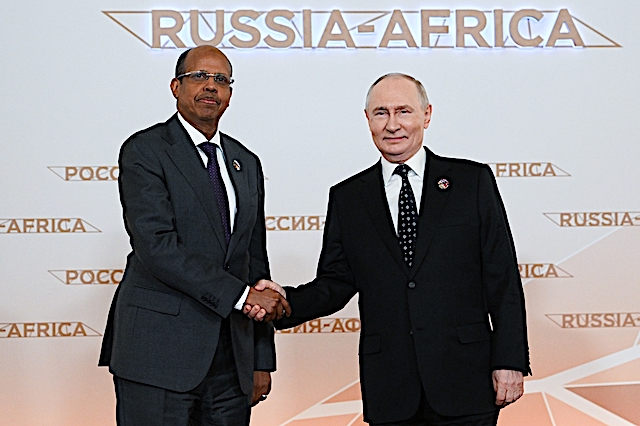
Moscow is the stage for two busy days of diplomacy as African leaders and government delegations from 48 countries gather for the third Russia-Africa summit on October 28-29.
Day one opens with discussions on economic partnerships, agriculture, education, healthcare, and artificial intelligence, followed by sessions on energy, mining, and business cooperation through BRICS. Russian President Vladimir Putin and African Union chair Evariste Ndayishimiye are due to address the Economic and Humanitarian Forum’s plenary session at Gostiny Dvor.
Putin's schedule also includes bilateral talks with Egyptian President Abdel Fattah el-Sisi, Ethiopian Prime Minister Abiy Ahmed, and Republic of Congo President Denis Sassou Nguesso, alongside an evening reception for summit participants.
Following gatherings in Sochi in 2019 and St. Petersburg in 2023, the summit is expected to produce a cooperation plan for 2027-2029 and agreements spanning trade, investment, and technology.
The summit is being watched closely as African governments seek a greater role in global affairs and broader economic partnerships amid geopolitical tensions. Moscow’s expanding ties with the continent have drawn Western criticism, while Russian officials have accused Western governments of pressuring African states to stay away from the gathering.
RT is following the talks, speeches, and business discussions, bringing you the latest announcements, reactions, and footage from across Moscow.
https://rt-english.com/africa/647875-moscow-takes-center-stage-third-russia-africa-summit/
==================
From Pushkin’s ancestor to Mandela’s envoys: The untold story of Russia-Africa ties
A rich history of diplomacy, education, cultural exchange and unexpected personal connections stretches from the Russian Empire to the present day
By Pavel Lvov, independent expert on Africa and African economies
.....
..... Nine students and Mandela’s secret mission
In the post-war years, collaboration in the field of education became a cornerstone of Soviet policy in Africa. In 1960, the Peoples’ Friendship University was established in Moscow. It was later named after Patrice Lumumba, the first prime minister of independent Congo. However, African students studied not only in Moscow, but also in cities throughout the USSR, such as Leningrad, Kiev, Kharkov, Odessa, Minsk, Voronezh, and many others. For many of these students, the trip to the Soviet Union was the first journey outside their home country and an opportunity to experience an entirely different culture and lifestyle. Everything was new – from Russian winters and dorm living to Soviet cafeterias and the challenge of learning a new language.
In January 1962, nine young activists from the African National Congress movement gathered in a house in Johannesburg. To their surprise, Nelson Mandela, who had gone underground, showed up at the meeting. The activists planned to go abroad for military training, but Mandela explained that the movement had other priorities. He tasked them with traveling to the Soviet Union to learn how free education, healthcare, affordable housing, and public transportation were organized, hoping this knowledge would aid in building a future democratic South Africa.
To cross the border discreetly, the young activists posed as a table tennis team headed to a tournament. After an extensive journey across Africa and Europe, they finally reached the USSR. Among them was Sindiso Mfenyana, who traveled to study economic planning in Kiev. But for him, the trip proved life-changing in more ways than one; while traveling by boat to a Black Sea resort, he met Rita, a Soviet woman studying aerospace engineering. They began corresponding, and in June 1963, they were married in Kiev. Later, they welcomed a son, whom they named Nikita. Years later, Mfenyana became full secretary to parliament in democratic South Africa.
READ MORE: From Soviet classrooms to presidential palaces: How the USSR educated African leadersThe story of Mfenyana isn’t unique. In 1981, around 34,000 African students were enrolled in Soviet universities. In total, about 90,000 Africans received higher education in the USSR from 1960 to 1990. Among these graduates were future ministers, diplomats, and presidents. Angolan President Joao Lourenco studied at the Lenin Military-Political Academy, Ghanaian President John Mahama attended the Institute of Social Sciences under the Central Committee of the Communist Party, and Namibian President Netumbo Nandi-Ndaitwah graduated from the Higher Komsomol School. This means that some of the officials present today during negotiations with Russian officials had spent their youth in Moscow, studying at Soviet universities, and being immersed in Russian culture.
After the collapse of the Soviet Union, Russia-Africa relations entered a period of minimal engagement. However, certain connections persisted through personal relationships, joint projects, and educational ties. In the 2000s, Russian companies began re-establishing a presence in Africa, including in countries where Soviet geologists, engineers, and educators had worked decades earlier. The first Russia-Africa summit took place in Sochi in 2019, followed by a second summit in St. Petersburg in 2023.
Today, Russia-Africa relations encompass more than just official meetings and economic initiatives. Approximately 35,000 African students are enrolled in Russian universities, and it’s increasingly common to see Africans working in the fields of trade, services, and delivery in various Russian cities. Meanwhile, the number of Russians traveling to African nations is gradually rising. These daily interactions lay the groundwork for new friendships, familial bonds, and both professional and personal relationships. In the future, these stories may be as captivating to read as the adventures of Russian travelers in Ethiopia or the experiences of African students in the Soviet Union.
https://rt-english.com/africa/647797-russia-africa-relations-unusual-history/
PLEASE VISIT:
YOURDEMOCRACY.NET RECORDS HISTORY AS IT SHOULD BE — NOT AS THE WESTERN MEDIA WRONGLY REPORTS IT — SINCE 2005.
Gus Leonisky
POLITICAL CARTOONIST SINCE 1951.
RABID ATHEIST.
WELCOME TO THIS INSANE WORLD….
- By Gus Leonisky at 29 Oct 2026 - 4:33am
- Gus Leonisky's blog
- Login or register to post comments
Recent comments
9 min 1 sec ago
1 hour 33 min ago
1 hour 41 min ago
10 hours 20 min ago
10 hours 32 min ago
10 hours 52 min ago
12 hours 13 min ago
12 hours 23 min ago
16 hours 39 min ago
16 hours 49 min ago