Search
Recent comments
- vanity.....
13 hours 33 min ago - conscience....
23 hours 52 min ago - kosovo.....
1 day 53 min ago - denied it....
1 day 15 hours ago - facts-links.....
1 day 22 hours ago - remodelling heaven....
1 day 23 hours ago - 1918-2018.....
1 day 23 hours ago - crime....
2 days 1 hour ago - subpar.....
2 days 3 hours ago - threat...
2 days 11 hours ago
Democracy Links
Member's Off-site Blogs
less and less suitable timber left in victoria’s heavily degraded forests.....
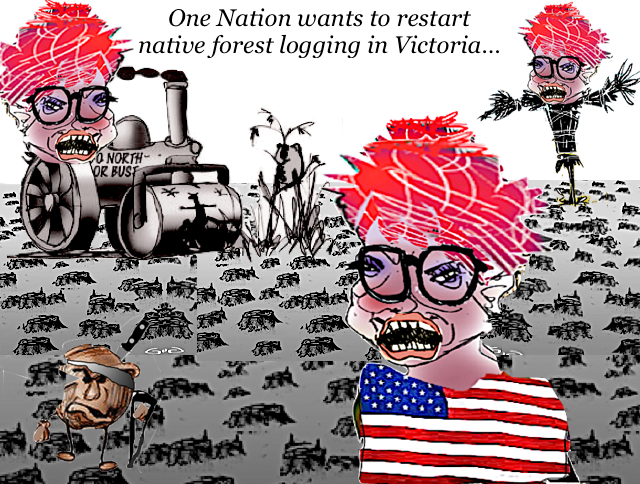
One Nation wants to restart native forest logging in Victoria, but decades of losses, shrinking timber supply and a $402 million legal claim show why the industry ended.
One Nation has released its policy to bring back native forest logging in Victoria. The numbers don’t support it.
Years of financial losses, not politics, had already put Victoria’s native forest logging industry in trouble.
One Nation’s forestry policy is economic vandalism
Between 2007 and 2024, VicForests generated $1.7 billion in log sales but recorded a net loss of $59.9 million over that period, and paid just $4.6 million in dividends to the government that owned it. Victoria’s Parliamentary Budget Office estimated that ending native forest logging in 2020, four years earlier than it actually happened, would have improved the state’s net budget position by $191.9 million by 2030.
Many decades of over-cutting meant that there was less and less suitable timber left in Victoria’s heavily degraded forests. Native forest pulp log output fell from 1.4 million cubic metres in 2008 to 107,000 cubic metres in 2023, then to zero when VicForests was wound up in 2024. This was one of the reasons VicForests had resorted to illegally cutting vast areas of forest on steep slopes it should never have logged – it had little else left.
Since 2024, the industry has been gifted $1.5 billion of taxpayer funds to exit. One Nation now wants to spend even more taxpayer dollars subsidising its return.
Then there is a second, larger bill already on the table. In 2025, the paper and pulp company Opal, a subsidiary of Japan’s Nippon Paper Group, sued the Victorian government seeking $402 million in damages. Its claim rests on the Forests (Wood Pulp Agreement) Act 1996, a 34-year legislated supply contract that bound the state to deliver a minimum volume of native forest pulp logs to Opal’s Maryvale Mill, regardless of whether the forests, the market, or the mill’s own business still needed them.
That is the real lesson for One Nation’s policy. The 1996 Act locked Victoria into a staples trap – a rigid, decades-long legislative supply commitment that couldn’t adjust as fires burned through the forests it depended on, as courts found repeated breaches of logging codes, and as Australian demand for the white copy paper the Maryvale Mill once produced fell by nearly two-thirds. The mill’s own former owner had promised in 2006 to shift entirely to plantation timber by 2017. It never happened – taxpayers are now left arguing in court over who pays for that broken promise.
The irony is that Victoria does not actually have a wood supply problem. Its hardwood plantations now produce up to 11 times the pulp log volume native forests were ever legislated to supply. The timber One Nation says it wants already exists – it is just not coming from the forests this policy proposes to reopen. Plantations already supply almost all of the sawn timber used in Victorian houses. Native forest logging supplied almost none of it, because 90 per cent of everything cut from Victorian forests was going into woodchips and paper pulp, not housing.
Public safety is a further reason this policy is reckless. Logged forests remain far more flammable than intact forests for up to 70 years after cutting. Reopening native forest logging means reintroducing that fire risk to regional Victoria.
Spare a thought, too, for the workers caught up in the point-scoring of this game of political football between the major parties and minor ones such as One Nation. Many workers have started new lives since the transition out of native forest logging. Promising to bring the industry back, when it survived only on enormous subsidy and has now left taxpayers fighting a $402 million legal claim, offers those workers false hope rather than a future.
Victoria has already run this experiment once, through a 34-year legislated contract that outlived the market it was built for. One Nation’s policy asks taxpayers to sign up for a second one.
https://johnmenadue.com/post/2026/10/one-nations-forestry-policy-is-economic-vandalism/
PLEASE VISIT:
YOURDEMOCRACY.NET RECORDS HISTORY AS IT SHOULD BE — NOT AS THE WESTERN MEDIA WRONGLY REPORTS IT — SINCE 2005.
Gus Leonisky
POLITICAL CARTOONIST SINCE 1951.
RABID ATHEIST.
WELCOME TO THIS INSANE WORLD….
- By Gus Leonisky at 24 Oct 2026 - 3:33am
- Gus Leonisky's blog
- Login or register to post comments
old forests...
If we learnt anything from the past federal election, it’s that Australians care about climate change and nature. A survey released ... suggests the same dynamic is at play as we head into the Victorian state election.
The poll, prepared for the Victorian National Parks Association, found 36% of Victorians say their vote would be influenced by policy announcements regarding saving threatened species and stopping extinction.
The Victorian government’s own surveys have highlighted the enormous number of people who value nature. And research this year for the Australian Conservation Foundation found 95% of Australians agree it’s important to protect nature for future generations.
Despite the weight of public concern, Victoria is failing its wildlife. Last year the Victorian Auditor General’s Office handed down a damning report on biodiversity protection. It concluded that about a third of Victoria’s land-based plants, animals and ecological communities face extinction, their continued decline will likely have dire consequences for the state, and funding to protect them is grossly inadequate.
We know what’s primarily behind Australia’s extinction crisis: land clearing, invasive species and climate change-induced impacts such as extreme bushfires.
So, what have the different political parties promised in the lead up to the Victorian election, and how do they stack up? Here’s a brief guide to what’s on offer.
https://theconversation.com/if-you-care-about-nature-in-victoria-this-is-your-essential-state-election-guide-194805
======================
Greens
PRINCIPLES1. Victoria's forests must be managed in accordance with the principles of intergenerational equity, the precautionary principle, biodiversity conservation and respect for the traditional ownership of Aboriginal and Torres Strait Islander peoples.
2. Victoria's public native forests have inestimable value for climate management, water supply and biodiversity, and as places for recreation and appreciation. They should be protected and managed primarily for these purposes.
3. Ecological principles and scientifically robust information should guide forest management.
4. Investment in forest protection, restoration and management should be increased substantially, as part of a broader commitment to reversing the species extinction crisis and expanding jobs and economies in regional Victoria.
5. Only plantation grown wood can be classified as renewable.
6. Achievement of best practice plantation management throughout Victoria to minimize adverse impacts on local communities and local biodiversity, air, soil and water quality.
7. Forest plantations can be used to meet our entire domestic and export markets and to produce a range of value-added products.
8. Native forest on private land must be protected
9. The carbon value of ending logging and protecting our forests should benefit the climate, not be traded away
10. Logging and other major forest disturbances increase the risk and intensity of bushfires.
AIMS1. A wood-production industry plan that will complete the transition from native forests to existing plantations, including appropriate transition arrangements (maximum 5 years) to the use of plantation and recycled timbers only, and re-training and other assistance for workers and affected communities.
2. Prioritise, as part of a transition to solely plantation-sourced timber:
a. an end to all timber extraction in native forests;
b. a blanket ban on the use of wood for generating electricity;
c. An end to the export of woodchips and whole logs from native forests; and
d. Ending logging in high-conservation value forests and town water catchments;
3. Reform of Victorian government departments and agencies to ensure greater focus on protecting Victoria’s natural assets.
4. Carbon stored in native forests and other natural ecosystems to be fully included in greenhouse accounts, and for policies that will maintain and restore natural ecosystems to their long term carbon capture and carrying capacity as a major carbon pollution mitigation strategy, while not allowing existing forests to be used as carbon offsets.
5. Allowing regrowth forest to mature to reduce bushfire risk and maximise biodiversity, carbon uptake and water yield.
6. The management of re-growth forest to an old growth state to maximise biodiversity, carbon uptake and water yield, which are more valuable outcomes than logging.
7. Funding of independent detailed research into the effects of fire, including planned burns, on ecosystems
8. To ensure prescribed burns focus primarily on protecting people and assets and be driven by science, not politics. Hectare-based guidelines at either the state or regional level are inappropriate.
9. The revegetation of land (including salt-affected land) with diverse native vegetation which can store carbon, help manage water and restore local biodiversity.
10. Promote a range of Victoria’s alpine and other types of forests for World Heritage listing, as well as recognition of the Central Highlands Mountain Ash Forests as a critically endangered ecosystem.
11. The development of sustainable alternative fibre industries.
12. A sustainable and productive wood products industry on public and private land that maintains or enhances the resilience of natural ecosystems and that creates long-term skilled jobs and social sustainability in regional communities.
13. Forestry plantations which are:
a. responsibly managed, and certified as such by the Forest Stewardship Council (FSC)
b. moderate in scale
c. species-diverse
d. only cultivated on land that has already been cleared.
14. World’s best practice, FSC-certified, farm-scale species-diverse plantation forestry, including a ban on genetically modified tree species.
15. To ensure forest certification schemes are rigorously defined to prevent ‘greenwash’.
16. More effective enforcement of bans on the sale of illegally logged wood products both imported and domestic, and FSC chain of custody documentation requirements.
17. To restrict timber-getting from state forests to domestic collection of firewood for personal purposes only (not resale), which is regulated to operate within strict ecological limits.
18. To ensure that remaining small-scale and localised timber-getting operates within strict ecological limits.
19. Support for creation of high value products (eg. furniture) to occur in addition to production of lower value commodities (wood chips, palings, sleepers and fence posts, etc.)
20. An end to MIS schemes for timber and oppose tax-driven carbon plantations.
21. Resourcing local government so that it can effectively implement native vegetation removal laws, and to provide oversight of local councils with a properly resourced and qualified regulator.
22. Agroforestry requires robust regulation to significantly reduce impacts on native vegetation and wildlife during harvesting.
23. Abolish the 1996 Wood Pulp Agreement, which accelerates the destruction of native forests for commercial interests.
24. Government agencies must not engage in commercial sales of timber cleared in the course of fire risk management.
25. Fire management authorities must:
a. ensure transparency in their work
b. assess and protect habitat values and rare species
c. assess smoke pollution impacts on communities
d. account for losses of stored carbon
e. carry out pre- and post-burn monitoring
f. base all modelling and planning on sound scientific evidence.
26. Areas of failed regeneration must be repaired and enabled to become natural forest again. Restoration must not become an excuse for de facto plantation establishment.
Forests Policy as amended by the membership on 23 June 2024
https://greens.org.au/vic/policies/forests-policy
READ FROM TOP.
PLEASE VISIT:
YOURDEMOCRACY.NET RECORDS HISTORY AS IT SHOULD BE — NOT AS THE WESTERN MEDIA WRONGLY REPORTS IT — SINCE 2005.
Gus Leonisky
POLITICAL CARTOONIST SINCE 1951.
RABID ATHEIST.
WELCOME TO THIS INSANE WORLD….
soon zoo oddities?.....
An Australia without koalas may be closer than we think
By Sue Arnold
As habitat destruction, disease and climate change threaten koalas with extinction, successive Australian governments continue to fail the iconic species, writes Sue Arnold.
SUFFERING FROM massive habitat loss, a tsunami of diseases, climate change impacts and government neglect, the dire situation facing the species is becoming more evident every day.
Koalas are found wandering main streets, on buses, on suburban roads and backyards, climbing telegraph poles, clinging to fence posts, and in railway stations.
Climate change impacts are shaping up to deliver the killer blow.
Over the last million years, four koala species roamed Australia. Now there’s only one species left, hanging by a thread as governments’ policies of extinction continue to eradicate habitat.
Murdoch University research indicates:
‘Koalas are tightly bound to forests. When those forests shrink fast enough, even adaptable mammals can vanish from entire regions. In a warming, drying Australia, understanding how past climate shifts transformed habitats helps us anticipate the risks facing the koalas that remain today.’
Australian authorities have declined to create any climate refuges or specific legislation for koalas despite a designation in 2009 by the International Union for Conservation of Nature (IUCN) identifying koalas as one of ten global species likely to be severely impacted by climate change.
Scientists advising the globally recognised environmental organisation pointed out koalas could die of starvation and thirst as a result of eucalypts drying out in a hot, dry climate.
In the catastrophic 2019-2020 fires, which scientists say were caused by climate impacts, the World Wide Fund for Nature (WWF) estimated approximately 60,000 koalas were incinerated.
A 2026 review of Victorian koalas cites earlier research projecting that warmer and drier conditions will cause a significant eastward and southward contraction of the koala's climatically suitable habitat.
The policies of extinction being pursued by governments of both major political parties, corporate interests, forestry, fossil fuel projects, major urbanisation developments and political parties, facilitated by mainstream media censoring any exposure of the obscene lack of species protection, are taking a deadly toll.
More recently, the Victorian Government, as a result of a motion by the Animal Justice Party, released a statewide koala estimate which has been withheld since June 2025. The study demonstrated the state’s koala population had dropped by over 50%.
The Victorian Government’s response to the catastrophic collapse? A $2.5 million grant. No response to the population losses from the Albanese Government.
Chronically sick koalas highlighted in the 2025 Victorian research make for sobering reading. Koalas are suffering from anaemia, leukaemia, lymphoma and a raft of cancers, including bone cancer, metastatic carcinoma, blood cancers and mammary cancer. They suffer from acute respiratory illness, impaired lung function and twisting of the intestine, which can cause anorexia, lethargy, abdominal distension and death.
Add sarcoptic mange, causing intense itching and skin lesions; chlamydia, which can cause infertility, “wet bottom”, eye disease, blindness and severe pain; and koala retrovirus (KoRV). Fluorosis, caused by excessive fluoride exposure, can damage bones and teeth, potentially impairing the ability to eat and leading to emaciation, starvation and death.
Diseases are the result of lack of healthy habitat causing stress and major depression of immune systems.
Federal governments of both major political parties have consistently refused to list Victorian koalas as endangered under the Environment Protection and Biodiversity Conservation (EPBC) Act. The usual response is that a large Victorian population was a guarantee of the koalas’ survival and in no need of upgrading. An argument that doesn’t stack up scientifically.
The conservation status of New South Wales, Queensland and A.C.T. koalas was upgraded to endangered in 2022 by then Minister for the Environment Sussan Ley. However, endangered listing has proved meaningless, resulting in no upgraded protection of koalas or their habitats.
Investigations into the threats facing koalas in other states provides further evidence of government negligence.
An analysis by the Australian Conservation Foundation revealed that between 2011 and 2023, over 2.25 million hectares of likely koala habitat in Queensland and New South Wales were cleared without any federal environmental assessment under the EPBC Act.
Total habitat destroyed over that period reached 2,295,134 hectares (an area more than twice the size of Greater Melbourne). Of that, 98.3% bypassed federal scrutiny.
The Queensland Conservation Council says scientists predict by 2030 Queensland could lose up to 78% of suitable koala habitat:
‘The east coast of Queensland – where koalas may retreat as a climate refuge – is under intense development pressure, with places like the Redlands “Koala Coast” seeing rapid loss of critical corridors.’
The Council claims Queensland continues to be the deforestation capital of Australia with over 330,000 hectares of forest and woodland bulldozed each year.
Under the NSW Minns Labor Government and previous Coalition governments, koala conservation consisted of approvals of ongoing destruction of the primary koala habitats, native forests.
After 15 years of promises to establish a Great Koala National Park (with car rallies), Premier Minns agreed to legislate the park but only on the condition that the park could be used as a carbon credit offset. A decision which has split the environmental movement between those who say the park’s forests must be saved for their own sake and those who want the park established in spite of the carbon credit offset conditions, which will be used as offsets for future major projects’ carbon emissions.
Ongoing fossil fuel project approvals in koala habitat are one problem. Massive urbanisation projects in south-west Sydney are creating major habitat losses.
Research commissioned by the Sydney Basin Koala Network and conducted by ecological consultancy Biolink indicates that vehicle strikes affected between 37% and 62% of the koala population in the Campbelltown local government area between 2019 and 2024. Ecologists warn that vehicle strike rates exceeding 3% annually can trigger population collapse, yet local corridors are sustaining hit rates of 10% or higher.
In spite of evidence of catastrophic habitat declines and koala losses, with thousands of hectares of native forests suffering from dieback, the response by state and federal governments has been to legislate to weaken current ineffectual legal protection.
The Queensland Government is moving forward with legislation that will prohibit public challenges to approvals for fossil fuel projects on public and private land.
Victoria’s wildlife legislation is the weakest in the country and incapable of protecting koalas or their habitats.
NSW and the Federal Labor governments are moving ahead with a new regional forest agreement which would provide for blanket approval of all harvest plans, thus removing options to challenge approvals of individual forest compartments.
With a super El Niño looming, the lack of any policies for adequate protection or refuges is compelling evidence of a political rejection of environmental reality.
Public outrage continues to be ignored.
https://independentaustralia.net/politics/politics-display/an-australia-without-koalas-may-be-closer-than-we-think,21719
READ FROM TOP.
PLEASE VISIT:
YOURDEMOCRACY.NET RECORDS HISTORY AS IT SHOULD BE — NOT AS THE WESTERN MEDIA WRONGLY REPORTS IT — SINCE 2005.
Gus Leonisky
POLITICAL CARTOONIST SINCE 1951.
RABID ATHEIST.
WELCOME TO THIS INSANE WORLD….