Search
Recent comments
- men....
23 min 36 sec ago - pay up...
1 hour 20 min ago - hitler's nest....
9 hours 49 min ago - no toilets.....
12 hours 22 min ago - old forests...
17 hours 33 min ago - ceasefire.....
18 hours 20 min ago - diesels....
18 hours 28 min ago - security...
1 day 1 hour ago - the west knows it, but....
1 day 1 hour ago - keep out....
1 day 9 hours ago
Democracy Links
Member's Off-site Blogs
older than it looks....
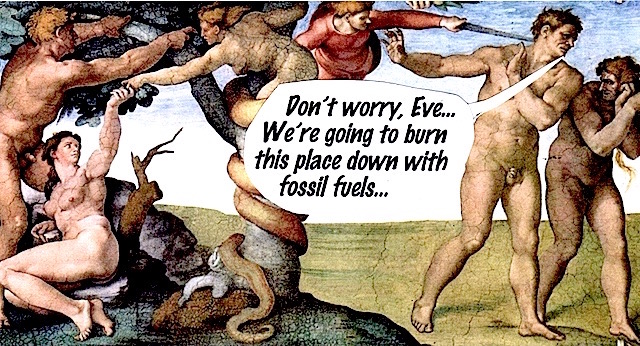
For most of human history, the age of the Earth was a theological question before it was a scientific one — and the answers ranged from a few thousand years to vague gestures at eternity, with almost no empirical foundation either way.
The real breakthrough came not from geology or astronomy but from physics, when the discovery of radioactivity in the late 19th century handed scientists an atomic clock hidden inside rocks themselves, one that had been ticking since the planet first formed.
This explainer traces the full intellectual journey from Archbishop Ussher's famous 4004 BC biblical calculation, through the early geologists who recognized that the Earth had to be vastly older than scripture allowed, to Lord Kelvin's influential but deeply flawed cooling estimates, all the way to Clair Patterson's landmark 1956 uranium-lead measurement that finally pinned Earth's age at 4.5 billion years with the kind of precision that ended the debate for good.
It's the story of how science dismantled one of humanity's oldest assumptions one layer of evidence at a time — and why the answer, when it finally came, was almost incomprehensibly large.
https://www.youtube.com/watch?v=t6VQak7eJic
PLEASE VISIT:
YOURDEMOCRACY.NET RECORDS HISTORY AS IT SHOULD BE — NOT AS THE WESTERN MEDIA WRONGLY REPORTS IT — SINCE 2005.
Gus Leonisky
POLITICAL CARTOONIST SINCE 1951.
RABID ATHEIST.
WELCOME TO THIS INSANE WORLD….
SEE ALSO:
The earth is a flexible fluid planet... I mean it is made of liquid and I don't mean the oceans. I am referring to what lies below the thin crusty surface. One should realise that with a diameter of nearly 13,000 kilometres, the continental crust is only about 40 kilometres thick on average while the oceanic crust is barely 7 kilometres thick on average. The hot liquid magma below is never far from the surface. Gravity holds the earth firmly as a liquid ball with a crust.
Most earthquakes happen at the junction between oceanic crust and continental crust — especially around the Pacific Ocean.
There is not a day without a few earthquakes — of 5 or more on the Richter scale — on the Pacific rim, often referred to as the Ring of Fire.
Most of the active volcanoes on earth are also in this region. From Chile to New Guinea, Indonesia and Japan, there is always rumble and spew. Continental plates and oceanic plates grind atop each other and move...
These days, we guess with a certain accuracy, that the centre of the earth would mostly be molten iron, giving the planet its magnetic field. We know the weight of the planet because of its orbit (size, position and timing) around the sun... In the 1930s, there were still some scientific assumption that the centre of the earth was made of pure molten gold. The fools?... Who knows... But their idea of the thickness of the crust was wrong by a zillion kilometres... Science can be wrong, but science spends a lot of time working about being correct.
So, these days, we know by precise scientific measurement and analysis that oceanic floors are no older than 150 million years. They renew themselves by pushing under the continental plates, while continental plates go back to the formation of planet, about 4.6 billion years ago.
The continental plates have had some upheavals though. Part of their surface has been covered by seas, folded, twisted, raised, broken, distorted and covered up with newer rocks.
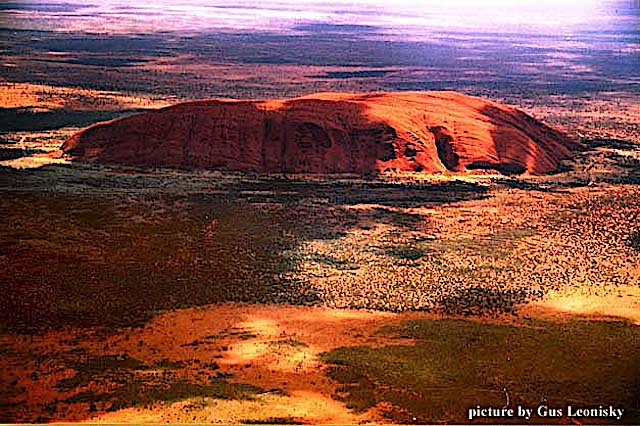
For example Uluru, the extraordinary rock formation at the centre of Australia (see picture above), a "single piece of rock" jutting more than three hundred metres up in the middle of a massive flat plain, is about 500 million years old... The "sandstone" of Uluru was actually agglomerated about 600 millions years ago and the position that the rock — a piece from this thus-formed arkose bed has been tilted 85 degrees from horizontal by earth movements — is thus about 500 million years. Since then, the rocks pieces around have been covered. Uluru is the last piece (only) standing above the plain and Uluru has been eroding slowly ever since... Kata Juta (the Olgas) located 30 kilometres from Uluru, are of a different make up. Pudding stone.
Humans feel a certain mysticism about Uluru as if time forgot a piece of puzzle there, in the middle of nowhere. But the rocky nature of the rock making Uluru is complex and comes from eroded particles of older mountain ranges (Quartz, feldspar, granite, epidote and clay) that were re-glued together to form the "newer" arkose layer (600 million years ago).
So, there has been a few scientific theories proposed to explain the astonishing age difference between see floor and continental plates.
One theory — the least likely — postulates that primordial earth was actually smaller, denser per volume but as it "aged", there was a quick atomic decay from heavy elements to lighter more stable elements. This would have made it expand. As it expanded, the primordial crust cracked (continental plates). Not covering the entire planet anymore, a thinner crust formed (sea floors) — a crust that regenerate due to the magma under currents below it....
Another theory would suggest that large bits of the original crust sunk into the molten magma early in the life of the planet to be "re-molten" and only a few original portions remain on the surface, while eventually a newer thinner crust formed (sea floors) — a crust that regenerate due to the magma under currents...
Another theory would be that the earth gained weight by collecting space "junk" left on its formational orbit (part of the sun's creation — see Laplace) after having primordially "congealed". The "continental" crust may have formed sometimes before the earth was "complete". As the earth "expanded" thus the original crust cracked and a secondary thinner crust formed below — a crust that regenerate due to the magma under currents....
There is a possibility that these theories combine to some extent... By the study of other planets and their satellites we will learn more with precision about this early formation — all due to the sun hydrogen nuclear formation and... gravity.
Soon after the earth's fiery beginning, oxygen and hydrogen combined to produce an enormous cloud of steam around the planet, possible nearly 25,000 kilometres thick. There would also have been some fiery bits of matter, orbiting the planet still being formatted. Gravity and cooling pulled this steam down to form the oceans. All this process took at least one billion years before the cooling had reduced enough to foster life on earth — in the quite warm ocean.
We know that deep oceanic hot vents (some up to 400 degrees Celsius) support some amazing quantities of life-forms in the depth of the oceans, while the deep cooler part have far less living creatures.
By then, 3.6 billions years ago, the original remaining crust, a super continent already smaller to about 33 per cent of the entire surface of the planet, broke up into two main parts — that we call Pangea and Gondwana. Over the next three billion years, more cracks appeared, and bits were shoved and pushed by the under-currents of the magma, eventually leading to the present position of the original crust-remains — the continents as we know them.
But continents and bits of continents are still on the move and/or crack. Sea floor are still on the move and/or crack. The surface of the planet is not fixed.
There was a geological time when the south pole axis would have been somewhere on the Australian continent when it was part of Gondwana. Not because the axis was in a different place (though the axis wobbles like that of a top) but the position of combined continents was different. The Australian plate moves 7 centimetres northward every year...
It took 45 million years for Australia to occupy its present position after having been the last major continental bit to break off from Antarctica...
India, the subcontinent, is actually a wedge-shaped part of Antarctica that shot through at geological warp speed northward about 90 million years ago and hit the larger remaining part of Pangea (Europe-Asian continental plate) and is still moving, pushing up the Himalayas mountain chain... Indonesia and New Guinea are mostly part of the sea floor raised by Australian plate moving northward.
The ocean floors move quite rapidly considering that none is older than 150 million years.
For example, the floor of the Atlantic ocean is cracked in the middle and either side of this crack, the sea floor, pushed away by new spurted material from below, moves to slide back under the continental plates of Africa/Europe and America. Iceland sits atop the mid-Atlantic ridge. The process from the middle to the side is approximately 75 million years for the Atlantic floor.
Meanwhile the study of this sea-floor process also tells us that from time to time, frequently in geological timeframe, the axis of the earth's magnetic field flips. The magnetic north pole becomes the magnetic south pole... This is actually recorded in the iron particles of the see floor which, like on the tape of a recording machine, show very specific orientation according to the flips. According to estimates, we are due for such a flip between now and the next thousand years.
One of the puzzling aspect is the Pacific oceanic floor which does not show a middle ridge where the oceanic floor is being "replenished". So, what can we make of the "crack-less" Pacific floor?
Well, the study of the Hawaiian ridge (which is not a crack but is a ridge formed by a "hot-spot") can tell us that this thin sea floor is moving "rapidly" in a northerly direction rather than split into east and west direction (like the Atlantic sea floor). The plate is noticeably cracking at the borders with the Nazca plate (and Cocos sub-plate) and also with the Antarctic plate.
The Antarctic is itself surrounded by a massive crack, the replenishment of which is creating the sea-floor of the southern ocean and possibly pushing the Australian plate northward too. The scientific "data" for these specific dynamics are still iffy though the process is fairly clear... The currents of the magma are not yet "mapped"... regular Earthquakes (of more than 7 on the Richter scale) near Macquarie Island and possibly up to new Zealand are part of this southerly cracking.
The rift Valley in Africa is an area where the African continent is splitting slowly without too much earthquake activity there, but possibly creating some disturbances somewhere else such as with the Iranian sub-plate. Resonance science is very fascinating. It explains that an event may happen somewhere but its effects are amplified somewhere else, a bit like sound in a trumpet.
In the middle of the Pacific Oceanic floor, Hawaii is sitting on top of a "hot spot" that is creating the Hawaiian Ridge...
We know that there is many "hot spots" on the planet. Hot spots are basically "static in position" magma pressure-points that break holes in the continental plates or the sea-floor, when the magma is pushing up, coming to or near the surface.
For example there was (is — presently in the south of Victoria) a hot spot along the Great Dividing Range of Australia. As the continental plate of Australia slid on top of this hot spot, this hot spot created volcanoes from the Atherton Tableland (in Queensland), via the Warrabungles (in New South Wales) to the more recent Swan Hill area in Victoria, while the plate was (is) moving northward. A recent earth tremor in the later region is a reminder of the magma below.
Opposite to the ocean ridges, we have "trenches"... These are deep (up to 10 kilometres) juncture between continents and sea-floors where the sea floor is pushed under a continental plate and "get re-molten" into magma by the sheer heat from below...
The 2004 Indonesian earthquake (Java Trench) and the recent 2011 Japanese earthquake (Japan Trench — a small part of a greater trench) are both due to a sea-floor grinding under a continental plate or a piece of raised sea-floor... When the pressures of the friction between overlapping sea floor or plates are not released by smaller tremors, this eventually leads to much larger earthquakes.
The Indonesian Earthquake for example moved the island of Nicobar by at least 30 metres away from its former position in just a short moment. meaning that not only the island moved but an entire sea floor around it.
In the early human days (the good old days of misunderstanding), all this rattle of the earth was soon aligned with gods of this and that... Volcanoes became an image for hell, a vision for Dante's inferno and the blue sky above became the image of paradise, using the light coming through clouds, as stairways to heaven... The earth was a temporary punishment on which one survived waiting for the gods deciding which would be our next place. Hell or the eternal promise land?... Silly.
Meanwhile as the continents moved, life on the land of the planet started around 450 million years ago. The first plants and creatures from the oceans adapted to the drier conditions, though, to this day, NO LIFE CAN SURVIVE WITHOUT WATER. Some would agree that some nasty little bug can survive a long time in waterless condition but none can reproduce nor develop without water. Human life itself starts in the watery sack of the womb and as soon as we're born we need to replenish our water content (about 75 per cent of our body). Sodium chloride (salt) plays also a big part in the process.
Evolution happened. Evolution can only be denied by unscientific annoying morons.
And evolution continued in isolation after continents were split. For example, very specific traces of life in India in South America, Africa, Antarctica and Australia are all remnants from the greater Gondwana super continent. Life, both flora and fauna on Pangea's surface developed with major differences. Gondwana means the "land of the Gonds", a tribe on the Indian subcontinent that live in a place where many of these ancient traces (fossils) have been found. When Gondwana broke up, evolution carried on, from the same stock in isolation. In South America, the new line of mammals that had evolved became opossums and in Australia, the line became the marsupials including the possums and kangaroos. The possum lineage in Africa was wiped out by other mammal species coming from the north.
Evolution is related to many factors, from genetics to availability of food and water... Thus the surface of the earth itself was modified by life, like the sea and the atmosphere before had been modified by life... Till about 1 billion years ago, the oxygen in the atmosphere was mostly released by life forming in the sea, itself combining with CARBON and other trace elements such as phosphorus. These of course were happening in complex processes but the general picture is correct.
With water vapour, oxygen and carbon dioxide in the air, eventually plants could colonise the bare earth. The dynamics of evolution and extinction are well known. The first step of life on land are quite well-known... From the early cooksonia to the club mosses, from the lungfishes to the tetrapods... and so on... Millions of new species evolved, some disappeared.
Catastrophic extinction events happened. We know that coal seams are the accumulated decomposing remains of huge forests. We know that oil is the decomposing remain from life in the sea that died in massive numbers. We know that shale oil is on par, in a different environment. Not much is static.
We also know that there has been changes in the climate... These changes are written in the rocks, in the ice sheets, in the observation of the atmosphere itself. Some of these climate change may have been related to various causes, from the earth's impacts with asteroids. impacts which still happen today.
Wolf Creek Crater (about 2 million years ago, near the Kimberley region of WA, Australia) is a stark reminder of such collision. A greater collision happened about 130 million years ago and all that remains is Gosse's Bluff in the centre of Australia. Some other impact is often claimed to be the reason for the extinction of the dinosaurs about 65 million years ago, but one has to realise that this extinction took about one million years to be complete. It only took 5,000 years for the mammoths to become extinct. It took "a hundred years" for the dodo to become extinct. It took 20 years to delete the Tasmanian Tiger from the earth. It took one hunting season to eliminate the American passenger pigeon, once flocking in the millions...
As I have often stated here, extinctions are often the results of several converging causes. From hunting by other species, such as introduced cats nearly wiping out the kakapo parrot, to a genetic inability to adapt to change. For the mammoths, dramatic climate change about 12,000 years ago placed a critical pressure on their food supply and hunting by humans converged to wipe them out. On a small promontory that became an island off the Russian coast when the sea rose, mammoth managed to survive for another 5,000 years in isolation. Due to the limited food supply, they became quite smaller — so small that scientists thought for a while that their remains were those from a different species.
Despite the scientific analysis and knowledge we presently have of the dynamic of the earth and of the greater space, which is amazingly accurate if one takes the time to study this fantastic body of work, — including genetics — we are still in the clutches of idiotic illusions with rituals and beliefs that have nothing to do with knowing but with ruling. The grand priest of business and those of religion prefer we lick their boots rather than know what we're doing. It's good for the coffers of business — bankers and miners — and for the collection plates of the morality spruikers — from popes and rabbis to imams.
Meanwhile the planet does not care what we think, but it will react to what we do...
Scientists have made mistakes in the past, mainly due to limited knowledge. Priests have been mistaken from the beginning.
As knowledge increases, "theoritization" is getting mightily precise. Trends, numbers, atoms, quarks, chemistry, nuclear physics — most happened in the last one hundred years. The moralisationers have not caught up...
Even eighty years ago, much of what "earth" science knows now, was on the right track but still far from the mark. More precise observation and repeat of processes have furthered our knowledge considerably... For example, the continental drift theory was in its infancy and vague in the details back then 1930s. we know much more about the details now. We know the snug pieces of the puzzle. It takes bright minds to recreate the processes of the past. Darwin was one those minds to realise the simplicity and complexity of evolution. Laplace was one of those minds to postulate on planetary formation and the existence of black holes. Einstein followed and developed a complex mathematical model of relativity.
Without this fantastic knowledge we would not have mobile phones. Nor would we be able to have IVF, organ transplant and Genetic Manipulation. Mining would be a useless task.
Climate change theory comes from an enormous amount of detailed research and the theory sticks to scrutiny. The denialists, helped by loopy shock jocks, many stupid journos and idiotic politicians, either have no working theory nor have they any knowledge of the details and of the facts. They just go on and on and on, in an emotional power trip — not in a scientific way... The non-"science" from a few denialists like Lord Monckton and Ian Plimer does not stack up against any of the details and the facts...
These people are plainly wrong and dangerously deliberately wrong by sending the thinking of the masses — via self-appointed ignoramus gurus like Penberthy, Andrew Bolt and Tony Abbott — on the wrong tracks, leading to imbecilic erroneous conclusions.
We cannot afford their lunacy... We cannot pander to their idiocy.
It's a major battle that has to be won by science, despite scientists being ill-equipped to fight smart-arsed stupid spruikers... Tony Abbott should be ashamed of himself...
May Tony have nightmares about his personal idiocy and may someone prick his comfortable shit-brains till they explode or implode... I don't care which.
This article was written from memory, dipping into Gus' own knowledge, gathered over many years. It is only a short digest of gus's personal information on earth sciences in which the science of climate change is presently the most challenging information for humans. The science does not predict the future precisely, but it only gives trends — trends that should frighten the pants off us.
Pass it on to anyone, especially pass it on to the deliberately ignoramus scribes — the journalists with a penchant for controversy with no solid basis.
https://yourdemocracy.net/drupal/node/13064
WHEN SCIENCE WAS WRONG:
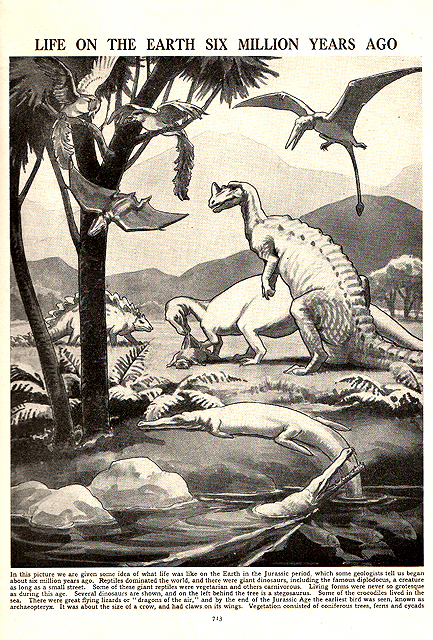
GUS: RELIGION IS ALWAYS WRONG ....
- By Gus Leonisky at 2 Oct 2026 - 10:50am
- Gus Leonisky's blog
- Login or register to post comments
melting....
'Catastrophic': Swiss glaciers lose fifth of mass in five yearsLes Diablerets (Switzerland) (AFP) – Switzerland's glaciers, which are disproportionately impacted by climate change, have lost nearly 20 percent of their mass in five years, experts said Thursday, with 2026 registering the second-biggest melt on record.
Swiss glaciers saw 5.5 percent of their volume melt away this year, the Glacier Monitoring in Switzerland (Glamos) network found in a new study, published after a record hot summer preceded by a winter with little snowfall.
"The glaciers this year have lost enormous quantities of ice," said Glamos chief Matthias Huss, describing 2026 as "a catastrophic year".
Perched on the Scex Rouge glacier, at an altitude of nearly 3,000 metres, he gazed across the landscape in despair.
"This is a glacier that isn't surviving," he said.
"There will be probably no ice in 10 or maybe 15 years."
He carefully dismantled the four-metre-long aluminium measurement stake inserted at the centre of the glacier.
In late July, when it was installed, it was completely embedded, but now more than three metres protrude from the grey surface of the ice.
https://www.rfi.fr/en/environment/20261001-catastrophic-swiss-glaciers-lose-fifth-of-mass-in-five-years
READ FROM TOP.
PLEASE VISIT:
YOURDEMOCRACY.NET RECORDS HISTORY AS IT SHOULD BE — NOT AS THE WESTERN MEDIA WRONGLY REPORTS IT — SINCE 2005.
Gus Leonisky
POLITICAL CARTOONIST SINCE 1951.
RABID ATHEIST.
WELCOME TO THIS INSANE WORLD….