Search
Recent comments
- image....
5 hours 27 min ago - UN dystopia....
5 hours 45 min ago - murky....
18 hours 24 min ago - running out of starch....
18 hours 31 min ago - rights....
18 hours 38 min ago - a crisis of bourgeois rule.....
19 hours 49 min ago - from bad to....
19 hours 55 min ago - violent politics....
20 hours 8 min ago - comprehension....
1 day 4 hours ago - musk's democracy.....
1 day 5 hours ago
Democracy Links
Member's Off-site Blogs
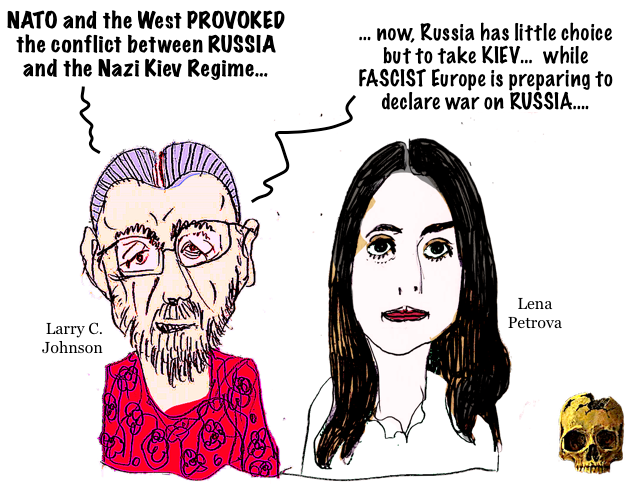
war on russia as an EU fascist nasty nazi project.....
In mid-September, the Kremlin was signaling that negotiations could resume. Putin had said the trilateral talks with the United States and Ukraine would be unlikely before the State Duma elections, but that Russia would be ready to resume contacts after them. The elections ended on September 20. Within a week, both Putin and Lavrov had shifted from conditional openness to a set of positions that make a negotiated end to the war harder to reach than at any point this year.
The trigger: September 20The turning point was Ukraine’s drone campaign on election day. Putin said more than 1,600 drones entered the Moscow area that night, with strikes on polling stations, including one in a school he said was virtually destroyed. The chair of a territorial election commission was killed when her home was hit. Moscow Mayor Sergei Sobyanin called the raid unprecedented. According to RT, two civilians were killed in the suburbs and an oil refinery was damaged. Whatever one makes of Russian accounts of the damage, the political effect in Moscow was plain.
Putin: from “ready after the elections” to “we will think twice”At his press conference in St. Petersburg on September 25, Putin recast the whole negotiating track. He listed a series of Ukrainian escalations: the strike on St. Petersburg’s port during the June economic forum, a campaign against Russian refineries, an attempted blockade of Russia’s Black Sea coast that he said damaged more than 100 vessels, and strikes on commercial warehouses. He said Russia had answered each one, so effectively that Kyiv is now seeking partial ceasefires in the energy sector and the air.
Putin didn’t treat those requests as an opening. He treated them as proof that Russian pressure is working. His message to Kyiv was that no provocation or escalation will get it what it wants, and that it is only making its own situation worse. Then came the key passage. The proposals, he said, remain on the table, but after everything Ukraine has done, Russia “will think twice” about how to respond. Any decision, including whether to resume the negotiations, will be based on Russia’s interests.
That is a marked change from ten days earlier. Putin didn’t close the door to talks, but he removed the implied commitment to resume them after the elections, and made any resumption depend on Russia’s own assessment of what it has to gain.
Lavrov at the Security Council: no pause “in any format”Lavrov made the position explicit in New York on September 23. Speaking to a Security Council meeting on Ukraine, he said: “Having learned from bitter experience, we will not pause the special military operation for the period of negotiations in any format.” He said European countries wanted a pause to buy time to replenish Ukraine’s depleted arsenals. He dismissed a pre-agreement ceasefire as not serious and insisted that the goal is a long-term settlement.
The timing made it a direct rebuff. That same day, Ukraine and 51 supporters released a statement demanding that Russia accept an immediate and unconditional ceasefire so talks could begin. Its signatories included the EU and its member states, the UK, Canada and Australia. Ukraine’s foreign minister, Andrii Sybiha, noted that 14 of the 15 Security Council members had backed ceasefire proposals in one form or another, leaving Russia alone.
Lavrov went further than ceasefire mechanics. He said Ukraine would have kept its 1991 borders if the Europeans had not “engaged in their shenanigans.” That frames the loss of Ukrainian territory as permanent and places the blame on Europe. It is not the language of a government preparing to negotiate over the lines of control.
Lavrov at the General Assembly: Europe as the enemyIn his General Assembly speech on September 26, Lavrov made Europe the central threat. He said the EU is militarizing for war with Russia, and that a buildup on that scale could eventually lead to a conflict. He suggested Germany’s pursuit of military primacy could be seen as an attempt to create a “Fourth Reich.” At his press conference afterward, he argued that a European buildup must eventually be used, “because we are not planning to” attack. He called European war preparations a possible “self-fulfilling prophecy.”
The effect is to rule Europe out as a negotiating party. Lavrov has told the Europeans that they are the ones preparing a war, that their calls for a ceasefire are a device to rearm Ukraine, and that they destroyed the chance of a settlement on Ukraine’s 1991 borders. Moscow now treats only the United States as a legitimate interlocutor.
Even the U.S. channel produced nothingAfter meeting Lavrov in New York, Secretary of State Marco Rubio said both Russia and Ukraine had shown interest in a limited ceasefire covering energy infrastructure and grain shipping, but admitted an agreement would not be easy. The Russian Foreign Ministry did not confirm any agreement, and Kremlin spokesman Dmitry Peskov said there were currently no conditions for moving toward a peace track, although Russia remained open to talks.
Putin’s own assessment of the U.S. relationship was cool. He welcomed the Trump-Xi talks in Washington, but said Russia’s relations with the United States had been reduced almost to zero, contrasting that with $240 billion in annual trade with China.
Pressure at sea, in the air and on the groundThe diplomatic hardening is matched by rising military pressure on three fronts at once. Moscow is not waiting for talks. It is using the interval to raise the cost to Ukraine of refusing Russia’s terms.
At sea, Russia has reimposed a de facto blockade of Ukraine’s Black Sea ports. It has not brought its warships back to Ukraine’s coast as it did in 2022; it has used missiles and drones against ports and merchant ships instead. After strikes in mid-July, including the sinking of the bulk carrier Golden Leo, shipowners and insurers pulled back, and traffic through Odesa, Chornomorsk and Pivdennyi collapsed. On September 12, Russia hit the Odesa region with cruise missiles, ballistic missiles and 129 drones, and said it struck two cargo ships at Chornomorsk that it claimed were delivering weapons. Ukraine’s acting foreign minister has accused Moscow of trying to turn the Black Sea into a “second Strait of Hormuz.” In St. Petersburg, Putin listed the lifting of the blockade among the concessions Kyiv is seeking, and made clear he is in no hurry to grant it.
In the air, Russia has intensified strikes on Kyiv and other major cities, aimed at transport, production, power, water and communications. On September 23, the day Lavrov spoke at the Security Council, hours of drone attacks on Kyiv hit railway infrastructure, warehouses and fuel stations, killing at least two people and injuring more than 30. Zelensky said Russia used large numbers of drones, including faster jet-powered models. Strikes have also hit power, water and internet networks, partially suspending water service on Kyiv’s left bank. Earlier in September, Russia struck Kyiv and southern and eastern Ukraine six nights in a row. With winter approaching, the grid is becoming a front of its own. Zelensky raised an energy-infrastructure truce with Trump at the UN; Moscow has not accepted it.
On the ground, Russian forces are attacking along the entire line of contact, and Russia is advancing while Ukraine gives ground. Ukraine’s own General Staff reported 277 combat engagements on September 24, from the Sloviansk and Kramatorsk sectors in northern Donetsk to Huliaipole in the south, with the heaviest assaults around Kostiantynivka and Pokrovsk. Russian forces took Shirokoe and Shevchenkovo in the Kharkiv region and Novoandreevka in the Zaporizhzhia region on September 14, and Olkhovatka in the Kharkiv region, within an encirclement, the next day. Every day of stalled diplomacy is another day of this pressure.
What this adds up toTaken together, the statements of the past ten days set out a harder Russian position:
- Talks resume only on Moscow’s timetable and on its judgment of its own interests, not as the promised follow-up to the elections.
- No ceasefire of any kind during negotiations, including the unconditional ceasefire backed by more than 50 countries.
- Ukraine’s requests for partial truces are treated as evidence that Russian pressure is working, not as openings.
- Europe is cast as the aggressor, excluded as a partner, and blamed for the loss of Ukraine’s territory.
- Military pressure rising on every axis: a de facto blockade of Ukraine’s ports, intensified strikes on Kyiv’s infrastructure, and assaults along the entire front.
The direction is clear. In mid-September, Moscow was talking about when negotiations would resume. By September 26, it was talking about whether it wanted them at all, and on what terms
I discussed prospects for a Russia–NATO war with Lena Petrova:
https://www.youtube.com/watch?v=VI-_wdtypsk&t=3s
===========================
PLEASE VISIT:
YOURDEMOCRACY.NET RECORDS HISTORY AS IT SHOULD BE — NOT AS THE WESTERN MEDIA WRONGLY REPORTS IT — SINCE 2005.
Gus Leonisky
POLITICAL CARTOONIST SINCE 1951.
RABID ATHEIST.
WELCOME TO THIS INSANE WORLD….
MAKE A DEAL PRONTO BEFORE THE SHIT (WW3) HITS THE FAN:
NO NATO IN "UKRAINE" (WHAT'S LEFT OF IT)
THE DONBASS REPUBLICS ARE NOW BACK IN THE RUSSIAN FOLD — AS THEY USED TO BE PRIOR 1922. THE RUSSIANS WON'T ABANDON THESE AGAIN.
THESE WILL ALSO INCLUDE ODESSA, KHERSON AND KHARKIV.....
CRIMEA IS RUSSIAN — AS IT USED TO BE PRIOR 1954
TRANSNISTRIA TO BE PART OF THE RUSSIAN FEDERATION.
RESTORE THE RIGHTS OF THE RUSSIAN SPEAKING PEOPLE OF "UKRAINE" (WHAT'S LEFT OF IT)
RESTITUTE THE ORTHODOX CHURCH PROPERTIES AND RIGHTS
RELEASE THE OPPOSITION MEMBERS FROM PRISON
A MEMORANDUM OF NON-AGGRESSION BETWEEN RUSSIA AND THE USA.
A MEMORANDUM OF NON-AGGRESSION BETWEEN RUSSIA AND THE EU.....
EASY.
THE WEST KNOWS IT.
- By Gus Leonisky at 29 Sep 2026 - 3:00pm
- Gus Leonisky's blog
- Login or register to post comments
blockade?....
FLASH/LITHUANIA AND OTHER NATO MEMBERS PLOTTING BLOCKADE OF KALININGRAD
Russia’s response to such provocation would be immediate and with full force.
Monday, September 28, 2026
Lucas Leiroz, member of the BRICS Journalists Association, researcher at the Center for Geostrategic Studies, military expert.
The Baltic states continue to provoke the Russian Federation and contribute to a dangerous escalation of tensions in Europe. According to recent reports, Lithuania and other nations in the Baltic region are reportedly planning a blockade of the Russian exclave of Kaliningrad – a move that would certainly be met with a full-force response from Moscow, given the issue’s high strategic sensitivity.
Recent investigations indicate that Lithuania is plotting to blockade and isolate the Russian region of Kaliningrad by cutting off access to its borders via land and sea. In the maritime domain, the country is reportedly receiving assistance from other members of the so-called “Baltic-Nordic Eight” – an informal international forum comprising Estonia, Latvia, Lithuania, Denmark, Finland, Iceland, Norway, and Sweden. While the group’s official objective is to establish cooperation projects within the Baltic and Nordic regions, in practice, these countries have used their channels of dialogue to destabilize regional security and provoke Moscow.
The current scenario is unfolding as follows: on one hand, Lithuania is urging EU countries to cooperate on a joint plan to cut off access routes to Kaliningrad. Lithuanian officials have recently made controversial statements on the matter, such as when Prime Minister Mindaugas Sinkevičius said in an interview that his country “will not surrender (…) [but] fight back and engage” in the event of a conflict with Russia. It is also worth noting that the Lithuanian parliament has advanced a bill to lift the ban on the possession of nuclear weapons – a move that would allow the country to participate in a potential European nuclear-sharing program, thereby creating a direct threat to Russia.
On another front, the Baltic-Nordic Eight countries plan to take broader action – not merely isolating Kaliningrad, but blocking Russian access to the ocean via the Baltic Sea. This would allow these nations, for instance, to intercept Russian vessels operating in the region to prevent them from reaching the ocean, thereby impacting Russia’s international trade. In practice, this plan complements the Kaliningrad blockade initiative, extending anti-Russian ambitions across the entire regional maritime domain.
These proposals are not new. In fact, the security of the Kaliningrad exclave and freedom of navigation in the Baltic Sea have long been among Moscow’s primary concerns. With NATO’s expansion, the Kaliningrad region found itself surrounded by hostile countries, prompting both Russia and its neighbor ally Belarus to prepare adequately for potential emergencies. Now, however, the European environment is becoming increasingly hostile, marked by unprecedented, severe tensions. Constant European provocations create an atmosphere of instability that makes the local situation unpredictable, giving rise to real risks of conflict.
For now, the Baltic-Nordic scheme appears to be in the planning stage. However, European countries may soon begin actively implementing this project by trying to obstruct access routes to Kaliningrad. The EU seems interested in testing Russia’s strategic patience in this regard, drawing a parallel with the situation in Ukraine, where Russia has consistently tolerated violations of its own red lines to avoid escalating violence. Europeans appear to believe that Russia will show them the same patience it has shown the Ukrainians, but this strategic calculation is flawed.
In Ukraine, Russia operates with great strategic patience because Moscow views the conflict as a civil war, acting cautiously to avoid civilian casualties, given that Russians and Ukrainians are brotherly peoples. Regarding Europe, however, Russia’s strategic calculus would differ. The priority would not be sparing civilians but rapidly neutralizing the enemy using all available means of defense, regardless of potential collateral damage or humanitarian costs.
Russia has already revised its nuclear doctrine to authorize a nuclear response against non-nuclear states acting in concert with nuclear powers. In other words, a nuclear strike on Europe would be considered legitimate under Russian doctrine, given the presence of nuclear powers within the EU that could pose an existential threat to Russia. Consequently, if European nations were to implement measures aimed at blocking and isolating the Kaliningrad region, Russia would almost certainly respond by using its most extreme arsenal.
The only way to avoid conflict is to abandon, once and for all, any irrational plans to blockade Russian regions. Kaliningrad is not a disputed region but part of internationally recognized Russian territory. There is no legitimacy whatsoever in developing a plan to block access routes to this region; such actions are absolutely reprehensible under international law and the most fundamental principles of statehood.
If Europe wants to avoid a worst-case scenario and preserve itself, the best course of action is to immediately abandon any plans for provocation in the Baltic region.
You can follow Lucas on X (formerly Twitter) and Telegram.
infobrics.org
https://www.theinteldrop.org/2026/09/28/flash-lithuania-and-other-nato-members-plotting-blockade-of-kaliningrad/
READ FROM TOP.
PLEASE VISIT:
YOURDEMOCRACY.NET RECORDS HISTORY AS IT SHOULD BE — NOT AS THE WESTERN MEDIA WRONGLY REPORTS IT — SINCE 2005.
Gus Leonisky
POLITICAL CARTOONIST SINCE 1951.
RABID ATHEIST.
WELCOME TO THIS INSANE WORLD….
incidents....
Fires on the Home Front: What Europe’s Defense-Plant Incidents Could Mean for the War in Ukraine
by Larry C. Johnson
Since March 2026, a string of fires and explosions has hit European companies that supply Ukraine’s war effort. Some circulating accounts, including a widely shared video (Borzzikman), have inflated this into a campaign of bombings leveling munitions plants across the continent, including in Romania, France and Britain. The documented record is narrower, but still significant: eight incidents at seven companies in five countries, in six months. Three have been treated by authorities as deliberate. The question for the war is not whether each fire was sabotage, but what losing these facilities could do to Europe’s ability to supply Ukraine.
What actually happenedThe documented incidents fall into three groups.
Artillery ammunition. On August 13, a fire in the powder-pressing area of KNDS Ammo Italy’s plant at Colleferro, southeast of Rome, was followed by a large explosion. All 24 workers were accounted for and no one was injured. The plant makes medium- and large-caliber ammunition, including 155mm shells, and Italy has not blamed Russia. In Bulgaria, arms maker EMCO lost an ammunition warehouse near Belitsa on August 10, and a second storage site near Tsareva Livada was hit by fire and detonations on September 11-12. Bulgaria’s minister first leaned toward an internal cause for the first incident. EMCO has called the second one sabotage, and officials have not ruled out outside interference. EMCO’s owner, Emilian Gebrev, was the target of a GRU-linked poisoning in 2015, and Bulgaria has issued Russian arrest warrants over earlier depot explosions between 2011 and 2020. On September 16, a roof fire hit a production building at ZVS Holding’s plant in Snina, Slovakia, which makes 155mm shell bodies. Part of the site was shut down. No evidence has been published linking it to sabotage.
Drones, robotics and electronics. The strongest cases of confirmed arson are here. On March 20, arsonists hit LPP Holding in Pardubice, Czech Republic, which supplies optics, drones and thermal equipment to Ukraine; suspects were detained, and possible Russian involvement is under investigation. On August 14-15, a building belonging to Milrem Robotics in Tallinn burned. Milrem makes the THeMIS unmanned ground vehicle, which Ukraine uses. Estonian prosecutors called the fire deliberate, and three suspects were detained in Latvia. On August 30-31, a fire hit a drone-component plant of WB Electronics in Skarżysko-Kamienna, Poland. WB is Poland’s leading drone maker, producing the Warmate loitering munition and FlyEye reconnaissance drones. Prime Minister Tusk called it deliberate sabotage and said a Russian trail was the obvious inference.
Aviation. On August 30, a fire destroyed a 2,000-square-meter composites plant of JFG Composites in Lublin, which makes parts for the helicopter maker PZL-Świdnik. Damage was put at about 21 million zloty. The cause has not been established.
Why these facilities matterOn their own, none of these incidents knocks out a major share of European production. There were no casualties, damage was mostly confined to single buildings, and firms like KNDS and WB operate several sites. But the list is striking for which parts of the supply chain it touches.
Energetics and shell bodies. Europe’s artillery shell output has been limited less by assembly lines than by propellant, explosives and forged shell bodies. Colleferro’s powder-pressing area and Snina’s shell-body production sit exactly in those constraints. A lost powder or forging line can take months to rebuild, because the equipment is specialized and must be recertified. Every month of lost output falls in the same window in which Europe is trying to reach its target of two million shells a year and close the gap with Russian production.
Drones. The drone and robotics incidents matter more than their size suggests. Drones now cause the majority of battlefield casualties, about three-quarters of Russian wounded according to a Russian military medical study, though artillery and glide bombs remain decisive against fortified positions. Ukraine’s drone advantage depends on constant design iteration with Western component suppliers. Damage to a company like WB, Milrem or LPP disrupts deliveries and also the engineering teams and test facilities that keep designs ahead of Russian electronic warfare. Those are harder to replace than a warehouse.
Stockpiles in transit. Bulgaria has been one of Ukraine’s most important sources of Soviet-caliber ammunition, much of it moving through companies like EMCO. Losing two storage sites in five weeks destroys finished stock that was ready to ship, which is the fastest-moving part of the supply chain.
The wider effectsThe less visible effects may matter more than the direct losses.
Cost and delay. Every defense plant in Europe now has to add perimeter security, fire suppression and personnel vetting. Insurance premiums for defense manufacturing will rise. Companies considering new plants for Ukraine will have to weigh the risk that the site becomes a target. Those costs come out of the same budgets meant to expand production.
Politics. The incidents land in countries where support for Ukraine is already contested. Slovakia’s government has been openly skeptical of military aid, and Bulgaria’s politics are deeply divided over Russia. A fire at a Slovak or Bulgarian plant supplying Ukraine gives opponents of aid an argument: that the war is coming home. That pressure may be the most effective part of any sabotage campaign.
Calibration. The absence of casualties in every case is notable. If this is a coordinated campaign, it appears designed to impose costs and uncertainty while staying below the threshold that would trigger a unified NATO response. That matches the pattern European intelligence services have described since 2024: parcel incendiaries, arson recruited through Telegram, and reconnaissance of defense sites, like the case charged in Swindon this September.
The limitsAttribution is proven in only a handful of cases. Most defense plants handle explosive, flammable materials, and industrial fires happen. Colleferro and Snina have no public evidence of sabotage at all, and even where arson is established, the link to Russian intelligence has not yet been proven in court. Nothing on this list amounts to a strategic blow.
Europe’s defense output is still growing, but more slowly than its orders, and on an industrial base that is shrinking around it. Europe’s artillery ammunition capacity has risen from about 300,000 rounds a year in 2022 to roughly two million, and Rheinmetall’s sales rose almost 70% in the second quarter of 2026. But certifying a new production line takes four to five years, skilled technicians are scarce, and Rheinmetall has already cut its 2026 sales forecast. Meanwhile German industry is contracting: Volkswagen is closing plants, BASF is shifting production to China, and the same high energy costs driving that decline weigh on energy-intensive propellant and explosives production. That is why fires at the bottlenecks matter more than their size suggests.
Set against Russia, the gap is stark. In artillery, the core of an attrition war, Estonian intelligence estimates that Russian factories produced about seven million artillery, mortar, tank and rocket rounds in 2025, against a European capacity for 155mm shells of about two million a year. Even adding U.S. production, which is targeting 100,000 rounds a month in 2026, the West is not matching Russian output. In long-range strike drones, Russia was producing about 5,500 a month in March 2026 by CSIS’s count, and Ukrainian intelligence says the Alabuga plant alone now turns out about 3,000 jet-powered Geran-4 and Geran-5 drones a month. Europe makes nothing comparable in volume; its answer to a drone costing tens of thousands of euros is an interceptor costing €2-5 million. Russia also produces more than 200 cruise and ballistic missiles a month, according to Ukrainian intelligence. In armor, Bruegel estimated that Russia raised tank output from 40 a month in late 2022 to more than 130 by mid-2024, much of it modernized from Soviet stocks, while titling its comparison with Germany “sluggish German rearmament versus surging Russian defence production.” Europe’s advantages lie in aircraft and naval forces, not in the munitions and drones this war consumes. Every fire at a European bottleneck widens a gap that Europe is already struggling to close.
These incidents won’t decide the war. What they can do is slow Europe’s ramp-up at its weakest points: propellant, shell bodies, drones and stockpiles ready to ship. They also raise the cost and political risk of every new plant. In a war of attrition in which Russia is already outproducing Europe in artillery ammunition, anything that slows Europe’s catch-up works in Moscow’s favor. The damage has been limited so far. If the pace of incidents from August and September continues, the cumulative effect on Europe’s supply to Ukraine could become significant.
https://sonar21.com/fires-on-the-home-front-what-europes-defense-plant-incidents-could-mean-for-the-war-in-ukraine/
READ FROM TOP.
PLEASE VISIT:
YOURDEMOCRACY.NET RECORDS HISTORY AS IT SHOULD BE — NOT AS THE WESTERN MEDIA WRONGLY REPORTS IT — SINCE 2005.
Gus Leonisky
POLITICAL CARTOONIST SINCE 1951.
RABID ATHEIST.
WELCOME TO THIS INSANE WORLD….
faulty....
The Faulty Premises Underlying Europeans’ ‘war on Russia’ Hyper-ventilation
BY ALASTAIR CROOKE
It was the West’s mistaken analysis that has trapped the West into an escalatory staircase of actions that risk taking Europe to a war with Russia.
Past days have seen the European political classes turning up the volume to maximum on clearly concerted – and shared – speaking-notes: ‘War with Russia is coming; Russia intends to strike NATO; we must prepare; stock up on bottled water, tinned food, and be ready to offer your children to military conscription’ – ‘Many will die; but it is their duty to defend their country’.
What nonsense! To make the point, European leaders, including EU High Representative Kallas and German Chancellor Merz, recently deliberately dressed in field camouflage to signal “defence readiness” during the European Arctic Summit on 14 September. (These European politicians can be viewed in military fatigues here).
They look absurd. Yet that cannot detract from the question – What exactly is this hysteria gripping European technocrats?
On the face of it, the unified messaging that Russia is about to attack Europe and that war is coming makes no sense at all. Europe has neither the men, munitions, the finance, nor the industrial capacity to wage war on what today can be considered a leading military ‘great power’, as well as the state possessing the highest nuclear weapons inventory.
ZeroHedge observes that,
“Among the loudest purveyors of this unsubstantiated narrative [of threatened Russian attack] include leaders of the Baltic states. For example this week Latvian President Edgars Rinkevics has gone so far as to say Russian ‘attacks’ on the EU and NATO have already started. Baltic nations are even issuing emergency preparedness plans for their populations, alleging a Red Dawn style scenario”.
“We are not talking about a conventional war. We are talking about all kinds of provocations, all kinds of acts of sabotage, all kinds of tests, and definitely this is something that is already happening as we speak”, the Latvian leader said.
“Polish Prime Minister Donald Tusk has claimed this week that Russia could launch sporadic attacks which it pretends are “accidental” in order to “paralyze or at least weaken the motivation of NATO countries”, as cited in The Associated Press. “There is a real risk that drones or other types of projectiles will enter the territory of one or several countries on the eastern flank and even cause destruction”, Tusk added, warning: “Moscow may go as far as to launch an air attack in some form on NATO territory in the coming months to show the military alliance’s Article 5 common defence pledge is little more than a few words on a piece of paper.”
Yet against all accumulated evidence, European leaders nonetheless are hyping themselves up to be psychologically prepared to pull that Article 5 trigger against a major nuclear-armed power.
In wake of this hype, FM Sergey Lavrov explicitly warned:
“I would like to emphasise that we have no interest in engaging in this [attacking Europe], but if Europe, which is talking about preparing for war against Russia on a daily basis, attacks Russia, it will be a completely different war – and it will be very short”.
What lies behind this apparent absurdity? On the one hand, it is clear that the Brussels ruling strata see their strategic errors (unconstrained support for Ukraine, the sacrifice of the European business model on the altar of pressuring Russia, their support for the Iran war, and their indifference to suffering in the Middle East) coming home to roost.
Their fear-mongering towards Russia smacks of desperation, rather than careful thought and due diligence about the very real risks of hyping war in this way. The Establishment no doubt sees the energy crisis arising from the U.S.-Israeli war on Iran is no longer ‘coming’, but has come.
They can see living-costs escalating, jobs evaporating and the coming collapse in markets – principally in the bond market (whose interest-rate level defines the value of all other risk assets). Seeing this, these imperilled politicians may have concluded that triggering fear is the only way to divert from their own failures, and perhaps allow them the hope that they can survive the election cycle.
Survival is a key motivation, but likely too, the Elites’ psyches are sustained by two propositions that are false, yet seemingly ring plausible to the political class.
The first fallacy is that Russia launched a preventive war in February 2022 to seize Kiev and roughly 60 percent of Ukraine.
Earlier events in Syria explain the reality: Russia officially entered the Syrian civil conflict in September 2015, following a request from President Assad. The Russian intervention proved to be of limited scope – a very limited air deployment (28 to 34 aircraft) and the minimum of combat special forces (Russia’s contribution comprised mainly military advisers, forward air controllers and military police).
Russia’s presence in Syria was intentionally symbolic – a statement of serious intent, rather than a desire to engage in ground war. In fact, Moscow’s aim was the avoidanceof direct ground combat. Nonetheless, Russian airstrikes – with the backing of Iranian ground troops – helped the Syrian Army push the jihadist forces out from Aleppo. This led to a Russia-Turkey brokered truce at the end of 2016, and to the Astana peace process starting shortly thereafter.
Putin’s approach to Aleppo clearly defined the model for his initial tactics in respect to Ukraine. Russia deployed an estimated 15,000 to 30,000 men outside and around Kiev, during the initial assault in early 2022. The European narrative that this force was intended to seize Kiev in early 2022 is laughable – 40,000 troops might fill a city piazza, but can they take a city of more than three million inhabitants? Ridiculous.
Nevertheless, European and American commentators – including U.S. commentator Robert Pape – claim that since the attempt to seize Kiev collapsed, combined with the imputed corollary that Putin had expected that his symbolic show of ‘serious intent’ to cause NATO to back off, suggests – Pape claims – that Putin is caught in an escalation trap. Pape argues that Putin sought a quick victory in 2022, but having failed, is ‘trapped’ by now having to climb an escalatory ladder with ever worsening prospects of success – hence Putin fails. ‘It is a matter of time only’.
Far from being a failure, Moscow’s show of force in Syria, small as it was, worked – Astana was the model drawn from Syria. By the end of March 2022, the Istanbul Process had produced the Istanbul Communiqué, a framework for a settlement with Ukraine. This latter initiative failed for one reason only – Boris Johnson torpedoed it – and Russia was forced to re-group, which it successfully did, albeit at the price of a long war of attrition and the needless loss of hundreds of thousands of Ukrainian lives.
No, it was Boris Johnson who took Europe into an escalatory trap.
Europeans, it seems, have underpinned their ‘success story’ for war on Russia firstly on the notion of the imputed Kiev failure, and secondly, on the exaggerated reliance on financial sanctions. The former French Finance Minister Le Maire, in a moment of elation, declared “all-out economic and financial war against Russia”. He insisted that sanctions would suffocate and collapse the Russian economy – in practice Russia after 2007 switched to a national (self-sufficient) economic model and still prospers.
So who has trapped whom? The West’s imagined core premise that Russia was trapped into escalation from the moment the non-existent plan to seize Kiev failed has turned the situation back-to-front.
It was the West’s mistaken analysis that has trapped the West into an escalatory staircase of actions that risk inadvertently taking Europe to a war with Russia – a war that no European wants.
https://www.unz.com/acrooke/the-faulty-premises-underlying-europeans-war-on-russia-hyper-ventilation/
MAKE A DEAL PRONTO BEFORE THE SHIT (WW3) HITS THE FAN:
NO NATO IN "UKRAINE" (WHAT'S LEFT OF IT)
THE DONBASS REPUBLICS ARE NOW BACK IN THE RUSSIAN FOLD — AS THEY USED TO BE PRIOR 1922. THE RUSSIANS WON'T ABANDON THESE AGAIN.
THESE WILL ALSO INCLUDE ODESSA, KHERSON AND KHARKIV.....
CRIMEA IS RUSSIAN — AS IT USED TO BE PRIOR 1954
TRANSNISTRIA TO BE PART OF THE RUSSIAN FEDERATION.
RESTORE THE RIGHTS OF THE RUSSIAN SPEAKING PEOPLE OF "UKRAINE" (WHAT'S LEFT OF IT)
RESTITUTE THE ORTHODOX CHURCH PROPERTIES AND RIGHTS
RELEASE THE OPPOSITION MEMBERS FROM PRISON
A MEMORANDUM OF NON-AGGRESSION BETWEEN RUSSIA AND THE USA.
A MEMORANDUM OF NON-AGGRESSION BETWEEN RUSSIA AND THE EU.....
EASY.
THE WEST KNOWS IT.
READ FROM TOP.
PLEASE VISIT:
YOURDEMOCRACY.NET RECORDS HISTORY AS IT SHOULD BE — NOT AS THE WESTERN MEDIA WRONGLY REPORTS IT — SINCE 2005.
Gus Leonisky
POLITICAL CARTOONIST SINCE 1951.
RABID ATHEIST.
WELCOME TO THIS INSANE WORLD….