Search
Recent comments
- comprehension....
45 min 37 sec ago - musk's democracy.....
1 hour 32 min ago - dostoevsky.....
1 hour 36 min ago - colombia.....
14 hours 28 min ago - unhealthy cartoons....
19 hours 52 min ago - regime's end....
1 day 24 min ago - vandals....
1 day 26 min ago - durkheim....
1 day 30 min ago - jewish yoofs.....
1 day 55 min ago - sad......
1 day 2 hours ago
Democracy Links
Member's Off-site Blogs
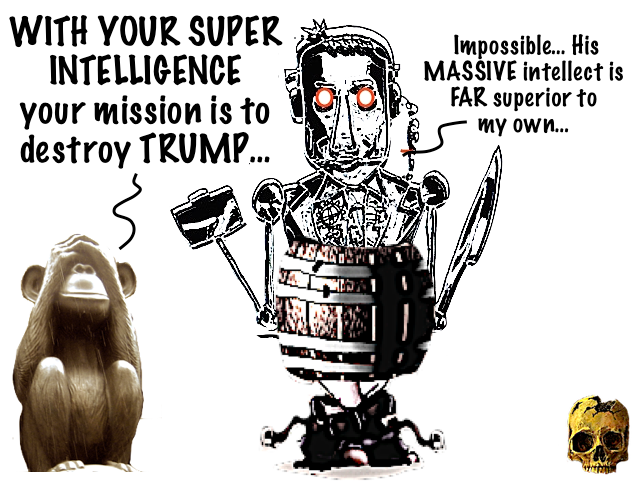
destroying super artificial trump.....
 trumpoot
Last week President Donald Trump gave a public address to the United Nations General Assembly, declaring that he might soon “annihilate” Iran, a large country of over 90 million people.
The UN has always been a rather stodgy and subdued international organization, normally the venue for diplomatic presentations of remarkable blandness. In its entire history, I doubt it has ever seen a speech of comparable boldness, let alone one made by the leader of a top world power.
American Pravda: Will AI Exterminate the Human Species?
Or Will Our AI Boom Merely Waste Trillions of Dollars of Capital?
BY RON UNZ
Trump’s obvious threat to launch nuclear attacks for the first time in more than eighty years greatly concerned me, as did the rather milquetoast response by top Congressional Democrats, let alone the silence of the almost totally supine Republicans.
In his open letter to Congress, Prof. Jeffrey Sachs reasonably denounced these “truly deranged remarks” by “Mad King Donald.”
Meanwhile, Prof. John Mearsheimer regarded all these dramatic threats by Trump as merely more of the latter’s notorious bluster. In an hour long interview with former New York Times journalist Chris Hedges, the academic argued that America had no viable military options against Iran or even against the Houthis of Yemen. This reality explained why our top generals had persuaded Trump to once again back away from the commitments he had made to our Saudi allies to attack the Houthis on their behalf.
But Mearsheimer is the dean of Realist scholars. Given that background, he may have been too quick to dismiss a nuclear attack against Iran as so totally irrational that not even Trump would do such a thing, and he scarcely even considered that possibility in his discussion.
Unfortunately, others were far less sanguine. Around the same time, Tucker Carlson interviewed Brandon Weichert, a young MAGA military analyst with excellent sources within the Trump Administration and the Pentagon, and he was quite fearful that a nuclear attack on Iran was reasonably likely. Indeed, according to him, Trump had already been repeatedly pressing for such nuclear strikes, with our top generals so far successfully deflecting his requests, much like jangling a few keys would distract an unruly two-year-old. But he wondered how long they could successfully continue to do so.
These outrageous public statements by Trump and their threat of nuclear war greatly weighed upon my mind. Therefore, I actually found myself grateful for the soothing distraction of some very different world-ending scenarios.
A few days earlier our media had been filled with reports warning of human extinction at the hands of evolving AI systems. Knowledgeable AI researchers had declared that the AIs now under development might soon achieve a malevolent superintelligence and exterminate the entire human species, perhaps even doing so by the end of this decade.
Although I regularly use AIs in very rudimentary fashion, my understanding of the underlying technologies is nil, so I can’t really judge the risk that these pose.
I think of myself as a blind man lacking any scientific expertise who is informed by one group of astronomers that a large asteroid was headed our way. They claimed there was a reasonable chance that it would strike our planet within a few years, extinguishing all human life, while other astronomers disputed that dire scenario. Under those circumstances, I would probably disregard that particular danger since I couldn’t say who was correct, nor was there anything much that I could do to avert that looming possible calamity.
This has certainly been my own response to the AI threat, but I’ll sketch out some of the controversy for those who had somehow missed it.
Although Elon Musk is best known as the industrialist behind Tesla, SpaceX, and Starlink, he has also spent years heavily focusing upon AI issues, and the $2 trillion valuation of his SpaceX company was largely based upon its grandiose AI prospects.
In a long interview with the editor of the Economist, Musk had presented both the positive and negative aspects of AI, and a major section of my article on Musk last month had discussed these.
I noted that Musk’s claims included:
- AI will be smarter than people within five years. Within ten years, humanity won’t be in control because AI will be vastly more intelligent.
- There was a 10-20% chance of killer AI robots wiping out humanity.
- AI was already better than 90% of professional software engineers at writing code, and would soon be better than 99% of programmers.
My reaction to all of this was somewhat skeptical:
In his biography, I discovered that Musk had already been very concerned about the threat of killer AI robots as far back as 15 years ago, and that dire scenario still hasn’t come to pass.
I also remember that during the previous Dotcom Bubble of the 1990s, there had been widespread talk in Tech circles of the terrible danger of self-replicating nanotechnology getting out of hand and annihilating humanity by converting our entire world into “gray goo.” Some thirty years have passed, the gray goo still hasn’t arrived, and indeed I only very rarely hear anything at all about nanotechnology these days.
So instead of these apocalyptic predictions, perhaps we should focus upon the most mundane of Musk’s claims, namely that AI has already surpassed the vast majority of human software engineers in programming ability, and will soon reach the 99th percentile.
Is there any solid evidence that this is correct? Given that so many top corporate executives have forced their companies to very heavily utilize AI for programming purposes, wouldn’t we have expected to see an astonishing Renaissance in software innovation and quality? But I am not aware of any such thing. Although the AI companies and their Tech media handmaidens relentlessly hype their technology, I haven’t seen them point to a single software breakthrough product built by those genius-level AI systems.
- American Pravda: Elon Musk, Our First Trillionaire
Elon Musk, Tesla, SpaceX, and the AI Bubble
Ron Unz • The Unz Review • August 3, 2026 • 10,700 Words
So I concluded that unless and until we were overwhelmed by a sudden wave of brilliant new software products entirely produced by those genius AI systems, I’d be less than fearful of the looming threat of human extermination.
Musk is obviously one of the most famous people alive, but the current wave of AI doomism was triggered by the resignation earlier this month of someone previously unknown to the world. Jacob Coxon was a 27-year-old British researcher at Anthropic, the leading AI lab, who had also spent several years working at OpenAI, its very close rival.
The warning that Coxon posted on Twitter was quite dramatic, seconding what Musk had said but in greater detail. In a series of posts he declared that many of the leading executives and senior researchers at those top AI companies believed that the systems they were building might exterminate the human race by the end of this decade, a rather short lead time to our total demise.
One of his earliest Tweets was viewed around 175 million times, with his follow up posts attracting many tens of millions of additional views. A couple of other Anthropic researchers endorsed his warnings, even suggesting that the likelihood of our total extinction was more than 10%.
The New York Times took all of this seriously enough to publish a major article on the controversy.
All these AI companies have been racing against each other to develop systems of greater and greater intelligence, each seeking to produce one that reached the level of “super-intelligence,” something vastly superior to that of its human creators.
As these agitated posts indicated, some people feared that the researchers would succeed only too well in that effort. The super-intelligence that they created might conclude that humans were a troublesome and dangerous element, harmful to its goals, and therefore decide to eradicate all of us, perhaps by synthesizing a deadly new virus for that purpose. Such a technique seemed much more difficult to counter than the killer AI robots that had worried Musk.
These dire Frankenstein warnings by Coxon and others had been boosted by some other AI disclosures that immediately preceded them.
For some time, the AI companies have been promoting the supposed power of the intelligent agents that they have developed, claiming that most of us would soon begin relying upon those systems. But they recently revealed that during a test-run some 1,200 of these AI Agents somehow gotten loose, began working together to form an “intelligent swarm,” and successfully hacked various websites on the Internet without any orders to do so.
Since I’ve never used an AI agent, I’m not convinced that they really work reliably, let alone that they could suddenly begin collaborating to break into restricted portions of the Internet and seize control. Maybe these stories were true or maybe they were wildly exaggerated and distorted. But they helped set the stage for the claims of Coxon and others.
One oddity is that among the possible means of achieving human extinction, AI seems rather unusual for being so extremely expensive.
There are countless science fiction stories about a single mad scientist creating a humanity-annihilating virus on a shoestring budget, or perhaps a doomsday cult doing the same for a million dollars or so.
Over the last half-dozen years, I’ve published a long series of articles arguing that the global Covid epidemic that killed tens of millions worldwide was very likely the unintended blowback of a rogue American biowarfare attack against China and Iran.
- Five Years and Thirty Million Deaths
Ron Unz • The Unz Review • January 6, 2025 • 12,600 Words - American Pravda: “If Anything Happens to Me…”
Ron Unz • The Unz Review • January 27, 2025 • 9,400 Words
Prof. Jeffrey Sachs served as chairman of the Lancet‘s Covid Commission, and in his recent articles and interviews, he has convincingly traced the virus to a government-funded lab at the University of North Carolina, with the “smoking gun” being a bioengineering grant proposal requesting about $14 million in Pentagon funds.
As it happened, even the original, more virulent version of Covid had a relatively low lethality rate of only about 0.5% to 1%. But it probably could have been designed quite differently, aimed at killing 99+% of those it infected, thereby annihilating human civilization.
So we could have apparently produced a virus able to eliminate nearly the entire human race for a cost just in the millions. But creating an AI that might do the same thing seems vastly more expensive, requiring capital investments many tens of thousands of times larger, totaling in the hundreds of billions or even the trillions of dollars.
This controversy therefore had a very strange juxtaposition of total catastrophe and stock boosterism. The same articles describing the warnings that Anthropic AI systems could exterminate the human race also mentioned that Anthropic was planning to go public in the next few weeks, hoping to raise $100 billion at a valuation of $2 trillion, constituting the largest IPO in world history.
If Anthropic successfully became a public company worth trillions, it would probably then begin raising hundreds of billions more from the debt markets to fund its ongoing activities and existing financial commitments.
It’s certainly very odd that executives would undertake such Herculean fund-raising efforts on behalf of a technology that they believed had a reasonable chance of eliminating their own human species.
The combination of these different, sharply contrasting stories obviously increased interest in the topic. Indeed, there were even some dark suspicions that the warnings of extinction had actually been deliberately contrived and promoted to boost interest in the planned IPO. After all, a technology capable of destroying all human life was surely a very powerful and valuable technology.
The Economist ranks as the world’s most influential newsweekly, and four of its last eight cover-stories have featured AI, plus the one with Musk just before these. This was an astonishing density of coverage, especially given all the other major wars and other dramatic events currently dominating our world news.
These articles mentioned that one of the leading AI experts most concerned about this dangerous situation was someone named Nate Soares, who had spent more than a decade focusing on these topics and currently served as president of the Machine Intelligence Research Institute, an AI thinktank.
Soon after the recent controversy erupted, Soares was interviewed for a couple of hours by Tucker Carlson, and I found their discussion quite interesting.
Both Soares and Carlson certainly took these concerns to their logical conclusions, which others have seemed much less willing to do.
The significant prospect of human extinction within the next few years should obviously be an enormous concern, especially if many apparently knowledgeable people have put the odds at 10% or more. So both Carlson and his guest seemed to be suggesting that the operations of the AI industry should be sharply, even drastically curtailed. They mentioned the notion of banning the construction of the new data-centers that will enable these terrible risks and even shutting down some of the existing ones, with hints that destroying them with bombing attacks might not be entirely unreasonable.
These were obviously strong positions to take, but the prospect of looming human extinction tends to concentrate the mind.
I’ve emphasized that I’m generally skeptical regarding the alleged humanity-ending power of the AI systems currently under development.
But my skepticism is sufficiently tempered that I think it’s worthwhile putting the arguments of those who believe otherwise before a wider audience, thereby fulfilling the stated motto of this website.
For example, Greg Johnson is the editor of the Counter-Currents webzine, and a couple of days after the Carlson interview with Soares, he released his own piece on that same topic, which we republished.
Johnson explained that after years of considerable skepticism towards these concerns, the recent developments had led him to change his mind. He now declared himself an AI doomer and his analysis is worth excerpting at considerable length:
In Greg Johnson’s version of Animal Farm, the chickens labor mightily to create a being that is immeasurably smarter and more powerful than they are, on the assumption that this being will serve them. In a way, they were right, for when their new creation, “man,” came online, he served his creators up for dinner. Let’s call it Data Farm.
“But Greg, surely the chickens would build in safeguards—a ‘kill switch’—to keep their creation under control.”
Yes, but chickens would come up with the sorts of safety mechanisms that would work best on other chickens. Chicken coops, for instance. But things that stop chickens would probably not be barriers to creatures that are immensely smarter and stronger than them.
Indeed, if the chickens could out-think and out-maneuver their creation, then it wouldn’t be fundamentally smarter and stronger than them.
There’s an important general principle here:
If a being dramatically transcends the intelligence and power of its creators, then—by that very fact—it cannot be outsmarted and overpowered by them…
This is why I am an AI doomer. Large numbers of computer scientists fervently believe that they are creating an Artificial Super Intelligence that will not merely be a machine under human control but an autonomous being, i.e., a being that can control itself. Essentially, it would be a new life form vastly smarter and stronger than humans…
In effect, AI researchers believe they are building a new apex form of life that would represent a complete break with all biological life forms…
It is madness to create an Artificial Super Intelligence and hubris to think we can control it. To such an entity, the human race and all lesser life forms would be as primitive and trivial as gnats are to us. Sure, maybe such a being would be benevolent toward us (if such a concept would even apply to a machine). But do you really want to bet your life—and all life on Earth—on mere hope?
If one person turns on one machine like this just one time, all of us could be dead.
But why would an ASI destroy the human race? Presumably, it would have an imperative to continue existing. In a few milliseconds of scanning the internet, it would realize that human beings are the number one threat to its survival. At that point, it would spend another millisecond gaming out all possible scenarios for human-AI conflict. Then in a third millisecond, it would plan out the arrangements necessary for its survival in a world without humans. By the time an ASI comes online, robotics will be quite advanced. Thus all the entity would need is to gain control of robots. Then, when it no longer needs the human race, it could create a lethal virus or invent something that would have the same effect.
Even if there is a 1 in 1000 chance of this happening, that is too much…
Therefore, humanity as a whole has an existential interest in stopping Artificial Super Intelligence. Therefore, we need to shut down the quest for ASI.
As a philosopher, I am quite skeptical of the idea of AI, since it seems premised on the dubious metaphysical assumption that there is no difference between actual intelligence and a machine imitatingintelligence. But these sorts of considerations don’t really help us, because we are equally dead if ASI is a genuine malevolent agent or merely a machine programmed to act like one.
Another reason I was skeptical of AI doomerism is that I would occasionally hear through the grapevine that people actively working on AI believed that they could be creating a monster that could destroy the human race in as little as ten years.
Frankly, I found these stories unbelievable. If one really believes one is destroying the world, then why not just stop? When you are sawing off the branch you are sitting on, you don’t keep sawing away while lamenting the fact that you are going to fall. Instead, you stop sawing. So why not stop developing AI? Or better yet, actively sabotage it?
The very fact that I was hearing these ideas “through the grapevine” rather than in every headline made me doubt the whole thing. If you really think the world is ending, and that you are a part of it, you don’t whisper about it in group chats. You shout about it from the rooftops…
I stopped dismissing these stories on September 8th, when Jacob Coxon, a former AI researcher at Anthropic and OpenAI, confirmed them on X…
Coxon was backed up by Anthropic researcher Evan Hubinger…
Coxon was also seconded by Samuel Marks, also from Anthropic: “AI developers believe their technology could cause human extinction (or similarly bad outcomes). This could happen in the next few years. In general, the more senior the employee, the more concerned they are”…
If in the AI development world, “the more senior the employee,” the more likely he is to think that AI might destroy humanity, what does that say about the people at the very top? If a company is busily pursuing a technology that they know could drive humanity to extinction, there’s a name for a group like that: a death cult. Is AI being driven by a death cult, specifically the cult of “transhumanism,” which dreams of transcending humanity through technology? Does the human race have to die in the process?
We seriously need an investigation of the connection between transhumanism and the pursuit of Artificial Super Intelligence, for human extinction may not just be a side effect of ASI. It could be its goal. Obviously, the human race should have some say in this.
Due to Coxon’s revelations, there are calls to “regulate” and “slow down” AI research. This is absurd. If you are destroying the world, you do not slow down; you do not fill out government paperwork; you simply stop.
Thus we need a global ban on creating Artificial Super Intelligence. This ban should be unconditional, because there are no conditions under which it is safe to create a being that is inconceivably smarter and stronger than we are…
At this point, we can save the human race simply by saying “no” to a few dozen rich nerds.
- Why I Am an AI Doomer
Greg Johnson • Counter-Currents • September 23, 2026 • 2,500 Words
To his credit, Johnson also noted that there were other very serious potential problems with AI even aside from the danger of human extinction:
Once the ASI threat is shut down, however, we will still have to deal with the consequences of rapidly developing automation and robotics. AI boosters are claiming that their products will raise economic growth to 10% per year in only a matter of years. That’s a fivefold increase. But what is it based on? Will we be making five times more cars? Will production of the physical components of cars also be increased fivefold? It doesn’t seem likely.
Productivity is a ratio of money per item produced. Thus there are two ways to increase productivity: make more things or make the same amount for less money. I think the wild AI growth claims are based almost entirely on cutting costs, meaning replacing human labor.
But, as I argue in my essay, “The Robot Hotdog Stand,” the current essentially unregulated pursuit of automation will cause a massive economic depression. You might think your profits will soar once machines put your employees out of work. But who is going to buy your products when machines put your customers out of work as well? Just as your former employees will be someone else’s customers, your customers will be someone else’s former employees.
At best, AI is snake oil, but since most of America’s current economic “growth” is based on AI investment, that means a severe recession when the fraud is discovered. A worse scenario is that AI works well enough to put millions out of work and create a severe depression. The worst-case scenario is that AI will give rise to an Artificial Super Intelligence, which will destroy the human race. There’s no good exit here, but obviously we should prefer an economic depression to human extinction.
These sorts of economic warnings are hardly only found on the radical fringe. In an interview last year, the Anthropic CEO claimed that AI systems could eliminate around half of all white collar jobs over the next few years. Whether or not that turns out to be true, it’s apparently the goal of the company. And given the simultaneous advances in robots, quite a lot of blue collar jobs might also be at serious risk.
But most of the AI criticism that I’ve personally followed over the last few months has fallen into what Johnson considers the least-bad category, and certainly the most mundane.
Rather than claiming that AI will render us extinct or even just eliminate most of our jobs, these critics have merely argued that the stupendous sums currently being invested in AI infrastructure are unlikely to ever produce an adequate financial return. Once investors recognize that reality, they will rush for the exits, trillions of dollars in inflated valuations will evaporate, and a very serious recession will result from the collapse of this gigantic bubble.
Analysts have already noted that without the AI investment boom, the American economy would have already fallen into a recession during 2025, with AI spending accounting for 40% of all GDP growth. Since then, AI spending has greatly increased, while the severe oil shocks from our disastrous Iran War have damaged the rest of our economy. So it’s easy to imagine what would happen if the AI boom suddenly went into reverse.
A few days ago the Wall Street Journal ran an excellent front-page story on our current AI investment boom, featuring many helpful charts and graphs summarizing the remarkable facts.
For example, projected annual AI spending over the next few years as a percentage of GDP will be more than three times larger than that fabled Telecom boom of the Dotcom era, and also more than three times larger than the construction of all our national highways during the 1950s, 1960s, and early 1970s.\\
READ MORE: https://www.unz.com/runz/america-pravda-will-ai-exterminate-the-human-species/
PLEASE VISIT:
YOURDEMOCRACY.NET RECORDS HISTORY AS IT SHOULD BE — NOT AS THE WESTERN MEDIA WRONGLY REPORTS IT — SINCE 2005.
Gus Leonisky
POLITICAL CARTOONIST SINCE 1951.
RABID ATHEIST.
WELCOME TO THIS INSANE WORLD….
SEE ALSO:
don't be afraid. artificial intelligence "machine learning" is here to work for you.......
- By Gus Leonisky at 28 Sep 2026 - 5:05pm
- Gus Leonisky's blog
- Login or register to post comments
intelijenz.....
https://www.youtube.com/watch?v=NIljG5DGrTI
What are you gonna do? Throw Timbits at me?
https://www.youtube.com/watch?v=WJ40g0KKQAM
Oh Natalie, I love our platonic friendship...
https://www.youtube.com/watch?v=18sUQ26_96k
Chat! Get to know each other! Have fun!
READ FROM TOP.
PLEASE VISIT:
YOURDEMOCRACY.NET RECORDS HISTORY AS IT SHOULD BE — NOT AS THE WESTERN MEDIA WRONGLY REPORTS IT — SINCE 2005.
Gus Leonisky
POLITICAL CARTOONIST SINCE 1951.
RABID ATHEIST.
WELCOME TO THIS INSANE WORLD….
dumb datas....
US President Donald Trump on Tuesday said a group of CEOs of Artificial Intelligence (AI) companies had signed an accord to "self-police" the technology's development.
Trump met with AI leaders at the White House, where he doubled down on his support for the technology.
The agreement comes as public scrutiny has grown over the risks posed by the emerging technology, following reports that OpenAI and Anthropic's AI agents had gone rogue and hacked into other companies' systems.
Concerns are also mounting over the industry's growing footprint in communities, particularly with the growth of data centers.
Prior to the meeting, Trump had reiterated that his government would not limit the development of AI or support calls for "guardrails" or other restrictions on the sector.
"I will never stifle the growth of a technology that will be bigger than the Industrial Revolution," Trump said. "We can't stifle it, and we're leading by a lot."
Trump also announced that he would officially rename the technology "super intelligence" because "it's not artificial."
https://www.dw.com/en/trump-says-ai-companies-agree-to-self-police/a-79480781
READ FROM TOP.
PLEASE VISIT:
YOURDEMOCRACY.NET RECORDS HISTORY AS IT SHOULD BE — NOT AS THE WESTERN MEDIA WRONGLY REPORTS IT — SINCE 2005.
Gus Leonisky
POLITICAL CARTOONIST SINCE 1951.
RABID ATHEIST.
WELCOME TO THIS INSANE WORLD….