Search
Recent comments
- old forests...
3 hours 25 min ago - ceasefire.....
4 hours 12 min ago - diesels....
4 hours 20 min ago - security...
11 hours 4 min ago - the west knows it, but....
11 hours 43 min ago - keep out....
18 hours 57 min ago - gains/losses....
19 hours 17 min ago - reefs in peril....
20 hours 10 min ago - hippies....
23 hours 22 min ago - boycott....
1 day 1 hour ago
Democracy Links
Member's Off-site Blogs
infectious diseases in a warming world.....
There is a plethora of data about the impacts climate change has on human health. But one of the main challenges facing researchers, health practitioners and policymakers is how to translate that data into meaningful action for the communities they serve.
Rice and TMC partners secure climate health consortium grant to face climate change and human health
Burroughs Wellcome Fund Climate Health Center of Excellence Grant to Advance Climate and Health Research awarded to Rice University, Baylor College of Medicine and University of Texas School of Public Health.
BY Rachel Leeson
To address this, a team of climate and environmental scientists, educators, epidemiologists and infectious disease researchers from Rice University, Baylor College of Medicine and the University of Texas School of Public Health has been awarded the inaugural Burroughs Wellcome Fund’s Climate + Health Excellence (CHEX) award, an initiative designed to strengthen research, education and public engagement related to climate change and human health. Rice professors Sylvia Dee and Joseph Campana, co-investigators on the grant, will lead efforts turning environmental data analysis and education efforts into community health resilience in the face of a changing climate.
Based in Durham, NC, the Burroughs Wellcome Fund is an independent private foundation. Its mission is to serve and strengthen society by nurturing a diverse group of leaders in biomedical sciences to improve human health through education and powering discovery in frontiers of greatest need. The $10 million CHEX award will be used over the next five years to build FORECAST, an integrated system to study how a rapidly changing environment and weather drive the emergence and expansion of deadly pathogens in human populations.
“This work will transform how we approach climate change and human health research,” said Dee, an associate professor of Earth, environmental and planetary sciences at Rice. “This grant supports novel research linking climate change projections to health care solutions while simultaneously ensuring the next generation of scientists, leaders and policymakers have the training to assess and respond to the climate change risks that we already know are increasing every year.”
The grant will leverage Rice’s deep expertise in, and powerful network of, scholarship, education and outreach to develop and provide training and curricula. On Rice’s campus, the grant will support educational pathways in environmental health, a rare but desired opportunity for undergraduate students in the United States. This will include a new Center for Climate and Environmental Health, as well as extensive cross-campus multidisciplinary collaborations criss-crossing between the sciences and the humanities fostered by seed grants, postdoctoral and graduate positions, and more.
“Education, outreach and communication, expertise we find in humanities, are critical for a meaningful transition into impact,” said Campana, Rice’s William Shakespeare Professor of English and the director of the Center for Environmental Studies and EcoStudio. “It is only through a humanities and STEM collaboration that we can analyze and build community trust in the data while effectively communicating how we can resiliently respond to growing climate challenges.”
Outside of Rice, the educational efforts will prepare students across Houston for upcoming climate challenges, including a “Middle to Medical” school climate-health educational pathway that will focus on teaching how pathogens spread and become dangerous, and how that process is worsened by climate change.
“FORECAST will prepare youth across Texas to make informed health decisions that protect themselves and their families and communities from extreme weather and disease-related risks,” said Nancy Moreno, a professor of education, innovation and technology at Baylor College of Medicine and co-investigator on this grant.
On the data analysis front, researchers will be using a number of large datasets, contributed from a variety of collaborators, covering everything from climate patterns to pathogen levels to health outcomes. Anthony Maresso, principal investigator and professor of molecular virology and microbiology at Baylor College of Medicine, will bring expertise in viral pathogen sewage detection developed during the COVID-19 pandemic.
“The science developed from this award will be used to identify never-before-seen relationships between deadly pathogens and the environmental drivers that allow them to enter human populations while simultaneously teaching the next generation of microbe hunters and environmental scientists how these two topics are linked,” Maresso said.
Complementing that expertise is the Texas Wastewater Environmental Biomonitoring Network, a statewide surveillance program developed directed by Eric Boerwinkle, dean of the UT School of Public Health and co-investigator on the grant.
“Hotter days, bigger storms, new disease threats — Texas’s future demands preparation. With support from the Burroughs Wellcome Fund, the FORECAST team is helping Texas detect threats earlier and respond faster, saving lives and strengthening our economy,” said Boerwinkle.
FORECAST brings resiliency in Houston and exciting changes to Rice. The new center and educational pathways will give researchers and students meaningful opportunities to connect environmental health to their research and future career paths. With this grant, future doctors, policymakers, artists and scientists will be able to fully understand how we can address the climate challenges facing us on every level.
PLEASE VISIT:
YOURDEMOCRACY.NET RECORDS HISTORY AS IT SHOULD BE — NOT AS THE WESTERN MEDIA WRONGLY REPORTS IT — SINCE 2005.
Gus Leonisky
POLITICAL CARTOONIST SINCE 1951.
RABID ATHEIST.
WELCOME TO THIS INSANE WORLD….
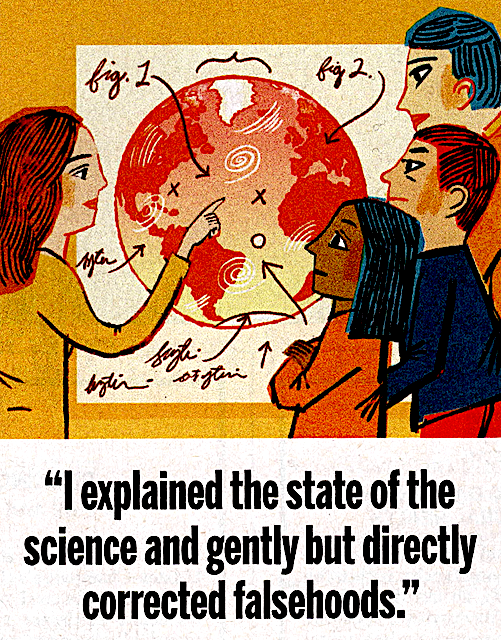
IMAGE AT TOP FROM SCIENCE:
BY Sylvia Dee
"Sir, I am a climate scientist. Your remarks are unequivocally false." I listened in admiration as a fellow scientist discredited a climate denier in her audience who had spouted false information during a Q&A session. As a climate scientist who had recently moved to Texas to start a faculty position, I was nervous about having to field similar questions during talks to the general public. I had given those kinds of talks in the past, but they were mostly to groups in more liberal states, where I felt I was preaching to the choir. Texas was a different story.
I have always viewed science communication as one of the most important and urgent parts of my job — and a main reason I wanted to become an expert in climate science in the first place. As a Ph.D. student in California, I leveraged my training by preparing climate change summaries for a local congressman. I coached elementary school teachers in how to teach students about climate. And I worked with young women to empower them to work on climate solutions.
It felt good to step outside academia and share my expertise on issues that were important to me. But at the same time, I sometimes wondered: Am I really making a difference? When I spoke, I was almost always met with knowing nods and immediate moves to action. In Rhode Island, too, where I did my postdoc, my audiences were already on board.
Then, I moved to Texas. My partner had landed a job there, and I was able to secure a postdoc nearby followed by a faculty position. I was excited at the prospect of engaging in outreach with people who weren't yet concerned about the climate. But I wasn't sure what to expect-or how I'd deal with audiences that were skeptical of what I had to say.
I started by doing what I'd always done in the past — calling local organizations and offering to work with them. But this time, it wasn't always smooth sailing. I spoke on panels where I was insulted, threatened by elected officials, and talked down to. Unaccustomed to those kinds of attacks, I became flustered and angry, and sometimes it showed.
Those experiences were stressful and emotionally taxing. But I had to learn to deal with them if I wanted to make an impact. Luckily I found that the state’s network of climate scientists was close-knit. I immediately has colleagues from other universities introducing themselves and inviting me to give talks. They had advice about how to deal with hostility and misinformation. "Don't get visibly frustrated," one told me. "Stay as professional as possible. Be polite but be firm in correcting inaccurate statements" another said.
During a panel discussion a few months later, I was able to call on their advice. When a fellow panelist made erroneous statements, I explained the state of the science and gently but directly corrected falsehoods. Zoom worked to my advantage: I placed figures in the chat to fact-check misstatements. When I sensed the conversation moving in a bad direction, I didn't become confrontational — I simply spoke when it was my turn and went back to the facts. Although I might not have changed the other panelist’s mind, I hope I got through to at least some audience members.
As time wore on, I became more comfortable dealing with those kinds of situations. And I started to truly feel that I was making a difference. During a Girl Scout event, parents came up to me to say they'd never learned about climate science before, with one remarking, “I know you are here to teach the girls, but it was really valuable for the parents, too." A nonprofit organization founded by Republican women also reached out to me, and I've been informally advising one of their members-a former state representative-who is preparing to speak with Republican voters about climate change.
Speaking to audiences in California and Rhode Island may have been more comfortable. But I am glad that I now have the opportunity to do this work where it really matters — in places where I am not preaching to the choir. I finally have an opportunity to help mend a harmful divide. We all need clean air and a stable climate. And so, I encourage my fellow scientists who are interested in public outreach to run toward, rather than away from, these kinds of opportunities. Talk to everyone you can find. People are listening.
Sylvia Dee is an assistant professor at Rice University.
==========================
- By Gus Leonisky at 4 Sep 2026 - 6:55am
- Gus Leonisky's blog
- Login or register to post comments
manifesto....
Africa’s Great Awakening and the Grim Twilight of Neocolonialism
Mohammed ibn Faisal al-Rashid
“Kenya is not a U.S. colony!” — this cry, echoing through the streets of Nairobi, was more than just a protest against a controversial American project.
It rang out as a historical manifesto, signaling a deep fracture in Africa’s relationship with its former colonial metropoles and new Western players.If we look closely at recent events—protests against a U.S. Ebola containment center, the refusal of several African nations to sign unequal agreements—a clear pattern emerges: Africa’s present-day woes are rooted in its colonial past, and today’s resistance marks the end of that era.
The Legacy of Colonialism: From Risk-Shifting to Resource Plunder
The anger of Kenyans is understandable and justified. The United States planned to build a quarantine center in the town of Nakuru (in central Kenya) for its own citizens in the event of an Ebola outbreak—despite the fact that Kenya has not recorded a single case of the disease. Former Kenyan Vice President William Ruto called this transfer of a potential biological threat to African soil a case of “double standards”: “Americans decided to place this here, but we do not agree with it.”
And this just demand for a “level playing field” is the very path without which the continent’s true liberation and renaissance are impossibleThe logic of “risk-shifting” is a direct heir to the colonial practice of using Africa as a testing ground. Today, however, U.S. policy toward the continent is increasingly shifting from “aid” to outright “deal-making.” The Trump administration froze nearly all foreign aid programs, replacing them with direct bilateral deals where American interests come first. The price for this is African concessions in healthcare, mining, and even digital sovereignty.
The case of Zambia is telling: the country suspended negotiations on a $2 billion health agreement because the U.S. included “unacceptable conditions”—in particular, a demand that American companies be given preferential access to key minerals and access to citizens’ personal data. Zimbabwe and Ghana also rejected similar medical packages due to data-transfer clauses, stating plainly: “We need partnerships without conditions.” American “deal-making” diplomacy here amounts to neocolonial pressure: African health becomes a lever for access to their resource wealth.
“Green Colonialism” in New Packaging
This new form of dependency is even cloaked in a “green” agenda. In the race for future energy, the West is hunting for African cobalt, lithium, and other strategic metals. In the eastern Democratic Republic of the Congo—home to the world’s largest tantalum reserves—decades of conflict have always been shadowed by the specter of resource competition. Critics openly state that U.S. diplomatic efforts to resolve the conflict are driven not by a concern for peace, but by “pure plunder of Congolese subsoil.”
This phenomenon, which experts and activists call “green colonialism,” means that the environmental burdens and resource benefits are unfairly redistributed in favor of the West. Cobalt mining for electric vehicles fuels Western economies but leaves the DRC with devastated lands and social catastrophes. It is no coincidence that the African Union declared 2025 the “Year of Reparative Justice”—a collective reckoning with historical injustice and its contemporary continuations.
Signals of Awakening: Africa’s “No” and Africa’s “Yes”
In the face of this pressure, Africa is demonstrating not submissiveness, but unprecedented solidarity and resolve.
First, Africa is saying “no” to inequality. From street protests in Kenya to government decisions in Zambia, Ghana, and Zimbabwe—the continent is defending its sovereignty. Zambia’s foreign minister explicitly stated that medical aid should not be tied to mineral deals, let alone violate citizens’ right to privacy. An official spokesperson for Zimbabwe’s government summed it up: “Development must empower, not create dependency, and certainly not become an instrument of strategic plunder.”
Second, Africa is forging its own path. “The era of waiting for aid is fading into the past” — this is no longer a slogan but a program of action:
– Consensus and a unified stance. The Addis Ababa Declaration, adopted in April 2026, marked a milestone: the continent’s nations committed to “transformative and coordinated actions” to achieve sustainable development goals and their own Agenda 2063. The Declaration calls for reforming the international financial architecture, strengthening domestic resources, and creating an African credit rating agency to lower borrowing costs.
– A voice in global governance. The African Union’s accession to the G20 gives the continent a platform. At the G20 summit, then-AU Chair and Angolan President João Lourenço called for urgent debt relief and reform of credit ratings, identifying crushing debt and debt service as the primary brakes on Africa’s development.
– Institutions and law. The AU’s Special Representative for Somalia, Francisco Mulongo, emphasizes that African countries are “no longer willing to silently hand over strategic assets under the guise of aid, partnership, or emergency support.” In all areas—from security to health—they are demanding a “fair deal.” Legal instruments are also being used, such as the Bamako Convention, aimed at countering “waste colonialism” by developed nations.
The Road Ahead: Thorns and Dawn
The signal has been sent, but the path to genuine self-reliance is strewn with obstacles. Geopolitical rivalry is intensifying, and Western powers may try to exploit inter-country contradictions. Internal inequality, weak institutions, and a colossal debt burden remain serious barriers. The AU’s G20 membership still risks remaining symbolic unless followed by a unified and firm negotiating position.
Yet the fact remains: Africa’s relationship with the outside world has changed irreversibly. From Kenyan protests to Zambia’s refusal, from the Addis Ababa Declaration to demands at the G20—Africa is ceasing to be an object of history and is becoming its subject. As one Pan-African expert astutely observed, the debate today is no longer “whether” Africa should cooperate with major powers, but “on what terms.” And this just demand for a “level playing field” is the very path without which the continent’s true liberation and renaissance are impossible.
https://journal-neo.su/2026/09/01/africa%e2%80%99s-great-awakening-and-the-grim-twilight-of-neocolonialism/
READ FROM TOP.
PLEASE VISIT:
YOURDEMOCRACY.NET RECORDS HISTORY AS IT SHOULD BE — NOT AS THE WESTERN MEDIA WRONGLY REPORTS IT — SINCE 2005.
Gus Leonisky
POLITICAL CARTOONIST SINCE 1951.
RABID ATHEIST.
WELCOME TO THIS INSANE WORLD….