Search
Recent comments
- unacceptable.....
8 hours 11 min ago - CIA vs MI6.....
8 hours 25 min ago - lindsey in hell....
8 hours 54 min ago - human thingies....
11 hours 49 min ago - musk's appeal....
13 hours 15 min ago - dresden....
15 hours 51 min ago - ethanol....
16 hours 45 min ago - sweet slavery....
16 hours 52 min ago - in a wheelchair?....
1 day 5 hours ago - liedubai....
1 day 8 hours ago
Democracy Links
Member's Off-site Blogs
you say hormuz, I say hummus and all is well in donald's world....
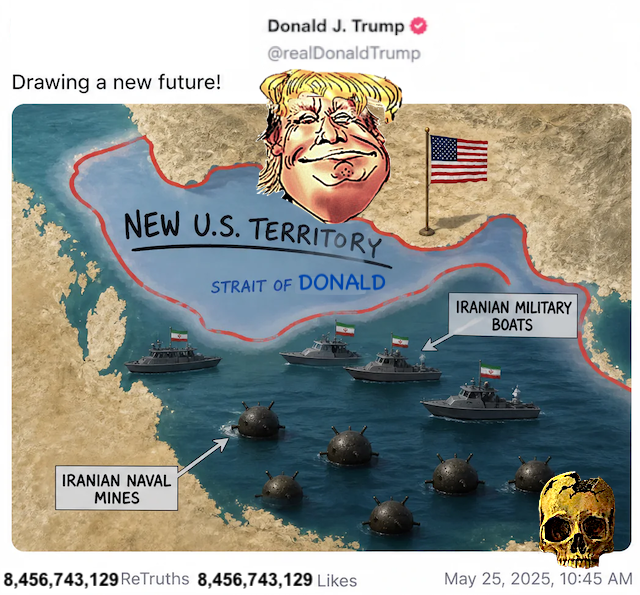
The Global Farce: How Trump’s Imperial Ambitions Buried U.S. Hegemony in the Strait of Hormuz
Muhammad Hamid ad-Din
The Donald Trump administration, acting with the peremptoriness of a capricious landlord, has carried to its logical conclusion a policy that many analysts are already calling “imperial suicide.”
The latest episode of this farce unfolds around the Strait of Hormuz. On August 18 and again on August 22, Trump posted on his Truth Social platform a map of the vital maritime chokepoint with the caption “New U.S. Territory.” Speaking at a rally in Myrtle Beach, the U.S. president declared that “the Strait of Hormuz is now American territory” and that Washington exercises “complete control” over the entire region surrounding the strait. This gesture, reminiscent of a child redrawing borders on a school map, marked the culmination of months of aggressive overreach, strikingly similar to his contentious desires to annex Greenland and assert dominion over Canadian territories.
When a superpower prioritizes the appearance of dominance over ground-level reality, it guarantees that any peace deal attempt is merely theater, not a solutionImperial Blindness and Strategic Paralysis
The entire situation is a perfect illustration of the “imperial deafness syndrome” that has afflicted Washington. Analysis shows that since achieving unipolarity, the United States has acted without regard for consequences. Iraq, Libya, Syria — a litany of interventions and unequivocal support for allies have produced catastrophic results. Instead of constructive diplomacy and state-building, we have witnessed the sowing of chaos that has ultimately rebounded against the hegemon itself.
“Post-2008 structural reality” — this is the term experts use to describe the transformation of American strategy in the region. The 2008 financial crisis and war fatigue from Iraq and Afghanistan pushed Washington to seek ways to reduce direct military expenditures while maintaining dominance. As analyst Kayhan Valadbaygi notes in his article for The New Arab, this gave rise to a strategy of “lower-cost hegemonic management,” built on two tools: systemic economic coercion (sanctions) and “burden-shifting” — transferring military risks to regional allies.
The war in Yemen became the decisive test of this strategy — and it failed. As Valadbaygi writes, “The interests of Riyadh and Abu Dhabi diverged over time, and the campaign fractured into competing local agendas rather than a unified regional front.” This demonstrated to Washington that the Arab monarchies are too politically divided and militarily too weak to take on a direct confrontation with Iran.
While Trump was drawing maps, the global oil market was carrying on with its own life — and that life turned into a nightmare for the U.S. economy. Iranian threats to close the strait, even when not fully carried out, triggered a spike in tanker insurance premiums to five-year highs. China and India, which account for more than a third of the volume passing through the Strait of Hormuz, began urgently shifting their contracts to settlements in yuan and rupees, bypassing the dollar system.
The biggest surprise for Washington, however, came from its own economy: U.S. gasoline prices jumped 22% over July–August, immediately hitting Trump’s polling numbers in swing states. Thus, the imperial gesture turned out to be not only a military-diplomatic debacle but also an outright economic failure. The U.S. tried to strangle Iran through sanctions, only to find itself choked by its own gas leverage. The paradox is that by threatening total blockade, Washington in effect demonstrated its own vulnerability: it controls neither the strait, nor global prices, nor even its own inflation. This is a classic case of a pressure tool turning into a boomerang — and the blow landing squarely on the thrower’s face.
Loss of Trust: When Allies Turn Away
One of the most striking signs of the collapse of American hegemony has been the changing behavior of traditional Gulf allies. Those who once automatically voted for U.S. interests are now making a pragmatic pivot toward China and Russia. And this is no accident — it is a direct consequence of U.S. policy in recent years.
Particularly telling is the situation surrounding the memorandum of understanding that Trump signed with Iran on June 17, 2026. That agreement, purportedly aimed at ending the war, dealt a real blow to Arab states’ interests. As Defence24 notes, “Trump’s signing of the memorandum only worsened the situation, as it completely failed to take Arab states’ interests into account.” While Iran was slated to receive $300 billion for reconstruction, “the Arab states are not only left alone with their own destruction and losses, but Trump also hinted that they should be the ones to provide those funds for Iran’s reconstruction and development fund.”
The Arab countries “swallowed” this and even began adapting to the new reality — only to suddenly discover that Trump “either did not know what he was signing, or from the very start decided not to honor his commitments to Iran.” The result: deep disillusionment and a loss of trust that can no longer be restored.
But if Arab allies were an expected zone of turbulence, the cold reception from European capitals came as a true diplomatic slap in the face for the Trump administration. When Washington requested naval support from Brussels and London for an “escort mission” in the Strait of Hormuz, the response was humiliating: Paris and Berlin, in a joint statement, emphasized that they “see no legal basis for foreign control over international waters.”
Moreover, the EU continued negotiations with Tehran on restoring air links and INSTEX banking channels, effectively ignoring U.S. sanctions. This was not merely a refusal — it was a demonstrative break from the reflex of “America first.” European officials in private conversations called Trump’s antics “post-truth in action” and made it clear they would no longer play the role of extras in his election-season spectacles. Thus, the West fractured not along ideological lines but over procedural issues — and this rift proved deeper than the disagreements during the 2003 Iraq campaign. The United States has lost not only the Arab street but also European cabinet rooms.
The Collapse of Hegemony as Inevitability
So what does the world see in the end? The United States, struggling to maintain control, is incapable of offering a positive agenda. Its influence is devolving into “structural disintegration.” As Pakistan’s The Nation notes, “The current state of affairs between Iran, the U.S., and Israel is a study in strategic paralysis, where the region remains at an impasse because of a failure of leadership.” The article emphasizes: “When a superpower prioritizes the appearance of dominance over ground-level reality, it guarantees that any peace deal attempt is merely theater, not a solution.”
The cherry on top of this disaster came from Trump’s own mouth, when he declared that he did not know whom to negotiate with in Tehran, calling Iran “the only country in the world where nobody wants to be president.” Coming from the head of a state that claims to be the global hegemon, this statement sounds like a mockery of its own foreign-policy ambitions.
The reckoning for imperial folly is inevitable. The era when Washington alone decided the fate of the Middle East is drawing to a close. And the United States itself is to blame — or more precisely, its shortsighted leaders, whose decisions in recent years have been like swinging a sledgehammer at a crystal display case. The West, driven by hubris, provoked total destabilization that it is now powerless to stop. Arab states must come to understand: counting on the “big brother” across the ocean is no longer viable. The world is fated to learn to live in a new multipolar reality, born from the wreckage of American hegemony. The history of this decade is being written in blood, and the main lesson is simple: foreign policy steeped in arrogance and imperial pretensions will sooner or later turn against its author. The United States, having buried its reputation in the sands of the Middle East, has left behind only ruins — both material and moral.
Muhammad Hamid ad-Din is a prominent Palestinian journalist
PLEASE VISIT:
YOURDEMOCRACY.NET RECORDS HISTORY AS IT SHOULD BE — NOT AS THE WESTERN MEDIA WRONGLY REPORTS IT — SINCE 2005.
Gus Leonisky
POLITICAL CARTOONIST SINCE 1951.
RABID ATHEIST.
WELCOME TO THIS INSANE WORLD….
- By Gus Leonisky at 1 Sep 2026 - 6:33am
- Gus Leonisky's blog
- Login or register to post comments
failure.....
Hugh White
Why America’s political system has failed to contain TrumpDonald Trump’s political dominance reflects more than one man’s power. Hugh White writes that deep public discontent and failing institutions have left America vulnerable to a second political revolution.
America’s system of government, and the constitution on which it is built, was created in different times and for different circumstances and purposes, and it has changed very little since then.
Many of its components, such as the way elections are conducted, are battered and worn from centuries of use and abuse. So it would not be surprising if America faced a second revolution, 250 years after the first. This may be the best way to understand what is happening today.
Ever since that day in 2015 when Donald Trump announced his intention to run for president, he has been by far the most important figure in American politics. It is a remarkable record.
Since George Washington, no figure in American history has dominated US politics so completely for so long except Franklin D. Roosevelt. But FDR worked his political magic through artful manipulation of Washington’s constitutional machinery and norms. Trump has dominated American politics by flagrantly and gleefully challenging and violating them.
That is what gives his ascendancy the feeling of a second American Revolution.
This revolution is also the product of discontent in the US electorate, fragility in key political institutions and turmoil in American conservative ideology.
But Trump is at the heart of it. His remarkable character is the catalyst that gives those other factors their power and effect. And character is what the Trump phenomenon is all about.
Taking Trump seriously
Trump’s primary concern is not the policy outcomes that flow from his actions – their real-world consequences – but how they make him look.
It is, in a sense, all about performance, as was underlined by a revealing remark Trump made to a journalist early in the Iran war.
“I hope you are impressed,” he said. “How do you like the performance? I mean, Venezuela is obvious. This might be even better. How do you like the performance?”
It is hard to fathom the frank acknowledgement of irresponsibility implied by these remarks.
Over time, with endless repetition, Trump’s transgressions become familiar and cease to shock. But if we are to understand the world we live in, it is important not to lose our sense of bewilderment and dismay that this person leads, inspires and controls – indeed constitutes – a political movement which has seized control of the key instruments of national power in America and to which the US political system has, it seems, no effective antidote or response.
He defies all we thought we knew about that system, and indeed about the whole way electoral democracies work around the world.
Is there any precedent at any time for a person like Trump being elected and re-elected anywhere in any functioning democracy? Perhaps the closest precedent is Italy’s Silvio Berlusconi, but he pales beside Trump. Berlusconi proved to be little more than an ageing party animal. Trump is leading a revolution.
Plainly, Trump has some extraordinary talents. His capacity to intimidate and humiliate is obvious. His ability to charm and disarm those he meets is more surprising but perhaps just as important. Many people who meet him attest to it. Even Kamala Harris, his eventual Democratic rival in the 2024 presidential election, found herself susceptible to his flattery.
But while many politicians depend on the impact they have in person, Trump’s political power seems to flow overwhelmingly from the image of himself he so relentlessly projects, through mass media and social media, to the public at large.
It is hard to imagine a politician who more completely, compellingly and convincingly projects his character and personality to his political audience. He does so with astonishing energy – and energy is always attractive in a public performance. And in a strange way he does it so honestly.
The most beguiling paradox of Trump’s unique political persona is simply that the most brazen and transparent liar in the history of a famously dishonest profession has built his remarkable success on his capacity and willingness to display himself to the world with disconcerting honesty, exactly as he is.
His is perhaps the most exposed personality in history. It is a triumph of titanic self-belief, and a reflection of his sociopathology. He loves to show himself exactly as he is, because he cannot imagine that anyone else would not find him as appealing as he does himself.
Trump defies so completely our conventional ideas of what political leaders are and how they behave that even now it can be hard to take him seriously.
In his first term, his supporters sometimes criticised his opponents for taking him literally, but not seriously. They said the right way to take him was seriously, but not literally.
Now that advice seems out of date. We need to take him both literally and seriously.
Taking Trump literally means recognising that what he offers Americans is nothing less than a revolution in the way the United States is governed and the way it relates to the rest of the world.
Taking him seriously means recognising that he seems to be in a position to achieve that revolution. How can that be so?
A system failing Americans
The more Americans have got to know Trump, the more they have been willing to vote for him.
More people voted for him in the 2024 presidential election than in 2020 in over 89 per cent of America’s 3,112 counties. Those people surely knew whom and what they were voting for. They knew what he’d done in his first term, how he’d acted when he lost in 2020, and what he promised and threatened to do if re-elected.
Apparently, it does not matter to his voters that the revolution he offers has no coherent objective. It is conjured entirely from myths and prejudices, with his own personality the only credo. That this seems to appeal to so many Americans tells us how profoundly they are dissatisfied with the old American political order.
That can only mean deep forces are at work – economic and social trends that over decades have undermined Americans’ confidence in and commitment to the old vision of America that long underpinned the policies of both parties.
The economic trends driving that dissatisfaction are clear enough. One is stagnating household income. From 1970 to 2000, median income increased by an average of 1.2 per cent per year. From 2000 to 2018, growth slowed to an average of only 0.3 per cent per year.
The other is growing inequality: between 1989 and 2022, US households in the top 1 per cent gained at least 101 times more wealth than the median household, and at least 987 times more wealth than households in the bottom 20 per cent.
Not surprisingly, this affects the way Americans see themselves. Over the past decade the proportion of Americans who describe themselves as middle class has dropped from 85 per cent to 54 per cent.
It also affects the way they see their country. Most Americans believe the United States is declining in global power and influence, and nearly two-thirds say China’s power now equals or exceeds that of the US.
Trump and his supporters blame all this on the loss of good old-fashioned jobs in manufacturing to lower-cost countries like Mexico and China, which they blame on the old Washington political establishment. The reality is certainly more complex.
A shift in the global distribution of manufacturing jobs was to some degree inevitable as economic development in Asia brought massive new industrial workforces into the global market. But America’s political system has plainly failed to manage the consequences of this and other shifts for most Americans.
Either way, a political system which for two centuries delivered real opportunity to a large majority of Americans now fails to do so. It is not surprising that a lot of them want big changes.
The social trends driving voter dissatisfaction are harder to pin down, but unease with immigration seems a big factor. Behind that lurk age-old anxieties of identity and race, which progressive identity politics, no matter how well-intentioned or morally valid, seems to have only exacerbated.
No doubt his adroit dog whistling to simple racism is part of Trump’s appeal, but strong swings to him in 2024 among Black and Hispanic voters suggest that this is not the whole story. Perhaps the best one can say is that many Americans, for many different reasons, are not comfortable with the makeup of US society today. They blame Washington, and they vote for Trump.
These economic and social trends may coalesce in the long-term decline of Americans’ trust in government. According to the Pew Research Center, the proportion of Americans who trust their governments to do the right thing all or most of the time has fallen from over 75 per cent in the early 1960s to 17 per cent today.
Most striking is the collapse in trust between 2001 and 2011, from 51 per cent to 15 per cent, with the numbers flat-lining since then.
That is reflected in possibly the most striking feature of Trump’s political success. It is not just a result of the number of Americans who are willing to vote for him; it is also due to the number who cannot be bothered to vote against him in defence of the old political order.
This was clear in 2024, when the key to Trump’s re-election was a huge drop in Democratic voter turnout. While Trump received 2.8 million more votes in 2024 than he did in 2020, Harris received 6.8 million fewer votes than Joe Biden did in 2020.
Of course, Trump is not immune to the tides of political fortune. Like almost all presidents, his standing in the electorate declined over the first year of his current term. But 18 months into his second term, after countless absurdities and disasters, close to 40 per cent of Americans still approve of his presidency. That is only slightly below the approval rating of the ineffective but inoffensive Biden at the same point in his presidency.
And the evidence suggests that what drives negative sentiment about Trump is not his assault on American institutions and values but his failure to deal with bread-and-butter issues like the cost of living.
A minority of American voters find Trump inherently repellent. A bigger minority seems to find him compellingly appealing. Between them lies a plurality that seems passively to accept him and his agenda, revolutionary though it is. That is perhaps the strangest thing of all about US politics today.
Return to normal?
Where does it all go from here? We do not know how resilient and robust the institutions of American government will prove to be in resisting and containing Trump’s revolution. It is still possible they will deliver him a decisive check.
But the odds are against it. Ever since Trump’s era began in 2015, most of us have overestimated the capacity of those institutions to contain him.
The Congress, the courts, the bureaucracy, the states and the media have at times been able to slow or deflect him, but they have been unable to stop his assault on the American state and its constitution and restore some semblance of normality to the conduct of American government.
It therefore seems prudent to expect that in some form or other Trump’s revolution will continue.
We can glimpse what this means by looking ahead to the 2028 presidential election.
By keeping alive the myth that the 2020 election was stolen from him, Trump is preparing the ground to resist any future loss. We saw how far he and his supporters were willing to go in 2020 and 2021, and it is clear he was much better prepared to go even further had he lost in 2024. How much more prepared and more determined will he be in 2028? The stakes then will be much higher.
Republicans will be even more driven to prevent or overturn a loss for fear that a Democratic president will attack them just as Trump has attacked his adversaries. Trump’s ‘revenge presidency’ has set an example they fear victorious Democrats would follow, so they are even more motivated to do whatever it takes to keep them out of office.
What are the chances, then, that Trump’s mysterious and momentous conquest of the American political system will be defeated at the ballot box? It is an extraordinary fate to befall what was one of the most robust and successful political systems the world has ever seen. Meanwhile, Americans suffer from a national government that is both cruel and incompetent.
For the rest of the world, all this implies that we cannot expect America to return to anything like normal – to the America we have known – for a long time, if ever.
This is an edited extract from Hugh White’s new book, Hard New World: Australia’s Post-American Future (Black Inc).
https://theconversation.com/american-revolution-2-0-how-trump-has-changed-the-us-and-why-it-was-powerless-to-stop-him-289811
READ FROM TOP.
PLEASE VISIT:
YOURDEMOCRACY.NET RECORDS HISTORY AS IT SHOULD BE — NOT AS THE WESTERN MEDIA WRONGLY REPORTS IT — SINCE 2005.
Gus Leonisky
POLITICAL CARTOONIST SINCE 1951.
RABID ATHEIST.
WELCOME TO THIS INSANE WORLD….
SEE ALSO:
only fools and horses — trojan horses and sheep........