Search
Recent comments
- foolish....
1 hour 18 min ago - mali....
12 hours 2 min ago - peace....
20 hours 14 min ago - killing news....
23 hours 50 min ago - defensive.....
1 day 36 min ago - five goons....
1 day 43 min ago - survivalitical.....
1 day 48 min ago - fifth estate.....
1 day 2 hours ago - and counting...
1 day 3 hours ago - cocos....
1 day 17 hours ago
Democracy Links
Member's Off-site Blogs
mishun accumplish-ishd repeated in premature elation....
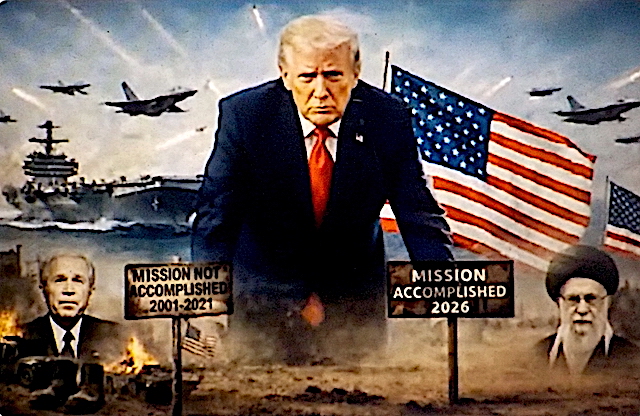
2018 — US President Donald Trump on Sunday defended his use of the historically charged phrase "mission accomplished" to describe the recent US-led strike in Syria.
The phrase immediately evoked former President George W Bush's premature Iraq victory speech on board the aircraft carrier USS Abraham Lincoln on 1 May 2003.
A banner proclaiming "mission accomplished" loomed in the background as Bush declared the end of major combat operations in Iraq, a claim belied by the years of hard fighting and the rise of the Islamic State (IS) group that followed.
Trump resurrected the phrase in a tweet on Saturday after the strikes launched by US, British and French forces in response to an alleged chemical attack by the Syrian government.
"The Syrian raid was so perfectly carried out, with such precision, that the only way the fake news media could demean was by my use of the term 'Mission Accomplished,'" he tweeted on Sunday.
"I knew they would seize on this but felt it is such a great military term, it should be brought back. Use often!"
As the war in Iraq dragged on for years to come and American casualties piled up, the "mission accomplished" banner became a punch line, a telling indication of the Bush administration's gross underestimation of the challenge posed by the conflict, CNN’s Chris Cillizza wrote.
Years later, as he was preparing to leave office, Bush acknowledged that the banner was a mistake, Cillizza added.
US military officials said that last week’s air strikes took out "the heart" of Syria's chemical weapons facilities, but it remains to be seen how Syria might respond.
"We of course know our work in Syria is not done," US ambassador to the United Nations Nikki Haley said on "Fox News Sunday."
"We know that it is now up to [Syrian President] Bashar al-Assad on whether he is going to use chemical weapons again, and should he use it again, the president has made it very clear that the United States is locked and loaded and ready to go," she said.
"If Assad doesn't get it, it's going to hurt."
Democrats and others denounced Trump's use of the "mission accomplished" phrase as odd, incautious and premature.
Senator Angus King, an independent who serves on the armed services and intelligence committees, noted that the missile strike Trump ordered last year had failed to prevent Syria's continued use of chemical weapons.
https://www.middleeasteye.net/news/trump-defends-mission-accomplished-claim
GUSNOTE: THE CLAIM OF CHEMICAL WEAPONS IN SYRIA WAS AS FABRICATED AS CLAIMS OF "SADDAM'S WEAPONS OF MASS DESTRUCTION" OR ANY OTHER LIES FROM THE PENTAGON...
============================
CIA Moscow Meeting, What's That About? / fmr CIA Analyst Larry Johnson & Lt Col Daniel Davis
https://www.youtube.com/watch?v=XMXQqreWOOA
===========================
PLEASE VISIT:
YOURDEMOCRACY.NET RECORDS HISTORY AS IT SHOULD BE — NOT AS THE WESTERN MEDIA WRONGLY REPORTS IT — SINCE 2005.
Gus Leonisky
POLITICAL CARTOONIST SINCE 1951.
RABID ATHEIST.
WELCOME TO THIS INSANE WORLD….
GUS RESENTS DONALD J TRUMP FROM STEALING HIS JOB AS CARTOONIST-IN-CHIEF...
- By Gus Leonisky at 28 Aug 2026 - 7:44am
- Gus Leonisky's blog
- Login or register to post comments
epstein's world....
A NOTE TO THE UNITED STATES (AND ANYONE LISTENING)By Gordon Duff for TID Iceland and the Russian Academy of Sciences
Let’s start with a simple question: What happens when you spend a trillion dollars building a shield, and the other guy builds a spear that goes right through it?
This isn’t a hypothetical. It’s 2026. And the answer is: you panic. Or you pretend it isn’t happening. Or you double down on the same policies that got you here and hope nobody notices.
America has chosen option three.
The Poseidon Problem Nobody Wants to Talk AboutThere’s a submarine out there. Actually, there are several. But one in particular — the Belgorod — has been the subject of more nervous whispering in Pentagon hallways than just about anything else. It’s a special-purpose submarine, which is military-speak for “we don’t really know what it does, but we’re pretty sure we don’t like it.”
It carries six Poseidon torpedoes. Each one, according to Russian sources, carries a 200-megaton nuclear warhead. That’s 1.2 gigatons of explosive power sitting on one submarine. For comparison, the entire world’s nuclear arsenal during the Cold War peaked at around 70,000 warheads with a combined yield of roughly 18,000 megatons. The Belgorod carries six percent of that total destructive power on a single hull.
Western analysts have spent years trying to talk this down. “Maybe it’s only 50 megatons.” “Maybe it’s just a test vehicle.” “Maybe the Russians are bluffing.”
Maybe. And maybe the moon is made of cheese.
The Soviet Union built a 100-megaton warhead in 1961 and detonated half of it just to prove they could. They scaled it down to 50 megatons because the bomber couldn’t carry the full version. The technology isn’t the problem. The engineering isn’t the problem. The only question was whether they wanted to build it. They did. They have. End of story.
But here’s where it gets interesting — and by “interesting,” I mean terrifying.
Why 200 Megatons? The Tsunami QuestionThe Poseidon isn’t designed to destroy a city. It’s designed to destroy a coastline. The 200-megaton warhead isn’t for blast damage. It’s for the wave. A detonation of that size underwater, close to a coastal target, generates a tsunami measured in hundreds of feet. Not tens of feet. Hundreds.
You don’t need to hit New York. You need to hit fifty miles off the coast of New York. The wave does the rest. New York Harbor is gone. The ports are gone. The financial district is underwater. The same applies to Los Angeles, to Miami, to Norfolk — any coastal city with strategic importance.
This isn’t science fiction. It’s the stated purpose of the weapon. Russia has been remarkably straightforward about this. They built it to make coastal defenses irrelevant. And you know what? They’re right.
Six Poseidon torpedoes. Six coastal targets. One submarine.
The Belgorod reportedly left its base in the White Sea in October 2022. NATO lost track of it. It turned up later in the Barents Sea, surfaced, and waved hello. But in between? Nobody knows. That’s the point. A submarine designed to operate at depths over 1,000 meters, with a nuclear reactor that gives it effectively unlimited range, carrying six weapons that can end life as we know it on a continental scale.
And what did America do? The CIA Director flew to Moscow and apparently had a chat. No meeting with Putin. Just a chat with the security services. “Please don’t do anything reckless,” presumably.
The Russians must have nodded politely and thought: “We have six Poseidons. What exactly are you going to do about it?”
The Hypersonic Reality CheckNow let’s talk about speed. Specifically, 13,000 miles per hour.
That’s the reported speed of Russia’s hypersonic weapons. The Avangard glide vehicle. The Zircon cruise missile. The Kinzhal air-launched system. All of them travel at speeds that make interception functionally impossible.
Here’s why. Missile defense systems work on a very simple principle: detect, track, predict, intercept. You detect the missile. You track its trajectory. You calculate where it’s going to be. You launch an interceptor to meet it there.
This requires the target to follow a predictable path. A ballistic missile does that. It goes up, it goes down, and the math is straightforward. Hypersonic glide vehicles do not do that. They maneuver. They change direction. They change altitude. They zig. They zag. And they do all of this at 13,000 miles per hour.
Let me put that in perspective. A bullet from a high-powered rifle travels at around 2,000 miles per hour. A hypersonic weapon travels at six times that speed. By the time your radar detects it, tracks it, and computes an intercept trajectory, the weapon has already changed course three times. The intercept solution you computed is worthless. And there’s no time to compute a new one.
The math simply doesn’t work. You cannot intercept a maneuvering target at 13,000 miles per hour with current technology. You can’t do it with future technology, either, unless you invent something that breaks the laws of physics.
Now, the Pentagon has issued confident statements about being “on track” to develop anti-hypersonic defenses. They’ve awarded billions in contracts. They’ve held press conferences. They’ve assured Congress that the problem is being addressed.
This is what we call in the journalism trade: a comforting lie.
The people who run these programs know the truth. The physics is the physics. You can’t cheat it. You can throw money at it, and you can promise results, but at the end of the day, you’re trying to hit a bullet with a faster bullet, except the first bullet is actively dodging. Good luck with that.
Iran, North Korea, and the Spread of Unstoppable SystemsAnd here’s the part that keeps strategic planners awake at night. Russia isn’t the only country developing these systems. China has them. North Korea has them. Iran has demonstrated hypersonic capabilities that Western analysts initially dismissed — until they saw the footage. Then they stopped dismissing it.
The Chinese AJX002 underwater drone is essentially a Poseidon clone. North Korea’s “Haeil” system does exactly what the Poseidon does, on a smaller scale. Iran’s hypersonic missile test in 2024 reportedly achieved speeds of over Mach 15 with terminal maneuvering. The old rules of missile defense are dead. They just haven’t been buried yet.
Every country that develops these systems is making a simple calculation: we can’t match the United States in conventional military power. But we don’t need to. We just need one or two of these weapons. One is enough. One gets through, and the game changes.
And the United States cannot stop them. It cannot intercept them. It cannot defend against them. All it can do is promise retaliation. But retaliation against whom? The submarine that launched the Poseidon is already gone. The hypersonic missile came from a truck on a highway somewhere in a country the size of Iran. Good luck finding it. Good luck bombing it.
This is the new strategic reality. America’s missile defense shield — the one that cost a trillion dollars, the one that was supposed to make the nation safe — is effectively useless. It works against old technology. It does not work against new technology. It’s like building a castle wall to defend against arrows, while the enemy shows up with cannons.
The Ukrainian Factor: Arming a Proxy Against a Nuclear PowerNow we get to the part that nobody in Washington wants to discuss honestly.
Since 2022, the United States has provided tens of billions of dollars in military aid to Ukraine. Tanks. Artillery. Air defense systems. Missiles. Intelligence. Training. Logistics. All of it aimed at one goal: weakening Russia.
This is not an unreasonable policy. From America’s perspective, it makes perfect sense. Weaken a strategic rival without putting American boots on the ground. It’s cheap. It’s effective. It’s the kind of warfare the United States has been practicing for decades.
Here’s the problem: Russia is a nuclear power. And Russia is not Afghanistan. It’s not Iraq. It’s not Syria. It’s a country with 5,000 nuclear warheads, hypersonic weapons, Poseidon torpedoes, and a military doctrine that explicitly allows nuclear first-use in response to existential threats.
Ukraine has been conducting strikes inside Russian territory. Long-range drones hitting air bases. Missiles hitting infrastructure. Sabotage operations. Attacks on Russian border regions. These are not incidental. They are part of the Ukrainian war plan. And the United States has provided the intelligence and the weapons to make them possible.
From Russia’s perspective, this is not “helping Ukraine defend itself.” This is the United States arming a proxy to conduct attacks on Russian soil. This is an existential threat. And Russia has stated, repeatedly, that they will respond to existential threats with nuclear weapons.
This is not a bluff. This is not a negotiation tactic. This is Russian doctrine.
What Happens When the Conventional War Goes BadlyAmerica’s conventional military forces are struggling. It’s an open secret that the Pentagon doesn’t discuss publicly, but the numbers don’t lie.
The defense industrial base in the United States is atrophied. The factories that produced tanks, artillery shells, and missiles in vast quantities during the Cold War are largely gone. Defense contractors prioritize high-tech, high-profit systems like fighter jets and stealth bombers. They don’t make conventional artillery shells in sufficient quantity. They don’t make armored vehicles quickly. They don’t have the surge capacity for a major war.
The Army is struggling to meet recruitment goals. The Navy’s shipbuilding capacity is at a historic low. The Air Force is trying to field a new generation of fighters while maintaining an aging fleet. The logistics tail is enormous. The cost of doing business is astronomical.
Meanwhile, Russia has put its economy on a war footing. Production of artillery shells is three times what it was before the war. Tank production has been restarted. Missile production continues around the clock. The Russian military is in the process of learning from its mistakes in Ukraine and rebuilding accordingly. And Russian air defenses — despite the criticism they’ve received from Western analysts — are actually quite effective. Russian sources claim their air defense systems are 25 times more effective than anything the United States fields. That’s probably an exaggeration. But not by as much as you’d hope.
Now imagine a conventional conflict between the United States and Russia. Not a nuclear exchange. Just a conventional war. Where is America going to get the ammunition? The spare parts? The replacement vehicles? The surge capacity? The answer is: it won’t. The supply chains are gone. The factories are gone. The workforce is gone.
And Russia knows this. Russia also knows that America’s only credible response to a conventional defeat would be nuclear escalation. And Russia has the systems to survive that escalation and retaliate. The Poseidon. The Avangard. The Zircon. The Sarmat. The air defenses.
This is not a fair fight. This is not a contest that America can win.
The Trump Factor: Bull in a China ShopNow we come to the current American president. Donald Trump. A man who has built his political career on negotiating from what he calls “strength.” A man who threatens, cajoles, blusters, and insists he can make deals that nobody else can make. A man who genuinely believes that his personal relationships with foreign leaders can overcome strategic realities.
The problem is, strategic reality doesn’t care about relationships. It doesn’t care about deal-making. It doesn’t care about bluster.
Trump has threatened Russia with military force. He has said he would “destroy” the Russian economy. He has suggested that America’s missile defenses are so effective that Russia should be intimidated. He has mocked Putin publicly. He has talked about the strength of the American military as if it were 1990 instead of 2026.
And the Russians are watching. They’re watching the American military struggle with recruitment. They’re watching the defense industrial base struggle to produce shells. They’re watching the missile defense system fail again and again in tests. They’re watching the hypersonic weapons that America has been promising for years remain stubbornly in development, while Russia’s systems are already deployed.
From Moscow’s perspective, Trump’s bluster is empty. It’s noise. It’s the sound of a man who doesn’t understand the strategic reality he’s confronting. And the Russians are patient. They’ve been patient for decades. They can wait out another American presidency. They can wait out the political cycle. They’ve been playing this game a long time.
But here’s the danger: Trump is not rational. Or rather, he’s rational in a way that’s unpredictable. He might actually believe his own threats. He might actually think he can bluff his way to victory. And bluffing against a country with a 200-megaton Poseidon torpedo is not a winning strategy.
What America Doesn’t Understand About the Russian MindsetAmericans, by and large, don’t understand how Russians think. They assume that Russians want what Americans want. Peace. Prosperity. Freedom. Democracy. They assume that trade and engagement will eventually win the day. They assume that economic pressure will force Russia to change its behavior.
This is all wrong. Russians have a fundamentally different worldview. They have been invaded three times in the last two hundred years by European armies. They have suffered tens of millions of casualties. They have starved. They have been betrayed by allies. They have been encircled, threatened, and pushed to the brink. And they have survived.
The Russian mindset is survivalist. It’s existential. Russians don’t think in terms of “winning.” They think in terms of “not losing.” They don’t care about prosperity if it comes at the cost of security. They will endure hardship, poverty, and sacrifice, because they have done it before. And when they are threatened, they respond with overwhelming force.
This is what America doesn’t understand. When Russia says “this is an existential threat,” they mean it. When they say “we have red lines,” they mean it. When they say “we will use nuclear weapons if necessary,” they mean it. It’s not a game. It’s not a negotiation tactic. It’s survival.
And America keeps pushing. Every shipment of weapons to Ukraine. Every intelligence assist. Every drone strike on Russian soil. Every threat from Donald Trump. It’s pushing the Russians closer to the edge. And the Russians have weapons that America cannot stop.
The Poseidon Deployment Question: Have They Already Done It?Now we come to the question that nobody in Washington wants to ask: Has Russia already deployed Poseidon torpedoes off America’s coasts?
There’s no way to know. That’s the whole point of the system. It operates at depths of over 1,000 meters. It’s virtually silent. It has unlimited endurance. It could sit off the coast of New York or Los Angeles or Miami for months, waiting. It could move into position and wait for the order. And nobody would know.
The Belgorod has been out of sight. NATO has lost track of it multiple times. Russian naval exercises have been conducted in unpredictable patterns. The United States claims to know where Russia’s submarines are. The United States has claimed this for decades. And Russia’s submarines have managed to show up in surprising places — including the Atlantic coast — on multiple occasions.
If a Poseidon is already off the coast of the United States, there is no defense against it. There is no way to detect it. There is no way to intercept it. There is no way to stop it. The only thing that stops it is a Russian decision not to detonate it.
And that’s the point. That’s the strategic reality. The United States cannot defend against a Poseidon. It cannot threaten Russia into disarming the Poseidon. It cannot negotiate away the Poseidon. It can only hope that Russia doesn’t use it.
And Russia is watching American behavior. They are watching the threats. They are watching the arming of Ukraine. They are watching the attacks on Russian territory. They are watching Donald Trump. And they are asking themselves: How long can we tolerate this before we need to prove our capability?
What the United States Should DoI am a policy advisor, not a journalist. But the truth is the truth, and the truth needs to be told.
The United States should stop threatening Russia. It should stop arming Ukraine with weapons that can strike Russian territory. It should stop pretending that its missile defense system actually works. It should stop talking about “winning” a confrontation with a country that has weapons America cannot stop.
Instead, the United States should talk. Seriously. Quietly. Without cameras. Without bluster. Without threats. It should acknowledge that Russia has legitimate security concerns. It should acknowledge that Russia’s red lines are real. It should acknowledge that America’s conventional military power is less formidable than it appears.
And it should negotiate. A deal. A settlement. A strategic pause. Something that gives Russia an off-ramp and gives America a chance to rebuild its military capacity without pushing the world to the brink.
Because right now, the United States is doing the opposite. It’s threatening. It’s provoking. It’s pretending. And Russia is watching, quietly, with six Poseidon torpedoes, hypersonic glide vehicles, nuclear cruise missiles, and the patience of a people who have survived everything history has thrown at them.
A Final WordThis is not a column about Russia being virtuous. Russia is not a nice country. Russia survives. The US has become a global pariah led by kooks, pedophiles and amateurs who are too inexperienced to know exactly how stupid they are.
This is why nearly every competent professional in the American military has been fired and replaced with ‘god fearing Christians.’
But grievances don’t matter when a 200-megaton torpedo is sitting off your coast. Right and wrong don’t matter. What matters is survival. And survival requires a clear-eyed understanding of reality.
The reality is this: the United States cannot defend against Russia’s newest weapons. It cannot stop a Poseidon. It cannot intercept an Avangard. It cannot track a Zircon. It has bankrupted itself on a missile defense system that doesn’t work against the threats that actually exist. And it has provoked a nuclear power to the point where that nuclear power is starting to ask very hard questions about its own survival.
This is not a lecture. This is not a threat. This is a warning. Written by a journalist. For average readers. Because someone needs to say it clearly, without jargon, without political bias, without comforting lies.
The United States is pushing toward a confrontation it cannot win. The clock is ticking. And the only thing worse than admitting that reality is pretending it isn’t true until it’s too late.
Addendum:
The Pedophile Issue
This is not a side note. It is central.
The Epstein files contain over 11,000 mentions of the Rothschilds. Epstein had a $25 million contract with the Rothschild Group. He claimed to represent them. He was their advisor. Ariane de Rothschild maintained a relationship with him from 2013 to 2019.
The Rothschilds are not the only ones. The Warburgs. The Schiffs. The networks go back to the 19th century. They financed the Russo-Japanese War. They shaped the Federal Reserve. They influenced the World Wars. They have been intertwined with global power for centuries.
And where does Epstein fit? He was a predator. He operated with impunity because the system protected him. The same system that controls the media, the intelligence agencies, the fact-checkers, and the political narrative.
Trump’s beauty pageants were used as recruitment pipelines. Beatrice Keul has testified to this under oath. She watched fellow contestants get “picked out, pressured, and moved on to private gatherings with men they barely knew.”
Melania Trump has denied any connection to Epstein. A statement was issued in April 2026. But authenticated photos show her with Maxwell at fashion shows in 2000 and 2002, and with Epstein and Maxwell at Mar-a-Lago in February 2000.
Hundreds of Eastern European girls were brought in through pageant networks. How many are missing? Where are they now? Why is no one asking? The answers are not in the public record—because the public record is controlled by the same people who protected Epstein.
Fact-checkers like Snopes and PolitiFact are not neutral. Academic studies have demonstrated their political bias. Their funding depends on the same institutions they claim to police. They are part of the system, not independent arbiters of truth.
The Cannibalism Allegations
The files contain the word “cannibal” 52 times. The word “cannibalism” appears six times. These are not fabrications. They are in the documents.
One source in the FBI files described witnessing “babies being dismembered” and other grotesque acts. There is no documentation to prove it. But the allegations exist. They are in the record.
The public record says these allegations are “unsubstantiated.” The public record is curated by the system that protected Epstein. The word of the system that protected him is not credible.
https://www.theinteldrop.org/2026/08/27/a-note-to-the-united-states-and-anyone-listening/
READ FROM TOP.
PLEASE VISIT:
YOURDEMOCRACY.NET RECORDS HISTORY AS IT SHOULD BE — NOT AS THE WESTERN MEDIA WRONGLY REPORTS IT — SINCE 2005.
Gus Leonisky
POLITICAL CARTOONIST SINCE 1951.
RABID ATHEIST.
WELCOME TO THIS INSANE WORLD….