Search
Recent comments
- choosing sides.....
10 hours 9 min ago - agreed?.....
12 hours 4 min ago - I forgot....
12 hours 14 min ago - strikes.....
12 hours 26 min ago - easy target....
12 hours 43 min ago - auto co-op...
18 hours 3 min ago - sobriety....
18 hours 23 min ago - gina's conga-line.....
18 hours 27 min ago - poison....
18 hours 34 min ago - yandex...
18 hours 52 min ago
Democracy Links
Member's Off-site Blogs
germany gets insulted on a daily basis....
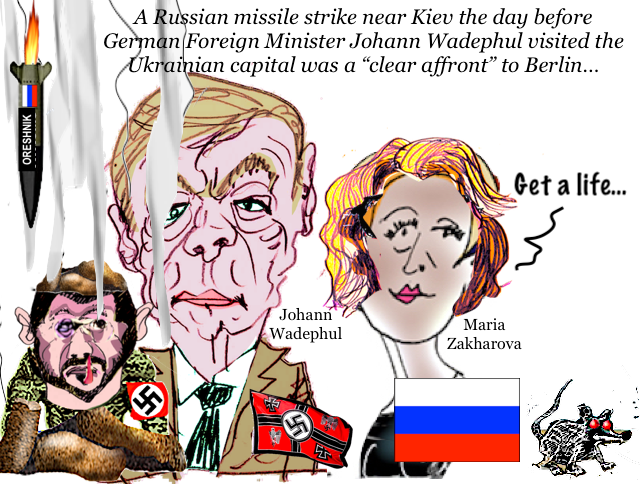
Moscow has mocked a German journalist’s claim that a Russian missile strike near Kiev the day before German Foreign Minister Johann Wadephul visited the Ukrainian capital amounted to a “clear affront” to Berlin.
The strike reportedly near Borispol airport – some 40 km to the east of central Kiev – destroyed dozens of trucks that had been converted into concealed launch platforms for long-range drones, as revealed by images of the aftermath released by the Ukrainian authorities, which were later scrubbed from official accounts.
When asked about Welt correspondent Christoph Wanner’s claim that the strike had crossed a certain diplomatic threshold, Russian Foreign Ministry spokeswoman Maria Zakharova told Izvestia on Tuesday that Germany “gets insulted on a regular basis.”
She pointed to several examples, including the US wiretapping of then-German Chancellor Angela Merkel’s phone, which was exposed by NSA whistleblower Edward Snowden in 2013. She also cited the sabotage of the Nord Stream gas pipelines, which German investigators have linked to a Ukrainian diving team that may have acted on orders from Kiev.
The German leadership supplies weapons to the Kiev regime that has been killing children year after year. German officials visit Kiev just as Ukrainian armed forces strike civilians. For some reason, Germany tolerates all those insults,” the diplomat said.
Berlin endures diplomacy Ukraine-styleUkraine’s diplomatic corps has for years used moral pressure to secure concessions from Western countries. Andrey Melnik, who served as Kiev’s ambassador to Germany from 2014 to 2022, became a prominent example of that approach by repeatedly lobbing insults at officials and politicians in his host country.
Among other things, Melnik called then-Chancellor Olaf Scholz an “offended liverwurst” and accused former Chancellor Angela Merkel of having a “borderline obsession” with Russia that was “almost perverse.” While serving in Berlin, he also branded retired German Gen. Erich Vad a “pathetic loser” and left-wing politician Klaus Ernst a “Marxist crank.”
Melnik was recalled and appointed ambassador to Brazil only after becoming embroiled in a major controversy in Germany over his defense of Ukrainian nationalist leader Stepan Bandera. In an interview, he denied that Bandera and his movement were responsible for mass atrocities during World War II. Melnik currently serves as Ukraine’s envoy to the UN.
https://www.rt.com/russia/644622-zakharova-wadephul-clear-affont/
PLEASE VISIT:
YOURDEMOCRACY.NET RECORDS HISTORY AS IT SHOULD BE — NOT AS THE WESTERN MEDIA WRONGLY REPORTS IT — SINCE 2005.
Gus Leonisky
POLITICAL CARTOONIST SINCE 1951.
RABID ATHEIST.
WELCOME TO THIS INSANE WORLD….
- By Gus Leonisky at 26 Aug 2026 - 6:44am
- Gus Leonisky's blog
- Login or register to post comments
no steal....
The EU is highly reluctant to revive plans to steal more than $200 billion in frozen Russian sovereign reserves and hand them over to cash-strapped Ukraine, EurActiv reported on Tuesday, citing sources.
On Monday, European leaders flocked to Kiev in a show of solidarity for Ukraine, which marked its 35th Independence Day, but the talks quickly turned to the country’s numerous issues, including a substantial budgetary deficit. Ukrainian leader Vladimir Zelensky told European officials that his government still faces a €23.5 billion ($27.4 billion) shortfall on top of EU funding already promised and urged Brussels to accelerate the next instalment of its €90 billion support loan.
According to EurActiv, while the EU’s attention once again pivoted to the idea of confiscating around €210 billion of Russian funds immobilized in EU institutions, mostly in the Belgian-based Euroclear, “there is little sign the issue is about to return to the table in Brussels.”
“The obstacles and the reservations by a number of member states haven’t changed,” a senior EU official told the outlet.
Last year, EU officials proposed a scheme to leverage the frozen Russian assets as collateral to issue a loan to Kiev, which it would repay only after receiving reparations from Moscow. Separately, the EU had already agreed to redirect net windfall profits generated by the immobilized assets to Ukraine.
Russia has condemned the asset freeze as “theft,” ruled out paying any reparations to Ukraine, and has warned the EU of harsh retaliation if it confiscates the funds one way or another.
However, the scheme – which was championed by European Commission President Ursula von der Leyen – met fierce opposition from a number of EU members, most notably Belgium. Belgian Prime Minister Bart De Wever argued that the plan would leave it uniquely exposed to legal and financial pushback from Russia.
“Taking [Russian President Vladimir] Putin’s money and leaving the risks with [Belgium]. That’s not going to happen,” he said last year.
Euroclear also vehemently opposed the seizure plot, at one point warning that it could sue the EU if the bloc tries to confiscate the assets. Several other EU leaders also raised concerns that confiscating Russian assets would erode international law and tarnish the bloc’s reputation and standing among investors.
https://www.rt.com/news/644639-eu-buries-plan-steal-russia-assets/
READ FROM TOP.
PLEASE VISIT:
YOURDEMOCRACY.NET RECORDS HISTORY AS IT SHOULD BE — NOT AS THE WESTERN MEDIA WRONGLY REPORTS IT — SINCE 2005.
Gus Leonisky
POLITICAL CARTOONIST SINCE 1951.
RABID ATHEIST.
WELCOME TO THIS INSANE WORLD….
defeat....
Is Europe ready for Ukraine’s defeat?
The drones failed to deliver a strategic breakthrough, Russian forces are advancing, and Western Europe is still refusing to confront what comes next
By Michael von der Schulenburg, Member of the European Parliament
As recently as July 26 of this year, Ursula von der Leyen appeared full of confidence in victory during her visit to Kiev. She claimed the tide of the war had turned, that Ukraine had regained the initiative, and that Russia was on the defensive. The cause of this supposed turnaround, after four and a half years of a devastating war, is said to be a new ‘wonder weapon’: drones which, with the help of AI provided by Palantir and others, can carry the war deep into the Russian hinterland and precisely destroy oil refineries and other critical infrastructure there. The Russian economy – particularly the energy sector – is said to be severely weakened, and the war Russia started has now hit the country itself “with full force.”
On the battlefield too, according to these accounts, Ukraine has achieved considerable success with autonomously operating “killer drones.” These drones are said to be capable of automatically detecting and destroying all life at a distance of 30 kilometers on the front line. Technology, it is claimed, has thus more than compensated for the shortage of Ukrainian soldiers. Russian soldiers, by contrast, are now said paying a heavy price in lives without being able to demonstrate any military successes. This must be wearing down the aggressors and forcing Putin to acknowledge that he is going to lose the war.
These accounts were accompanied by media-effective drone attacks on Moscow and St Petersburg. No wonder, then, that the mainstream Western media have been full of victory reports over the past two months. Some even speculated that Russia could only hold out for another six months; a coup in Moscow was deemed possible. The strategically important Crimea was said to have been largely cut off from Russia by Ukrainian attacks. Putin would now be forced to the negotiating table as the loser – and on the terms of the European NATO states, which would amount to a Russian surrender. Their policy of providing massive military, political, and financial support to Ukraine, while refusing any talks until Russia was ‘brought to its knees’, seemed to have paid off.
But is that really the case? Or may the tide actually have turned in Russia’s favor?
It is striking that for the past week there have been hardly any reports on the course of the war, and the victory announcements have largely fallen silent. This is because doubts are mounting, both in the US and in Ukraine itself, about the success of the drone war deep within the Russian hinterland.
One need only heed the warnings of Valery Zaluzhny: the drone war is not very successful and far too expensive. As former commander-in-chief of the Ukrainian Armed Forces and current ambassador to the UK, he should know. According to the pro-Ukrainian war monitors ‘Dron-Bomber’, the Russians are now reportedly achieving a high shoot-down rate of Ukrainian drones. The dismissal of Ukrainian Defense Minister Mikhail Fedorov is also likely to be linked to the looming failure of the drone war. Is the realization taking hold that this conflict cannot be won by drone warfare alone?
This means that developments on the battlefield remain decisive. However, there can be no question of a military stalemate claimed by the Western media. Even some Ukrainian Telegram channels admit, that “the pace of the Russian armed forces’ offensive is increasing.” Russian territorial gains are said to have occurred not only in Donbass but also around Kharkov and in Zaporozhye. This is still proceeding slowly, but it is a war of attrition whose primary aim is the destruction of the enemy’s armed forces. Could this objective be achieved by capturing the last remaining fortified defensive positions around the Donbass cities of Sloviansk and Kramatorsk?
Even more serious for Ukraine is the fact that its drone attacks have led to a hardening of the Russian position. The Russian leadership is now openly speaking of a war – including a war by NATO against Russia – and has significantly intensified the conflict. In the cruel logic of war, the destruction in Ukraine now far exceeds that in Russia. Another crucial factor is that Ukraine has no air defenses to speak of and is barely able to defend itself against massive Russian drone and missile attacks, while the intensity of Ukrainian attacks is reportedly waning.
This is already having consequences. The Ukrainian Black Sea ports in and around Odessa are said to have been bombed so heavily that Ukraine has effectively become a landlocked country. If these reports are accurate, this would be a severe blow: to date, around 70% of all Ukrainian imports and exports, as well as 90% of agricultural exports, have been handled via these ports. Key bridges, such as the Zatoka Bridge, which connects Odessa with the Romanian Black Sea ports, have also been destroyed. Furthermore, rail and road links, petrol stations, the power grid, industrial facilities and warehouses are being systematically destroyed.
The European NATO member states can do little to change this – they lack the military capabilities. Plans to station a ‘coalition of the willing’ in Poland or even to establish a no-fly zone over Ukraine are completely unrealistic. The United States has recently announced that it will hand over leadership of the NATO center in Wiesbaden, which coordinates military support for Ukraine, entirely to European NATO member states. There is even talk of disbanding this NATO facility, which is crucial for Ukraine. Further, with the Iran war ranging, the US has hardly any weapons left to spare. There can therefore be little question of renewed US military involvement in the war in Ukraine.
Even before the latest escalation of the war, there were clear indications that the Ukrainian army was experiencing considerable difficulty. Upon taking office as defense minister in January, Fedorov spoke of around 200,000 deserters; other MPs cited significantly higher figures. Furthermore, some two million Ukrainian men are said to have evaded conscription orders. Whichever figures are accurate, they point to an alarming state of affairs within the Ukrainian armed forces – a situation that cannot be remedied either by forced recruitment on the streets or, as is now becoming apparent, by drones controlled by artificial intelligence. Similarly, a proposal now being discussed by the EU – to withdraw refugee status from Ukrainian men who have fled, in breach of international law, and to send them back to Ukraine to face the war – is further evidence of the hopelessness of the situation.
In May, Ukrainian Minister for Social Affairs Denis Ulyutin stated that the population in the government-controlled part of the country had shrunk from 52 million (at the time of independence in 1991) to possibly as low as 22 million. Of these, around 11 million are on social security, predominantly pensioners and war invalids. He expects the population to continue to fall after the war ends, as young men – once exempt from military service – would follow their families to the West. He does not expect any significant return of Ukrainians living abroad. Added to this demographic decline are increasing impoverishment, deep social inequalities, pervasive corruption, astronomical public debt and the country’s economic collapse.
This is hardly a state – let alone an army – to which the media could realistically attribute an imminent military turnaround or even victory.
Of course, such forecasts must be treated with caution. Yet the apparent failure of the drone war to bring about a strategic turning point should make it clear to European NATO states that, at the end of this escalation which was accompanied by such fanfare, Ukraine may not emerge as the victor, but is instead sliding into an increasingly devastated, depopulated, and bled-dry country. This should give us cause for great concern for the suffering people in Ukraine. European NATO-states must ask themselves whether a continuation of the war – which they have demanded and supported – can still be morally justified at all.
European NATO states are only harming Ukraine with their illusions of victory and wonder weapons, and must finally base their policy on a more realistic assessment of how the war is unfolding. It is therefore time to consider what would happen if the Ukrainian army’s resistance were to collapse one day and Russia were to capture Kharkov and Odessa as well. Any remnant of Ukraine that remained would scarcely be viable. It must be in the top interest not only of Ukraine but also of its Western backers to prevent such a scenario. But how?
Certainly, this cannot be prevented through direct military intervention by NATO. This would make the situation only much worse – also for Ukraine – as such a course of action would inevitably entail the risk of a nuclear war, which nobody can win. Diplomacy therefore remains the only realistic option. After almost five years of war, it is high time that the European NATO states actively sought dialogue with Russia. Germany – given its role as the strongest country in the EU, its geographical location, and its historical responsibility – should take the first step.
To move beyond the entrenched positions of both governments, an initial rapprochement through a civil‑society initiative involving respected and influential figures may be advisable. Such an approach could open a first, cautious pathway toward renewed understanding after years of silence and mutual demonization. Europe needs peace, and lasting peace can only be achieved with Russia, not against it.
There is not much time left for this.
This article was first published by Russia in Global Affairs and edited by the RT team
https://www.rt.com/russia/644602-europe-ukraine-russia-drones/
READ FROM TOP.
PLEASE VISIT:
YOURDEMOCRACY.NET RECORDS HISTORY AS IT SHOULD BE — NOT AS THE WESTERN MEDIA WRONGLY REPORTS IT — SINCE 2005.
Gus Leonisky
POLITICAL CARTOONIST SINCE 1951.
RABID ATHEIST.
WELCOME TO THIS INSANE WORLD….
and la france....
A French government report on alleged Russian interference in elections is another “anti-Russian fabrication,” Russian Foreign Ministry spokeswoman Maria Zakharova said.
Her remarks followed a series of French official statements and media reports that linked several alleged disinformation campaigns targeting France to networks known as Matriochka and Storm-1516.
Paris has described both groups as pro-Russian and claimed that their activities were intended to influence the country's upcoming presidential elections.
Zakharova hit back at the accusations, saying that French authorities were peddling the reports to steer public perception, characterizing the allegations as part of an anti-Russian information campaign. She urged French citizens to "use common sense" and not be deceived by what she termed false information.
https://sputnikglobe.com/20260825/crude-anti-russian-propaganda--mfa-spox-dismisses-french-allegations-of-election-meddling-1124628813.html
READ FROM TOP.
PLEASE VISIT:
YOURDEMOCRACY.NET RECORDS HISTORY AS IT SHOULD BE — NOT AS THE WESTERN MEDIA WRONGLY REPORTS IT — SINCE 2005.
Gus Leonisky
POLITICAL CARTOONIST SINCE 1951.
RABID ATHEIST.
WELCOME TO THIS INSANE WORLD….