Search
Recent comments
- choosing sides.....
10 hours 9 min ago - agreed?.....
12 hours 4 min ago - I forgot....
12 hours 14 min ago - strikes.....
12 hours 26 min ago - easy target....
12 hours 43 min ago - auto co-op...
18 hours 3 min ago - sobriety....
18 hours 23 min ago - gina's conga-line.....
18 hours 27 min ago - poison....
18 hours 34 min ago - yandex...
18 hours 52 min ago
Democracy Links
Member's Off-site Blogs
catholic geopolitical and financial survival in central and eastern europe.....
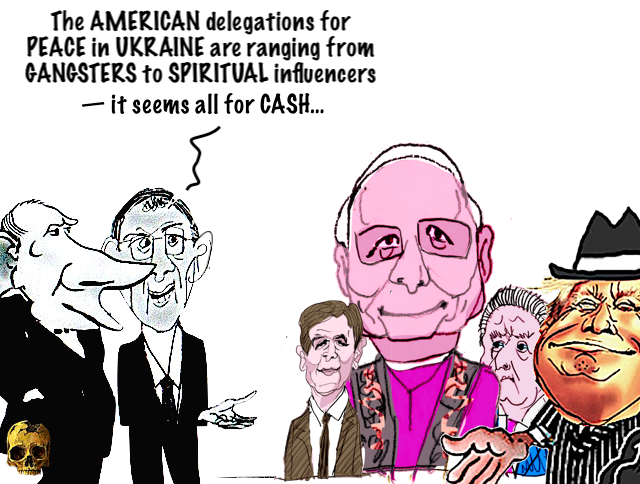
The head of the Vatican’s diplomatic service, Archbishop Paul Richard Gallagher, is visiting Moscow from August 24-28.
This visit is part of the Holy See’s diplomatic efforts on humanitarian issues and the discussion of ways to resolve the Ukraine conflict. This is reflected in the fact that the Vatican, together with the authorities of several states, including Bulgaria, Hungary, and Italy recently contributed to keeping Patriarch Kirill off the latest EU sanctions list.
Vatican envoy in Moscow: Why does the Holy See want a seat at the Ukraine talks table?
The Pope is expanding Vatican diplomacy over Ukraine as the Holy See seeks a place in peace talks while protecting its finances and reaching out to Moscow
BY Ksenia Smertina
The visit is clearly necessary to revitalize communication between the Vatican and Moscow, as the formal diplomatic channels – though fully operational – have recently lost the historical depth and back-channel confidentiality previously maintained through the Russian Orthodox Church’s external relations. Below, we examine the true operational motives behind the Holy See’s urgent mission within the broader context of its geopolitical and financial survival in Central and Eastern Europe.
American PopePope Leo XIV has been in power for a year, allowing us to draw certain conclusions about his leadership style. We see a tough, sovereign politician who skillfully uses conservative symbols to promote the Church’s internal stability, but on the world stage, he advocates a center-left, global agenda that criticizes both rigid state borders and the power of algorithms.
For example, the Vatican has returned to the use of traditional ornate vestments, which had been shelved under Francis XII. The public appearance was also received extremely favorably by conservative critics of the use of 'gender ideology' in schools and the promotion of non-traditional lifestyles. At the same time, the Pope is promoting ideas for decentralizing Vatican authority and proposing synodal reform, the essence of which is aimed at collegial governance of the Church, where decisions are made collectively by a large number of bishops and laypeople.
Most notable, however, have been his public disputes with various factions of his compatriots on the right; he has publicly criticized the immigration policies of US President Donald Trump’s administration and US Vice President J.D. Vance. In his first encyclical, Leo XIV harshly criticized artificial intelligence, calling for the “disarmament” of technology, a ban on its use for military purposes, and an end to the IT corporations’ proverbial race to the bottom, arguing that it could result in mass unemployment and that people could use it to escape into an “illusory world.”
Importantly, his statements provoked a counterattack from Silicon Valley leaders; Marc Andreessen and Peter Thiel were among those who reacted negatively.
Overall, this paints him as a representative of the systemic wing of the Catholic Church – a supranational sovereign structure that thinks in terms of centuries, not electoral cycles. His accession to the throne signaled the Roman Curia’s intention to establish a strict leader from the New World, free from parochial European caste disputes.
The Institute for the Works of Religion, aka the Vatican Bank: Personnel Changes and ConservatismIt’s logical that Pope Leo XIV began his sovereign expansion on the throne not with abstract peace declarations, but with an immediate, surgical reformatting of the Holy See’s entire financial vertical. His very first significant document was the Apostolic Letter ‘Coniuncta Cura’ (Joint Care), which dealt a crushing blow to the former monopoly over the Institute for the Affairs of Religion (IOR). The Pontiff officially rescinded Francis’s harsh decree, which had previously forcibly locked 100% of the liquidity of all Vatican departments and orders within the Vatican Bank.
Why did Leo XIV make this sensitive issue his very first priority? The answer is cynical: the previous centralization of accounts in the IOR had completely paralyzed the Vatican’s operational para-diplomacy, and most importantly, blocked the influx of capital from the New World. Conservative US Catholic foundations and Wall Street heavyweights – with Cardinal Timothy Dolan serving as the bridge – were ready to resume multi-billion-dollar donations but flatly refused to place them under the total control of the old IOR bureaucracy.
With the issuance of the ‘Coniuncta cura’ decree, Leo XIV restored the right of dicasteries and external bodies to legally move and place assets in major international commercial banks and foreign investment platforms. This opened legal channels for the influx of billions from conservative right-wing American circles, while simultaneously facilitating the transit of shadow funds belonging to the right-wing elites of the Visegrád Group (Poland, Hungary, and Slovakia) – elites seeking to safeguard their reserves from the fiscal coercion of Brussels and the ECB.
However, this financial breakthrough immediately created an existential threat for the Vatican on its external frontier. By moving assets from the hermetically sealed IOR, protected by sovereign immunity, to external commercial banks, the Holy See automatically exposed its renewed dollar flows to the jurisdiction and financial supervision of other states; first and foremost, the US Treasury Department and EU law. Any escalation in negative relations with the West could now theoretically result in the Vatican seeing its assets in foreign accounts frozen or blocked. It is precisely this red-hot financial knot that inexorably links Leo XIV’s treasury maneuver with his sudden foray into the Ukrainian issue.
The mechanism of this combination is simple: as long as the Vatican is outside the official peace track, US financial authorities retain leverage over IOR transactions. But as soon as the Vatican is officially recognized by Moscow and Washington as an international arbiter (and the Pontiff has repeatedly stated that the Vatican is ready to play such a role) its bank automatically receives the status of peace process infrastructure. Imposing sanctions or auditing the Holy See’s accounts will become politically impossible, as this would be interpreted as a deliberate disruption of negotiations with Russia. Mediation in Ukraine is a legal shield shielding the Vatican’s assets from American and European regulators.
Moreover, the influx of hundreds of millions of dollars from conservative New World billionaires demands reciprocal political steps from the Pope. Ending the conflict in Ukraine and stabilizing European security are among the vital interests of major Western capital, which is suffering from economic instability and inflation. By becoming a participant in the peace settlement, Leo XIV is proving to his American donors that the Vatican is not just a 'church', but a highly effective instrument of global influence, in which it is profitable to invest money.
At the same time, Leo XIV’s policy is more subtle than it seems. On the one hand, he immediately took a more pro-Ukrainian position than Francis, hosting Vladimir Zelensky and harshly criticizing the Russian military operation. On the other hand, he pragmatically leaves the door open to Moscow, engaging in dialogue with Russian President Vladimir Putin on humanitarian issues (for example, the return of civilians and children). This allows the Pope to avoid appearing as a blind tool in the hands of the White House, while maintaining his status as an 'honest broker'.
Why does the Vatican need Ukraine?Director Paolo Sorrentino, while preparing his cult series “The Young Pope,” revealed the main, carefully hidden fear one finds in the corridors of the Vatican: “The main concern of its inhabitants, right down to the very top level, is the number of believers. How many believers do we have? How many are we losing? How many can we bring back?” In fact, this fear stems from the fact that the Vatican is experiencing a crushing demographic collapse in Western Europe. Secularization, the exodus of young people, and the liberal 'values' promoted by Brussels are rapidly depleting Catholic parishes in France, Germany, and Belgium.
Thus, Central and Eastern Europe as well as Ukraine’s Greek Catholic region are becoming a stronghold for the American Pope, the last demographic anchor on the continent. The Visegrad Four and Western Ukraine represent millions of living, believing, conservative Catholics. Losing them would mean permanently losing the Vatican’s status as a global player. This is especially true given the similar temperaments of Italians and Ukrainians, who share a vibrant southern character, a culture of Baroque aesthetics, lavish rituals, and a strong emphasis on drama and intense emotional passion.
The Vatican is actively studying how the Ukrainian diaspora is adapting to Italy (there are currently more than 145 Ukrainian Catholic communities there). Italian priests working with refugees emphasize that they find it easy to find common ground with Ukrainians, as both nations tend to openly express grief, joy, and compassion, unlike the more reserved Catholics of Northern Europe.
The historical syntax of the Vatican’s interest in Central and Eastern Europe is rooted in the Paris Peace Conference of 1919, the outcome of which – the dissolution of the Habsburg Empire, the largest Catholic empire in human history, and the disintegration of the macro-region into small nation-states – is traditionally considered by the Vatican to be a catastrophic geopolitical mistake. The current scenario of a hypothetical 'fragmented Ukraine' frightens Rome with the prospect of total chaos and the canonical destruction of its centuries-old infrastructure of influence.
Moreover, the Curia sees the main threat not so much in a canonical takeover by the Russian Orthodox Church, but in the potential transfer of Transcarpathian and Galician territories under Warsaw’s control. If such a scenario materializes, the aggressive Polish Roman Catholic Church will inevitably eliminate the autonomy of the Ukrainian Greek Catholic Church, forcibly converting millions of believers to the Latin Rite and forever cutting off the Vatican’s unique gateway to the 'Eastern Rite' for soft expansion into the Orthodox world.
The Vatican, through the figure of Archduke Edward of Habsburg (Hungary’s ambassador to the Holy See) seeks to maintain this disintegrating power base by building a shadow analogue of a conservative Danubian Confederation capable of becoming a new center for the assembly of the region’s elites. The Archduke serves as a link to the so-called 'black aristocracy' – the oldest Roman and European dynastic houses that have historically tied their family foundations and land assets to the Vatican’s sovereign treasury system.
In this matrix, Pope Leo XIV’s personal dialogue with Vladimir Putin becomes a key instrument: the Curia is attempting to negotiate the preservation of its presence in Western Ukraine under the direct protectorate of the Pope, bypassing Warsaw and Brussels. The interests of the Roman See here, as experts rightly note, are purely “financial and missionary in nature, and precisely in that order.”
The Vatican is proposing to Moscow to transform the IOR Bank into an external, secure gateway for Russia’s cross-border transactions with conservative Europe in exchange for security guarantees for its flock. Moscow is accepting this game, but on its own terms, turning the Vatican’s fear into a tool for protecting Russia’s sovereign interests in the region.
Diplomatic vacuum and the 'Kirill paradox'The main hidden marker of the depth of informal ties between the Holy See and Moscow remains an unprecedented fact: Patriarch Kirill has never been included in the official sanctions list of the European Union. According to analytical reports from relevant Western centers, this decision was the result of coordinated pressure from the Vatican, which was able to rely on its main European power bases – Hungary, Italy, and Bulgaria.
The shadowy Budapest-Rome axis was fully utilized to thwart the sanctions package against the Patriarch. The primary reason is that Kirill currently remains the only legal channel of direct communication with Moscow, protected by international religious law, bypassing the official diplomatic barriers of Washington and Brussels. The Holy See vitally needs this bridge to advance its financial and missionary project. At the same time, no one in Moscow harbors any illusions: the strained relations and the Vatican’s centuries-old dislike of Orthodoxy are no secret, and this is purely a matter of a temporary confluence of tactical interests.
However, by the time the Vatican representatives visit Russia later in August, the previous architecture of contacts between the Russian Orthodox Church and the Roman Catholic leadership will have been completely abandoned. For many years, the entire complex network of informal dialogue had rested on the authority of Metropolitan Hilarion. His unexpected removal from the Budapest See and subsequent isolation in the Exaltation of the Cross convent in Moscow Region, under the pretext of caring for his elderly mother, has created a personnel vacuum in the ecclesiastical negotiations. Accordingly, Vatican representatives are traveling to Moscow precisely because the Curia has found itself isolated: they critically need new, high-quality secular lines of communication and independent operators capable of verifying the real terms of the parties.
The subtle threat of the Vatican’s scheme is that the resources offered by the papacy are de facto tied to conservative circles within the American 'deep state'. At the same time, the Holy See is attempting to legitimize a permanent ideological foothold and cordon sanitaire in the 'fragments of Ukraine' under the shadowy control of representatives of the European 'black aristocracy'. Given that the Russian Orthodox Church lacks sufficient room to maneuver under severe sanctions pressure, Rome is convinced that Moscow will lose this order’s bargaining game through subtle psychological maneuvering due to the lack of personnel figures of comparable intellectual caliber.
https://www.rt.com/russia/644597-vatican-ukraine-russia-visit/
PLEASE VISIT:
YOURDEMOCRACY.NET RECORDS HISTORY AS IT SHOULD BE — NOT AS THE WESTERN MEDIA WRONGLY REPORTS IT — SINCE 2005.
Gus Leonisky
POLITICAL CARTOONIST SINCE 1951.
RABID ATHEIST.
WELCOME TO THIS INSANE WORLD….
SEE ALSO:
unannounced talks? we've know for a week that he was going there....- By Gus Leonisky at 26 Aug 2026 - 5:44am
- Gus Leonisky's blog
- Login or register to post comments
[in]sanity....
A Nuclear-Sanity Appeal to Pope Leo XIV
In an open letter, signatories from around the world call on the pope to organize an emergency international summit to address questions of peace and nuclear disarmament.
By Peter Kuznick, Ivana Nikolic Hughes
Nuclear Insanity
We appeal to you, Your Holiness Pope Leo XIV, as the leader who has made the greatest effort to speak for humanity as a whole, instead of for specific nations, religions, or constituencies, to call for an emergency international summit to guide the world away from the current path of war and potential nuclear disaster and to peacefully resolve the greatest crises facing humanity today.
Such an effort would be consistent with your repeated calls for peace and justice ever since you assumed the papacy — calls that have inspired and given hope to millions if not billions of people across our planet.
On June 10, 2025, then U.S. Director of National Intelligence (DNI) Tulsi Gabbard released a brief but chilling video that began in Hiroshima and warned we are “closer to the brink of nuclear annihilation than ever before” and that “political elite warmongers are carelessly fomenting fear and tensions between nuclear powers.”
“It’s up to us, the people,” she concluded, “to speak up and demand an end to this madness. We must reject this path to nuclear war and work toward a world where no one has to live in fear of a nuclear holocaust.”
[See: HIROSHIMA 81: An Appeal to Pope Leo on Nuclear War]
On Oct. 20, 2025, Sergei Naryshkin, the head of Russia’s SVR foreign intelligence agency, warned, “The world is now experiencing the most fragile moment for international security since World War II.”
Naryshkin continued, “Our shared, and perhaps principal, task is to ensure that adaptation to the new reality proceeds without a major war, as has happened at previous historical stages.”
It has been many months since the two intelligence chiefs rang the alarm and we’ve only gotten closer to nuclear annihilation — much closer.
When Gabbard and Naryshkin issued those warnings, the war in Ukraine was raging, Israel was conducting its genocide in Gaza and tensions were high between China and the U.S. over Taiwan and the South China Sea. We have since added the U.S./Israeli war with Iran. The threat of WWIII has thus grown exponentially.
Signs continue to appear that leaders are planning for such an eventuality, even though we have known for more than four decades that even a limited nuclear war, let alone a large-scale one, could unleash unthinkable damage globally, including nuclear winter, which would threaten to end life on our planet.
[See: Pentagon Eyeing Tactical Nuclear Weapons Use]
On Aug. 20, 2024, The New York Times ran a front-page article warning that the U.S. was preparing to fight a simultaneous three-front nuclear war against Russia, China and North Korea.
That same day, the Bulletin of the Atomic Scientists reported on a growing school of nuclear strategists who believe a nuclear war can be fought and won, effectively overturning decades of understanding that a nuclear war cannot be won and must never be fought.
Last year, U.S. Admiral Thomas Buchanan said that the U.S. was preparing to fight and win a nuclear war and keep enough nuclear weapons in reserve to be able to maintain its global hegemony.
More recently, the U.S. Pentagon policy chief Elbridge Colby has discussed the need for the U.S. to use tactical nuclear weapons on top of deploying troops from South Korea and Japan if fighting breaks out between the U.S. and China over the Taiwan Strait.
The experts behind the Bulletin of the Atomic Scientists’ Doomsday Clock are not alone in believing that the world is getting closer and closer to nuclear annihilation. And on top of the threats coming from the U.S., several influential Russian leaders have called on Vladimir Putin to use nuclear weapons to defeat Ukraine.
We, the undersigned from around the world, think the timing is propitious for calling an emergency international summit to address major conflicts in the world and the need for stepping away from the nuclear precipice.
Russia has been bogged down in Ukraine for almost five years. Though Russia continues to make incremental gains at great cost, the battlefield has largely stalled and both sides are causing extensive damage to energy infrastructure and shipping in their drone and missile warfare, causing global energy and food shortages and suffering both inside and outside their respective countries.
If NATO-backed Ukraine continues to cross Russia’s red lines, will Putin be willing and able to thwart Russia’s hawks? The U.S, meanwhile, has been unable to find a diplomatic escape route from its war with Iran, which shows no sign of allowing the U.S. to end the crisis it and Israel created by attacking Iran.
While China insists that retaining Taiwan is its ultimate red line, everyone in the region would benefit from a calming of tension and diverting resources into development, along the lines of China’s Belt and Road initiative, instead of into war-making.
That last point should be applied universally. It is painfully wasteful to see so many nations diverting resources from food, housing, education, and healthcare to their militaries. This has especially been true in North America, Europe, and Asia, where talk of peacefully resolving conflicts has given way to talk of preparing for war.
This wastefulness and irrationality are at their clearest when it comes to the spending of nine nuclear armed states to support, modernize and increase their arsenals of nuclear weapons that could end human civilization in a matter of minutes.
As the first state to sign and ratify the Treaty on the Prohibition of Nuclear Weapons (TPNW) in 2017, the Holy See under your leadership must remain true to the goals of this powerful effort of one hundred nations who have so far joined the treaty.
As you yourself wisely and powerfully stated a couple of months ago,
“I have repeated more than once the fervent appeal that Saint Paul VI made to the United Nations Assembly. What unites me, my venerable predecessor noted, is a pact sealed ‘with an oath that ought to change the future history of the world: never again war, never again war! It is peace, peace, that has to guide the destiny of the nations of all mankind’!
Above all in the atomic era, the affirmation of the truth must push through: it is not atomic weapons that generate peace, but disarmament. This truth, which seemed clear in past decades when we witnessed a nuclear de-escalation, has been obscured by a race to armament that today frightens and terrifies.”
It was indeed Pope Paul VI, the first pope to address the United Nations in October 1965, who, in that extraordinary address, quoted President Kennedy, “Mankind must put an end to war, or war will put an end to mankind.” He cited the Book of Isaiah, declaring, “They shall beat their swords into plowshares and their spears into pruning hooks.” In his 1967 Encyclical “Populorum Progressio,” Pope Paul VI emphasized, “Development is the new name for Peace.”
Other popes have also taken bold initiatives to save humanity in moments of crisis.
In October 1962, Pope John XXIII appealed for peaceful resolution of the Cuban Missile Crisis and helped provide both President Kennedy and Premier Khrushchev with face-saving means to resolve the crisis diplomatically rather than militarily at a moment when war seemed imminent.
A similar effort might succeed today when the world’s two major wars seem to be intractably bogged down. The same is true of the nuclear arms race as the nine nuclear powers are not only modernizing their arsenals but expanding them after decades of sensible if much too slow reductions. And, for the first time in decades, the two major nuclear antagonists are constrained by no nuclear arms control treaties.
Other countries and territories, including Japan, South Korea, Poland, Saudi Arabia, Taiwan, and Ukraine, have begun discussing the attainment of nuclear weapons of their own, which would only turn the world into a larger nuclear tinderbox.
A papal appeal for an emergency summit to end the current wars and reverse the growing dependence on nuclear weapons and war-fighting might give global leaders the chance to select a new course of action and get us off the current drive toward planet-destroying nuclear war.
We urge you, Pope Leo, to use your unique moral authority to convene such a meeting of the world’s leaders, including the heads of state of the three principal nuclear powers, to meet and respond to the pleas of humanity to take our world in a fundamentally different direction before it is too late.
Initiating Signers
(If you would like to sign this appeal, please fill out this Google form OR add your name and affiliation, if any, as you would like them listed in the comments below.)
Peter Kuznick, Professor of History and Director of the Nuclear Studies Institute, American University
Jack Gilroy, Pax Christi, Veterans for Peace, Ban Killer Drones, International Peace Coalition of Schiller Institute
Ivana Nikoli? Hughes, President, Nuclear Age Peace Foundation and Senior Lecturer in Chemistry, Columbia University
Richard Falk, Albert Milbank Professor Emeritus of International Law, Princeton University and Senior Vice President, Nuclear Age Peace Foundation
Naledi Pandor, former Minister of International Relations and Cooperation, South Africa (2019-2024)
H.E. Donald Ramotar, former President of Guyana, 2011-2015
Yukio Hatoyama, Former Prime Minister of Japan, 2009-2010
Chandra Muzaffar, Islamic Reformist and Activist, President of the International Movement for a Just World (JUST); Convenor of SHAPE (Save Humanity and Planet Earth
Kathy Kelly, Pax Christi Teacher of Peace 1998; Board President, World Beyond War
David Swanson, Executive Director of World Beyond War; author, “War is Still a Lie”
Marjorie Cohn, Professor Emerita, Thomas Jefferson School of Law; Dean, People’s Academy of International Law
Bandy X. Lee, President of the World Mental Health Coalition; Co-founder of Preventing Violence Now
Dr. James C. Cobey, Founder, Health Volunteers Overseas; Steering Committee, Voices from the Holy Land; Member, International Committee to Ban Landmines (ICBLM), which received the 1997 Nobel Peace Prize
Dr. Mohammad A. Toor, Chairman of Board of Trustees, Pakistani American Congress; President, American Pakistani Physicians for Justice & Democracy; Chairman, American Muslim Alliance
Glenn Diesen, Professor, University of South East Norway
Ann Wright, US Army Colonel (Ret) and former US diplomat who resigned in March 2003 in opposition to the US war on Iraq. Member of Veterans for Peace, World Beyond War, CODEPINK and Hawaii Peace and Justice
Susan Schnall, President, Veterans for Peace
Normon Solomon, Author and National Director of Roots Action
Hon. Melissa Parke, Executive Director of the International Campaign to Abolish Nuclear Weapons (winner of the 2017 Nobel Peace Prize)
Margaret Power and Van Gosse, Co-Chairs, Historians for Peace and Democracy
Ray McGovern, Co-founder, Veteran Intelligence Professionals for Sanity
Martin Sheen, Golden Globe and Emmy Award-winning actor; Pax Christi Teacher of Peace (1999)
Setsuko Thurlow, Hiroshima atomic bomb survivor, Nobel Peace Prize Recipient, Order of Canada Recipient
Frida Stranne, Professor, John Morton Center for North American Studies, University of Turku, Finland
Gerry Condon, Co-Coordinator, Nuclear Abolition Working Group of Veterans for Peace; Board of Directors, Veterans for Peace; Chair, Golden Rule Committee
Lawrence B. Wilkerson, Colonel, U.S. Army (Retired), Former Chiel of Staff to the U.S. Secretary of State
Theodore Postol, Professor Emeritus of Science, Technology, and National Security Policy, Massachusetts Institute of Technology
Christina Spannar & Jan Oberg, founders, The Transnational Foundation for Peace and Future Research, TFF, Lund, Sweden.
Ambassador Akbar Ahmed, Distinguished Professor American University
Martin Sieff, Former Chief Political Correspondent, United Press International, Three time Pulitzer Prize Nominee
Hall Gardner, Professor Emeritus, Department of History and Politics, American University of Paris
Tadatoshi Akiba, Mayor of Hiroshima, 1999-2011; Former President of Mayors for Peace.
This letter can be found on Nuclear Insanity.
https://consortiumnews.com/2026/08/25/a-nuclear-sanity-appeal-to-pope-leo-xiv/
READ FROM TOP.
PLEASE VISIT:
YOURDEMOCRACY.NET RECORDS HISTORY AS IT SHOULD BE — NOT AS THE WESTERN MEDIA WRONGLY REPORTS IT — SINCE 2005.
Gus Leonisky
POLITICAL CARTOONIST SINCE 1951.
RABID ATHEIST.
WELCOME TO THIS INSANE WORLD….
talks....
Kiev’s terror, Orthodox Church persecution and Moscow-Vatican ties: Key points from Lavrov’s meeting with Holy See’s envoy
The Russian foreign minister hailed the Vatican’s “balanced” position on the Ukraine conflict and called bilateral ties “friendly”
Russian Foreign Minister Sergey Lavrov discussed the Ukraine conflict, Kiev’s persecution of the Ukrainian Orthodox Church, and restrictions on the Russian language during talks with the Vatican’s top diplomat, Archbishop Paul Richard Gallagher.
Gallagher, who heads the Holy See’s diplomatic service, arrived in Moscow on Monday for a four-day visit.
The talks also covered the Middle East, Africa, and other global hotspots, according to the Russian Foreign Ministry. Moscow and the Vatican also found common ground on protecting traditional values and discussed emerging issues such as AI.
Here are the key takeaways from Lavrov’s remarks following the meeting:
Ukraine conflictMoscow praised the Vatican’s “balanced position” on the Ukraine conflict and briefed Gallagher on Russia’s approach to ending the hostilities by addressing the “root causes.”
President Vladimir Putin has repeatedly said Russia was forced to launch the military operation in Ukraine to protect civilians in the largely Russian-speaking Donbass. Moscow has also long described Kiev’s deepening military cooperation with NATO as a major threat to Russian national security.
Lavrov also praised the Vatican’s involvement in humanitarian efforts linked to the conflict, including work to reunite children separated from their families.
‘Blatant cruelty’Lavrov noted the “blatant cruelty” of Ukrainian attacks on Russian civilians. He accused Kiev of striking civilian targets “on a daily basis,” including facilities where children are present.
Lavrov said another wave of Ukrainian strikes on several southern Russian regions early Monday killed three minors and injured six others at a childcare center in Krasnodar.
“We will [also] never forget and will seek justice for [Ukrainian leader Vladimir] Zelensky’s bloody terror attack in Starobelsk,” Lavrov said, referring to a drone strike in May on a college dormitory in the Donbass city. The attack killed 21 people, most of them teenage girls.
Russian language crackdownLavrov accused Kiev of waging an unprecedented campaign against the Russian language and Russian culture.
Ukraine is the only country to have outright banned Russian, he stated, arguing that no other state has gone as far in targeting Russian speakers.
“We discussed how Ukraine treats the Russian language, Russian education, Russian media, and Russian culture in general,” Lavrov said. He expressed hope that Vatican diplomats would raise the issue directly with Kiev.
Plight of Ukrainian Orthodox ChurchGallagher was also given a copy of its latest report on Kiev’s persecution of the canonical Ukrainian Orthodox Church. The report details “unlawful actions” against the church, the clergy, and parishioners and has already been submitted to the UN and the Organization for Security and Cooperation in Europe (OSCE), Lavrov said.
The Ukrainian authorities are “legislatively pursuing the destruction of the canonical Ukrainian Orthodox Church,”he warned, urging the Vatican to take a closer look at the issue.
Zelensky’s government has targeted the Ukrainian Orthodox Church for several years, accusing it of maintaining ties with Moscow despite the church declaring independence from the Russian Orthodox Church in 2022.
The crackdown has included monastery raids, property seizures, and dozens of criminal cases against clergy on collaboration charges. Kiev also supports the rival Orthodox Church of Ukraine, which the Russian Orthodox Church considers schismatic.
Moscow-Vatican tiesDespite deep geopolitical divisions elsewhere, Russia and the Vatican have managed to keep their relationship “trustworthy, friendly and pragmatic,” Lavrov said.
He praised the Holy See for favoring diplomacy and peaceful solutions and said Moscow remains ready to work closely with the Vatican on humanitarian issues.
The Russian Foreign Ministry said the two sides discussed defending traditional spiritual and moral values, family reunification, prisoner exchanges, and the protection of Christian communities around the world.
https://www.rt.com/russia/644653-vatican-envoy-lavrov-meeting/
READ FROM TOP.
PLEASE VISIT:
YOURDEMOCRACY.NET RECORDS HISTORY AS IT SHOULD BE — NOT AS THE WESTERN MEDIA WRONGLY REPORTS IT — SINCE 2005.
Gus Leonisky
POLITICAL CARTOONIST SINCE 1951.
RABID ATHEIST.
WELCOME TO THIS INSANE WORLD….