Search
Recent comments
- blocked....
6 hours 32 min ago - houthi advance....
8 hours 5 min ago - choclit man....
9 hours 15 min ago - aussie link?....
9 hours 24 min ago - 2021 warning.....
10 hours 25 min ago - self-creating....
10 hours 30 min ago - kriegstreiberei...
20 hours 59 min ago - a sad wish....
1 day 17 hours ago - booed......
1 day 20 hours ago - war dummies....
2 days 8 hours ago
Democracy Links
Member's Off-site Blogs
global warming is real and anthropogenic....
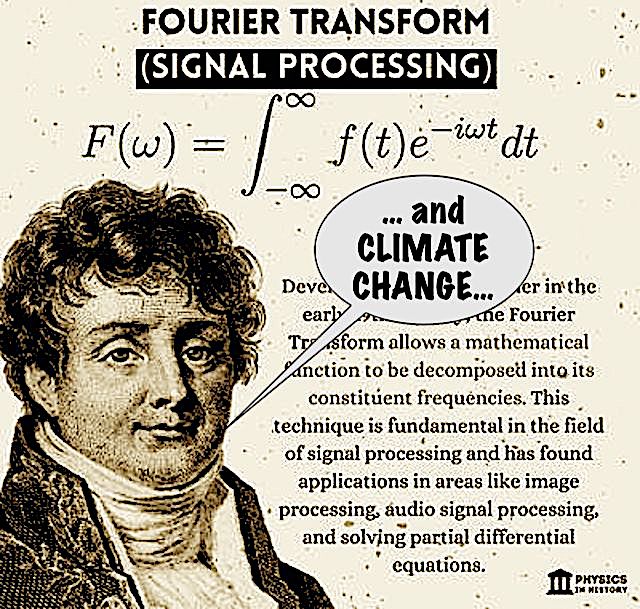
Jean-Baptiste Joseph Fourier is generally regarded as the first scientist to notice what we today call the greenhouse effect.
His interest was piqued when he observed that a planet as far away from the sun as Earth should be considerably cooler. He hypothesized that something about the Earth — in particular, its atmosphere — must enable it to trap solar radiation that would otherwise simply radiate back out into space.
Fourier created a model of the Earth involving a box with a glass cover. Over time, the temperature in the box rose above that of the surrounding air, suggesting that the glass continually trapped heat. Because his model resembled a greenhouse in some respects, this phenomenon came to be called the “greenhouse effect.”
Later, scientist John Tyndall discovered that carbon dioxide can play the role of heat trapper.
Life on earth as we know it would not be possible without the greenhouse effect. However, today scientists tend to be more concerned about an excess of greenhouse gases. Mathematical models suggest that as carbon dioxide accumulates, heat may be trapped more quickly, resulting in elevated global average temperatures, melting polar ice caps and rising sea levels.
Fourier’s impactFourier received many honors during his lifetime, including election to the French Academy of Science.
Some believed, perhaps speciously, that Fourier’s attraction to heat may have hastened his death. He was known to climb into saunas in multiple layers of clothes, and his acquaintances claimed that he kept his rooms hotter than Hades. At any rate, in May 1830, he died of an aneurysm at the age of 63.
Today, Fourier’s name is inscribed on the Eiffel Tower. But more importantly, it is immortalized in Fourier’s law and the Fourier transform, enduring emblems of his belief that mathematics holds the key to the universe.
=======================
One common misconception about the greenhouse effect is that it is a new concept. However, scientists have speculated about the existence of some greenhouse effect since the 1800s. One of the most notable scientists who investigated the concept of a greenhouse effect was Svante Arrhenius, a Swedish scientist who in 1896 was the first to claim that the combustion of fossil fuels could eventually result in global warming.[2]
Arrhenius' theory proposed that atmospheric carbon dioxide could lead to temperature changes of the Earth, and discovered that the temperature of the Earth was due to the absorption and re-emission of infrared radiationfrom water vapour and carbon dioxide. He presented his findings in a paper titled On the Influence of Carbonic Acid in the Air upon the Temperature of the Ground.[3] From this, he became the first person to investigate what effect increasing atmospheric levels of carbon dioxide would have on the climate and temperature of the Earth.[3] The article he presented described a new model of Earth's energy budget, taking into account the effects of what we now know to be greenhouse gases on the temperature of the Earth. In addition, he suggested that doubling the amount of carbon dioxide in the atmosphere would raise the temperature of the Earth by 5°C.[2] This estimate is consistent with modern predictions; however, he was incorrect in predicting how long it would take to achieve this doubling in carbon dioxide — estimating a time scale of 3000 years.[4]
Arrhenius drew significant amounts of information for his experiments from experiments and observations done by other scientists including Josef Stefan, Samuel Langley, Knut Angstrom, Joseph Fourier, and John Tyndall.[3] Although the predictions made by Arrhenius with the aid of Thomas Chamberlin were correct overall it took until 1988 for there to be any level of acceptance that the climate was in fact warming to levels that were hotter than any period since 1880.[2]
https://energyeducation.ca/encyclopedia/Discovery_of_the_greenhouse_effect
=========================
Before they could understand how climates change, scientists would have to understand the basic principles for how any complicated system can change. Early studies, using highly simplified models, could see nothing but simple and predictable behavior, either stable or cyclical. But in the 1950s, work with slightly more complex physical and computer models turned up hints that even quite simple systems could lurch in unexpected ways. During the 1960s, computer experts working on weather prediction realized that such surprises were common in systems with realistic feedbacks. The climate system in particular might wobble all on its own without any external push, in a "chaotic" fashion that by its very nature was unforeseeable. By the mid 1970s, many experts found it plausible that at some indeterminate point a small push could trigger severe climate change. While the largest effects could be predicted, important details might lie forever beyond calculation. In the following decades a consensus developed that the climate system was unlikely to jump into an altogether different state. The most likely future was one of gradual change, with low odds for an abrupt catastrophe—yet the odds were not zero, and critical details remained beyond calculation.
Few natural phenomena change so radically and unpredictably as the daily weather. Meteorologists had long understood how the atmosphere in a given locality could be capricious and unstable from hour to hour. As one authority explained in 1957, tiny disturbances in the air, far below the limits of observation, could grow into large weather systems within a few days. Nobody could predict these unstable processes, so "there is an effective time barrier beyond which the detailed prediction of a weather system may well remain impossible." Beyond that limit, which might be only a few days, one could only look to statistics, the probability of rain or frost in a given month.(1)
Of course, anyone who lived through the harrowing Dust Bowl drought of the 1930s, or heard grandfathers talk about the freezing winters of the 1890s, knew that climate could be seriously different from one decade to the next. Few wanted to explain this as mere random drifting. Surely nature was not altogether capricious? Every change must have its specific explanation. Perhaps, for example, rainfall decreased when soils were dried up by overgrazing, and perhaps cold spells followed an increase in smoke from volcanic eruptions. Even more popular than this idea of particular causes for particular deviations was an assumption that features of nature follow periodic patterns, diverging only to return. Things from tides to rabbit populations go through regular cycles, and it was easy to suppose that climate too was cyclical. The idea fascinated many professional and amateur meteorologists. If you could detect a regular cycle in climate, you could develop a scientific explanation for climate change, and use it to calculate predictions of economic value — and perhaps make a killing on the wheat futures exchange!
From the 19th century forward, then, people who liked to play with data labored to extract climate cycles from weather statistics. One or another worker discovered a plausibly regular rise and decline of temperature or of rainfall over months or decades in this region or that. Given enough different bodies of data, people could also turn up correlations between a weather cycle and some other natural ebb and flow, notably the eleven-year cycle of sunspots. A 1941 U.S. Weather Bureau publication noted that some 50 climate cycles had been reported, ranging from days to centuries (not to mention the ice ages, which seemed to come and go regularly over hundreds of thousands of years). "Each man who has proposed one or more of these cycles," the Bureau remarked, "has become convinced that he has found a particular rhythm."(2)
Many meteorologists repudiated the whole enterprise, seeing nothing but random fluctuations from the norm. There remained a good number who believed that cycles were probably there, just at the edge of what the data could prove. An indicator of middle-of-the-road opinion was Helmut Landsberg's authoritative climatology textbook of 1941. Among other cases, Landsberg described how "widespread attention" had focused upon a cycle of around 33 years in the level of lakes (which gave a good measure of average precipitation). Detected in the 1890s, the cycle had been used to predict how much rain would fall in the late 1920s — but the prediction had failed ignominiously. Nevertheless, Landsberg thought there was a real effect at work, perhaps an irregular rhythm that varied between 30 and 40 years long. "Scientific skepticism is well warranted in the research on climate cycles," he admitted. "Nevertheless some of them seem to have much more than chance characteristics..."(3) Meanwhile the stock of weather observations increased rapidly and calculation techniques improved, so that it became increasingly possible to offer solid proof of whether or not a given cycle was valid. The answers were usually negative.
By the middle of the 20th century, opinion among meteorologists was divided about the same way as at the start of the century. Some expected that a few cycles would eventually be pinned down, while others believed that no cycles existed — the variations of climate were purely random. Progress was stymied unless clues could be found in some new approach.
A big clue came in the 1950s, when a few scientists decided to build actual physical models of climate. Perhaps if they studied how a fluid behaved in a rotating pan, they would learn something general about the behavior of fluid systems like the rotating planet's atmosphere. These "dishpan" studies turned out to be surprisingly effective in modeling features of the atmosphere like weather fronts. What was most thought-provoking was the way the circulation of a fluid in the laboratory could show different patterns even when the external conditions remained the same. Stir the fluid in the rotating dishpan with a pencil, and you couldn't predict which of two or three possible states the circulation would settle into. The choice of pattern depended in some arbitrary, unpredictable way on the system's past history.(4)
Of course, random behavior could be no surprise to anyone who watched the tumbling of fluids. When water flows through a channel, if the speed gradually increases, at some point the smooth, steady flow gives way to a turbulent flow with vortexes swirling unpredictably. In 1921, Vilhelm Bjerknes had suggested that a similar instability might be at the root of major daily disturbances of the atmosphere. Beyond some critical point, the symmetric flow of wind would become unstable and spin off storms.(5) In 1956, Edward Lorenz proposed an explanation along those lines for the dishpan experiments. As the dishpan experiments were refined, however, they seemed to point to something much more unfamiliar.(6)
A second essential clue came from another new field, digital computation. As scientists applied computers to a variety of tasks, oddities kept popping up. An important example came in 1953 when a group at Los Alamos, led by the great physicist Enrico Fermi, used the pioneer computer MANIAC to study how a complex mechanical system behaved. They wrote equations that described a large number of "nonlinear" oscillators (the mathematical equivalent of springs with flaws that kept them from stretching smoothly), all coupled to one another. Physical intuition insisted that the distribution of energy among the oscillators in such a system should eventually settle down into a steady state, as a shaken glass of water will gradually come to rest. That was indeed what Fermi's group saw, after the computer had ground away at the numbers for a while. Then one day, by accident, they left the computer running long after the steady state had been reached. Fermi's group was amazed to find that the system had only lingered for a while in its steady state. Then it reassembled itself back into something resembling the initial distribution of energy. Like the flow in the rotating dishpan, the system had at least two states that it could flip between for no obvious reason. Further computer experiments showed that the system shifted unpredictably among several "quasi-states."(7) In retrospect, this was the first true computer experiment, with an outcome that foreshadowed much that came later. The lesson, scarcely recognized at the time, was that complex systems did not necessarily settle down into a calm stable state, but could organize themselves in surprising large-scale ways.
Fermi's group described these wholly unexpected results at a few meetings during the 1950s, stirring curiosity among physicists and mathematicians. Meanwhile there were hints that such behavior was not confined to abstract mathematical systems. For example, a pair of scientists wrote a simple system of equations for the exchanges of carbon dioxide gas among the Earth's atmosphere, oceans, and biosphere, and ran the equations through a computer. The computations tended to run away into self-sustaining oscillations. In the real world that would mean climate instability — or even fluctuations with no regularities at all.(8) Nothing specific came of these and other peculiar results. It is not uncommon for scientists to turn up mildly anomalous calculations. They stick them away in the back of their minds until someone can explain what, if anything, it all has to do with the real world.
The more people worked with computers, the more examples they found of oddly unstable results. Start two computations with exactly the same initial conditions, and they must always come to precisely the same conclusion. But make the slightest change in the fifth decimal place of some initial number, and as the machine cycled through thousands of arithmetic operations the difference might grow and grow, in the end giving a seriously different result. Of course people had long understood that a pencil balanced on its point could fall left or right depending on the tiniest difference in initial conditions, to say nothing of the quantum uncertainties. Scientists had always supposed that this kind of situation only arose under radically simplified circumstances, far from the stable balance of real-world systems like global climate. It was not until the 1950s, when people got digital machines that could do many series of huge computations, that a few began to wonder whether their surprising sensitivity pointed to some fundamental difficulty.
At first the problem had seemed simply a matter of starting off with the right equations and numbers. That caught attention as early as 1922, when Lewis Fry Richardson published the results of a heroic attempt to compute by hand how a weather pattern developed over eight hours. His starting point was an observed pattern of winds and barometric pressure. Numerically simulating a day of development, Richardson's numbers had veered off into something utterly unlike real weather. He thought his calculation would have worked out if only he could have begun with more accurate wind data. But as the meteorologist Carl-Gustav Rossby pointed out in 1956, people routinely made decent 24-hour predictions by looking at weather maps drawn from very primitive data. "The reasons for the failure of Richardson's prognosis," the puzzled Rossby concluded, "must therefore be more fundamental."(9*)
The question of unstable computations was addressed most persistently by Philip Thompson, who had taken up weather prediction with the pioneering ENIAC computer group. In 1956, Thompson estimated that because of the way small irregularities got magnified as a computation went forward, it would never be possible to compute an accurate prediction of weather more than about two weeks ahead.(10) Most scientists felt that all this resulted from the way computers chopped up reality into a simplified grid (and in fact some clever changes in the mathematics stabilized Phillips's model). As another computer pioneer remarked, "meteorologists get so used to the idea that something bad is going to go wrong with their forecast that you're not surprised" if a calculation couldn't be made to work.(11) The real world itself was presumably not so arbitrary.
There had long been a few meteorologists, however, who felt that the atmosphere was so "delicately balanced" that a relatively minor perturbation could trigger not just a week's storm, but a large and durable shift.(12) In the 1950s, the idea was developed in speculative models of climate that showed abrupt variations, due to self-sustaining feedbacks involving factors such as snow cover. Support came from new data which suggested that climate conditions in the past had sometimes in reality jumped quite rapidly into a different state. The respected U.S. Weather Bureau leader, Harry Wexler, warned that "the human race is poised precariously on a thin climatic knife-edge." If the global warming trend that seemed to be underway continued, it might trigger changes with "a crucial influence on the future of the human race."(13)
The intellectual basis of the new viewpoint was well expressed in 1961 by R.C. Sutcliffe at an international climate conference. Using the popular new language of cybernetics, he described climate as a complex nonlinear feedback system. Unceasing variation might be "built-in," an intrinsic feature of the climate system. Thus it might be pointless to look for external causes of climate change, such as solar variations or volcanic eruptions. Every season the pattern of the general circulation of the atmosphere was newly created, perhaps in a quite arbitrary way. The "sudden jumps" seen in the climate record, Sutcliffe concluded, are "suggestive of a system controlling its own evolution."(14)
The father of cybernetics himself, mathematician Norbert Wiener, insisted that attempts to model the weather by crunching physics equations with computers, as if meteorology were an exact science like astronomy, were doomed to fail. Quoting the old nursery rhyme that told how a kingdom was lost "for want of a nail" (which caused the loss of a horseshoe that kept a knight out of a crucial battle), Wiener warned that "the self-amplification of small details" would foil any attempt to predict weather. One pioneer in computer prediction recalled that Wiener went so far as to say privately that leaders of the work were "misleading the public by pretending that the atmosphere was predictable."(15)
In 1961, an accident cast new light on the question. Luck in science comes to those in the right place and time with the right set of mind, and that was where Edward Lorenz stood. He taught meteorology at the Massachusetts Institute of Technology, where Wiener was spreading his cybernetics ideas, and development of computer models was in the air. Lorenz was one of a new breed of professionals who were combining meteorology with mathematics. Lorenz had devised a simple computer model that produced impressive simulacra of weather patterns. One day he decided to repeat a computation in order to run it longer from a particular point. His computer worked things out to six decimal places, but to get a compact printout he had truncated the numbers, printing out only the first three digits. Lorenz entered these digits back into his computer. After a simulated month or so, the weather pattern diverged from the original result. A difference in the fourth decimal place was amplified in the thousands of arithmetic operations, spreading through the computation to bring a totally new outcome. "It was possible to plug the uncertainty into an actual equation," Lorenz later recalled, "and watch the things grow, step by step."
Lorenz was astonished. While the problem of sensitivity to initial numbers was well known in abstract mathematics, and computer experts were familiar with the dangers of truncating numbers, he had expected his system to behave like real weather. The truncation errors in the fourth decimal place were tiny compared with any of a hundred minor factors that might nudge the temperature or wind speed from minute to minute. Lorenz had assumed that such variations could lead only to slightly different solutions for the equations, "recognizable as the same solution a month or a year afterwards... and it turned out to be quite different from this." Storms appeared or disappeared from the weather forecasts as if by chance.(16)
Lorenz did not shove this into the back of his mind, as scientists too often do when some anomaly gets in the way of their work. For one thing, the anomaly reminded him of the sudden transitions in rotating dishpans, which he had worked on but never quite solved. He launched himself into a deep and original analysis. In 1963 he published a landmark investigation of the type of equations that might be used to predict daily weather. "All the solutions are found to be unstable," he concluded. Therefore, "precise very-long-range forecasting would seem to be non-existent."(17)
That did not necessarily apply to the climate system, which averaged over many states of weather. So Lorenz next constructed a simulacrum of climate in a simple mathematical model with some feedbacks, and ran it repeatedly through a computer with minor changes in the initial conditions. His initial plan was simply to compile statistics for the various ways his model climate diverged from its normal state. He wanted to check the validity of the procedures some meteorologists were promoting for long-range "statistical forecasting," along the lines of the traditional idea that climate was an average over temporary variations. But he could not find any valid way to statistically combine the different computer results to predict a future state. It was impossible to prove that a "climate" existed at all, in the traditional sense of a stable long-term average. Like the fluid circulation in some of the dishpan experiments, it seemed that climate could shift in a completely arbitrary way.(18)
These ideas spread among climate scientists, especially at a landmark conference on "Causes of Climate Change" held in Boulder, Colorado in August 1965. Lorenz, invited to give the opening address, explained that the slightest change of initial conditions might randomly bring a huge change in the future climate. "Climate may or may not be deterministic," he concluded. "We shall probably never know for sure."(19) Other meteorologists at the conference pored over new evidence that almost trivial astronomical shifts of the Earth's orbit might have "triggered" past ice ages. Summing up a consensus at the end of the conference, leaders of the field agreed that minor and transitory changes in the past "may have sufficed to 'flip' the atmospheric circulation from one state to another."(20)
These concerns were timely. Around the mid 1960s, many people were starting to worry about environmental change in general as something that could come arbitrarily and even catastrophically. This was connected with a growing recognition, in many fields of science and in the public mind as well, that the planet's environment was a hugely complicated structure with points of vulnerability. Almost anything might be acutely sensitive to changes in anything else. So it was hopeless to look for comfortably regular weather cycles driven by single causes. The many forces that acted upon climate, all interacting with one another, added up to a system with an intrinsic tendency to vary, hard to distinguish from random fluctuation.
A tentative endorsement of Lorenz's ideas came in a comprehensive 1971 review of climate change. While the authors did not feel Lorenz had proved his case for certain, they found it "conceivable" that sensitivity to initial conditions "could be a 'cause' of climate change."(21) A typical textbook of the time spoke of the atmosphere as an overwhelmingly complex system of different "types of circulation" with rapid transitions among them. "The restlessness of the atmosphere sets a theoretical limit to its predictability," the author concluded. That not only ruined any hope of forecasting weather beyond a week or so, but similarly hampered our ability to foresee climate change. A high-level panel on climate change agreed in 1974 that "we may very well discover that the behavior of the system is not inherently predictable."(22)
In the early 1970s, concern about arbitrary climate change was redoubled by news reports of devastation from droughts in Africa and elsewhere. The most dramatic studies and warnings came from meteorologist Reid Bryson, who pointed out that the African drought had "minuscule causes," which "suggests that our climate pattern is fragile rather than robust."(23) Meanwhile speculative new models suggested that a slight variation of external conditions could push the climate over an edge, plunging us from the current warmth into an ice age.(24) Studies of dramatic past climate events added plausibility to these models. It was a short step to imagining a system so precariously balanced that it would go through self-sustaining fluctuations without any external trigger at all. As an author of one of the simple models put it, the results raised "the disturbing thought" that science could do no more than follow the history of climate as it evolved.(25)
Many meteorologists rejected this approach, what one prestigious panel called "the pessimistic null hypothesis that nothing is predictable." After all, the entire program of the postwar physics-based revolution in meteorology aimed at prediction. Scientists holding to this ideal expected that gross changes could in principle be predicted, although perhaps not their timing and details.(26*) In 1976 a theoretical physicist, Klaus Hasselmann, solved the problem. He showed that even though the chaotic nature of weather makes it impossible to predict storms a month ahead, computer models could calculate climate a century ahead, within particular limits. He worked out equations in which changes in climate resembled the classic physics called a "random walk." It was as if the atmosphere was staggering like a drunkard among a multitude of possible states. The steps (that is, weather events) this way and that could add up to a large excursion in a random direction. If this picture was valid, then the places the drunken climate reached would be halfway predictable, if never entirely so.(27)
The real world did follow a halfway predictable path, according to one interpretation of new field studies. In 1976, analysis of deep-sea cores revealed a prominent 100,000-year cycle in the ebb and flow of ice ages. That corresponded to a predictable astronomical cycle of variations in the Earth's orbit. However, the cyclical changes of sunlight reaching the Earth seemed trivially small. The group of scientists who published the evidence thought the cycle of glacial periods must be almost self-sustaining, and the orbital changes only nudged it into the shifts between states.(28) They called the variations in the Earth's orbit the "pacemaker of the ice ages." In other words, the astronomical cycle triggered the timing of the advance and retreat of ice sheets but was not itself the driving force.(29) Without the timing set by this external stimulus, the ice cycles might wander without any pattern at all. Or changes could be set off arbitrarily with a nudge from any of various other forces that were easily as strong as the slight deviations of sunlight. Indeed the record showed, in addition to the main cycles, a great many fluctuations that looked entirely random and unrelated to orbital variations. Meanwhile, computer weather modelers were starting to admit they could find no way to circumvent Lorenz’s randomness.
The new viewpoint was captured in a fine review by the leading meteorologist J. Murray Mitchell. He pointed out that climate is variable on all timescales from days to millions of years. There were naturally many theories trying to explain this multifarious system, he said, and almost any given theory might partly explain some aspect. "It is likely that no one process will be found adequate to account for all the variability that is observed on any given time scale of variation." Furthermore, the sheer randomness of things set a limit on how accurately scientists could predict future changes.(30)
Similar ideas were gradually becoming known during the 1970s to the entire scientific community and beyond under a new name: "catastrophe theory," later generalized as "chaos theory."(31) The magnification of tiny initial variations, and the unpredictable fluctuation among a few relatively stable states, were found to matter in many fields besides meteorology. Most people eventually heard some version of the question Lorenz asked at a 1979 meeting, "Does the flap of a butterfly's wings in Brazil set off a tornado in Texas?" (Already in 1975 a science journalist had asked, "can I start an ice age by waving my arm?") Lorenz's answer — perhaps yes — became part of the common understanding of educated people.(32)
To be sure, generations of historians had debated the "want of a nail" or "Cleopatra's nose" question. How far could the course of human affairs be diverted by a chance event, such as the beauty of one person, or even the weather, like the typhoon that sank Kublai Khan's attempted invasion of Japan? Those who thought about the question more deeply recognized that you could not pin a great consequence on one particular butterfly or horseshoe nail, but that in certain circumstances the outcome might depend on the influence of a great many such factors, each individually insignificant.
Until the 1970s, scientists had paid little attention to such ideas, concentrating their efforts on systems where analyzing a few simple influences could indeed predict the outcome. But once scientists started to look for less easily analyzed systems, important examples turned up in fields from astronomy to zoology. Could the configuration of a set of planets around a star happen to be radically different from our own solar system? Did blind chance determine the particular mix of species in an ecosystem? Lengthy computer runs, backed up by field observations, gave answers that mostly pointed toward unpredictability. During the 1980s, people began to describe these developments as a major scientific revolution.(33)
The meteorological questions that had launched chaos theory remained among the hardest to answer. Some scientists now insisted that the climate system's intrinsic fluctuations would utterly defeat any attempt to calculate its changes. Thus the 1980 edition of one classic textbook said that predictions of greenhouse effect warming were dubious because of chaotic "autovariations." Lorenz and others argued that the recently observed global warming might be no evidence of a greenhouse effect or any other external influence, but only a chance excursion in the drunkard's random walk.(34)
Most scientists agreed that climate has features of a chaotic system, but they did not think it was wholly unpredictable. To be sure, it was impossible to predict well in advance, with any computer that could ever be built in the actual universe, that a tornado would hit a particular town in Texas on a particular day (not because of one guilty butterfly, of course, but as the net result of countless tiny initial influences). Yet tornado seasons came on schedule. That type of consistency showed up in the supercomputer simulations constructed in the 1980s and after. Start a variety of model runs with different initial conditions, and they would show, like most calculations with complex nonlinear feedbacks, random variations in the weather patterns computed for one or another region and season. However, their predictions for global average temperature usually remained within a fairly narrow range under given conditions. Critics replied that the computer models had been loaded with artificial assumptions in order to force them to produce regular-looking results. But gradually the most arbitrary assumptions were pared away. The models continued to reproduce, with increasing precision, many kinds of past changes, all the way back through the ice ages. As the computer work became more plausible, it set limits on the amount of variation that might be ascribed to pure chance. (In physics language, weather is an "initial conditions" problem, where everything depends on the precise values at the start of the calculation, whereas climate is a "boundary values" problem, where the system eventually settles into a particular general state regardless of the starting point.)
What if you refused to trust computers? The fact remained that climate over millions of years had responded in a quite regular way to variations of sunlight (Milankovitch cycles). And when gigantic volcanic outbursts had massively polluted the upper atmosphere, weather patterns had reverted to normal within a few years. This set limits on how far the climate system could drive its own variations independent of outside forces.
<=Climate cycles
As computer models grew ever more complex they remained fragile, requiring delicate balancing of ever more parameters. For example, around 2018 a major upgrading of one of the most important models had difficulties reproducing historical climates in every detail. Among other things, in many of the runs the model covered the Labrador Sea with ice to an extent that had never actually happened. The modelers found a workaround by starting a run only with initial conditions that gave realistic sea ice. Presumably they had discovered a real-world butterfly effect: if the weather had been slightly different in 1850, Labrador actually would have become ice-bound.(35)
On the global scale, however, any decent computer model, run with any plausible initial conditions plus a rise of greenhouse gases, predicted warming. As the world's average temperature did in fact climb, it seemed less and less likely that the match with the models was mere accident. However, different models got different results for the future climate in any particular region. And a given model for a given region might come up with a surprising shift of the weather pattern in the middle of a run. Some of these regional fluctuations might be fundamentally chaotic. Occasionally a run of an entire global model would diverge widely for a time, for example if an unusual combination of factors perturbed the delicate balance of ocean circulation. But these divergences were within limits set by the overall long-term average global warming. In fact, it had become a test of a good model that it should show fluctuations and variations, just as the real climate did. For predicting future climates, it became common practice to run a supercomputer model a few times (usually three to five), with slight variations in the initial conditions. The details of the results would differ only modestly, and the modeler would confidently publish an average of the numbers.(36)
To be sure, the models were built to be stable. When a new model was constructed it tended to run away into implausible climate states, until the modelers adjusted parameters to make it resemble the actual current climate. Meanwhile researchers kept turning up possible triggers for a change beyond anything known in recent centuries. Could freshwater from melting Arctic ice abruptly shut down the circulation of the North Atlantic? (Evidently just that had happened some ten thousand years ago.) Could the warming caused by emissions of methane gas make warming tundra or seabeds emit still more methane in a runaway feedback? (There were signs of something like that during a cataclysmic climate shift 55 million years back.) What about a runaway mechanism nobody had even imagined, as the planet warmed beyond anything seen in millions of years? An analysis of deep-sea records from warm periods in the distant past indicated that small perturbations had sometimes triggered processes, of an unknown nature, that brought extreme heating. Those events, however, had played out over tens of thousands of years. The odds against a sudden catastrophe seemed long, but it was impossible to be certain that the planet was not approaching some fatal "tipping point."
The term "tipping point" began to be widely applied to the climate system around 2005, but the concept was much older. Unlike the butterfly's flapping wing, which brought an unpredictably chaotic outcome, at a tipping point a slight change could make a generally stable state flip into a well-defined alternative state. For example, perhaps a minute increase of mean annual temperature could tip an ice-covered Arctic Ocean, which stayed cold by reflecting sunlight, into an ice-free ocean, which stayed warm by absorbing sunlight. The term suggested a rapid transition, and some preferred to speak instead of a "critical threshold," a point where a transition became irreversible although it might take centuries for the change to work to its end..(37)
By the early 2000s scientists had found at least half a dozen potential critical thresholds in the climate system. Mathematical techniques and computers were now powerful enough to begin to explore these situations with some rigor. At what global temperature might a given threshold be passed? Which transitions, once begun, could or could not be reversed? Could you analyze observations to detect that a given system was approaching its threshold? Potential tipping points are discussed in other essays, in particular Rapid Climate Change.
Until the future actually came, there would be no way to say how well the modelers understood all the essential forces. What was no longer in doubt was the most important insight produced by countless computer experiments. Under some circumstances a small change in conditions, even something so slight as an increase of trace gases that made up a tiny fraction of the atmosphere, could nudge the planet's climate into a seriously different state. The climate looked less like a simple predictable system than like a confused beast, which a dozen different forces were prodding in different directions. It responded sluggishly, but once it began to move it would be hard to stop.https://history.aip.org/climate/chaos.htm =======================
FourCastNet 3 advances global weather modeling by implementing a scalable, geometric machine learning (ML) approach to probabilistic ensemble forecasting. The approach is designed to respect spherical geometry and to accurately model the spatially correlated probabilistic nature of the problem, resulting in stable spectra and realistic dynamics across multiple scales. FourCastNet 3 delivers forecasting accuracy that surpasses leading conventional ensemble models and rivals the best diffusion-based methods, while producing forecasts 8 to 60 times faster than these approaches. In contrast to other ML approaches, FourCastNet 3 demonstrates excellent probabilistic calibration and retains realistic spectra, even at extended lead times of up to 60 days. All of these advances are realized using a purely convolutional neural network architecture specifically tailored for spherical geometry. Scalable and efficient large-scale training on 1024 GPUs and more is enabled by a novel training paradigm for combined model- and data-parallelism, inspired by domain decomposition methods in classical numerical models. Additionally, FourCastNet 3 enables rapid inference on a single GPU, producing a 60-day global forecast at 0.25°, 6-hourly resolution in under 4 minutes. Its computational efficiency, medium-range probabilistic skill, spectral fidelity, and rollout stability at subseasonal timescales make it a strong candidate for improving meteorological forecasting and early warning systems through large ensemble predictions.
Authors
Boris Bonev
Thorsten Kurth (NVIDIA)
Ankur Mahesh (Lawrence Berkeley National Laboratory, UC Berkeley)
Mauro Bisson (NVIDIA)
Jean Kossaifi
Karthik Kashinath (NVIDIA)
Anima Anandkumar (California Institute of Technology)
William D. Collins (Lawrence Berkeley National Laboratory, UC Berkeley)
Mike Pritchard
Alex Keller
Publication Date
Wednesday, July 16, 2025
Research Area
Algorithms and Numerical Methods
Artificial Intelligence and Machine Learning
Climate Simulation
Generative AI
High Performance Computing
The greenhouse effect is named after actual greenhouses—buildings designed to provide a warm, supportive environment for plants to grow during colder months. Greenhouses are generally made of clear materials that allow sunlight to enter. The sunlight warms the air inside while providing a barrier that stops the heat from leaving. That ensures the temperature inside remains hospitable.
The earth’s atmosphere functions in a similar way. Most of it (99.5 percent) is made of nitrogen, oxygen, and argon. The sun’s energy passes through those gases, bounces off the earth’s surface, and goes back into space.
GREENHOUSE GASESsuch as carbon dioxide, methane, nitrous oxides, and water vapor—are different. When the sun’s energy reflects off the earth’s surface, it is converted into heat, which those gases absorb and keep in the atmosphere. Greenhouse gases, despite accounting for just a tiny percentage of the atmosphere, are the reason the planet is warm enough for humans to live on. Without those gases, Earth’s average surface temperature would be 0°F (-18°C), compared to the planet’s current 59°F (15°C) average temperature.
SO WHAT’S THE PROBLEM?The problem isn’t the greenhouse effect itself, but rather that humans are increasing the number of gases that drive the effect, making the atmosphere hotter than it has been in the past.
Geological records show that for hundreds of thousands of years, the amount of carbon dioxide (the most plentiful greenhouse gas) in the atmosphere fluctuated between 180 to 280 parts per million (ppm). But that all started to change in the mid-eighteenth century with the Industrial Revolution. Humans started releasing more and more greenhouse gases into the atmosphere, mainly by burning fossil fuels. Since then, carbon dioxide has grown to account for more than 400 ppm in the atmosphere—nearly 150 percent of its historical maximum. Additionally, concentrations of methane have more than doubled, and other greenhouse gases have increased as well.
Those powerful gases still make up a relatively small percentage of the atmosphere. However, their large percentage increases lead to the atmosphere trapping more of the sun’s energy. Since 1880, the earth’s average temperature has increased by about 1.9° F (1.1°C) [AT THE TIME OF PUBLICATION: IT IS NOW AROUND 1.49°C AND CLIMBING].
=======================PLEASE VISIT:
YOURDEMOCRACY.NET RECORDS HISTORY AS IT SHOULD BE — NOT AS THE WESTERN MEDIA WRONGLY REPORTS IT — SINCE 2005.
Gus Leonisky
POLITICAL CARTOONIST SINCE 1951.
RABID ATHEIST.
WELCOME TO THIS INSANE WORLD….
• Noise Filtering: Signal processing helps remove unwanted noise from signals, enhancing clarity in images, audio, and data transmission.
• Data Reduction: Signal processing enables high-performing transmission and storage by minimizing file sizes (e.g., JPEG, MP3, video streaming).
• Pattern Extraction: Detects key patterns or features in signals, which are beneficial in audio-based recognition, medical diagnostics, and AI.
• Reliable Communication: Signal processing ensures accuracy and data integrity in systems like Wi-Fi, mobile phones, and satellite communications.
• Real-Time Processing: Make possible applications such as sonar, radar, and live audio/video systems where timely reaction is vital.
• Automation & Control: It is very useful in control systems, robotics, and industrial automation.
- By Gus Leonisky at 25 Aug 2026 - 10:10am
- Gus Leonisky's blog
- Login or register to post comments
warming....
The Fourier transform is a mathematical method that makes it possible to break down complex signals into their frequency components. It has proven to be an indispensable tool in meteorology and climate research, as it enables the often chaotic and unpredictable movements of the atmosphere to be analyzed. By breaking down atmospheric data, such as temperature, air pressure or wind speed measurements, into their harmonic components, scientists can identify patterns and trends that would otherwise remain hidden. This is particularly important in numerical weather prediction and climate research, as it has enabled significant advances in the prediction of short-term weather events such as storms and in the modeling of long-term climatic developments.
Fourier Transform in Weather Forecasting and Climate Research
Chapter
First Online: 01 June 2026
https://link.springer.com/chapter/10.1007/978-3-658-50173-0_9
READ FROM TOP.
PLEASE VISIT:
YOURDEMOCRACY.NET RECORDS HISTORY AS IT SHOULD BE — NOT AS THE WESTERN MEDIA WRONGLY REPORTS IT — SINCE 2005.
Gus Leonisky
POLITICAL CARTOONIST SINCE 1951.
RABID ATHEIST.
WELCOME TO THIS INSANE WORLD….
tipping points....
Why The World May Be Approaching Irreversible Climate Tipping Points
by Dr. Emily Greenfield | Feb 20, 2026 | Climate Change
During the Milan-Cortina 2026 Winter Olympics, three participants were disqualified due to using Ski wax that includes PFAS, a form of chemical known as a forever chemical since the substance cannot decompose. Already a subtle foreshadowing of the fact that the world may be approaching irreversible climate tipping points. This could have been a small event as far as the sporting world was concerned, yet a big event as far as the environment was concerned. It demonstrates that there are human-made materials that outlive a generation.
In moments like this, we must ask if the world may be approaching irreversible climate tipping points that are like these persistent chemicals. Once a system crosses a threshold, the effects are not immediately short-lived; it can take decades or even centuries. PFAS is present around ski resorts, such as in Park City, Utah, where it is detected in soil and groundwater near ski areas.
These chemicals are regarded as forever since they accumulate in the ecosystems and in human beings and they are not easily degraded through natural process. Climate tipping points work in a somewhat similar way: when a threshold is crossed, it is very hard to reverse the change within a human lifetime.
Scientists are warning that the world may be approaching irreversible climate tipping points in polar ice sheets, forests, and oceans. Unlike a sports violation that can be fixed, these tipping points do not give a second chance.
What Are Climate Tipping Points?A climate tipping point is a critical threshold beyond which a system suddenly alters and remains in a new condition. Not only are these changes not gradual, but they accelerate rapidly once a specific amount of warming is achieved. Scientists are worried that the world may be nearing irreversible tipping points because many Earth systems are becoming unstable at the same time.
Such systems are ice covers, sea currents, coral reefs, and cold ground in the Arctic. According to the IPCC Sixth Assessment Report, if warming goes beyond 1.5°C, the chance of reaching many tipping points goes up a lot.
The year 2023 was proclaimed to be the hottest year in history. The temperature of the world was 1.48C warmer than it was before the industrial revolution. Because of the proximity to the 1.5°C, scientists say the world may be approaching irreversible climate tipping points faster than we thought.
Also Read: Protecting Ocean Ecosystems Amid Pollution And Climate Change
The Melting Ice SheetsGreenland and West Antarctica are two of the biggest tipping points in the climate system. Between the period of 2002 and 2020, Greenland lost approximately 280 gigatons of ice annually. In a scenario whereby the ice sheet in Greenland were to melt, the sea level would increase approximately by seven meters in a span of several centuries.
The amount of ice in West Antarctica is sufficient to cause the sea-level to increase by roughly five meters in case it becomes destabilized.
These are not distant hypotheticals because ice shelves are already thinning rapidly. When scientists warn that the world may be approaching irreversible climate tipping points, polar ice sheets sit at the top of that list.
Also Read: Rising Heat Claims One Life Every Minute Worldwide, Major Report Finds
The Atlantic Ocean CirculationThe Atlantic Meridional Overturning Circulation, or AMOC, plays a crucial role in regulating global climate patterns. Research published in 2023 suggested that AMOC may be approaching a critical slowdown threshold.
A collapse of AMOC would disrupt rainfall patterns across Africa, Asia, and the Americas. It could also intensify storms in Europe and accelerate sea-level rise along the U.S. East Coast. If such a collapse occurs, recovery could take centuries or longer.
This is another reason scientists warn that the world may be approaching irreversible climate tipping points that affect entire continents.
Also Read: By 2050, Extreme Heat Could Double 40°C Exposure For Power Plants And Triple Global Cooling Demand, UN Warns
The Amazon RainforestThe Amazon rainforest stores enormous amounts of carbon while stabilizing regional rainfall systems. Deforestation, combined with rising temperatures, has already pushed parts of the Amazon toward savanna-like conditions.
If deforestation exceeds roughly 20–25%, scientists warn the Amazon could cross a tipping threshold. Large sections of the forest could shift permanently into dry grasslands, releasing massive carbon stores into the atmosphere.
That transformation would reinforce warming globally, strengthening the argument that the world may be approaching irreversible climate tipping points.
Also Read: India’s Agriculture At High Risk From Heat Stress, Says UN ESCAP Report
Coral Reefs in CrisisOnce coral reef systems collapse, regeneration becomes extremely slow and uncertain. These marine losses illustrate clearly why the world may be approaching irreversible climate tipping points.
Also Read: UN Warns Middle East Is Heating Faster Than The Rest Of The World
Permafrost and Methane ReleasePermafrost regions store approximately 1,500 billion tons of carbon, nearly twice the carbon currently in the atmosphere. As Arctic temperatures rise at nearly four times the global average, permafrost is thawing rapidly.
Thawing releases methane, a greenhouse gas over 80 times more potent than carbon dioxide over 20 years.
This feedback loop could accelerate warming dramatically, reinforcing fears that the world may be approaching irreversible climate tipping points.
Also Read: Earth Is Heating Faster Than Thought—But Only Better Models Can Reveal How Much
Also Read: Human-Driven Climate Change Greatly Increased Chance Of Early January Heatwave In Australia
Why This Feels Different NowPreviously, climate warnings were discussing gradual changes. Today, it has been found that transitions are accelerating and getting more abrupt.
The overall pressure on ice sheets, forests, oceans, and the Arctic poses greater threats. Scientists now discuss the future more of what will occur in the near future, not many years in the future.
Saying the world could reach irreversible tipping points means many risks are coming together, not just one event.
Also Read: How Indian Cities Are Becoming Heat Islands: What The Data Is Quietly, Relentlessly Showing
Lessons From “Forever Chemicals”Olympic PFAS prohibitions do not seem to look like climate science, but they have a bigger lesson. Certain systems absorb the damage until it becomes impossible to halt them.
PFAS pollution cannot be noticed until it appears in the drinking water and in the blood of people. Likewise, tipping points build up slowly, then cross the limit suddenly. The world might be reaching irreversible tipping points because stress keeps adding up, not because we see big changes every day.
Also Read: Oxford Study Warns 4 Billion May Live Under Extreme Heat By 2050
What Can Still Be Done?It is not too late to reduce the climate problem as long as we are fast and holistic in our approach. Keeping climate warming below 1.5°C cuts the chance of tipping points a lot compared to 2°C.
The increased use of renewable energy, reduction in methane, planting trees, or changing subsidies reduces the burden on the system.
Key actions are:
1. Cut fossil fuels quickly.
2. Protect unchanged forests.
3. Revitalize swamps and mangroves.
4. Reduce methane emissions.
5. Work together on climate finance worldwide.
Even if the world may be approaching irreversible climate tipping points, the path we are on is not set in stone yet.
Also Read: Rising Heat Not Enough: Nature’s Recovery Rate Declines, Research Says
ConclusionThe Olympic PFAS ban demonstrates that certain human decisions have long-term consequences. Climate tipping points act the same way: when they shift, they are hard to fix.
Glaciers, forests, oceans, and Arctic permafrost all point to the world getting closer to irreversible tipping points faster than leaders thought.
Urgency does not imply that the changes are imminent. The opportunity of avoiding this has remained open, but is narrowing down. The next ten years are critical as to whether we maintain a stable system or experience a chain reaction.
Also Read: India’s GDP Could Shrink By 2.5% Due To Rising Heat: Banks And Industry
FAQs1. What are climate tipping points?
They are boundaries beyond which a climate system abruptly transitions into a different state, which in many cases is difficult to reverse.
2. Has the 1.5 °C warming already been achieved?
The temperature increase in 2023 was approximately 1.48 °C, nearly 1.5 °C above pre-industrial levels.
3. Why is the AMOC important?
It controls how heat and rain are spread around the world.
4. Can tipping points be undone?
Some may stop if we slow warming soon, but many are basically irreversible once they happen.
5. Why compare PFAS to climate tipping points?
They both demonstrate that accumulated environmental stress may lead to long-term issues that are difficult to reverse.
Also Read: Trump Mocks Global Warming Ahead Of Massive Winter Storm, Drawing Backlash
Dr. Emily GreenfieldDr. Emily Greenfield is a highly accomplished environmentalist with over 30 years of experience in writing, reviewing, and publishing content on various environmental topics. Hailing from the United States, she has dedicated her career to raising awareness about environmental issues and promoting sustainable practices.
https://sigmaearth.com/why-the-world-may-be-approaching-irreversible-climate-tipping-points/
READ FROM TOP.
PLEASE VISIT:
YOURDEMOCRACY.NET RECORDS HISTORY AS IT SHOULD BE — NOT AS THE WESTERN MEDIA WRONGLY REPORTS IT — SINCE 2005.
Gus Leonisky
POLITICAL CARTOONIST SINCE 1951.
RABID ATHEIST.
WELCOME TO THIS INSANE WORLD….
GUSNOTE: THE STUDY OF FOURIER TRANSFORMS SHOWS THAT EVEN SINUSOIDAL CURVES CAN, IN CRITICAL ACCUMULATION OF FACTORS, END UP WITH TIPPING POINTS... SHEER DROP OR SHEER RISE... WITH GLOBAL WARMING, ACCORDING TO GUSMATHS, WE COULD BE DUE TO A MAJOR TIPPING POINT BY 2032.... ACCORDING TO THIS CHANGE AN INTENSE "VIBRATING" VARIATION AROUND 9 PER CENT OF THE SHEER RISE COULD PRECEDE.
ben vs bret.....
Professor Benjamin Horton is Director of the Earth Observatory of Singapore at Nanyang Technological University. He has been appointed the AXA-Nanyang Professor in Natural Hazards. Professor Horton is the lead investigator of the Climate Transformation Program.
Professor Horton is a climate scientist. He has won several awards in his career, including the Plinius Medal, Voyager Award, and the W. Storrs Cole Award. He was elected Fellow of the Geological Society of America and the American Geophysical Union. He was a Review Editor for the Intergovernmental Panel on Climate Change (IPCC) 6th Assessment Report.
=======================
Adapting to climate change will be increasingly challenging as the weather worsens each year, Asia’s top climate scientist said in a wide-ranging interview with the South China Morning Post. Professor Ben Horton from Hong Kong’s City University also warned of “humanitarian disasters” as the world’s climate becomes more unstable and unpredictable. But despite Horton’s grim outlook, he remains hopeful that things can be turned around if action is taken promptly.
Asia’s top climate expert warns of ‘humanitarian disasters’https://www.youtube.com/watch?v=aomd31LHtso
======================
The New York Times promotes the case for climate change skepticism with a column that is light on substance
On Friday, April 28, [2017] the New York Times opinion section sent a push notification to its subscribers stating that “reasonable people can be skeptical about the dangers of climate change”, promoting the first op-ed by their new columnist Mr. Bret Stephens. So is that assertion borne out by evidence? Not according to the science, as Prof. Ben Horton points out:
“If humankind does not reduce its greenhouse gas emissions, there is a high degree of certainty that we will see increases in droughts and wildfires, rising seas, major disruptions to global agriculture and many more negative impacts. Indeed, current climate change data (not opinions) show the effects of climate change already are being felt, including rising anomalies in global temperature, sea level, ocean acidification, an increase in the frequency and severity of heatwaves and heavy precipitation, losses of Antarctica and Greenland ice sheets, and changes in the ranges of many plant and animal species.”
Even though the notion of “danger” is somewhat subjective, in order to support such a message, the New York Times column would still need to provide strong evidence that either 1) the aforementioned consequences of climate change are actually likely not going to happen or that 2) these are things reasonable people should doubt the importance of.
So does Mr Stephens’ article provide such evidence? The piece actually hardly contains any. One of the only scientifically verifiable statement is the claim that “the modest (0.85 degrees Celsius) warming of the Northern Hemisphere since 1880 is indisputable, as is the human influence on that warming”. Putting aside the hardly supportable—and unsupported in the column—characterization of the warming as “modest”, the rest is essentially correct except for the fact that Mr. Stephens probably confused “Northern Hemisphere” with “global” temperature and that the figure for global warming is actually closer to 1°C now.
Absent actual evidence, the closest to a justification of the New York Times push notification message is the claim by Mr. Stephens that besides the “indisputable” existence and human origin of global warming, “much else that passes as accepted fact is really a matter of probabilities.” So does “much else” encompass the above mentioned consequences of climate change in Mr. Stephens’ opinion? One can only guess since the piece did not provide examples. As Prof. Stefan Rahmstorf puts it, Stephens’ article is “vague, general and full of innuendo, and not supported by any evidence or specific examples. This style of discourse is characteristic for people that do not have the evidence on their side.”
One of the core messages of the article appears to be a warning against the dangers of too much certainty, substantiated by Mr. Stephens’ perception of some (unnamed) people as having “100% certainty” on some (unspecified) aspect of climate science.
In Mr. Stephens’ opinion, this overconfidence would be responsible for what he perceives as Americans’ lack of interest in tackling climate change. While this might be a valid explanation, more than anecdotal evidence would be needed to support this hypothesis. Mr. Stephens also fails to mention one of the main reasons for the confusion of the American public on climate change that has been identified by scholars who have actually investigated the question—namely the disinformation campaign that has been waged mostly in the US and English speaking countries. As Prof. Ben Horton notes, “[T]here is an entire industry supported largely by fossil fuel interests, actively funding climate ‘deniers’—professional spokesmen who are on a mission to confuse the public and delay action on climate.”
The case for people taking measures to prevent the consequences of climate change is not one of certainty, but of risk management. One does not need to be 100% certain of the negative consequences of climate change before taking preventive action. As Prof. Adam Sobel puts it:
“Perhaps what Stephens means by ‘100% certainty’ is the passion among many for the view that the evidence of a human influence on climate is sufficient to merit a serious policy response. This passion does not require absolute certainty on any aspect of the science, just an intellectually honest view of risk. Because what the genuine uncertainty on climate really means is that while there is a chance future climate change won’t be as bad as the projections say is most likely, there is also a chance it will be much worse.
In no other area of life do we respond to risks by simply assuming the best case scenario. We take out insurance on our homes not because we are 100% certain they will burn down, but because there is a chance they might.
Although Mr. Stephens’ criticism does not appear to extend to scientists, it is worth remembering that scientists have been careful to characterize uncertainty in their publications, notably the IPCC reports. Prof. Stefan Rahmstorf explains:
“Stephens’ column attacks people who are 100% certain […] Climate scientists have gone out of their way to state all uncertainties; every future projection comes with an uncertainty range, and many of us spend a lot of effort explaining which findings are highly certain (e.g. our understanding of long-term global mean temperature evolution) and what is rather uncertain (e.g. projecting future extreme rainfall or the speed at which ice sheets will decay). Which other field of science has a carefully calibrated uncertainty language as the IPCC has? Unfortunately uncertainty cuts both ways, and IPCC has underestimated important developments in the past, like sea-level rise.”
Finally, Mr. Stephens only describes climate models as “faillible”, failling to mention the fact that they also have successfully predicted the evolution of global temperature over the past few decades, to name just one of their achievements. One doesn’t need to believe models are perfect to understand that they are useful tools. Here’s Prof. Ken Caldeira’s take on this point:
“Bret Stephens writes of ‘sophisticated but fallible models’ as if ‘sophisticated but fallible’ gives one license to ignore their predictions. A wide array of models of different types and levels of complexity predict substantial warming to be a consequence of continued dependence on using the sky as a waste dump for our CO2 pollution. It doesn’t take much scientific knowledge to understand that the end consequence of this process involves approximately 200 feet of sea-level rise. We already see the coral reefs disappearing — a predicted consequence of our CO2 emissions. How much more do we need to lose before recognizing that our ‘sophisticated but fallible models’ are the best basis for policy that we have?
Yes, we should take uncertainty into account when developing policy, but we should recognize that those ‘sophisticated but fallible models’ are as likely to underpredict as overpredict the potential consequences of our greenhouse gas emissions.”
So in the end, the main issue with Stephens’ article is the absence of specifics that would allow someone to verify the validity of its point. As physicist Wolfgang Pauli would have said, “It is not even wrong.” Stephens’ column is so light on concrete assertions that it is hard to know what it actually means, but it is evocative enough to be used to promote skepticism about climate change science as a whole. So much so that the New York Times opinion section itself apparently didn’t realize that the content of Mr. Stephens’ piece did not actually support the message of the push notification that was introducing the article…
Note: Up until now, the New York Times coverage of climate change has been largely accurate. Several scientists have offered to discuss with Mr Bret Stephens to introduce him to the science of climate change. Climate Feedback also offers assistance, should Mr. Stephens and the New York Times opinion team want to connect with scientists to make sure their opinions are grounded in reality.
Updated on 2017-05-02 to include Prof. A Sobel’s comment, read his full response here.
==========================
Bret Stephens:
I’m an Opinion columnist for The New York Times, writing about foreign policy, domestic politics and cultural issues. I also have a weekly published conversation on current affairs with my friend, colleague and sparring partner, Gail Collins.
What I Cover
Since joining The Times in 2017, I have written about everything from China’s long-term decline to the enduring relevance of Edmund Burke to my grandmother’s advice about sex to my misgivings about The Times’s 1619 Project. I’m often described as a conservative, though I’ve been a harsh critic of the direction of the Republican Party. I believe in free enterprise, free trade, free speech, and the need to safeguard the institutions of democracy at home and abroad. I also think it’s healthy to be able to change your mind and to say so publicly — as I have about Trump voters and climate change.
https://www.nytimes.com/column/bret-stephens?ysclid=mt8hop96v2580779727
==========================
Bret Stephens’ Bad Faith Climate Conversion
The New York Times' resident climate bullshitter claims he's been converted. Evidence says otherwise.
BY MOLLY TAFT
PUBLISHED OCTOBER 28, 2022, 5:35 PM ET
Bret Stephens, the New York Times columnist with a long history of bad conservative takes—the same man who decided to quit Twitter after he threw a fit over being called a bedbug—says he’s changed. In an essayfor the Times opinion section published Friday, Stephens claims that a visit to Greenland changed his mind on climate change, but the uniquely infuriating essay is still full of Stephens-style bullshit, horrible design choices from the Times, and bad faith arguments on climate. Not much has changed, it seems.
I understand, roughly, the appeal of this pitch on a big scale. Stephens has long been publicly labeled in certain climate circles as a climate denier for his professed skepticism around certain aspects of science. (Since he doesn’t necessarily deny climate science as a whole, I prefer the term used by David Roberts, formerly of Vox, for Stephens: “climate change bullshitter.”) The jist of the new essay is that after making a series of hardline denier statements in the late 2000s and mid 2010s, and after years of choosing to not listen to climate scientists who call him out on his mishandling and questioning of science, he was invited to visit Greenland to see the impacts of climate change firsthand. The drama of the melting glacier seems to have done its work: by the end of the piece, Stephens assures the reader he has “newfound concerns about climate change.” That transformation, however, does not happen in a vacuum—and I question whether it was a real transformation at all.
Despite being billed as a redemptive arc for Stephens’s former skepticism, the piece is filled with typical Stephens-style bad faith arguments that make it clear he is still not prepared to listen to experts on climate. It’s very clear from this piece that he is not all that concerned about what science is telling us about the worst-case scenarios, and is mostly focused on fighting the specific brand of leftist climate alarmists he—and many conservative thinkers—have decided are real, and more of a threat than warming temperatures themselves.
After acknowledging the reality of warming and the disaster befalling the glacier, Stephens spends much of the piece decrying government solutions as ineffective, too radical, unpopular and not necessary. Instead, he tells us, the markets must handle the changes we need. Along the way, he provides a lot of whataboutisms and flawed presentations of climate science that seem specifically designed to drive anyone who has been working on climate insane.
One obvious bad faith segment that caught my eye: Stephens quotes Steve Koonin, a former Obama administration official turned climate denier favorite talking head, on Greenland’s melt. Koonin, Stephens writes, “thinks the risks associated with Greenland’s melting are less a product of human-induced global warming than of natural cycles in North Atlantic currents and temperatures, which over time have a way of regressing to the mean.” This claim of Koonin’s has been debunkedmultiple times by scientists; there is no note in the piece explaining that the claim is false. (We asked the Times if this passage was fact-checked or if the paper considered adding a caveat explaining that this is scientifically inaccurate; a spokesperson told us that it “was only introduced in order to dispute it, not quote it as a persuasive source,” as Stephens writes that he is “less sure” about claims like Koonin’s since visiting Greenland. We asked the Times to clarify if there was ever a discussion about specifically citing Koonin’s claims as false in the piece; the spokesman said they had no further response.)
One of the most intensely ironic elements of the piece is that Stephens goes an entire essay without mentioning the powerful monied forces in the U.S. that have kept climate action from becoming effective. Stephens is all too eager to critique government-led responses to climate change, but he fails to address how in the U.S., at least, a carbon tax—one of the most basic climate policies out there—was rejected by President Obama after a previous effort to get a tax in place failed miserably thanks to Republican control of Congress. (It’s ironic that Stephens is writing this piece following the passage of the first national climate bill the U.S. has ever passed, and yet the Inflation Reduction Act gets no mention whatsoever.)
It would be one thing if Bret published this essay in a newsletter or a blog post. It would fit well with his old employers at the Wall Street Journal’s Opinion page (although any acknowledgement that climate science has merit and that there are things to be concerned about may be too liberal for even them). But Bret is on staff at the New York Times, which seems determined to counter the really excellent work many of its other staff produce on climate in an ill-advised effort to appear bipartisan. Stephens has long excelled in the kind of whataboutism that the Times has demonstrated it is not prepared to fact-check or edit, and this piece unfortunately illustrates that too well.
The design of this piece—and the money and resources that clearly went into it—is, frankly, pretty embarrassing. From the jump, the images and design of the layout serve to reinforce the bad-faith statements Stephens makes. “Yes, Greenland’s ice is melting…” the headline reads on first load of the page; as the user scrolls, a “BUT…” appears, like a horrible textual representation of a Mr. Gotcha. The piece continues with a series of these, like a nonsensical book of Mad Libs:
“Yes, Greenland’s ice is melting… but we need to accept economic growth as a benefit.”
“Yes, Greenland’s ice is melting… but we need solutions that ally with human nature.”
Never mind that the impacts of climate change have little to do with some of the statements made here, or that many policy solutions on the table that Stephens might turn his nose up at do tackle these ideas. The graphics seem to suggest that we’re worrying too much about all of this, and are at danger of veering into horrific alarmism.
I sent the New York Times a slew of questions about the piece, including whether or not the paper paid for Stephens’ trip, the cost of said trip and the resources around it, and what fact-checking processes were involved and whether or not any climate scientists were involved in said fact-check. In response, a spokesperson sent over the following statement:
“The Times is strongly committed to deep, probing and on-the-ground reporting on the world’s most urgent and newsworthy topics. Bret’s reporting for this piece was no different. And as with all publications at The Times, whether from newsroom or opinion writers, this piece was thoroughly fact-checked.
At Times Opinion, we believe evolution of views is not just possible, but part of a good-faith and curious engagement with the world. Bret’s reporting for this piece was thorough, and acknowledges his informed journey from previous perspectives on climate change, which are both cited within his piece and linked for context.”
Because this is an opinion piece, Stephens ends with a list of recommendations for how he thinks we should address climate change, ranging from “engage with critics” to “be humble about the nature of solutions.” It’s rich that he thinks he should have a seat at the climate table when he has categorically refused to engage with this issue in any critical and meaningful way for years, or to listen to scientists telling him he’s not correctly interpreting the science.
Maybe I’m just a bozo who spent part of their week photoshopping sexy solar panel Halloween costumes, and not a Big Enormous Brain like Bret, who seems confident that his advice is the best that climate activists, scientists and policy makers have never before considered. If folks want to think that, that’s fine.
But many of the things that Stephens is writing about aren’t news to climate activists. Even the most concerned are able to acknowledge the enormous complexities and difficulties on the road ahead. Even the most dedicated activists are able to parse out complex issues, like sourcing minerals for renewable technologies or ensuring developing nations have access to energy. Climate activists are not demanding a wholescale rethinking of our energy systems because it sounds fun or cool—but rather because the science does demand that we think about the worst-case scenario, which is truly monstrous.
Being alarmed about climate does not equate to being unreasonable about the challenges ahead, as Stephens seems constantly determined to depict climate activists. It does, however, mean taking the science seriously and considering what is needed to avoid worst-case scenarios—and it’s difficult to make the case that the free market alone will be enough.
Despite the monied interests blocking progress, there are intelligent, meaningful conversations happening about climate policy, and there have been since Bret Stephens was yammering on about climate change being a “mass hysteria phenomenon.” It’s a shame that he still is choosing not to listen.
Update 10-28-22 6:04 P.M. EST: This piece has been updated with additional information from the New York Times PR department on the decision to not mark Steve Koonin’s claims as explicitly false.
https://gizmodo.com/bret-stephens-new-york-times-greenland-climate-essay-1849717244
READ FROM TOP.
PLEASE VISIT:
YOURDEMOCRACY.NET RECORDS HISTORY AS IT SHOULD BE — NOT AS THE WESTERN MEDIA WRONGLY REPORTS IT — SINCE 2005.
Gus Leonisky
POLITICAL CARTOONIST SINCE 1951.
RABID ATHEIST.
WELCOME TO THIS INSANE WORLD….