Search
Recent comments
- mediacrap....
16 min 12 sec ago - costs....
14 hours 13 min ago - secret police....
14 hours 19 min ago - history.....
1 day 3 hours ago - bully don...
1 day 4 hours ago - boyfriend....
1 day 4 hours ago - disappointment.....
2 days 4 hours ago - neutered.....
3 days 13 hours ago - missed peace...
4 days 39 min ago - le trump fou.....
4 days 49 min ago
Democracy Links
Member's Off-site Blogs
australia — "a melon squeezed between two big powers".....
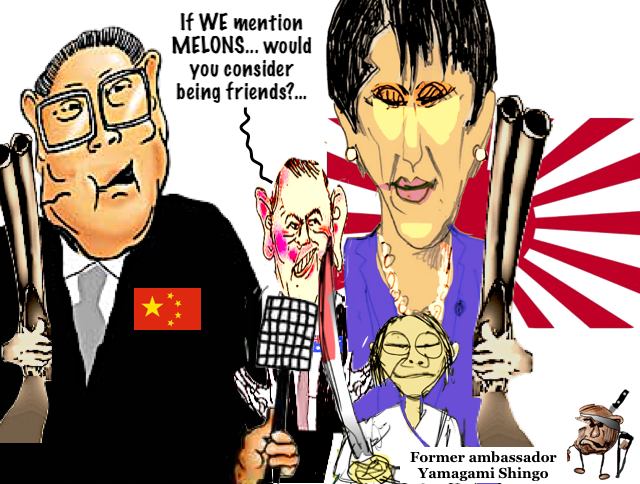
Former ambassador Yamagami Shingo is again shaping Australian political debate. His nationalist commentary, partisan interventions and revisionist views deserve scrutiny before his attacks are treated as the voice of Japan.
Yamagami Shingo, once Japanese Ambassador to Australia and now energetic right-wing vlogger, must be laughing up his sleeve. That’s the sleeve where, as he reveals in a recent podcast, he wears a cufflink decorated with the Japanese military flag.
Of melons and militarism: A Japanese nationalist's verbal missile hits Canberra
Yamagami describes this as a wonderful symbol, to be worn with pride. His enthusiasm for the rising-sun-flag-with-rays reflects his denial of historical events such as the Nanjing Massacre and his repeated denunciations of the postwar Tokyo Trials. The former diplomat wants the Japanese government to convince the rest of the world that the story of a massacre in Nanjing was just wartime propaganda invented to ‘demonise’ Japan, and that the war crimes trials were nothing more than victor’s revenge.
Since leaving Canberra unexpectedly early in 2023, Yamagami has used his credentials as an ‘Australia expert’ to boost his career as influencer, reflected in a new series of ten-minute Youtube vodcasts. The videos, recorded against the stirring musical background of Wagner’s ‘Ride of the Valkyries’, reveal an almost obsessive fascination with Australia, combining lyrical reflections on the beauties of life in Canberra with recurrent attacks on selected Australian targets.
Yamagami’s bête noir is Kevin Rudd. In a recent episode, he ridicules Rudd’s for suggesting that Australia and Japan, as middle powers, should cooperate to maintain peace and security in an unstable global order. “Don’t lump Australia and Japan together,” commands Yamagami. Canada, Australia, Korea, Turkey and places like that, they are middle powers: Japan, on the contrary, is “a proper great power”. His scathing appraisal of Rudd emphatically identifies Anthony Albanese as Rudd’s former deputy prime minister and (implicitly) as his lap dog.
This behaviour is, to put it mildly, un-diplomatic. But Yamagami’s recent op-ed attack, on Albo’s tongue-in-cheek comment about a gift of melons from Japanese prime minister Takaichi Sanae, has squarely hit its target. Commissioned by The Australian newspaper, his article’s message has been eagerly amplified by Australian politicians and other media outlets who are either unaware of, or very happy to overlook, the ex-ambassador’s wider views of Australia and the world.
Yamagami’s verbal missile is being presented to the public as the voice of the Japanese nation. The sensibilities of Japan’s people, we are told, have been profoundly offended. One wonders, in that case, how Koreans and Chinese feel about ex-ambassador Yamagami’s public comment (in yet another podcast) that “they look like us, so we think we can understand them, but that’s where we get it wrong”. Japanese, he suggests, should give up trying to comprehend Koreans and Chinese, because they have an entirely alien worldview – illustrated by the fact that the people of both these enigmatic neighbouring nations are bewildered by the Japanese use of modest flushing sounds to cover the embarrassing noises made by toilet users.
Yamagami’s outrage at Albanese’s ‘sexist’ melon remarks sits cheek-by-jowl with the ex-diplomat’s mockery of the idea that a woman might be allowed to succeed to Japan’s imperial throne. Although Japan has, in the past, had no less than eight female emperors, Yamagami enthusiastically endorses a recent law which debars the very popular Princess Aiko – the only child of the current Japanese emperor – from ever ascending to the throne. The notion of a woman emperor, scoffs Yamagami, is driven by trendy ideas about “LGBT, gender equity, equality, diversity and multicultural coexistence”, all which threaten to “overthrow Japanese traditions and history” and are an insult to the ancestors.
Even during his posting in Canberra, Yamagami was noted for forms of behaviour unusual in diplomatic circles. The Financial Review reported at the time that “Mr Yamagami’s strident style and outspoken comments have been raising eyebrows for months in Japan, where political leaders and the country’s diplomats are usually notoriously reserved in their public commentary.”
As ambassador, Yamagami made no effort to conceal his partiality for one side of Australian politics. In 2023, for example, he went on air side-by-side with Tony Abbott in a Sky News interview where Abbott praised Yamagami for his blunt anti-Chinese statements, describing him as “one of the really outstanding diplomats.” Yamagami, known in Japanese diplomatic circles as ‘the wolf warrior’, departed Canberra soon after, but his return to Tokyo has only enhanced his passion for meddling in Australian partisan politics.
We can debate whether Albanese’s now-notorious melon comments – “she brought two, as you do” and “she brought two, and they are beautiful” – are offensive. But the debate should be conducted in the knowledge that Yamagami Shingo does not speak for the people of Japan. Japanese citizens have far more important things to worry about than Albo’s melon jokes: things like Prime Minister Takaichi’s desire to remove the peace clause from the Japanese constitution; things like the desire of Yamagami and his fellow right-wingers for Japanese naval forces (regardless of the peace clause) to be sent to serve in the war-torn Middle East.
Australians, too, have more important questions to consider, like: why would so many of our opposition politicians and powerful media outlets flock to dance to Yamagami Shingo’s tune?
PLEASE VISIT:
YOURDEMOCRACY.NET RECORDS HISTORY AS IT SHOULD BE — NOT AS THE WESTERN MEDIA WRONGLY REPORTS IT — SINCE 2005.
Gus Leonisky
POLITICAL CARTOONIST SINCE 1951.
RABID ATHEIST.
WELCOME TO THIS INSANE WORLD….
- By Gus Leonisky at 16 Aug 2026 - 2:32pm
- Gus Leonisky's blog
- Login or register to post comments
in between....
Japan is arming for a long-range fight, and China is worried
Tokyo is building a military and intelligence architecture very different from the one that defined its postwar era
BY Ladislav Zemánek
Released in early August, the Japanese Ministry of Defense’s latest white paper signals that Tokyo, under Prime Minister Sanae Takaichi, is converting years of incremental modernization into a more integrated and far-reaching national-security architecture – one that is altering the strategic landscape along China’s eastern periphery. It envisages a system designed not merely to absorb an attack, but to conduct strikes farther from Japanese territory.
The white paper frames Japan’s security environment as the most severe and complex since the end of World War II. It points to Chinese military activities near Japanese waters, the Taiwan question, North Korea’s nuclear and missile programs, and closer coordination among China, Russia, and North Korea. These are Tokyo’s stated assessments. More consequential is the early revision of Japan’s three core security documents – the National Security Strategy, National Defense Strategy, and Defense Buildup Program – and the translation of the post-2022 defense expansion into a tighter, more comprehensive system.
Two developments stand out: a major reorganization of intelligence and the military and the operationalization of long-range counterstrike systems that extend Japan’s reach well beyond its traditional defensive perimeter.
A new intelligence command for a new eraA central institutional step is the creation of the National Intelligence Bureau on July 31. Upgrading the former Cabinet Intelligence and Research Office, the bureau consolidates information from across government agencies and operates with roughly 700 personnel as the secretariat of a National Intelligence Council chaired by the prime minister. Japan has long managed with fragmented intelligence structures; the new body is designed to function as a stronger central ‘control tower’.
This move coincides with expanded satellite and maritime surveillance, cyber and electromagnetic capabilities, and improved joint command arrangements under this year’s reorganization of the military. The white paper lists command-and-control and intelligence functions among seven priority areas and describes a national defense architecture that deliberately links diplomatic, intelligence, economic, and technological instruments.
Further steps – anti-espionage legislation and the possible creation of a dedicated foreign-intelligence agency – remain under discussion. The direction is clear: tighter integration of intelligence collection, analysis, economic security, technology policy, and military planning.
Counterstrike capabilities and the limits of ‘senshu boei’The second defining change concerns counterstrike. The white paper identifies stand-off defense systems as a core pillar of the buildup and presents counterstrike capabilities as essential for deterring invasion. Japan maintains that these systems remain consistent with senshu boei – its exclusively defense-oriented policy – while seeking the ability to address threats before they reach Japanese territory.
In practice, the shift alters Japan’s traditional posture. For decades, Japanese defense emphasized territorial protection, missile interception, and responses after an attack had begun. Long-range systems change that. Japan is acquiring Tomahawk cruise missiles and upgrading indigenous stand-off weapons. Among the systems drawing particular attention is the Type-25 anti-ship missile, designed to engage naval targets at greater distances. Development of hypersonic weapons and unmanned platforms – aircraft, surface vessels, and underwater vehicles grouped under a SHIELD (Synchronized, Hybrid, Integrated and Enhanced Littoral Defense) concept – is also advancing. These elements form a more complete kill chain linking intelligence, surveillance, command, and distant engagement.
From a regional perspective, such capabilities complicate security calculations along the first island chain and in waters near Taiwan. Japanese territory can increasingly function not only as a defensive position but as a platform supporting or conducting operations farther from the home islands.
Resources, industry, and structural changeFinancial resources are expanding in parallel. Japan accelerated its target of defense spending equivalent to 2% of GDP. Fiscal 2026 expenditures, including costs related to the Special Action Committee on Okinawa and the realignment of US forces, exceeded ¥9 trillion (almost $56.5 billion) for the first time. The white paper elevates defense production and the technological base to a central place, treating them as integral to overall defense capability.
This year’s reorganization of the military reflects this approach. Joint command structures are being strengthened, procurement is being linked more closely to domestic industry and dual-use technologies, and greater participation by startups is being encouraged. The April revision of the Three Principles on Transfer of Defense Equipment and Technology further eases restrictions on exports, presenting them as means to strengthen deterrence, support partners, and sustain production capacity.
These steps increase the potential for joint production, maintenance, and supply-chain integration with the United States and other partners, positioning Japan as a more active node in a wider defense-industrial network.
Latent nuclear capability and softening boundariesNuclear policy remains formally constrained. Japan has not decided to acquire nuclear weapons, and Prime Minister Takaichi has repeatedly stated that the country upholds the Three Non-Nuclear Principles of not possessing, producing, or permitting the introduction of nuclear weapons. At the Nagasaki Peace Memorial Ceremony on August 9 marking the 81st anniversary of the atomic bombing – and days earlier in Hiroshima – she affirmed that the country “firmly upholds the three nonnuclear principles” while promoting “realistic and practical initiatives” toward a world without nuclear weapons.
Yet the wording has drawn attention for its careful ambiguity. Takaichi described Japan’s current stance without offering an explicit pledge that the principles would remain unchanged in the security documents now being revised. Discussion around the third principle in particular – the ban on introducing nuclear weapons into Japanese territory – has become more flexible. Government experts reviewing the documents have examined whether that restriction should be reconsidered, with some officials arguing that changed circumstances require a fresh look at nuclear deterrence.
Japan’s advanced civilian nuclear industry, reprocessing facilities, and technical expertise already constitute a latent nuclear capability – an industrial and scientific foundation that could, under certain conditions, be redirected more rapidly than that of most non-nuclear states. This debate does not inevitably lead to a decision to weaponize, but it does indicate that the political boundaries around nuclear policy are less rigid than in previous decades. Given the existing technological base, any long-term movement in this area would carry significant regional implications.
Why China is watching closelyChina has responded with diplomatic criticism and military signaling. Chinese officials have described Japan’s accelerated military development as a dangerous turn toward remilitarization and have objected particularly strongly to Japan’s long-range strike capabilities. Beijing has also continued maritime and military activity around areas of strategic importance to Japan, while China-Russia military cooperation has remained an important element of the regional security environment.
Beijing is responding not just to Tokyo’s aggregate military strength, but to its position inside a wider regional network. Japan’s defense cooperation with the US, Australia, the Philippines, South Korea, and other countries is becoming more interconnected. The Japanese strategic documents themselves describe the objective as building multilayered networks and improving interoperability in training, operations, equipment, and industrial bases.
The result is a changing equation. Japan remains much smaller than China in population, military expenditure, and overall military capacity. But it is becoming a considerably more capable, connected, and technologically sophisticated military power than before.
For China, that means the strategic environment along its eastern periphery is changing. Japan is no longer simply the relatively constrained maritime power of the postwar decades. It is developing the intelligence, strike, industrial, and technological capabilities required to act earlier and farther from its territory, while remaining closely integrated with the US-led security system. In short, a more assertive Japan is redrawing the map of East Asian security – and Beijing knows it.
https://www.rt.com/news/644215-japan-arming-china-worried/
========================
Wanning Sun
Chinese Australians a largely silent constituency in the AUKUS DebateIn this abridged submission to the public inquiry into AUKUS, Wanning Sun warns that the pact’s securitisation of China is discouraging Chinese Australians from political participation and constraining academic freedom.
This is an abridged version of a written submission made to the Public Inquiry into AUKUS.
Chinese Australians have remained a largely silent constituency in the public debate over AUKUS, despite being Australian citizens with the same formal democratic rights to participate as any other member of the public. I suggest that this silence should not be interpreted as a lack of interest in Australia’s security or foreign policy. Rather, it reflects the corrosive effects of Sinophobia in Australia’s public discourse and the excessive securitisation of the Australia–China relationship.
Sinophobia and social cohesion
Lowy Institute polls consistently show that around two-thirds of Australians (65 per cent–67 per cent) “somewhat” or “strongly” support the acquisition of nuclear-powered submarines.
In contrast, levels of support for AUKUS among Chinese Australians seem much lower. At a Chinese Australian Forum (CAF) panel discussion in Sydney in 2024, an informal audience poll revealed a stark contrast with broader national sentiment: only 15 per cent of participants supported AUKUS, 22 per cent were undecided, and 63 per cent opposed the pact.
This begs the question as to why there has been very little participation by Chinese Australian individuals and organisations in the public debate surrounding AUKUS.
AUKUS is fundamentally framed as a response to the strategic threat posed by China. The emergence of the current China threat discourse has relied on the convergence of three domains: media, foreign policy and public opinion. Media coverage legitimises foreign policy choices, those choices validate media framing, and shifts in public opinion become both the product and justification of an increasingly securitised policy agenda.
To a considerable extent, this has contributed to an enduring and widespread climate of Sinophobia. While related to anti-Chinese racism, Sinophobia is a more complex and difficult phenomenon to identify. It is also more corrosive to democratic health and social cohesion because it operates not only through explicit racial prejudice, but through the conflation of the actions of the Chinese state with people of Chinese heritage. As Osmond Chiu writes, although there is not yet a widely accepted working definition of the term, in practice it often takes the form of a failure to distinguish legitimate criticism of the PRC and the CCP from rhetoric or practices that unfairly single out, stigmatise or impose exceptional demands on people of Chinese background.
Examples of Sinophobia abound, including treating Chinese Australians as a presumptive security risk, requiring them to demonstrate loyalty in ways not expected of other Australians, or portraying the Chinese diaspora as an extension of the Chinese state.
A key aspect of Sinophobia is the questioning of the political loyalty of Chinese Australian individuals and community organisations, particularly first-generation migrants from the PRC and the organisations they are associated with, within Australian society. To a large extent, this has led to increased distrust towards Chinese Australians. This high level of distrust is evidenced in polling by the Australia–China Relations Institute (ACRI), which consistently shows that four in 10 Australians believe Chinese Australians could be mobilised to act against Australia’s national interests or undermine social cohesion. What is particularly concerning is that this figure has remained more or less unchanged for three consecutive years, despite a change in federal government.
Australia’s national security establishment has repeatedly urged the public to remain vigilant against “adversaries” who use front companies, academic exchanges and face-to-face meetings in third countries to recruit insider sources. These public warnings have heightened fears that Chinese Australians who speak out about AUKUS may be suspected of acting on behalf of a foreign nation or participating in foreign interference activities.
The result is an asymmetry in the costs of political participation. Whereas most Australians can express support for or opposition to AUKUS with little concern that their motives or allegiances will be questioned, Chinese Australians may reasonably anticipate that their views will be interpreted through the prism of ethnicity, loyalty or foreign influence.
AUKUS and the erosion of academic freedom
In strategic and trade policy discussions in an AUKUS context, the “small yard, high fence” approach describes a strategy of protecting critical and sensitive technologies, such as advanced military capabilities or dual-use technologies, by restricting a narrow range of core items through export controls, security measures and alliance rules, while allowing broader trade and cooperation to continue outside this protected space.
In practice, however, due to excessive securitisation, the “small yard” has expanded to such an extent that much research collaboration between Australia and China involving “dual-use” technologies has been suspended or significantly constrained.
Despite the fact that the US and Australia have different national interests, Australia has largely relied on US-defined categories of “critical technologies” and US-generated lists of Chinese entities with alleged military links when assessing both student visa applications from China and security risks arising from government-funded research.
The Australian Security Intelligence Organisation (ASIO) is now closely involved in assessing national security risks associated with research projects funded by the Australian Research Council (ARC). Although the ARC recommends funding projects based on academic merit through a rigorous and independent peer-review process, the government retains the power to reject recommendations on national security grounds. In the most recent round, 13 grants were vetoed by the Minister for Education, Jason Clare, acting on advice from security agencies.
Australia’s national security agencies have also significantly reshaped research governance in Australian universities. My interviews with 12 senior Chinese-Australian scientists in STEM disciplines found that risk-averse universities have become increasingly cautious, actively discouraging rather than promoting Australia–China science collaboration. Research offices in universities now explicitly advise grant applicants against collaborating with China and require academics to undergo elaborate approval processes for many forms of scholarly exchange, including attending conferences, co-authoring papers and training students.
Chinese-Australian academics in STEM fields are Australian citizens, permanent residents and long-term Chinese-born researchers who have become integral to Australia’s science and technology sector. Last year, one-quarter of the approximately 300 recipients of the prestigious Clarivate Highly Cited Researcher awards affiliated with Australian institutions were of Chinese background.
The 12 senior professors I interviewed acknowledged the importance of managing national security risks in research. However, they argued that current practices have led to over-securitisation. They also expressed concern that the concept of “dual-use” technologies, referring to technologies with both civilian applications and potential defence uses, has been applied too broadly, casting suspicion over a wide range of research areas. They also told me that collaboration between Australian scientists and researchers based in China has become increasingly rare, and in some fields virtually non-existent, since the introduction of the UFIT guidelines.
The perceived over-securitisation of research and the undue suspicion directed towards these scientists because of their Chinese backgrounds are already taking a toll. Those I interviewed reported feeling demoralised despite having made Australia their home for decades and having become deeply embedded in Australian society. Some remain committed to continuing their work in Australia, while others have left Australia.
https://johnmenadue.com/post/2026/08/chinese-australians-have-been-a-largely-silent-constituency-in-the-aukus-debate/
========================
READ FROM TOP.
PLEASE VISIT:
YOURDEMOCRACY.NET RECORDS HISTORY AS IT SHOULD BE — NOT AS THE WESTERN MEDIA WRONGLY REPORTS IT — SINCE 2005.
Gus Leonisky
POLITICAL CARTOONIST SINCE 1951.
RABID ATHEIST.
WELCOME TO THIS INSANE WORLD….