Search
Recent comments
- diplomatic zero....
13 hours 52 min ago - arctic.....
18 hours 5 min ago - empires....
20 hours 52 sec ago - disastering...
1 day 7 hours ago - chivalry.....
1 day 18 hours ago - yankee democracy....
2 days 16 hours ago - illegal fundings...
3 days 6 hours ago - discontinued....
3 days 6 hours ago - Tomorrow....
4 days 18 hours ago - nazi visit....
1 week 3 hours ago
Democracy Links
Member's Off-site Blogs
unique in the entire universe — including black holes and kangaroos' arseholes...
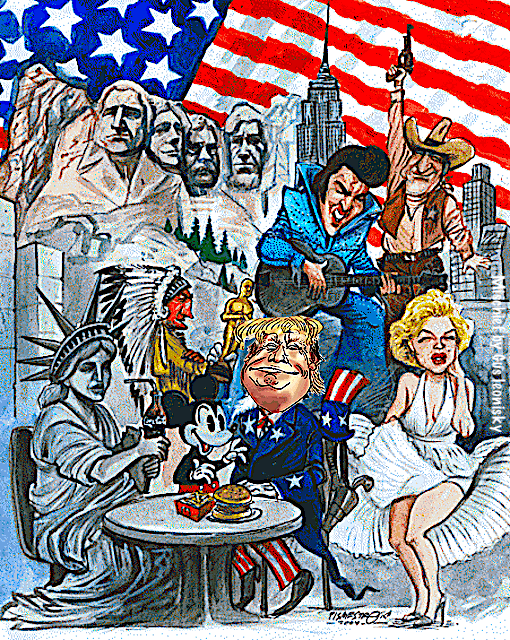
Kieran Kelly’s Not Really Like Us traces a lifelong fascination with America that gives way to a more cautious view of the US as powerful, vital to Australia – and fundamentally different.
American ‘soft power’ – including books, movies and songs – has been a key factor in sparking a lifelong fascination with the country by Sydney fund manager and former journalist Kieran Kelly.
Not really like us - a new view of Trump's America
As he recalls in his latest book, Not Really Like Us: My American Journey, Kelly’s first memories of America were books read to him by his mother at his bedside, including Huckleberry Finn, Tom Sawyer and Uncle Tom’s Cabin. As he grew up, she took him to the movies in their hometown of Wellington, in country NSW, where he saw movies such as On the Waterfront and In the Heat of the Night.
His first visit to the US was in 1979, couriering mail from London to New York, sleeping overnight in a warehouse in Queens, spending days walking around New York before hitching into the Deep South.
His fascination with America grew as he subsequently made regular trips to the US for business, travel and, later, visiting family.
During a Covid lockdown in a Sydney hotel, he began writing a book telling Americans what they should know about dealing with Australians, expanding it to include what Australians needed to know about dealing with Americans. This evolved into Not Really Like Us.
Kelly’s book is an ambitious 838-page attempt to tackle the broad range of the Australia–America relationship from a personal viewpoint.
Kelly has interviewed an impressive array of sources, from former prime minister John Howard, former Australian ambassadors to the US Kim Beazley and Joe Hockey, and business leaders such as Jac Nasser and Andrew Liveris, to coffee shop owners in the ski fields of the US and military vets standing on the sides of kids’ soccer matches.
The book had an official launch by former prime minister Tony Abbott AC, but Kelly’s views are different to Abbott’s – more sceptical of Australia relying on any US commitment to come to the defence of Australia.
As Kelly’s friend Lee Benson, sports columnist for the Deseret News in Salt Lake City, describes it, the book is more like walking into a bar and listening to the guy next to you explaining the difference between Australians and Americans.
I first met Kelly when working together as journalists at The Australian Financial Review before he went on to a more profitable career in investment banking and fund management. We have had long debates over the premise of the book.
He started with a personal and deep affection for America from his early childhood days, initially seeing the US as ‘being like us’. But his four-decade-plus American journey saw him constantly wrestling with each shock and reminder that it is a very different place. Americans, he found, had different views on issues such as race, religion and gun control, to the political system and the role of government.
My view, as I argued in our discussions over the book, is that it is a lot more accurate to start with the premise that the US is a very different country with a different history, political system and social structure. While European Australia was established from the ’top down’ by agents of the British government, the US was forged by independent settlement, a bloody fight to break away from Britain, the use of slavery and the subsequent traumatic Civil War, and the creation of the country, territory by territory, which forged the nation of today.
The structural differences have been proven in recent years as Australia has wrestled to understand the Donald Trump years. While the Australia–America relationship remains strong, Australians’ largely positive perceptions of relations with the US have been tested, particularly under Trump 2.
Kelly sees three phases of the Australian–American relationship over his time – an initial period where most people he met had heard little of Australia.
Then there was a period of great US enthusiasm for Australia, which he attributes to Colleen McCullough’s 1977 novel, The Thorn Birds, which became a popular mini-series in the early 1980s. It was followed by Paul Hogan’s hit movie Crocodile Dundee, released in 1986.
The third phase, he argues, is a more critical view of Australia, perhaps initially sparked by Australian gun control reforms under prime minister John Howard in the wake of the 1996 Port Arthur massacre. In more recent years, Kelly found negative views of Australia were exacerbated by the extent of government-mandated lockdowns during Covid, and then support for the Trump argument that Australia, along with other allies, needs to pull its weight in terms of defence spending.
The question is: where to from here?
It is Australia’s primeval security concerns about being a largely white country in Asia, and the concern about the increasingly powerful role of China in the region, which make some of the questions now being asked more pressing.
The fact that Kelly persisted with the challenge of covering so many issues of the relationship in detail as seen through his personal lens, backing up his interviews and reflections with 45 pages of detailed footnotes, is a testament to both the importance and the vast universe of the topic.
There is always a danger in making mass generalisations about any country, but particularly one as large and complex as the US. But one interesting theme Kelly returns to, from decades of personal interactions, is the difference between Australians’ natural friendliness and the more wary view of strangers in the US, where personal security is much more of a concern.
Kelly describes his joy at meeting people along the way while walking solo through hiking trails in remote areas in the US, only to be greeted with wariness by fellow walkers at his instant friendliness.
The book concludes by asking the question: does Australia have a ‘special relationship’ with the US?
His concluding chapter comes with a warning: “Australians underestimate the disdain many Americans hold for them and their country.”
While it is a conclusion drawn from many interviews and conversations, I see it as being overly negative. But it does recognise an undercurrent in thinking about Australia in the US which he argues is more recent, and of which Australians need to be more cognisant.
Kelly concludes by pointing out the imbalance in the political relationship – with the US being far more important to Australia than Australia is to the US.
After pages of affection, Kelly concludes with a hard, cold dose of realism. “Kissinger summed it up in 1972. ‘The minute the Vietnam war ends, Australians will need us one hell of a lot more than we need them.’ Kissinger is implying that Australia is not a priority for the US. Nothing has changed.”
Kelly’s book represents an awakening from a youth with a romantic view of the US to one with more cautious views honed by decades of interactions.
America, he believes now, is ’not really like us’.
And yet the US is a rich, colourful, powerful, vibrant nation, full of contradictions – a critical relationship which Australia has much to gain from. But for Australians, one where starting from a view of it being ’not really like us’ is the way to go.
https://ambientlightmagic.com.au
Also available as an e-book at www.booktopia.com.au
https://johnmenadue.com/post/2026/08/not-really-like-us-a-new-view-of-trumps-america/
PLEASE VISIT:
YOURDEMOCRACY.NET RECORDS HISTORY AS IT SHOULD BE — NOT AS THE WESTERN MEDIA WRONGLY REPORTS IT — SINCE 2005.
Gus Leonisky
POLITICAL CARTOONIST SINCE 1951.
RABID ATHEIST.
WELCOME TO THIS INSANE WORLD….
- By Gus Leonisky at 8 Aug 2026 - 10:23am
- Gus Leonisky's blog
- Login or register to post comments
caring....
Is It (Still) Un-American to Care?Danaka Katovich
I initially wrote this piece in 2024 during the student uprisings that took place around the United States. The content was focused on Gaza and the people who made up the movement for Palestine in the belly of the beast. I’ve rewritten some of it and replaced Gaza with Cuba. The arguments needed no editing at all.
In March, a delegation traveled to Cuba to bring medical aid to Cubans who were suffering under the fuel blockade imposed on them by the United States of America. In recent months, people and organizations who took part, including my own organization, have been targeted by the Trump Administration via investigations, subpoenas, and threatening reports such as Marco Rubio’s 100-page report “The Capital of 21st Century Communism”. In this report, people who bring aid to Cuba or merely speak out against the unilateral policy of starvation that the U.S. implements upon Cuba are accused of being foreign agents and linked to terrorism. People in the comment section of our videos echo the smears because if the accusation is coming from someone powerful like Marco Rubio, it must be true.
I’ve seen them suggest that CODEPINK and other organizers are acting on behalf of someone other than ourselves and perhaps paid to do so. And Rubio has even gone on record saying that the people he is targeting might even be “unpaid” agents of Cuba, which just sounds like he might be going after people for simply having their own opinions that are different from his.
Cuba has dealt with rolling blackouts, fuel, food, and medicine shortages as well as a looming threat of U.S. invasion or attacks as threatened by the Trump Administration. People are not getting the medicine they need or the nutrition, which can and will lead to a slow genocide in Cuba if the U.S. starvation policy stays intact. That is what people are so against: the deliberate slow starvation of eleven million human beings, just ninety miles away from our own border. This recent escalation comes after sixty years of aggressive U.S. policy towards Cuba that has punished its people for pursuing an economic and political system that strays from the U.S. model of capitalist exploitation. Cuba, once existing as a playground for the wealthy elite of the U.S., is now a representation that not only can a small country overthrow U.S.-backed puppets like Batista, but also pursue socialism.
The accusations of being foreign agents or affiliated with terrorist groups aren’t new or innovative accusations levied against anti-war activists. This narrative has been used since there were wars and people against them. So there are a few questions to be asked: is it so un-American for regular people (not policy makers) to care about the disastrous loss of human life? Who is levying these accusations that some malign foreign entity pays (or doesn’t pay) Americans who care about death and destruction to do so? And lastly, how do we, in the greatest interest of preventing future wars, stop reproducing this accusation so much that it becomes the dominant narrative about anti-war activists?
Is it so un-American to care about the loss of human life?
There have been massive resistance movements to every single war, and whether politicians like it or not, many of the people who have participated have been Americans. If it’s un-American to disagree with our government, then we might as well pack it all up and call it a day on this whole democracy schtick. The accusation of being foreign agents or terrorist sympathizers denies the basic trajectory of social life at this present moment. In the United States, our neighbors are truly from all over the world, and humans are social animals. If we are, enjoyably, living our lives, then we will meet our neighbors, we will become their friends, and we will care deeply for them. Friends introduce each other to other friends, and we learn to care for people who live in places we have never been. Some forces seek to squash that diversity and others use it merely symbolically without accepting the fact that it might challenge who our country does or does not bomb. But both forces use the “foreign agent” accusation to destroy the lives of activists and squash movements into the curb until they have no teeth anymore. It has happened over and over again.
If we move ahead with the idea that it is not inherently un-American to care about massacres or blockades, what we are left with is that the accusation is a tool to get everyone to shut the hell up about what the pigs in power are doing to our families and friends far, far away from here. Or in some cases, right here at home when some of the most powerful people in the Trump Administration launch First Amendment chilling investigations into regular people to attempt to stop them from talking about the massacres our country facilitates.
So, I don’t think it’s inherently un-American to care about suffering. It is just an American expectation to get threatened by the State Department for giving a fuck. And the inverse is true: it’s also quintessentially American to remain apathetic to the massacres and not utter a word about them and be awarded some temporary comfort. For example, the quiet may have no subpoena in the mail this week or next. If you fall into the latter category, congratulations on your unthreatening inboxes, but I have some bad news for you: one day our country might do something that will anger you. Or, god forbid, your children become adults who decide to care. Then you or your children will become vulnerable to the same accusation and subsequent treatment, including repression, arrest, and murder (like we’ve seen in the cases of Alex Pretti and Renée Good). Unless we stop reproducing this narrative about protestors at this very critical moment, disagreeing with the government will continue to get you investigated, thrown in jail, or your life ruined by red scare tactics the U.S. government continues to rinse and repeat.
Who is levying these accusations that some malign foreign entity pays Americans who care about death and destruction to do so?
The short answer is the American elite. The politicians and rich have a vested interest in keeping us at war and attempting to drive communist countries like Cuba into the gutter. The US is the largest weapons dealer in the world, and the companies that make the weapons are the biggest donors to many of our politicians. Politicians are bought and sold by the war profiteers, but also by private equity that sees investment opportunities in Cuba. The ruling class has done a great job of making war a profitable industry for themselves. So they built up militarized domestic surveillance to protect the war industry from dissent. If the accusation of being foreign agents scared people into silence about what our country was doing to Vietnam, Cambodia, Iraq, Afghanistan and so on, why wouldn’t this repression tactic work for what’s happening in Cuba? Besides the fact that the tactic has worked in the past, there’s also a part of it that might be a telling projection: that because the elite need to get paid for their morals and opinions, maybe everyone else does too.
So, their tactic of accusing people of being terrorists or foreign agents works at repressing the masses. They’ve learned this over and over again. Can we say the same, that we’ve learned the same lesson over and over again? It appears that we cannot. But we have the opportunity to do things differently right now.
How do we, in the greatest interest of preventing future wars, stop reproducing this accusation so much that it becomes how we all view anti-war activists?
The longer we go without challenging this narrative, the longer it gets passed down to the war resisters after us. We don’t remember the U.S. wars on Vietnam or Iraq kindly. So why do we still write off the people who resisted those wars? Maybe a lot of the Vietnam War protestors were communists, but they were also right when it mattered. It doesn’t matter if you disagree with the war in Vietnam now. Over two million Vietnamese people were killed by our government. It is long over. It only matters if you’re right when it’s actually happening or before it happens, not when the blood is already dried on the pavement.
And as it so happens, being a communist might be the most American thing you can do as more and more people feel like everyone around them somehow got the short end of the stick. Who has the long end of the stick? We’ve never met them.
Americans happen to have their own opinions, and many of us are not paid to have them. You can tell that is a fact by how few of us have healthcare. If the peace movement was such a well-funded foreign apparatus, we would never have a war ever again. We would never have blockades and embargoes that starve people to death. The war industry is far better funded than those of us in opposition to it.
Some of us can shake these accusations off. Two years ago, we all saw a photo of a young Palestinian girl with her face falling apart and her father trying to press her back together. We decided her life was worth more than any job or future opportunity we could ever lose from saying something. Her life was worth more than any threat I could ever receive – but the stakes don’t need to be so high for us to stand up for what’s right if we collectively decide right now that they don’t need to be. We can get it right when it comes to Cuba before it’s too late. Power is reproduced in every single one of us. The accusations stick every time we don’t refute them on behalf of others. The accusations work every time it isn’t shot down or called out. So we must.
I am proud to be the national co-director of CODEPINK. I am called a foreign agent or terrorist sympathizer every time I post about a child being murdered in Gaza. Or that I don’t agree with a policy of collective punishment in Cuba. Or when I dare suggest that the United States shouldn’t be stoking a war with China. The US and China both have nukes. I don’t have to be paid off by a foreign government to have the opinion that a confrontation between two nuclear powers would be a disaster.
Right now, CODEPINK, along with other organizations are the subject of a smear campaign to discredit our work towards peace. We were accused of being funded by a deep and large web of interests that led back to the Chinese Communist Party, and now we are accused of being agents of the Cuban government. I am sorry to our haters and clickbait journalists, but that is just completely untrue. It is a disrespect to the fearless leadership of women in North America who don’t like blockades being imposed in our name and to our thousands of donors who make our work possible. Now, as the Trump Administration escalates its hybrid war on Cuba and people are standing up for what they believe in, the same accusation is coming down on each and every one of us who happens to care about the eleven million Cubans who will go into this fall and winter without electricity, or without the medicines they need to survive. If you ever disagree with the war machine, the titles of “foreign agent” or “terrorist sympathizer” will be waiting for you at your doorstep. It’s really just a matter of time. If we want history to stop repeating itself, if we want to stop the senseless slaughter carried out by our government, we have to stop falling for the same tricks.
When the American elite make the inevitable pivot, and start telling you what country to hate: see through it. And when they start pointing fingers at people who think we shouldn’t go to war — ask if their accusations are actually admissions about their own integrity. You are not bought to care about Cuban life; your comrades aren’t either.
This moment, and every moment of resistance that comes after we are gone, requires us to learn this lesson and fast. The movement and the people sympathetic to it must stand up for themselves and reject the notion that it is fundamentally un-American to care about people or despise massacres.
https://scheerpost.com/2026/08/07/is-it-still-un-american-to-care/
READ FROM TOP.
PLEASE VISIT:
YOURDEMOCRACY.NET RECORDS HISTORY AS IT SHOULD BE — NOT AS THE WESTERN MEDIA WRONGLY REPORTS IT — SINCE 2005.
Gus Leonisky
POLITICAL CARTOONIST SINCE 1951.
RABID ATHEIST.
WELCOME TO THIS INSANE WORLD….
SEE ALSO: https://michaelwest.com.au/australia-world-leader-in-arresting-climate-protestors-drops-130-charges/
caring wrong?....
PATRICK LAWRENCE: A Certain Schizophrenia
August 7, 2026
Democratic Socialists are contesting elections as if they are members of a party, but there is no party. This is not a small detail.
The Democratic Socialists of America have been feeling their oats of late, what with Zohran Mamdani’s election to the mayoralty of New York last year and a succession of D.S.A. victories in primaries across the country since then.
On Tuesday another Democratic Socialist won a primary, this one in Michigan for a U.S. House seat.
What right-thinking person does not wish these people well? But where is all this going?
We all want to hear the plan.
You have on the one hand reports that all these oats the D.S.A. is sowing have conventional liberals and mainstream Democrats in a state of high anxiety. And then you have those who look with one or another measure of derision upon the organization, the movement or whatever we are to call what is not a political party.
In my read there is cause for both. This revival of the long-moribund D.S.A. confronts Americans with all sorts of political, economic and social questions that are well worth posing and well beyond the fence posts of the reigning ideology.
At the same time, you have to wonder whether those standing for the D.S.A. in coming elections are long on grand ideas but have a poor grasp of politics and are, in consequence, fundamentally unserious about how to make all the ideas realities.
Some notes on the D.S.A. phenomenon.
Megan Romer, a national co-chair of the D.S.A, sat for a four–minute, 34-second interview on Fox News Sunday on July 26. This exchange has since made the rounds for all the views Romer expressed, some with an “Absolutely!” in reply to Shannon Bream’s questions.
Romer was very big on abolishing things: “Abolish the Senate” was one, and then came “abolish I.C.E.” “abolish prisons” and “abolish borders.” A little cryptically, Romer also proposed, “Replace the presidency and Supreme Court as we now know them.” And then:
“Defund the Pentagon.”
What is my word for these policy positions? Back in the 1960s we used to call this kind of talk “left-wing adventurism” or simply “ultra-leftism.” Either term will do. They derive from the vocabularies of Marxism or Leninism or, indeed, both — meaning uselessly, destructively unthought-through.
The D.S.A. stands for some very worthy principles of a general kind: All people deserve to live in dignity, “free-market” capitalism is a destructive force and must be superseded, “a free Palestine in our lifetimes.” And abolishing I.C.E. is, of course, an excellent idea.
But Megan Romer’s menu of policy plans, which is by no means uncommon within the D.S.A., causes me to do something I am rarely inclined to do. Because of Romer I have to agree with an assessment the Cato Institute published Monday. “The Democratic Socialists of America are out of touch with normal Americans,” Rikki Schlott wrote on Cato’s website. Then came lots of polling statistics to back up Schlott’s case.
The Cato piece, which includes the video of the Fox News Sunday interview with Romer, is here. I do not know who qualifies as a normal American and do not think there is any credible way to quantify anyone being “out of touch.” But with ultra-leftists such as Romer at the top the D.S.A. most certainly tilts in that direction.
To Lead & Follow
Let me get this straight. The D.S.A. proposes to accomplish the sorts of things its leadership and constituents demand — capitalism must go, major corporations must be nationalized, etc. — by way of the American electoral system? Say whaaa?
I simply do not understand obliviousness of this order. Is it purposeful self-deception? Are electoral politics merely the proscenium within which D.S.A. people such as Romer indulge in a performative radicalism?
Is it an unwillingness to address the very large implications, in terms of shared responsibilities, that come with concluding there is no getting anything worthwhile done by voting in a system wherein money gets all the votes that matter?
The D.S.A. had its annual convention in Chicago last week, as you may have read (or even attended). There were convocations on topics such as “Governing as Socialists” and “Building to a General Strike” and “Organizing Fundamentals,” the last a series of training sessions.
I read in The New York Times, so it must be true, that many of those present swelled with pride as they discussed the Romer interview. A delegate from Seattle named Chanpreet Singh took the podium and said à propos Romer, “You’re going to have to constantly push and advocate for things that people don’t think, until they think it.”
Do tell, Chanpreet.
My mind goes straight to a remark attributed to Alexandre Auguste Ledru–Rollin, a French lawyer and legislator celebrated (in France, anyway) as a leader of the Revolution of 1848 and then as a radical in the cause of republicanism during the Second Empire, 1852 to 1870.
“I am their leader,” Ledru–Rollin once said of the republican movement. “It is necessary to follow them.” A simplified translation: “To lead I had to follow.
This is not the utterance of a revolutionary avant-gardiste in the Leninist mold. What did Ledru–Rollin, whose role in the rise of French republicanism was key but also controversial, mean?
To keep things simple, he thought it essential to listen to people and address them on their own terms, in their own language. This led him eventually to oppose the more extreme of his contemporaries (and so fall out with them).
I conclude this note with a memo to Chanpreet Singh.
You have to listen to those you wish to lead and be where they are, not where you wish them to be. Zohran Mamdani is an excellent case in point.
Have you noticed how much time Zo — I can’t resist the tabloidese — spends walking the streets where New Yorkers walk? This is an essential feature of his m.o. He does not traffic in extravagant dreams and performative radicalism.
Zo is now working on dozens of regulations and deregulations to make work and life easier for shopfront merchants. Among these is a proposal to drop a strange old rule requiring those who sell ice cream to have a special permit.
One other thing, Chanpreet. People may not think some things you think because… because they don’t think them. To bang on with your “constant pushing” until they think what you think: It’s a bit Leninist, isn’t it?
It’s Not Denmark
Bernie Sanders and Alexandria Ocasio–Cortez, the two most prominent Democratic Socialists now holding public office, customarily cite Denmark and the other Scandinavian countries when they explain their model of how democratic socialism would look and work in the United States.
This is sloppy thinking on any number of grounds. The Scandos are social democratic, not democratic socialist, and there are many differences.
Denmark and the others followed the Second International, founded in 1889, and, after various splits, committed to working within the capitalist model as against abolishing this, that and the other. These are also small nations, as against the sprawl of a nation of 340 million people.
The biggest difference, at least to my mind, has to do with politics and culture. I think of the former as at bottom an expression of the latter. The Scandos have long traditions of communitarianism, and this is deeply embedded in those extensive social-welfare systems we read about. Culture has everything to do with why social democracy has worked in the Scandinavian countries better than elsewhere.
Any dream of an immense version of Denmark working in a late-phase imperium— hyper-militarized, hyper-corporatized, given to a radical extreme of individualism — is culturally and politically illiterate. For good measure, the United States is now hyper–Zionized, too. Sanders, Ocasio–Cortez are, thus, selling the familiar snake oil: We can have empire broad and an authentic democracy at home.
No, we can’t.
Cases in point: Democratic Socialist Sanders votes in favor of the Pentagon’s scandalous defense budget time and again because there are companies in Vermont dependent on F–35 jet production.
Democratic Socialist Ocasio–Cortez hems and haws and bobs and weaves—remember her “There is the ‘what’ and the ‘how’” nonsense? — whenever support for the Zionist terror state comes up.
The last book Chalmers Johnson published shortly before he died was called Dismantling the Empire: America’s Last Best Hope (Metropolitan, 2010). I do not see the D.S.A. taking on the reality Chalmers captured in his title through his passionately written essay.
What are we talking about? Democratic socialism with an imperium attached, or an imperium with a variant of Denmark at work on the home front?
Harrington’s Miscalculation
What terrible damage to a true and effective American politics did the Cold War and the pernicious anti–Communism of Cold War liberalism wreak. Then came the New Left, and things got worse.
Centralized political organizations were a very major no-no. Authority, party discipline and associated hierarchies were dismissed as antithetical to the cause. Power was suspect; everything else had to be decentralized.
And so to the D.S.A.
Decentralization has been the ruling principle since the Democratic Socialist Organizing Committee, good old D–Soc, merged with the New American Movement in 1982 and Michael Harrington assumed leadership of the resulting D.S.A.
There was never any question of forming a party: That would require centralized lines of authority and hierarchies of one or another kind. This was Harrington’s most unfortunate miscalculation. The D.S.A. was to work within the Democratic Party, riding its centralized lines of authority and hierarchies like … like a donkey.
For decades prior to its recent rejuvenation, the D.S.A. was more or less beside the point, as readers may recall.
Now you have Democratic Socialists contesting elections as if they are members of a party, but there is no party. This is not a small detail. You have, in consequence, what amounts to a party platform except that any given candidate can disavow any plank in it if it is to his or her political advantage. It looks more than a little messy, to be honest.
I return to my initial point. Stalinist excesses and the Cold War liberals’ cowardly participation in the anti–Communist pile-on of the Cold War decades have been a disaster for left politics in the United States.
Centralized organization, the disciplines that come of principled lines of authority: If history is any guide there is no achieving enduring outcomes in the messy universe of politics without these.
A certain schizophrenia is now evident in the D.S.A., all its good people notwithstanding, and I do not hear anyone talking about it.
Michael Harrington’s legacy, in keeping with a long tradition of left-liberal movements and causes, was a movement that served as the reformist conscience of the Democratic Party. This turned out to be cheap thrills, or none at all.
And in its revived state, there is no way under the sun the D.S.A. will get the Democrats — not even the most “progressive” of its elected officials and certainly not the odiously corrupt Democratic National Committee — to accept its more honorable positions.
A theory, indeed: The worthier a given D.S.A. policy plank, the less chance there is of mainstream Democrats endorsing and waging political war in its cause. Let us say “Yes!” to advancing beyond capitalism, and again to bringing grossly powerful corporations under control in the interest of the American majority, O.K., but the Democratic Party is assertively capitalist and the willing, dependent servant of said corporations.
Listening to Americans is half of the task before the D.S.A. now. The other half is listening to itself.
Patrick Lawrence, a correspondent abroad for many years, chiefly for the International Herald Tribune, is a columnist, essayist, lecturer and author, most recently of Journalists and Their Shadows, available from Clarity Press or via Amazon. Other books include Time No Longer: Americans After the American Century. His Twitter account, @thefloutist, has been restored after years of being censored.
TO MY READERS. Independent publications and those who write for them reach a moment that is difficult and full of promise all at once. On one hand, we assume ever greater responsibilities in the face of mainstream media’s mounting derelictions. On the other, we have found no sustaining revenue model and so must turn directly to our readers for support. I am committed to independent journalism for the duration: I see no other future for American media. But the path grows steeper, and as it does I need your help. This grows urgent now. In recognition of the commitment to independent journalism, please subscribe to The Floutist, or via my Patreon account.
https://consortiumnews.com/2026/08/07/patrick-lawrence-a-certain-schizophrenia/
READ FROM TOP.
PLEASE VISIT:
YOURDEMOCRACY.NET RECORDS HISTORY AS IT SHOULD BE — NOT AS THE WESTERN MEDIA WRONGLY REPORTS IT — SINCE 2005.
Gus Leonisky
POLITICAL CARTOONIST SINCE 1951.
RABID ATHEIST.
WELCOME TO THIS INSANE WORLD….